

Cast iron prices rose by 15% in early 2026, making the cost of hardware replacement more volatile than at any point in the last decade. You're likely dealing with the reality that industrial wastewater management is a constant battle against solids and chemical corrosion. It's frustrating when industrial submersible pumps for wastewater that are rated for heavy duty still clog within weeks or fail due to abrasive wear. You need equipment that stays submerged and operational without constant manual intervention. Frequent downtime from inaccurate sizing or poor material selection is a risk your production schedule can't afford.
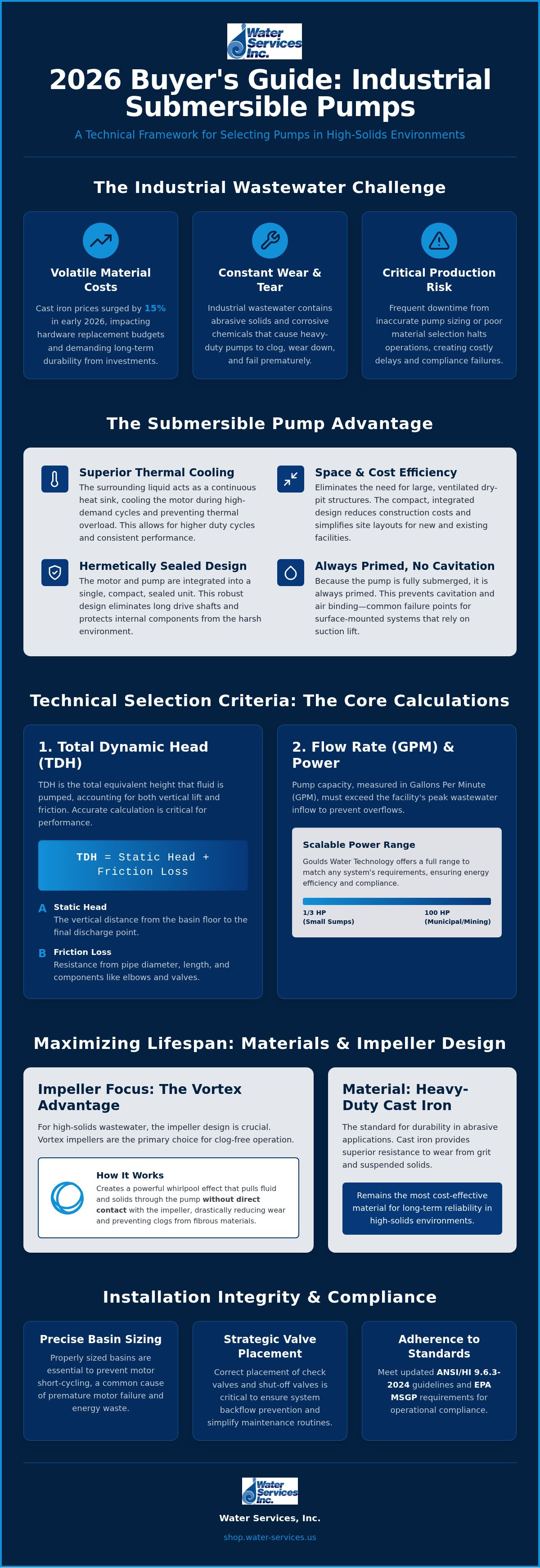
This 2026 buyer's guide delivers a technical framework for selecting pumps that excel in high-solids environments. We'll outline the specific engineering metrics required to handle your site's head requirements while adhering to the updated ANSI/HI 9.6.3-2024 operating region guidelines. You'll learn how to simplify procurement using Goulds Water Technology's 1/3 HP to 100 HP range to ensure your system remains energy efficient and compliant with the latest EPA Multi-Sector General Permit requirements. We'll focus on maximizing equipment lifespan through superior solids handling and rugged cast iron construction to ensure your facility maintains peak uptime.
Key Takeaways
- Master the technical calculation of Total Dynamic Head (TDH) and GPM requirements to match pump capacity with peak industrial inflow.
- Identify the material specifications for industrial submersible pumps for wastewater that provide maximum resistance to corrosion and abrasive solids.
- Implement precise basin sizing and valve placement strategies to prevent motor short-cycling and ensure system backflow prevention.
- Understand the thermal cooling advantages of hermetically sealed motor designs for maintaining operational integrity during high-demand cycles.
- Streamline procurement by accessing a scalable range of Goulds Water Technology pumps from 1/3 HP to 100 HP through an authorized global distributor.
Industrial Wastewater Dynamics: Why Submersible Design Matters
Industrial submersible pumps for wastewater are hermetically sealed units designed to operate entirely underwater. This submersible pump design integrates the motor and pump housing into a single, compact assembly. It eliminates the need for long drive shafts and external support structures. In industrial applications, this configuration provides a distinct thermal advantage. The surrounding fluid acts as a continuous heat sink, cooling the motor during high-demand cycles. This allows the equipment to run at higher duty cycles without the risk of thermal overload, ensuring consistent performance in demanding environments.
Space efficiency is a major driver for choosing submersible units in modern lift stations. These pumps remove the requirement for large, ventilated dry-pit structures. This reduces total construction costs for new facilities and simplifies the layout of existing sites. Submersible units also solve common suction lift issues found in mining and municipal pits. Because the pump is submerged, it's always primed. This prevents cavitation and air binding, which are frequent causes of failure in surface-mounted systems that rely on atmospheric pressure to move fluid to the impeller.
Wastewater vs. Clean Water Pumping
Wastewater pumping involves non-homogenous fluids containing suspended solids, fibrous materials, and industrial grit. These materials cause rapid wear on standard internal components if the pump isn't properly specified. Industrial submersible pumps for wastewater utilize heavy-duty cast iron housings to resist this abrasive wear. While cast iron prices rose by 15% in early 2026, it remains the most cost-effective material for long-term durability in high-solids applications. You can view our full range of industrial pumps to compare specific material grades and impeller designs for different wastewater profiles.
Submersible Pump Water Solutions for Remote Sites
Remote operations in the mining and oil sectors require equipment that can be deployed quickly and operated with minimal oversight. Modular, plug-and-play submersible units are essential for these sites. They minimize the need for complex on-site engineering and specialized installation crews. Reliability is critical because remote maintenance is expensive and logistically difficult. Operators must also ensure compliance with the 2026 Multi-Sector General Permit (MSGP) for stormwater and wastewater discharges. For a deeper analysis of these technical challenges, see our guide on Mining Wastewater Treatment Solutions. These systems provide the robust performance needed to meet stringent environmental standards in isolated locations.
Technical Selection Criteria: Flow, Head, and Solids Handling
Selecting industrial submersible pumps for wastewater requires precise engineering math rather than guesswork. Accurate pump selection criteria must account for the specific gravity of the fluid and the environmental conditions of the lift station. Total Dynamic Head (TDH) is the most critical calculation for system performance. It represents the sum of the static head, which is the vertical lift from the basin floor to the discharge point, and the friction loss caused by the piping system. You'll need to calculate friction loss based on the pipe's internal diameter, total length, and the specific resistance of every elbow or valve in the line.
Flow rate requirements are measured in Gallons Per Minute (GPM). Your pump capacity must exceed the peak wastewater inflow of the facility to prevent basin overflows or environmental compliance failures. Scaling for industrial submersible pumps for wastewater ranges from 1/3 HP dewatering units for small sumps to 100 HP heavy-duty industrial models for high-volume municipal or mining lift stations. Matching the pump's performance curve to your site's resistance curve ensures the motor operates within its intended efficiency range.
Impeller Types: Vortex vs. Channel
Impeller geometry determines how the pump handles suspended solids and fibrous debris. Vortex impellers create a whirlpool effect that pulls fluid through the pump without the solids contacting the impeller directly. This makes them the primary choice for stringy materials and high-solids concentrations. Channel impellers offer higher hydraulic efficiency and are better suited for high-flow wastewater movement with fewer solids. A standard industrial 3-inch discharge pump is typically designed with a spherical solids handling capability of 2.5 inches to ensure large debris passes through the volute without causing a mechanical bind.
Duty Cycles and Motor Insulation
Industrial lift stations often demand continuous duty operation rather than the intermittent cycles seen in light-duty applications. To ensure motor longevity, you should specify motors with Class F or H insulation. These ratings allow the motor to withstand the higher internal temperatures generated during extended run times or frequent starts. You'll also need to match the electrical supply of your site, choosing between single-phase 115/230V for smaller units or three-phase 230/460V for high-horsepower industrial configurations. Reliability in these systems depends on matching these technical metrics to your specific site conditions.
If you're ready to specify hardware for your next project, you can browse our standardized Goulds components to find the exact match for your TDH and GPM requirements. For more specialized configurations, you can explore the full catalog at shop.water-services.us to ensure your facility maintains operational integrity.
Top Cast Iron Submersible Pumps for 2026 Operations
Goulds Water Technology Pumps remain the industry gold standard for reliability in 2026. Their heavy-duty industrial submersible pumps for wastewater are engineered for high-uptime operations in corrosive and abrasive environments. These units feature oil-lubricated mechanical seals that provide a superior barrier against fluid ingress compared to standard air-filled motors. All external hardware utilizes 300-series stainless steel fasteners to ensure the pump remains serviceable after years of submersion in aggressive wastewater. The use of heavy-duty cast iron for the pump volute and motor housing provides the structural mass needed to dampen vibration and resist the wear of industrial grit.
Choosing between automatic and manual control mechanisms depends on your facility's existing infrastructure. Automatic models utilize integral float switches for standalone operation in basement drainage or small sumps. Manual models are preferred for larger industrial lift stations where the pump is integrated into a central control system using Walchem controllers or Signet flow sensors. This allows for precise monitoring of duty cycles and prevents the short-cycling that leads to premature motor failure. Using standardized Goulds components ensures that replacement parts are readily available through our global distribution network, reducing the risk of extended downtime.
High-Performance 1/3 HP to 1 HP Units
Small-scale dewatering requires compact hardware that doesn't compromise on structural integrity. Our 1/3 HP to 1 HP cast iron units are ideal for industrial sump pits where space is limited but solids handling is still required. These pumps maintain the same high-quality metallurgy as their larger counterparts, ensuring resistance to the sediment common in manufacturing runoff. You can browse 1/3 HP to 1 HP models here to find the correct fit for your facility's secondary drainage needs. These units are designed for quick deployment and long-term reliability in specialized commercial environments.
Heavy-Duty 3 HP to 100 HP Industrial Models
Large-scale operations in the mining and municipal sectors require significant scaling of both flow and pressure. Our heavy-duty 3 HP to 100 HP industrial submersible pumps for wastewater are designed to move high-volume waste over long distances or high vertical lifts. These units feature larger discharge diameters and specialized impellers to handle the increased solids concentration found in primary treatment stages. For a detailed look at specifying these larger systems, read our guide on Choosing the Best 3 HP Pump for Industrial Movement. These high-horsepower units provide the logistical competence required for global industrial water management.
Installation and Operational Integrity: Avoiding Common Failures
Proper basin sizing is the first line of defense against motor burnout. If a basin is too small, the pump will experience short-cycling, where the motor starts and stops too frequently. This creates excessive heat and wears out the motor windings prematurely. For industrial submersible pumps for wastewater, you should design the basin to allow for a minimum run time of one minute per cycle. Additionally, proper valve placement is mandatory for system health. A check valve must be installed in the discharge line to prevent the column of water from flowing back into the basin when the pump shuts off. This prevents unnecessary restarts and reduces mechanical stress. A gate valve should follow the check valve to allow for isolation during maintenance procedures.
Electrical protection is equally vital for maintaining operational integrity in demanding environments. Standard industrial configurations should include dedicated control panels equipped with seal leak sensors and thermal overloads. These sensors detect early moisture ingress before it reaches the motor windings, allowing for proactive maintenance rather than catastrophic failure. You can Explore Electric Power Controls for Pump Protection to see standardized panels that integrate seamlessly with Goulds hardware. These systems ensure that your industrial submersible pumps for wastewater operate within safe electrical parameters even during heavy-duty cycles.
The Critical 5-Step Installation Checklist
Before lowering the unit into the pit, verify voltage and phase compatibility at the control panel. Wiring errors on three-phase pumps can cause the impeller to rotate in the reverse direction, leading to a significant drop in performance and potential internal damage. You must inspect the rotation direction by briefly "bumping" the motor before final installation. Additionally, ensure the tether length for float switches is adjusted correctly. A tether that's too long can cause the float to hang up on basin walls or piping, preventing the pump from starting or stopping as required. Always confirm that the power cable is secured to the discharge pipe with stainless steel cable ties to prevent it from being drawn into the intake.
Troubleshooting in Harsh Sites
In remote mining or oil sites, monitoring performance is the only way to prevent unplanned downtime. You should track early signs of seal failure or impeller wear by using Ashcroft pressure gauges and Signet flow sensors. A gradual drop in discharge pressure or a decrease in GPM typically indicates that abrasive grit has worn down the impeller clearances. For a deeper look at managing these technical challenges, refer to our guide on Troubleshooting Submersible Sewage Pumps in Harsh Sites. Proactive monitoring ensures you can schedule repairs before a total system failure occurs.
If you're managing a high-stakes facility, you can procure industrial-grade pumping hardware through our curated e-commerce platform for immediate global distribution.
Procuring Industrial Reliability with Water Services, Inc.
Water Services, Inc. (est. 1994) functions as a curated authority for professional buyers in the global water sector. We specialize in the distribution of Goulds Water Technology Pumps and advanced modular treatment systems. Our e-commerce platform provides quick access to standardized components, simplifying the procurement of industrial submersible pumps for wastewater. This direct-access model reduces lead times and ensures that critical infrastructure projects remain on schedule. We understand the rigors of demanding commercial environments and provide technical solutions that prioritize functional value and logistical competence.
Our role extends beyond simple equipment supply. We act as a dependable partner for facilities that require exact engineering solutions for high-solids and corrosive environments. By focusing on industrial-grade hardware, we help operators eliminate the inefficiencies of inaccurate sizing and frequent pump failure. Our inventory is structured to allow for quick scanning by professionals seeking specific data points, from HP ratings to material specifications. We take pride in our ability to support specialized management requirements through a transparent and technical procurement process.
Global Logistics and Technical Support
Our logistical competence extends to the most remote industrial sites across Africa, South America, and the Middle East. We support complex projects involving containerized reverse osmosis plants and mobile ultrafiltration systems. These modular units often require specialized accessories such as Viqua UV systems, FilmTec membranes, and Pentair filter housings. You can Shop Industrial Water Treatment Components to source the exact media and chemicals needed for these integrated systems. Our global distribution capabilities ensure that technical specifications translate into tangible hardware delivery at the site level, regardless of geographic challenges.
Secure Your Infrastructure for 2026
Securing your infrastructure for 2026 requires a focus on total lifecycle costs. Heavy-duty cast iron pumps offer superior resistance to abrasive wear, which is essential for maintaining compliance with the latest EPA wastewater standards. While initial capital expenditure may be higher, the reduction in maintenance frequency and downtime provides a significant ROI. We offer a scalable range from 1/3 HP to 100 HP to meet the specific head and flow requirements of mining and oil/gas operations. Our commitment to technical integrity makes us a dependable partner for facilities requiring exact pumping solutions. Browse the Full Submersible Sump Pump Collection today to finalize your 2026 equipment specifications and ensure operational uptime.
Strategic Hardware Selection for 2026 Wastewater Operations
Selecting industrial submersible pumps for wastewater requires balancing hydraulic performance with material durability. Calculating accurate Total Dynamic Head and ensuring proper basin sizing are the most effective ways to prevent motor burnout. Investing in industrial-grade cast iron construction ensures your system withstands the abrasive wear of suspended solids and corrosive fluids common in mining and oil sectors. By utilizing standardized Goulds components and dedicated electrical protection, you can maintain compliance with 2026 environmental standards while extending the operational lifespan of your infrastructure.
Water Services, Inc. has provided global engineering expertise since 1994. As an authorized Goulds Water Technology distributor, we offer the logistical competence required to deliver high-performance pumping solutions to remote sites worldwide. Our curated inventory prioritizes technical integrity and efficiency, allowing you to procure hardware with confidence. We focus on providing utilitarian solutions that meet the exact specifications of professional users in specialized markets.
Take the next step in optimizing your facility's reliability. Shop Heavy-Duty Cast Iron Submersible Pumps to secure your facility's uptime and operational efficiency for the year ahead. Secure your infrastructure with hardware designed for the most demanding industrial environments.
Frequently Asked Questions
What is the difference between a sump pump and a wastewater submersible pump?
Wastewater submersible pumps are specifically engineered to handle suspended solids and aggressive fluids, whereas standard sump pumps are designed for relatively clean water removal. Industrial submersible pumps for wastewater feature larger volutes and specialized impellers, such as vortex or channel designs, to pass debris without clogging. They also utilize higher-grade metallurgy and mechanical seals to withstand the abrasive grit found in manufacturing or mining runoff, ensuring long-term reliability in harsh environments.
How do I determine the required horsepower for my industrial submersible pump?
Horsepower requirements are determined by calculating the Total Dynamic Head (TDH) and the required flow rate in Gallons Per Minute (GPM). You must account for the vertical lift from the basin floor to the discharge point and the friction losses within the piping system. Matching the pump's performance curve to these site-specific metrics ensures the motor operates efficiently. Water Services, Inc. provides technical consulting to help you scale from 1/3 HP to 100 HP units.
Can these pumps handle solids like rags or industrial debris?
Yes, industrial submersible pumps for wastewater are designed with specific spherical solids handling capabilities to pass debris like rags or industrial waste. Pumps equipped with vortex impellers are particularly effective for stringy materials because they create a whirlpool effect that moves solids through the volute without direct impeller contact. A standard 3-inch discharge pump typically handles solids up to 2.5 inches in diameter, though you should always verify the specific rating for your debris profile.
Why is cast iron preferred over plastic or aluminum for industrial wastewater?
Cast iron provides the structural mass and abrasive resistance necessary for demanding industrial wastewater applications. It dampens motor vibration and resists the wear caused by suspended grit and sediment much more effectively than lighter materials like plastic or aluminum. While cast iron prices increased by 15% in early 2026, the material remains the industry standard for durability. It ensures that the pump housing maintains its integrity during high-duty cycles in corrosive mining or oil sector environments.
How often should I perform maintenance on a submersible wastewater pump?
Maintenance intervals depend on the severity of the site conditions and the duty cycle of the equipment. For high-demand industrial lift stations, you should perform a visual inspection of the basin and check for debris buildup every quarter. Annual maintenance should include testing the oil-lubricated seals for moisture ingress and inspecting the impeller for abrasive wear. Utilizing Walchem controllers and Signet flow sensors allows for real-time monitoring, which can help you identify performance drops before a scheduled service date.
What happens if a submersible pump runs dry in an industrial pit?
Running a submersible pump dry can lead to rapid motor overheating and mechanical seal failure because the surrounding fluid is required for cooling and lubrication. Most industrial-grade units, such as those from Goulds Water Technology, feature thermal overload protection to shut down the motor if internal temperatures exceed safe limits. To prevent dry-running, you must ensure that float switches are set to maintain a minimum liquid level that keeps the motor housing submerged during operation.
Do I need a special control panel for a three-phase submersible pump?
Yes, three-phase submersible pumps require a dedicated control panel that includes a motor starter, thermal overloads, and a phase monitor. These panels protect the motor from phase loss or reversal, which could cause the pump to run backward and sustain internal damage. Water Services, Inc. provides specialized electric power controls that integrate seal leak sensors to detect moisture before it reaches the windings. This setup is essential for ensuring the operational uptime of high-horsepower industrial configurations.
Are Goulds submersible pumps compatible with existing industrial lift stations?
Goulds submersible pumps are designed with standardized discharge sizes and mounting configurations to ensure compatibility with most existing industrial lift stations. They can typically be integrated into current rail systems using standard adapters, allowing for a straightforward retrofit of aging infrastructure. Because they are a curated authority in the sector, Water Services, Inc. ensures that replacement units match your existing TDH and GPM requirements, facilitating a seamless transition without needing extensive basin modifications or piping overhauls.
0 comments