

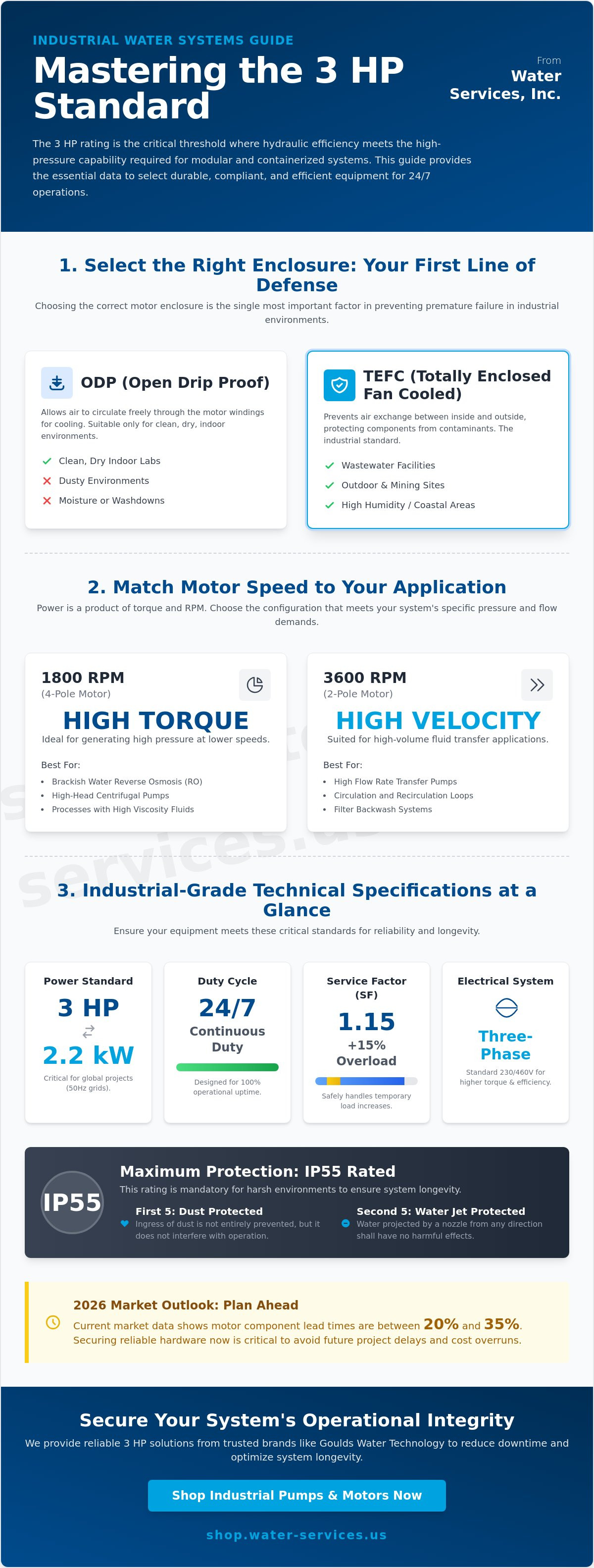
In industrial water treatment, a 3 hp rating is the critical threshold where hydraulic efficiency meets the high-pressure capability required for modular and containerized systems. Selecting the wrong enclosure often leads to catastrophic equipment failure and expensive downtime. You already know that 24/7 operations demand hardware that withstands harsh environments while maintaining peak energy efficiency. It's a balance between technical precision and long term reliability.
This guide helps you master the technical specifications for 3 hp industrial equipment to optimize your fluid handling systems. We will examine how to identify durable solutions from trusted brands like Goulds Water Technology. You'll learn to ensure compliance with NEMA or IP55 standards and reduce maintenance intervals. We also address the total cost of ownership in a 2026 market where lead times for motor components currently range from 20% to 35%. This technical overview provides the data points needed to secure your system's operational integrity and performance.
Key Takeaways
- Define the role of the 3 hp power standard as the critical threshold for balancing hydraulic pressure and flow in modular water treatment plants.
- Differentiate between ODP and TEFC enclosures to select the correct protection level for 24/7 industrial operations in harsh environments.
- Analyze the performance trade-offs between 1800 RPM and 3600 RPM motor configurations to meet specific torque and speed requirements.
- Apply precise Total Dynamic Head and flow rate calculations to ensure your selected pump assembly meets the exact demands of your fluid handling process.
- Identify reliable hardware solutions from Goulds Water Technology to reduce maintenance downtime and optimize the longevity of your water treatment system.
Understanding the 3 HP Power Standard in Industrial Water Systems
Horsepower is a standardized unit of measurement representing the rate at which mechanical work is performed. In the context of industrial fluid handling, a 3 hp rating indicates that a motor can deliver approximately 2.2 kilowatts of power to a pump's impeller or drive shaft. This specific rating is widely considered the "sweet spot" for modular water treatment designs. It provides sufficient pressure for brackish water reverse osmosis (RO) membranes without requiring the heavy electrical infrastructure associated with larger 5 hp or 7.5 hp systems. It's the ideal balance of performance and footprint.
Selecting the correct unit requires an understanding of the relationship between power, torque, and rotational speed. Power is the mathematical product of torque and RPM. If your process requires high pressure at lower speeds, a 4-pole motor running at 1800 RPM provides significant torque. Conversely, a 2-pole motor at 3600 RPM is better suited for high-velocity transfer applications. Professionals must avoid "SPL" (Special) ratings commonly found on retail-grade equipment. These labels often reflect peak or "breakdown" horsepower rather than the sustained output needed for industrial reliability. A true industrial motor delivers its rated power continuously without thermal degradation.
Horsepower vs. Kilowatts: The Global Metric
International engineering projects require precise conversion between imperial and metric standards. One horsepower is equivalent to 0.746 kilowatts. Therefore, a 3 hp motor is technically 2.238 kW, though it's usually labeled as 2.2 kW in metric markets. This conversion is vital for projects in the Middle East or Africa where 50Hz power grids are common. Using mismatched ratings leads to improper fuse sizing or VFD programming errors. Technical data for these global standards is available in our industrial pump collection.
Continuous Duty vs. Intermittent Duty
Industrial water systems operate 24/7, demanding a 100% duty cycle. The Service Factor (SF) is a key metric here. Most industrial-grade 3 hp motors feature a 1.15 SF. This means they can safely operate at 115% of their rated load for short periods. Intermittent duty motors found in consumer tools will fail quickly if used for continuous fluid transfer. High SF ratings ensure the motor can handle the fluctuations in viscosity or pressure common in industrial wastewater and chemical processing without burning out the internal windings.
Key Technical Specifications for 3 HP Industrial Units
Industrial stability depends on the electrical configuration of your prime mover. While consumer-grade equipment often relies on single-phase power, professional fluid handling systems standardize on 230/460V three-phase power for any 3 hp motor. This three-phase requirement ensures a balanced electrical load and higher starting torque, which is essential for initiating flow in high-head centrifugal pumps. It also allows for smaller wire gauges and reduced heat generation during 24/7 continuous duty cycles. Operating on a three-phase system significantly extends the service life of the internal windings by minimizing voltage drop and current fluctuations.
Enclosure selection is your primary defense against premature failure in the field. Open Drip Proof (ODP) motors are suitable for clean, dry indoor environments where air can circulate freely through the motor. However, most industrial water treatment applications require Totally Enclosed Fan Cooled (TEFC) units. These enclosures prevent the exchange of air between the inside and outside of the motor, protecting sensitive components from airborne contaminants and moisture. Choosing the wrong enclosure rating is a leading cause of winding insulation breakdown in wastewater facilities.
TEFC and IP55 Protection
Mining operations and outdoor wastewater sites demand TEFC enclosures with an IP55 rating. This specific rating confirms the motor is protected against dust ingress and low-pressure water jets from any direction. For maximum durability, these units should feature corrosion-resistant epoxy paint and stainless steel nameplates. These features prevent environmental degradation that can obscure vital maintenance data over time. In coastal or high-humidity regions, these protections are mandatory to prevent housing oxidation and bearing contamination.
Frame Selection and Mounting
Standardizing on NEMA frame sizes like 145T, 182T, or 184T ensures long-term compatibility and ease of replacement. A 56C frame with a C-Face mounting is common for close-coupled pumps, while the larger 182T or 184T frames provide a rigid base for frame-mounted configurations. Larger frames offer superior heat dissipation due to increased surface area, which directly correlates to extended bearing life. You must verify that your motor frame aligns with the bracket requirements of Goulds Water Technology Pumps to maintain precise shaft alignment and reduce vibration.
Modern efficiency standards also require Inverter Duty ratings for any motor paired with a Variable Frequency Drive (VFD). These motors feature specialized insulation systems designed to withstand the voltage spikes and harmonic distortions produced by VFDs. Using a non-inverter rated motor with a drive will lead to rapid insulation failure. Review our electric power controls to ensure your motor protection and drive systems are fully compatible with your 3 hp hardware.
Common Applications: Where 3 HP Equipment Excels
A 3 hp motor serves as the primary workhorse for mid-range industrial fluid systems. Its specific power capacity allows for high-pressure delivery within a compact physical footprint. In many facilities, this rating is the standard for critical transfer and processing tasks where smaller 1 hp units lack the necessary torque and larger 5 hp units exceed the available electrical capacity. It's a versatile solution for systems requiring precise flow control and sustained hydraulic performance.
Reverse Osmosis and Desalination
High-pressure membrane filtration requires consistent force to overcome osmotic pressure. This motor rating provides the necessary PSI to drive brackish water through spiral-wound membranes effectively. These units are frequently integrated into commercial reverse osmosis water filtration systems to ensure stable permeate flow rates. Designers favor these pumps in modular RO skids where space is limited but pressure requirements remain high. Modern 2026 designs also incorporate energy recovery devices that work alongside the primary driver to maximize hydraulic efficiency and lower total energy consumption.
Wastewater and Sewage Lifting
Lifting solids-laden fluids requires substantial starting torque and robust internal components. Professionals specify submersible sewage pumps with a 3 hp rating for grinder and solids-handling applications. These pumps are capable of generating the vertical lift, or head, necessary to move wastewater from low-lying collection pits to main treatment headers. In military field camps and remote mining outposts, these units provide the durability needed for 24/7 lift station operation. Calculating the Total Dynamic Head (TDH) is essential to ensure the motor doesn't operate at the end of its curve, which prevents overheating and premature winding failure.
Centrifugal Transfer and Mining Slurry
Centrifugal pumps utilizing this power rating excel at moving large volumes of process water across industrial sites. In mining slurry management, these units handle abrasive fluids at remote sites where reliability is paramount. The power output is sufficient to maintain velocity in the discharge piping, preventing solids from settling and clogging the system. Whether it's chemical dosing or bulk fluid transfer, these pumps offer the utilitarian performance required for demanding industrial environments. They bridge the gap between light commercial hardware and heavy-duty process machinery, providing a stable platform for most industrial fluid handling needs.
Selection Criteria: Matching 3 HP Power to Your Process Needs
Selecting a 3 hp unit requires mapping the system's Total Dynamic Head (TDH) against the desired flow rate in Gallons Per Minute (GPM). If the TDH is overestimated, the pump will operate at a higher flow rate than intended, potentially overloading the motor and exceeding its rated service factor. Conversely, underestimating TDH results in insufficient pressure for membrane penetration or vertical lift. Material selection is equally critical for long-term reliability. While cast iron is standard for general process water, 316 stainless steel is mandatory for reverse osmosis permeate or corrosive chemical handling to prevent galvanic corrosion. You must also consider mechanical seal materials, such as Viton or Silicon Carbide, to ensure compatibility with the specific chemical profile of your process fluid.
The Impact of RPM on Pump Longevity
Speed selection directly influences the wear rate of internal components and the overall efficiency of the hydraulic system. An 1800 RPM (4-pole) configuration is the preferred choice for abrasive fluids, such as mining wastewater, because the lower rotational speed reduces impeller erosion and extends bearing life. In contrast, 3600 RPM (2-pole) motors offer higher pressure capability in a smaller package, which is ideal for high-pressure RO applications. To ensure your system operates within its designed parameters, you should use a water flow meter GPM to verify real-time performance against the manufacturer's performance curve. This data-driven approach prevents the motor from operating in a "run-out" condition that leads to cavitation.
Environmental and Safety Controls
Protecting your 3 hp investment requires sophisticated monitoring and distribution hardware. Basic across-the-line starters are sufficient for simple transfer tasks, but high-precision systems benefit from VFD integration to match pump output to varying demand. You must select electric power controls that include phase monitoring and thermal overload protection to prevent winding burnout caused by voltage unbalance or phase loss. For oil and gas facilities or chemical storage areas, ensure the motor and control enclosure meet Class I, Div 1 hazardous location ratings. These safety measures are non-negotiable for maintaining site compliance and operational uptime in demanding commercial environments. Proper circuit breaker sizing is also essential to handle the inrush current during startup without nuisance tripping.
Browse our complete catalog of industrial 3 hp pumps to find the exact configuration required for your facility's hydraulic and electrical profile.
Reliable 3 HP Solutions from Water Services, Inc.
Water Services, Inc. maintains a curated inventory of high-performance 3 hp hardware designed for immediate integration into demanding industrial workflows. Our selection focuses on Nidec/US Motors for electrical reliability and Goulds Water Technology for hydraulic precision. We understand the logistical challenges of remote site delivery and complex procurement cycles. Our global distribution network ensures that critical components reach your facility without unnecessary delays, regardless of your geographic location. This logistical competence is backed by technical support during the commissioning phase to ensure all equipment operates according to factory specifications and performance curves.
Technical integrity is the foundation of our product selection process. We provide comprehensive data sheets for every motor and pump assembly to assist engineers in matching hardware to specific electrical profiles. Our support extends beyond the initial sale, offering guidance on maintenance schedules and the selection of compatible replacement parts. We also supply essential accessories including Ashcroft pressure gauges and Signet flow sensors to monitor the real-time health of your fluid handling system. This holistic approach to equipment supply reduces the risk of unexpected failures and optimizes the total cost of ownership for your facility.
Goulds Water Technology: The Gold Standard
Goulds Water Technology remains the preferred manufacturer for 3 hp centrifugal and submersible pump requirements in the water sector. Their engineering focuses on extreme durability within industrial water treatment systems. These pumps feature robust casing designs and precision-balanced impellers that minimize vibration and mechanical stress on the motor bearings. Replacement parts are readily available through an extensive global service network, ensuring that maintenance downtime is kept to a minimum. Whether you are managing process water transfer or high-pressure filtration, Goulds hardware provides the stability required for continuous 24/7 operation.
Integration and Custom Systems
Our engineering team specializes in incorporating 3 hp units into complex modular water treatment plants and containerized reverse osmosis systems. We match these pumps with Walchem controllers and Pulsafeeder metering pumps to create a fully automated fluid handling solution. Safety remains a priority during system commissioning and routine maintenance. Technicians must utilize appropriate personal protective equipment (PPE) when servicing high-pressure pump assemblies or handling chemical dosing components. This ensures compliance with industrial safety standards while protecting your personnel. Contact our engineers to discuss a custom system design tailored to your specific TDH and GPM requirements.
We invite you to review our technical catalog for the latest 2026 specifications on 3 hp pumps and motors. Our team is ready to assist with sizing, selection, and international logistics for your next project.
Optimizing Your Fluid Handling Infrastructure for 2026 and Beyond
Selecting the right industrial hardware requires a precise understanding of your system's hydraulic and electrical demands. You've learned that matching a 3 hp motor to the correct enclosure rating and RPM is essential for preventing premature failure in harsh environments. Whether you're managing a high-pressure reverse osmosis skid or a wastewater lift station, technical integrity must remain your primary focus. Utilizing industrial-grade components ensures your facility maintains peak efficiency while reducing the total cost of ownership.
Water Services, Inc. has provided specialized engineering expertise since 1994. We're an authorized Goulds Water Technology distributor with the logistical capability to handle global shipping to remote mining and military sites. Our team ensures that every component meets the rigorous standards of modern industrial applications. You can rely on our stable supply chain and technical knowledge to keep your operations running without interruption. Take the next step in securing your system's performance.
Shop 3 HP Industrial Pumps and Motors today to find the exact configuration for your project. We look forward to supporting your industrial water treatment needs.
Frequently Asked Questions
Can I run a 3 HP motor on a single-phase residential circuit?
Yes, you can run a 3 hp motor on a single-phase circuit if the electrical service provides 230V and sufficient amperage. A typical single-phase motor at this power rating requires a dedicated 30-amp breaker to handle the inrush current during startup. While this is common in high-performance residential settings—where experts like Right Pool Care manage complex pool systems—industrial facilities prefer three-phase power for its superior starting torque and electrical efficiency during continuous 24/7 operation.
What is the difference between a 3 HP 1800 RPM and 3600 RPM motor?
The primary difference lies in the torque output and the intended hydraulic application. An 1800 RPM motor features four poles and delivers higher torque, making it suitable for viscous fluids or abrasive slurries. A 3600 RPM motor has two poles and is designed for high-speed, high-pressure tasks like clean water transfer or reverse osmosis membrane feeding.
How much water can a 3 HP pump move per minute?
A 3 hp pump typically moves between 40 and 160 gallons per minute (GPM) depending on the Total Dynamic Head (TDH). For example, a centrifugal pump at this power rating might achieve 100 GPM at 60 feet of head, but flow drops as pressure increases. You must review the specific hydraulic performance curve to determine the exact flow rate for your system's pressure requirements.
What does TEFC mean for a 3 HP industrial motor?
TEFC stands for Totally Enclosed Fan Cooled. This enclosure type prevents the exchange of air between the motor's interior and the surrounding environment, which protects internal windings from dust and moisture. An external fan attached to the shaft blows air over the motor's ribbed frame to dissipate heat during heavy duty cycles.
Do I need a VFD for my 3 HP pump?
You need a Variable Frequency Drive (VFD) if your application requires precise flow control or energy savings during low-demand periods. A VFD allows you to adjust the motor speed to match system requirements rather than running at full RPM constantly. It also provides a soft-start function that reduces mechanical wear and electrical spikes during activation.
What is the standard frame size for a 3 HP motor?
Standard NEMA frame sizes for these units include 145T, 182T, and 184T. For close-coupled pump configurations, the 56C frame is a common industrial standard. Frame selection is critical for ensuring proper shaft alignment and mounting hole compatibility when replacing existing equipment in modular water treatment skids.
Is a 3 HP pump sufficient for a commercial reverse osmosis system?
A 3 hp pump is highly effective for commercial reverse osmosis systems producing between 5,000 and 15,000 gallons per day. This power level provides the necessary pressure to overcome osmotic resistance across brackish water membranes. It's the standard choice for modular RO designs where footprint and energy efficiency are primary engineering constraints.
How do I protect my 3 HP motor from corrosion in mining environments?
Protect your motor by specifying an IP55 rated TEFC enclosure with a corrosion-resistant epoxy finish. You should also ensure the unit features a stainless steel nameplate and internal tropicalization of the windings to resist moisture ingress. Regular inspection of the conduit box gaskets is necessary to prevent acidic or saline mine water from reaching the electrical connections.
0 comments