

In 2026, a pressure gauge is no longer a simple mechanical indicator; it's the primary diagnostic sensor standing between your infrastructure and a costly system failure. You've likely dealt with the frustration of gauge failure due to constant vibration or the confusion of selecting the right wetted materials for corrosive environments. These aren't just maintenance headaches. They're direct threats to your process control and safety. Correctly implementing ashcroft pressure gauges for industrial water systems is now essential for meeting the new 2026 EPA and EU regulations regarding PFAS monitoring and industrial wastewater discharge.
This technical guide provides the data you need to master gauge selection and ensure peak performance in your water infrastructure. You'll learn how to extend equipment life and reduce maintenance downtime by applying the ASME B40.100-2022 standard to your hardware specifications. We'll cover the industry shift toward digital diagnostics, the latest surcharges on sanitary series models, and the specific safety features required for modern industrial compliance. This is your roadmap to achieving accurate diagnostic data for superior water process control.
Key Takeaways
- Learn to utilize pressure monitoring as a diagnostic vital sign to prevent cavitation and protect high-value pump infrastructure.
- Master the technical selection of ashcroft pressure gauges for industrial water systems by matching ASME B40.100-2022 accuracy grades to specific process requirements.
- Evaluate the durability framework of PLUS! Performance technology for stabilizing readings and reducing mechanical wear in high-vibration environments.
- Identify specific gauge configurations for monitoring membrane delta-P in reverse osmosis systems and handling abrasive mining wastewater slurries.
- Gain insights into integrating specialized pressure instrumentation into custom containerized water treatment plants for reliable global deployment.
The Strategic Role of Pressure Monitoring in Industrial Water Systems
Pressure monitoring serves as the vital sign for any industrial water treatment infrastructure. Without precise data, operators are blind to the internal stresses affecting pipes, valves, and mechanical components. The Strategic Role of Pressure Monitoring extends beyond simple observation; it's a critical component of predictive maintenance. Reliable instrumentation ensures that every stage of the treatment process operates within its engineered parameters.
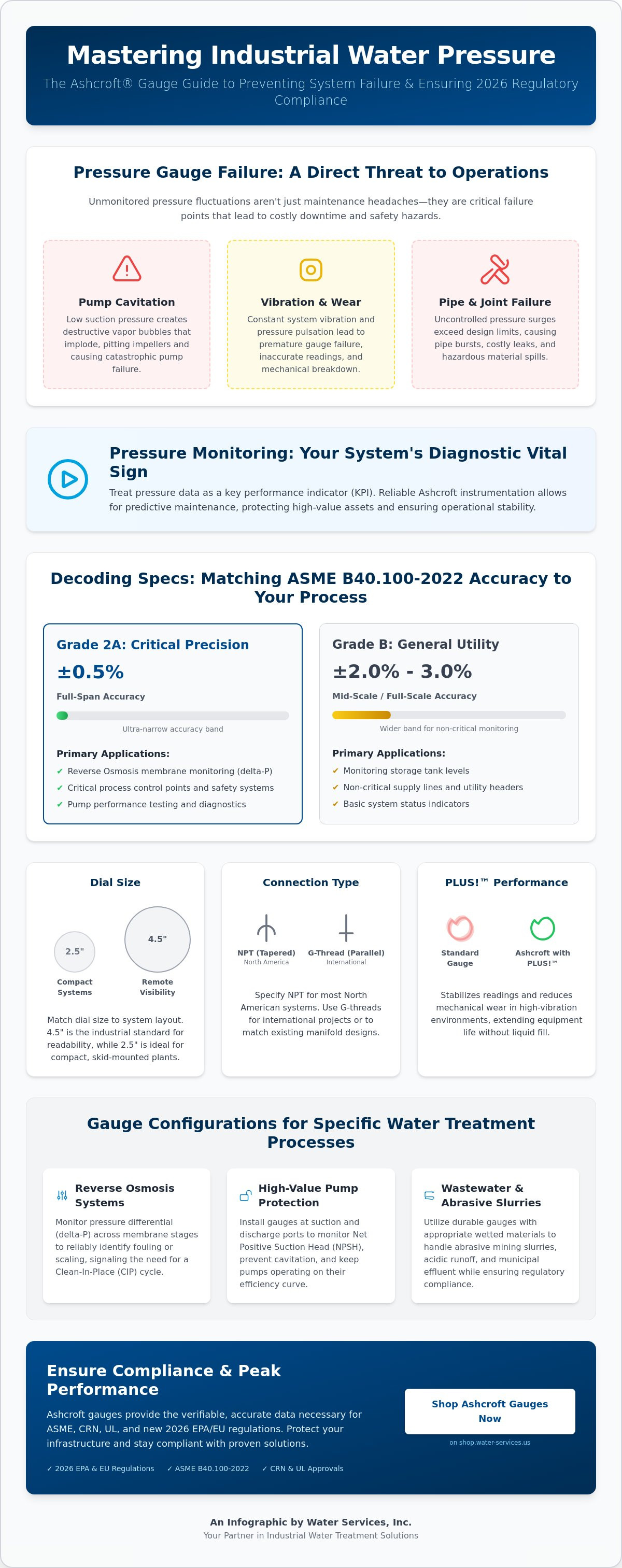
High-performance Goulds pumps require specific inlet and outlet pressure conditions to operate within their designed efficiency curves. If suction pressure drops below the required Net Positive Suction Head (NPSH), cavitation occurs. This process creates vapor bubbles that implode, pitting impellers and causing catastrophic mechanical failure. By installing ashcroft pressure gauges for industrial water systems at the pump suction and discharge ports, operators can detect these fluctuations instantly. This direct feedback allows for immediate throttle adjustments or VFD corrections to protect the equipment.
In Reverse Osmosis (RO) systems, monitoring pressure differentials across membrane stages is the most reliable way to identify fouling or scaling. A sudden increase in delta-P indicates that the feed water is meeting resistance, signaling the need for a Clean-In-Place (CIP) cycle. Wastewater treatment companies rely on Ashcroft for regulatory safety compliance because these gauges maintain accuracy in harsh, abrasive environments. Whether managing acidic runoff or municipal effluent, having dependable pressure data is the only way to ensure the system doesn't exceed its design pressure limits.
Early Warning: Preventing Catastrophic System Failure
Operators use pressure data to identify pump strain long before a mechanical breakdown occurs. Monitoring filter saturation levels through pressure drop analysis allows for optimized maintenance cycles, ensuring that media is backwashed or replaced only when necessary. This proactive approach prevents the sudden surge pressures that often lead to pipe bursts. Systemic pressure health is a key performance indicator (KPI) that quantifies the operational stability and mechanical integrity of the entire water treatment circuit.
Regulatory and Safety Compliance Standards
Compliance starts with hardware that meets the ASME B40.100-2022 standards for pressure gauge accuracy and construction. For international projects, CRN and UL approvals are mandatory specifications that ensure equipment meets local safety codes. Ashcroft gauges provide the verifiable data logs necessary for environmental reporting. These instruments help wastewater companies stay compliant with evolving discharge permits by providing accurate, defensible data for regulatory audits.
Decoding Ashcroft Specs: Accuracy, Materials, and Design
Selecting ashcroft pressure gauges for industrial water systems requires a rigorous evaluation of technical specifications to ensure long-term field performance. Accuracy requirements are defined by ASME B40.100-2022 standards, which categorize gauges into specific grades. For critical process control and membrane monitoring, engineers specify Grade 2A gauges that provide a ±0.5% full-span accuracy. General utility applications, such as monitoring storage tank levels or non-critical supply lines, typically utilize Grade B gauges with an accuracy of ±2.0% in the middle half of the scale and ±3.0% over the remainder. The technical integrity of these instruments is a prerequisite for successful industrial water system maintenance protocols.
Physical integration into global water infrastructure involves choosing between NPT and G-thread connections. North American systems predominantly use 1/4 or 1/2 NPT tapered threads, while international projects often require G-threads (Parallel) to match existing manifold designs. Dial size also impacts operational efficiency. A 4.5-inch dial is the industrial standard for remote sites where visibility from a distance is necessary. Smaller 2.5-inch dials are reserved for compact skid-mounted systems where space is limited. Engineers often review technical data sheets to verify these dimensions before finalizing a bill of materials.
Wetted Materials for Harsh Water Chemistry
Wetted materials must be compatible with the specific fluid chemistry of the system. 316 Stainless Steel serves as the baseline standard for treated process water and provides excellent resistance to oxidation. However, high-salinity mining wastewater or brackish intake water requires more robust alloys like Monel or Hastelloy to prevent pitting and chloride stress corrosion. It is also vital to verify that the gauge internals are compatible with the water treatment chemicals used in the process, such as antiscalants or biocides, which can be aggressive toward standard copper-based alloys.
Case Design and Environmental Protection
The choice between the Ashcroft Duragauge (1279) and Duralife (1009) series depends on the installation environment. The 1279 Duragauge features a phenolic "Turret" case that is inherently resistant to chemical atmospheric corrosion, making it ideal for outdoor wastewater plants. In contrast, the 1009 Duralife uses a stainless steel case better suited for wash-down environments. Both series offer high Ingress Protection (IP) ratings, such as IP65 or IP66, to prevent moisture from entering the dial and clouding the lens in humid industrial settings. Solid-front case designs provide an additional layer of operator safety by including a blowout back to redirect pressure in the event of a Bourdon tube failure.
Ashcroft vs. Standard Gauges: The Durability Framework
Procurement managers often view instrumentation as a commodity, yet the hidden costs of low-tier utility gauges frequently exceed their initial savings within the first year of operation. Standard gauges suffer from pointer flutter and accelerated mechanical wear when exposed to the high-frequency vibrations of industrial pumps. In contrast, ashcroft pressure gauges for industrial water systems are engineered to withstand these stresses while maintaining precise calibration. Calibration retention is a critical metric for adherence to water system design standards, which require consistent pressure monitoring to ensure infrastructure longevity and public safety. Ashcroft units utilize a movement design that resists the zero shift common in cheaper alternatives after a pressure surge or thermal cycle.
Thermal stability is another factor where Ashcroft outperforms standard equipment. In extreme environments, such as desert-based desalination plants or arctic water intake sites, temperature fluctuations cause standard gauge internals to expand or contract, leading to inaccurate readings. Ashcroft gauges are tested to maintain their accuracy across wide temperature spans, ensuring that diagnostic data remains reliable regardless of the ambient conditions. This stability is essential for operators who rely on exact data to manage high-value assets like Goulds pumps and high-pressure RO manifolds.
Liquid-Filled vs. Dry Gauges with PLUS! Performance
Traditional liquid-filled gauges use glycerin or silicone to protect internal components from vibration and pulsation. While effective, these fluids can leak, discolor, or require replacement during maintenance. The Ashcroft PLUS! Performance technology provides the same vibration dampening in a dry gauge, eliminating the maintenance requirements of liquid fills. Choosing the right dampening method is vital for high-vibration pump skids where constant needle movement would otherwise destroy a standard dry gauge movement in weeks.
Total Cost of Ownership (TCO) in Water Infrastructure
Total Cost of Ownership analysis shows that the price of an Ashcroft 1279 Duragauge is negligible compared to the cost of a single hour of system downtime. When a gauge fails, the lack of data can lead to improper valve positioning or pump cavitation. Precision gauges ensure that metering pumps deliver the exact volume of water treatment chemicals required, which directly reduces the significant expenses associated with chemical over-dosing and premature membrane scaling. The longevity of these instruments in 24/7 industrial operations makes them the more economical choice over the equipment lifecycle.
Selecting Gauges for Specific Water Treatment Processes
Application-specific configuration of ashcroft pressure gauges for industrial water systems is the only way to ensure instrumentation survival in high-stress environments. In Reverse Osmosis (RO) plants, gauges must monitor both the high-pressure pump discharge and the membrane delta-P to ensure system integrity. Mining wastewater applications require a different approach, focusing on resistance to abrasive slurries and acidic runoff. For mobile treatment units and military deployments, the primary requirement is durability during transport and the reliability to function in remote sites where replacement parts are weeks away. These environments demand hardware that maintains calibration despite mechanical shocks and environmental exposure.
Reverse Osmosis and Ultrafiltration Requirements
Specifying sanitary gauges is necessary for high-purity water production to prevent bacterial growth in stagnant pockets within the instrument. Monitoring pre-filter and post-filter pressure is the standard method for membrane protection, allowing operators to trigger backwash cycles before fouling occurs. Integration with electric power controls enables automated shut-offs when pressure exceeds safe thresholds. This protects expensive RO membranes from irreversible physical damage during a surge event. Digital variants like the Ashcroft 2030 series are often preferred here for their higher accuracy and integrated data-logging capabilities.
Wastewater Slurry and Abrasive Handling
Standard Bourdon tubes fail quickly when exposed to solids or high-viscosity slurries found in wastewater. Diaphragm seals are the essential solution for protecting gauges from clogs. These seals isolate the gauge movement from the process media while transmitting pressure accurately through a fill fluid. Selecting flushing ports allows for easy cleaning of the sensing element without removing the gauge from the line. This configuration is critical for managing pressure spikes in municipal lift stations and preventing equipment failure in abrasive mining environments where acidic runoff can quickly degrade standard internal components.
Mobile treatment units face unique challenges during transit and rapid deployment. Vibration during transport can loosen standard gauge movements, leading to zero-shift or mechanical failure upon arrival. Ashcroft gauges with PLUS! Performance technology offer the necessary dampening to survive these conditions without the risk of liquid fill leaks. In military or remote industrial sites, reliability is the primary logistical concern. A failed gauge in these locations results in blind operation for weeks, making the initial investment in high-durability Ashcroft hardware a strategic necessity.
You can source Ashcroft instrumentation and diaphragm seals directly for your next water project to ensure long-term reliability.
Implementing Ashcroft Solutions with Water Services, Inc.
Successful deployment of ashcroft pressure gauges for industrial water systems requires a partner who understands the complex integration of mechanical, chemical, and digital components. Water Services, Inc. provides a curated selection of instrumentation specifically tested for global industrial environments. We serve as a seasoned single-source supplier, coordinating the simultaneous delivery of high-value Goulds Water Technology pumps, FilmTec reverse osmosis membranes, and Ashcroft gauges. This consolidated procurement approach eliminates the logistical friction of managing multiple vendors. It also ensures that every diagnostic tool is technically compatible with the specific flow rates and chemical profiles of your treatment infrastructure.
Our expertise extends beyond simple distribution to include robust global logistics and compliance management. We specialize in shipping critical water treatment components to remote and demanding operations across Africa, Latin America, and the Middle East. In these regions, mechanical failure isn't just an inconvenience; it's a total stop to production. Having a reliable supply chain for high-durability instrumentation like the Ashcroft 1279 Duragauge is a strategic necessity for long-term stability. Whether you're operating a mining site in high-altitude terrain or a remote military facility, we ensure your diagnostic tools arrive on site and meet all international shipping standards for industrial hardware.
Custom Engineering and Integration Services
We match Ashcroft instrumentation to custom-designed modular water skids and containerized reverse osmosis plants. Our team provides technical consulting for mining and military water specifications, ensuring that the selected gauges meet the specific environmental demands of the project site. This process involves evaluating the need for specialized wetted materials or the PLUS! Performance vibration-dampening technologies discussed earlier. By integrating Ashcroft solutions early in the engineering phase, we help operators avoid field-fitting issues. This ensures that the system's KPI monitoring is accurate from the moment the plant is commissioned.
Direct Procurement and Global Logistics
Professionals can access an extensive inventory of Ashcroft 1009 and 1279 models through our online procurement platform. This direct access is essential for facilities running 24/7 operations where a single failed gauge can lead to blind operation or pump damage. We maintain a steady supply of these critical components to support remote operations where local availability is non-existent. Our logistical framework is built for speed and technical integrity. We prioritize getting the right hardware to the right location, ensuring that your water process control remains uninterrupted.
Browse Ashcroft Pressure Gauges at Water Services to secure the instrumentation needed for your next industrial water project.
Optimizing System Reliability with Precision Instrumentation
Achieving operational stability in 2026 requires more than just standard hardware. You must match specific accuracy grades and wetted materials to the unique chemistry of your process to avoid premature failure. Implementing high-performance ashcroft pressure gauges for industrial water systems is the most effective way to secure your infrastructure against mechanical failure and regulatory non-compliance. These instruments provide the defensible data necessary for modern process control and safety audits in demanding environments.
Water Services, Inc. has provided global industrial expertise since 1994. As an authorized distributor for Ashcroft and Goulds Water Technology, we specialize in technical solutions for complex mining and military water projects. Our logistical framework ensures that critical components reach remote sites in Africa, Latin America, and the Middle East without delay. It's clear that technical integrity is the foundation of your facility's success, and we provide the reliable hardware to maintain it.
Take the next step in hardening your water infrastructure against the rigors of industrial operation. Shop Ashcroft Pressure Gauges for Industrial Systems today to ensure your system operates at peak efficiency for years to come.
Frequently Asked Questions
What is the difference between an Ashcroft 1009 and 1279 pressure gauge?
The Ashcroft 1009 Duralife is a compact gauge featuring a stainless steel case, typically available in 2.5 or 3.5 inch dial sizes for skid-mounted systems. The Ashcroft 1279 Duragauge is a 4.5 inch process gauge with a phenolic turret case and a solid-front safety design. Choose the 1279 for 24/7 process lines where operator safety and maximum case durability are the primary requirements.
When should I use a diaphragm seal with my Ashcroft gauge in a wastewater system?
Install a diaphragm seal whenever the process water contains suspended solids, sludge, or aggressive chemicals that could clog the internal Bourdon tube. Diaphragm seals isolate the gauge movement from the media while accurately transmitting pressure through a specialized fill fluid. This configuration is the standard for wastewater lift stations and chemical dosing lines where clogging is a frequent failure mode.
How do I choose between a liquid-filled gauge and Ashcroft PLUS! Performance?
Choose Ashcroft PLUS! Performance when you need vibration dampening without the maintenance risks of liquid-filled cases. Liquid-filled gauges use glycerin or silicone to stabilize the pointer but can leak or yellow over time in outdoor installations. PLUS! Performance provides the same pointer stability in a dry gauge, making it the preferred choice for high-vibration pump skids and remote maintenance sites.
What wetted materials are best for high-salinity industrial water?
Specify Monel or Hastelloy C-276 wetted materials for high-salinity or brackish water applications. Standard 316 Stainless Steel often fails due to chloride-induced pitting and stress corrosion in these harsh environments. These specialized alloys ensure the longevity of ashcroft pressure gauges for industrial water systems when monitoring seawater intake, desalination manifolds, or acidic mining runoff.
How often should industrial pressure gauges be calibrated for compliance?
Industrial pressure gauges should typically undergo calibration every 12 months to maintain compliance with ASME B40.100 standards. Critical processes or systems subject to strict environmental regulations, such as PFAS monitoring, may require semi-annual checks. Regular calibration ensures that diagnostic data remains defensible during regulatory audits and prevents inaccurate readings from leading to system-wide mechanical strain.
Can Ashcroft gauges be used in military-grade mobile water treatment units?
Ashcroft gauges are frequently integrated into military-grade mobile water treatment units due to their resistance to mechanical shock and environmental extremes. Models equipped with PLUS! Performance technology are specifically suited for transport on rugged terrain. These units maintain their zero calibration point despite the extreme vibrations and thermal shifts encountered during rapid deployment in remote global locations.
What does Accuracy Grade 2A mean for industrial water monitoring?
Accuracy Grade 2A signifies a permissible error of plus or minus 0.5% across the entire pressure range of the gauge. This high-precision standard is necessary for monitoring membrane delta-P in reverse osmosis systems where small pressure shifts indicate early-stage fouling. It provides the exact data required for sophisticated process automation and ensures the protection of high-value pump infrastructure.
Do Ashcroft gauges support digital integration for remote monitoring?
Ashcroft supports digital integration through specialized digital gauges and pressure transducers that offer 4-20mA or 0-10 Vdc output signals. These instruments allow ashcroft pressure gauges for industrial water systems to communicate directly with SCADA systems or programmable logic controllers. This connectivity enables remote monitoring and automated system shut-offs to prevent equipment damage when pressure exceeds defined safety limits.
0 comments