

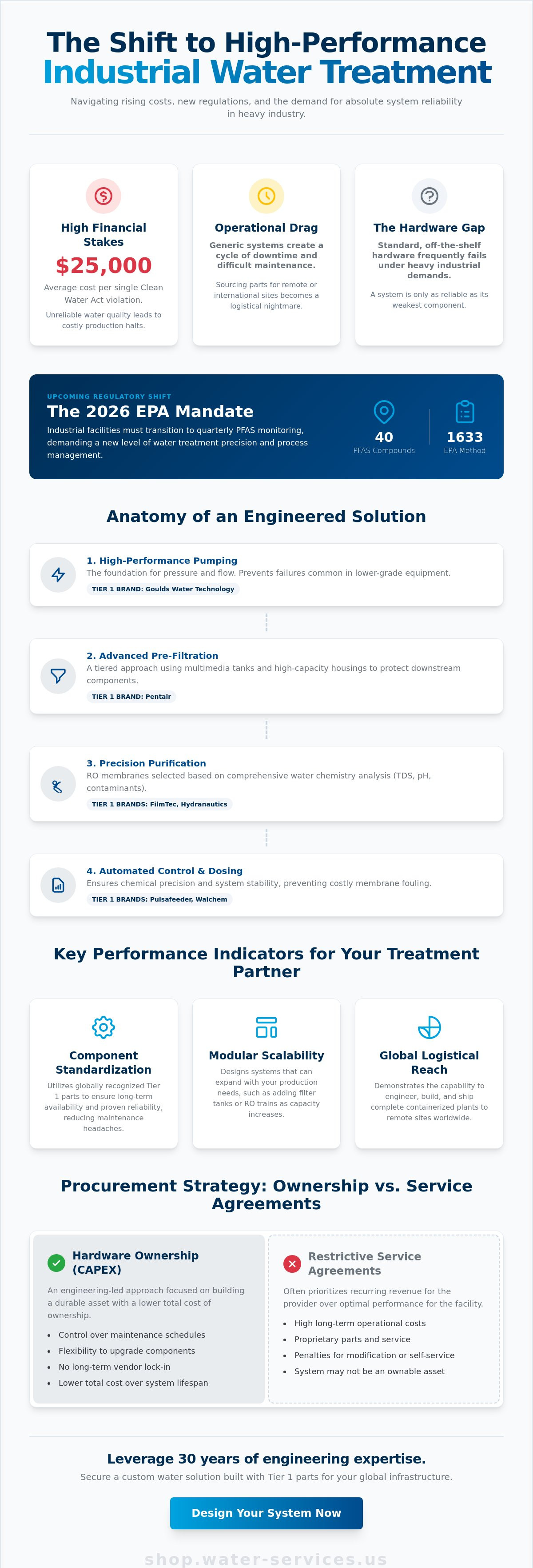
A single Clean Water Act violation currently costs industrial facilities an average of $25,000 per instance. For operators managing high-stakes environments, the financial risk of a production halt due to unreliable water quality is even higher. You've likely experienced the frustration of generic systems that are difficult to maintain or the logistical nightmare of sourcing replacement parts for remote international installations. It's clear that standard hardware often fails to meet the rigorous demands of heavy industry.
This case study provides a technical framework for evaluating industrial water treatment companies through the lens of modular system design and high-specification engineering. You'll discover how to secure a custom-engineered water system that utilizes Tier 1 components from manufacturers like Goulds and Viqua. We also address the 2026 regulatory shift requiring quarterly PFAS monitoring under EPA Method 1633. By prioritizing standardized parts and advanced filtration from brands like FilmTec and Pentair, you can reduce downtime and ensure your facility remains compliant with the latest EPA effluent limitations.
Key Takeaways
- Understand the 2026 industry transition from basic filtration to complex process water management for large-scale facilities.
- Evaluate industrial water treatment companies based on their integration of high-performance hardware like Goulds pumps and Pentair filter housings.
- Review a mining case study detailing the deployment of modular, containerized Reverse Osmosis (RO) plants in remote, high-stakes environments.
- Assess the financial advantages of hardware ownership and CAPEX strategies compared to restrictive, long-term service agreements.
- Learn how to leverage thirty years of engineering expertise to secure custom water solutions and Tier 1 replacement parts for global infrastructure.
Evaluating Commercial Water Treatment Companies for Industrial Scales
In 2026, the role of a water treatment partner has transitioned from a utility supplier to a critical engineering asset. Facilities now face stringent NPDES indicator monitoring for 40 different PFAS compounds under EPA Method 1633. This shift requires industrial water treatment companies to provide more than basic filtration; they must manage complex industrial water treatment processes that integrate seamlessly into high-output production lines. The industry has moved beyond simple sediment removal toward comprehensive process water management that ensures chemical precision and mechanical reliability.
Avoid providers that focus on residential tap filters or general commercial plumbing. Heavy industrial applications require specialists who understand high-pressure environments and chemical compatibility. Reliability starts with the hardware. A system is only as durable as its weakest component. This is why top-tier engineering firms prioritize Goulds Water Technology pumps and Pentair filter housings. These components are designed for continuous duty in demanding environments where a single pump failure can halt an entire production schedule. When evaluating partners, prioritize those who build systems around these recognized industrial standards.
The Role of Engineering in Commercial Water Systems
Off-the-shelf systems fail because they ignore site-specific variables. Effective industrial water treatment companies begin with a comprehensive water chemistry analysis. They evaluate total dissolved solids (TDS), pH levels, and specific contaminants like silica or manganese. This data informs the selection of specific FilmTec or Hydranautics RO membranes. Technical consulting must precede hardware procurement. This ensures the system handles the exact feed water profile of your site, rather than a generic average. Engineering-led design prevents the high maintenance costs associated with fouled membranes and improper chemical dosing.
Key Performance Indicators for Treatment Partners
Durability directly correlates to system uptime. Evaluate potential partners based on these specific industrial metrics:
- Component Standardization: Use of Tier 1 parts like Pulsafeeder metering pumps and Walchem controllers ensures long-term part availability.
- Scalability: The ability to expand modular systems, such as adding multimedia filter tanks, as production capacity increases.
- Logistical Reach: The capability to ship containerized reverse osmosis plants to remote sites while maintaining a reliable supply chain for replacement sediment and carbon filters.
Reliable partners focus on the total cost of ownership. They prioritize robust engineering over low-cost, generic alternatives that increase maintenance frequency. A successful partnership is defined by the system's ability to maintain water quality standards consistently under variable load conditions.
The Anatomy of Industrial-Grade Treatment: Components and Design
System reliability isn't a result of luck. It's the outcome of selecting hardware that survives the rigors of 24/7 industrial operations. While many industrial water treatment companies emphasize long-term service contracts, the most resilient systems are built on engineering-led hardware choices. High-performance pumping remains the foundation of any treatment plant. Goulds Water Technology pumps are the industry standard for a reason. They provide the necessary head pressure and flow rates required for reverse osmosis and ultrafiltration without the frequent seal failures common in lower-grade equipment.
Advanced filtration requires a tiered approach to protect expensive downstream components. This starts with multimedia tanks for bulk solids removal, followed by high-capacity Pentair filter housings for fine sediment capture. As facilities look toward water reuse, advanced filtration membrane technology is becoming essential for handling complex wastewater streams. For purification requirements that demand chemical-free disinfection, integrating Viqua UV systems provides a robust solution for microbial control. Monitoring these processes requires precision data. Walchem controllers and Signet flow sensors allow operators to track real-time performance metrics, ensuring the system stays within specified operational parameters.
Standardizing on Tier 1 Components
Standardization reduces the logistical burden of maintaining remote sites. Investing in FilmTec and Hydranautics RO membranes offers a superior long-term ROI by extending the interval between membrane cleanings and replacements. Precision monitoring is handled by Ashcroft pressure gauges, which provide the accuracy needed to detect fouling before it causes a system shutdown. You can find these essential components in our catalog of industrial pumps and centrifugal systems. Choosing recognized brands ensures that replacement parts are available globally, preventing extended downtime when a component eventually reaches its end-of-life.
Chemical Dosing and Process Accuracy
Consistent water chemistry is vital for preventing scale and protecting equipment. Pulsafeeder metering pumps deliver precise chemical volumes to maintain optimal antiscalant levels. Automating these treatment cycles with advanced electric power controls removes the risk of human error in chemical management. For a detailed breakdown of chemical selection and integration, refer to our Water Treatment Chemicals Distributor Guide. If you're designing a new system or upgrading an existing plant, you should browse our industrial water treatment equipment to ensure your project utilizes only verified Tier 1 hardware.
Case Study: Deploying Containerized RO Systems in Remote Mining
Remote mining operations face logistical challenges that standard utility providers can't meet. For a 500-person camp in a remote African region, the requirement wasn't just for potable water but also high-purity process water for mineral extraction. This necessitated a modular approach that could be fully tested before shipment. Unlike many industrial water treatment companies that rely on local assembly, we engineered a complete containerized Reverse Osmosis (RO) plant at our Provo, Utah headquarters. This system was designed to treat high-salinity brackish water while withstanding the mechanical stresses of international transit and harsh on-site conditions.
Engineering for Extreme Environments
Extreme temperature fluctuations and high-sediment raw water sources demand robust pre-treatment. We integrated mobile ultrafiltration systems to remove suspended solids before the water reached the RO membranes. This protection is vital for maintaining the integrity of high-performance FilmTec membranes and preventing premature fouling. For a deeper look at these technical requirements, see our guide on Mining Wastewater Treatment Solutions. The use of multimedia filter tanks and Pentair housings ensured the feed water remained within tight specification limits regardless of seasonal source water changes. This engineering precision ensures that high-pressure Goulds pumps operate within their optimal curves, extending the life of the entire system.
Results: Operational Efficiency and Compliance
The implementation resulted in 99% system availability, a critical metric for a site where water failure equals production stoppage. The plant's design adhered to Zero Liquid Discharge (ZLD) principles, ensuring that wastewater management met both local requirements and the rigorous standards found in the EPA's Industrial Effluent Guidelines. Real-time monitoring was facilitated by Signet flow sensors and Ashcroft pressure gauges, allowing on-site technicians to maintain precise control over the RO process. Because the system was built into a standard shipping container, it offered a plug-and-play interface for rapid commissioning. This modularity also allows for future relocation as mining operations move, providing a long-term capital asset rather than a sunk cost.
Operational success in remote environments depends on the ability to source replacement parts quickly. By standardizing on Tier 1 components like Viqua UV systems and Pulsafeeder pumps, the mining operator ensured that critical spares could be sourced through global distribution networks. This reduced the need for massive on-site inventories while maintaining high uptime. If your project requires a similar level of engineering rigor, you can explore our full range of containerized RO plants and filtration systems.
Procurement Criteria: Comparing Service Providers vs. Engineering Experts
Selecting the right procurement model determines the long-term financial health of your water infrastructure. Many industrial water treatment companies operate on a "service-first" model that prioritizes recurring revenue over technical empowerment. This often leads to restrictive contracts where the facility doesn't truly own its hardware or operational data. An engineering-led approach shifts the focus toward Capital Expenditure (CAPEX) that builds permanent site value. Owning your hardware, such as a containerized RO plant or a custom filtration skid, significantly reduces long-term Operating Expenditure (OPEX) by eliminating the need for expensive, monthly service visits.
In-house maintenance is the most efficient path for remote or high-security sites. Site engineers must have the capability to troubleshoot and repair systems without waiting for a third-party technician. This model requires a partner that provides full technical transparency and direct access to Tier 1 components. A partner with a robust e-commerce shop allows your team to manage their own inventory of critical spares, from Signet flow sensors to Ashcroft pressure gauges. This level of autonomy is essential for maintaining 24/7 production schedules and avoiding the delays inherent in traditional service-based models.
Evaluating Technical Support and Maintenance
Commissioning is the phase where you verify that the system meets original design specifications under actual field conditions. It's not just about turning the system on; it's about validating flow rates, pressure drops, and chemical dosing accuracy. For ongoing reliability, Walchem controllers facilitate remote monitoring and off-site troubleshooting. This allows your engineering team to receive expert guidance without the cost of a site visit. For a comprehensive look at these criteria, consult our Commercial Water Treatment Buying Guide.
Sourcing Consumables and Replacement Parts
Sourcing consumables for remote international installations is a major pain point. Standardizing on globally compatible brands like Harmsco and Pentair ensures that replacement sediment and carbon filters are readily available through established distribution networks. This reduces the risk of production halts caused by simple filter fouling. Maintaining a local stock of high-performance antiscalants and replacement membranes is a foundational requirement for industrial reliability. You can browse our full inventory of water treatment components and filtration media to secure your supply chain.
To secure high-performance hardware and engineering support for your next project, explore our industrial water treatment equipment catalog.
Partnering with Water Services, Inc. for Global Infrastructure
Water Services, Inc. has spent over 30 years refining the procurement and engineering of water infrastructure. Headquartered in Provo, Utah, the company has expanded from its domestic origins to support global industrial installations in the most demanding sectors. Unlike many industrial water treatment companies that focus on a single region or a narrow service niche, our model integrates custom engineering with a high-volume hardware catalog. This allows us to support military bases, mining camps, and oil production facilities with the exact specifications their environments demand. We prioritize technical integrity, ensuring every system is built to survive the rigors of heavy industrial use.
Reliability in the field depends on a simplified supply chain. We provide everything from full-scale containerized reverse osmosis plants to individual Goulds pumps and Pulsafeeder metering pumps. This "One-Stop Shop" model ensures that site engineers don't have to manage multiple vendors for a single system. Whether you need a Walchem controller for an existing skid or a complete mobile ultrafiltration system for a new site, the logistics are handled through a single, authoritative source. Our experience across 30 years of global deployment means we understand the logistical hurdles of shipping Tier 1 components to remote international locations.
Custom Modular Solutions for 2026
Engineering for the 2026 regulatory environment requires a focus on resource recovery and sustainability. Our modular plants are increasingly designed with Zero Liquid Discharge (ZLD) principles to minimize environmental impact and comply with evolving EPA effluent guidelines. We recognize that not every project requires a permanent installation. For temporary mining sites or emergency response scenarios, we offer flexible rental and leasing options for our containerized systems. This allows facilities to deploy high-purity water systems without the immediate capital burden of a full purchase. Requesting a technical consultation ensures your modular plant is sized correctly for your specific water chemistry and flow requirements.
Direct Procurement for Site Engineers
Efficient operations require immediate access to replacement parts. Our e-commerce platform is designed for site engineers who need to source FilmTec membranes, Viqua UV lamps, or replacement sediment and carbon filters without the friction of a traditional sales cycle. Beyond treatment hardware, ensuring site safety is a primary operational requirement. We provide specialized PPE for water treatment operations to protect your team during chemical handling and system maintenance. By maintaining a direct procurement path, we help industrial water treatment companies and facility managers reduce lead times and keep critical infrastructure online.
Ready to upgrade your facility's water infrastructure with engineered reliability? Contact Water Services, Inc. for a Custom Engineering Quote and secure the high-performance hardware your project demands.
Securing Your 2026 Water Infrastructure
Reliable industrial water management requires a transition from restrictive service contracts toward engineering-led hardware ownership. By prioritizing modular designs and Tier 1 components from brands like Goulds, Viqua, and FilmTec, facilities can reduce long-term operational costs and ensure site-wide compliance. The move toward containerized solutions has already proven successful for remote mining and military installations across the Americas, Africa, and the Middle East. It's clear that the right hardware selection is the only way to prevent costly production halts.
Not all industrial water treatment companies offer the technical depth required for high-stakes environments. Water Services, Inc. has provided specialized engineering since 1994, leveraging over 30 years of experience to support complex global infrastructure. As an authorized distributor for the industry's most reliable hardware, we ensure your system is built for durability and precision. You don't have to settle for generic solutions when custom engineering is available.
Request a Custom Engineering Consultation from Water Services, Inc. to optimize your facility's water performance and build a more resilient operation for the future.
Frequently Asked Questions
What should I look for in commercial water treatment companies?
High-stakes industrial water treatment companies should be evaluated on their engineering capacity and hardware standards. Look for partners who prioritize Tier 1 components like FilmTec membranes and Goulds pumps over low-cost generic alternatives. A reliable company provides technical consulting alongside direct hardware procurement to ensure system longevity and operational stability.
How do I choose between a fixed water treatment plant and a mobile containerized system?
Select a fixed plant for permanent facilities with high, unchanging flow requirements and established infrastructure. Choose a mobile containerized system for remote mining sites or projects requiring rapid deployment and future relocation. Modular systems provide flexibility for capacity expansion and are easier to transport to international locations compared to stick-built facilities.
Can commercial water treatment companies help with environmental compliance in mining?
Engineering-led companies help facilities meet strict discharge standards, such as the 2026 EPA requirements for quarterly PFAS monitoring. Using EPA Method 1633 to test for 40 different PFAS compounds ensures regulatory data reporting is accurate. Systems designed with Zero Liquid Discharge (ZLD) principles help mining operations manage wastewater without violating water quality-based effluent limitations.
What are the most reliable brands for industrial water pumps in 2026?
Goulds Water Technology remains the industrial standard for high-pressure and centrifugal pumping in 2026. For chemical dosing and process accuracy, Pulsafeeder metering pumps are the preferred choice for most heavy industrial applications. These brands offer the mechanical durability required for continuous 24/7 duty in demanding commercial environments.
Do commercial water treatment companies provide on-site maintenance for remote locations?
Maintenance availability varies by provider. Some companies focus on providing commissioning services and technical support for remote sites rather than ongoing local labor contracts. Utilizing Walchem controllers allows for remote monitoring and troubleshooting, which reduces the need for frequent on-site visits in isolated or international areas.
What is the difference between a water service provider and a water engineering firm?
A water service provider typically focuses on recurring maintenance contracts and operational management services. In contrast, an engineering-led industrial water treatment company prioritizes system design, hardware ownership, and technical consulting. Engineering firms empower site managers to maintain their own equipment through standardized parts and technical transparency.
How long does it take to deploy a containerized reverse osmosis plant?
Deployment times vary based on the specific system configuration and site requirements. Because containerized reverse osmosis plants are engineered and tested off-site, they offer a significantly faster commissioning phase than traditional built-in-place facilities. This plug-and-play design allows for rapid integration into existing site infrastructure once the unit arrives on-site.
Can I purchase industrial water treatment components directly online?
Specialized providers now offer direct online procurement for critical industrial components. You can purchase Goulds pumps, FilmTec membranes, and replacement sediment filters through a dedicated e-commerce shop. This model allows site engineers to manage their own inventory and reduce downtime by sourcing Tier 1 parts without the friction of traditional sales cycles.
0 comments