

Could a 15% surge in polymer prices and shifting EPA groundwater regulations turn your remediation budget into a moving target? Mining operators currently face a volatile landscape where unpredictable water chemistry and $500 million in federal funding cuts to the Abandoned Mine Land fund create significant financial risk. You likely understand the frustration of balancing compliance with the high CAPEX required for permanent infrastructure. Calculating the true cost of acid mine drainage treatment requires more than just a chemical quote; it demands an engineering perspective on site-specific variables and equipment durability.
This guide provides a comprehensive technical breakdown of the engineering and economic drivers that dictate the total cost of ownership for AMD systems. We'll examine how modular equipment, such as containerized reverse osmosis plants and mobile ultrafiltration systems, offers a scalable alternative to high-CAPEX builds. You will learn how precision dosing with Walchem controllers and Pulsafeeder metering pumps stabilizes OPEX by optimizing chemical consumption. From membrane selection to sludge management, this article outlines the strategies necessary to achieve regulatory compliance and predictable operational costs in demanding industrial environments.
Key Takeaways
- Identify how pyrite oxidation and Thiobacillus ferrooxidans bacteria accelerate acidification to better anticipate chemical consumption and treatment frequency.
- Implement a multi-stage engineering roadmap that utilizes redundant pumping systems to maintain continuous 24/7 operation in demanding environments.
- Evaluate the cost of acid mine drainage treatment by comparing traditional lime neutralization against high-recovery membrane technologies for strict sulfate compliance.
- Compare the long-term capital expenditure of permanent infrastructure against the flexibility and lower initial costs of modular, containerized treatment plants.
- Optimize total cost of ownership through site-specific water chemistry analysis and the integration of industrial-grade components like Goulds pumps and FilmTec membranes.
Chemical and Biological Drivers of AMD Treatment Costs
The primary driver of the cost of acid mine drainage treatment is the geochemical reaction occurring within the mine strata. When sulfide minerals, specifically pyrite, are exposed to oxygen and water during excavation, they oxidize to form sulfuric acid and dissolved iron. This process is the fundamental cause of Acid mine drainage. The reaction doesn't remain purely chemical; it's significantly accelerated by biological catalysts. Thiobacillus ferrooxidans and other acidophilic bacteria obtain energy by oxidizing ferrous iron and sulfur. These microorganisms can increase the rate of acidification by several orders of magnitude, necessitating more frequent chemical dosing and higher equipment maintenance cycles.
As acidic water moves through the site, the dissolved iron eventually oxidizes and hydrolyzes. This creates a bright orange or yellow precipitate known as "Yellow Boy," or iron hydroxide. While visually distinct, its engineering impact is severe. This sludge coats pipes, fouls sensors, and reduces the efficiency of water treatment components. Managing this precipitate requires robust clarification stages and specialized filtration media to prevent system downtime. Key contaminants such as dissolved heavy metals and high sulfate concentrations further complicate the treatment profile and increase total expenditure.
The Role of pH and Sulfuric Acid in Metal Leaching
Low pH environments act as a solvent for heavy metals trapped within the rock matrix. As sulfuric acid concentrations rise, the water mobilizes toxic elements such as arsenic, cadmium, and lead. In active sites, water chemistry is often managed through daily monitoring, while legacy sites may exhibit extreme concentrations due to decades of unmitigated leaching. Iron begins to precipitate out of solution as iron hydroxide when the water pH reaches approximately 3.5 to 4.5.
Regulatory Compliance and Discharge Risk
Regulatory bodies increasingly focus on Total Dissolved Solids (TDS) and specific sulfate concentrations. High TDS levels often require more complex treatment than simple pH neutralization. Failing to meet heavy metal discharge limits results in substantial fines and potential site closures. Operators must implement precise Mining Wastewater Treatment Solutions to ensure compliance and avoid the escalating costs of environmental remediation. These contaminants, along with high sulfate levels, are the primary technical variables that dictate the overall expenditure for a treatment facility.
The Multi-Stage AMD Treatment Process: An Engineering Roadmap
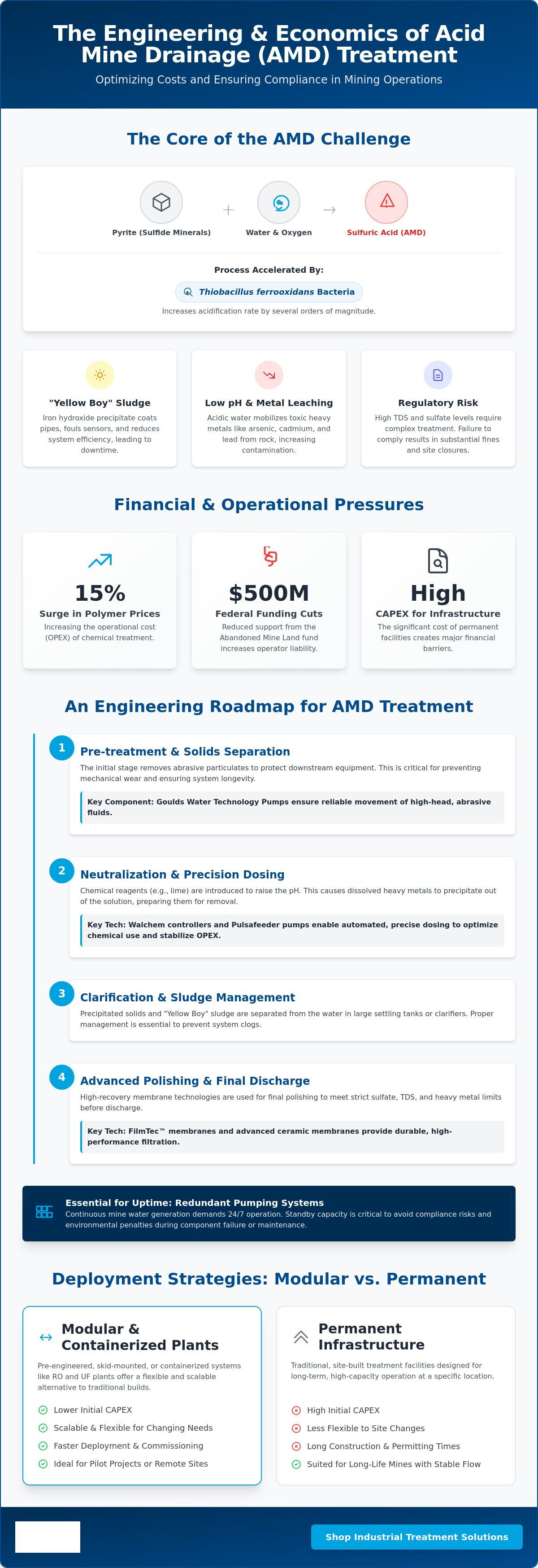
Designing an effective remediation system requires a linear engineering roadmap that balances chemical reaction kinetics with hydraulic throughput. The cost of acid mine drainage treatment is often dictated by how well these stages are integrated to prevent equipment fouling and chemical waste. A standardized flow typically moves from pre-treatment through neutralization, clarification, and final polishing. Because mine water generation is a continuous process, the inclusion of redundant pumping systems is essential for 24/7 operation. Without standby capacity, component failure leads to immediate compliance risks and potential environmental discharge penalties.
Process stability relies on integrating chemical dosing with real-time feedback loops. Automated systems adjust reagent delivery based on fluctuating influent chemistry, ensuring that reactor tanks maintain the correct residence time for complete reactions. While traditional methods focus on chemical precipitation, emerging research into Advanced Ceramic Membrane Technology highlights the shift toward more durable, high-recovery polishing stages that can withstand the harsh conditions of mining environments.
Stage 1: Pre-treatment and Solids Separation
The initial stage focuses on protecting downstream components from mechanical wear. Utilizing Goulds Water Technology Pumps ensures reliable movement of high-head, abrasive fluids from the source to the treatment plant. Removing large particulates early through multimedia filter tanks and sediment filtration prevents the clogging of sensitive instrumentation. For sites with significant heavy machinery activity, corrugated plate interceptors are deployed to separate oils and coarse solids before the water enters the chemical reaction chambers.
Stage 2: pH Adjustment and Chemical Neutralization
Neutralization is the core of the treatment process where acidity is countered and metals are forced out of solution. Precise reagent delivery is achieved using Pulsafeeder metering pumps, which allow for exact lime or caustic soda dosing. These pumps work in tandem with Walchem controllers to provide real-time monitoring and automated pH adjustments. By optimizing flocculation at this stage, operators can accelerate metal precipitation, which often allows for a smaller footprint in reactor tank design and reduces overall CAPEX.
Stage 3: Clarification and Sludge Management
Once metals have precipitated, they must be separated in high-rate clarifiers to produce clear effluent. The solubility of specific metals decreases as the pH increases, causing them to precipitate out of the water at predictable alkaline thresholds. Managing the resulting metal hydroxides is a significant operational expense. Implementing efficient sludge dewatering techniques reduces the total waste volume, which directly lowers the logistical costs associated with waste transport and disposal. For those seeking to upgrade existing systems, sourcing industrial-grade filtration components can significantly improve these separation rates.
Advanced Membrane Technologies: Sulfate and Metal Removal
While the neutralization and clarification stages described in previous sections effectively remove the majority of dissolved heavy metals, they often fail to address high sulfate concentrations. Modern discharge permits frequently set sulfate limits below the solubility of gypsum, which is the primary byproduct of traditional lime treatment. This regulatory pressure directly impacts the cost of acid mine drainage treatment; operators must transition from basic chemical precipitation to high-recovery membrane systems to achieve compliance. Membrane separation provides a definitive physical barrier against dissolved ions, ensuring high-purity discharge that meets the most stringent environmental standards.
Transitioning to membrane technology requires a precise approach to managing the total cost of ownership. Although membranes offer superior rejection rates, they are highly susceptible to fouling in harsh mining environments. Utilizing industrial-grade water treatment antiscalants and chemicals is necessary to prevent mineral scaling on membrane surfaces; to explore tailored chemical programs, you can discover JAS Global Industries. This operational strategy extends the lifespan of expensive components and maintains consistent flux rates, even when treating mine water with fluctuating Total Dissolved Solids (TDS) levels. Selecting high-pressure housings and robust seals is equally critical to ensure system longevity and prevent mechanical bypass.
Reverse Osmosis (RO) vs. Nanofiltration (NF) in Mining
Reverse Osmosis and Nanofiltration represent the primary technologies for deep sulfate and metal removal. FilmTec and Hydranautics RO membranes are industry standards for high-TDS mine water applications because they provide exceptional salt rejection and durability. To maintain these membranes under high operational pressures, engineers select Pentair filter housings for their proven mechanical integrity. In single-pass RO configurations, sulfate rejection typically exceeds 98%. Double-pass configurations are utilized when permeate quality must meet drinking water standards or specific industrial reuse requirements. Nanofiltration is often preferred when the goal is to selectively remove divalent ions like sulfate while allowing some monovalent ions to pass, potentially reducing operational pressure and energy costs.
Ultrafiltration (UF) as Pre-treatment
The longevity of a reverse osmosis system depends heavily on the quality of the influent water. Mobile ultrafiltration systems serve as an essential pre-treatment stage to remove colloidal silica, bacteria, and fine organic matter that would otherwise foul RO membranes. By significantly reducing the Silt Density Index (SDI), ultrafiltration prevents premature membrane failure and reduces the frequency of chemical clean-in-place (CIP) cycles. For a detailed technical overview of how these technologies integrate into broader facility designs, consult our guide on Industrial Water Filtration Systems. This multi-stage approach ensures that the most expensive membrane assets are protected from the abrasive and fouling-prone nature of raw mine drainage.
Deployment Strategies: Modular vs. Permanent Infrastructure
The cost of acid mine drainage treatment is fundamentally linked to the anticipated operational lifespan of the mine site. For facilities with a projected 20-year life, permanent concrete and steel infrastructure often provides the lowest long-term cost per gallon treated. However, many modern operations require more flexible deployment. Modular systems significantly reduce the upfront capital expenditure (CAPEX) associated with civil engineering and site preparation. These systems allow operators to bypass the lengthy construction timelines of permanent plants, moving from design to deployment in a fraction of the time.
Scalability remains a critical economic driver. As mine operations expand or water chemistry shifts, modular configurations allow for the addition of parallel treatment trains without disrupting existing processes. This incremental approach protects cash flow by aligning infrastructure investment with actual production needs. Logistical efficiency is also paramount for global installations. In remote regions of Africa and South America, shipping standardized, skid-mounted components is far more cost-effective than transporting raw construction materials to isolated territories. This logistical competence ensures that technical integrity is maintained regardless of the site's geographic constraints.
Containerized Reverse Osmosis Plants
Containerized Reverse Osmosis Plants represent the apex of "plug-and-play" engineering. These units are housed in standardized shipping containers, making them ideal for rapid deployment or emergency remediation. Each system is enclosed in a climate-controlled environment; this protects sensitive membranes and electronics from extreme heat or sub-zero temperatures found in high-altitude mining. Once a remediation project concludes or a mine is decommissioned, these units are easily disconnected and relocated to a new site. This portability preserves the asset's value and prevents the "sunk cost" associated with abandoned permanent infrastructure.
Mobile Treatment Units and Rental Options
Rental options for mobile treatment units provide a strategic alternative for short-term remediation or pilot testing. Choosing a rental model allows operators to address immediate compliance needs without the burden of long-term CAPEX. These units require minimal site integration and often come with comprehensive technical support to ensure performance targets are met. Successful deployment depends on robust Electric Power Controls to manage the high-torque requirements of industrial pumps and sensors. To secure the components necessary for your site's specific requirements, view our industrial water treatment equipment to find reliable solutions for your next project.
Optimizing the Total Cost of AMD Treatment
Achieving a sustainable cost of acid mine drainage treatment requires moving beyond basic neutralization to focus on total system optimization. Efficient operations rely on the integration of high-performance hardware with precise control logic. While initial capital outlay is a factor, the long-term reliability of components like Goulds Water Technology pumps and Pentair filter housings determines the frequency of unplanned downtime and maintenance expenses. High-quality sourcing ensures that equipment can withstand the corrosive and abrasive nature of mine water, providing a stable platform for continuous remediation. Global logistical support further stabilizes these costs by ensuring that critical spare parts reach remote sites in Africa or South America without excessive delays.
A significant opportunity for cost optimization lies in resource recovery and Zero Liquid Discharge (ZLD) strategies. Modern engineering allows operators to extract valuable materials from the waste stream, such as rare earth elements or high-purity iron precipitates. Concentrating these metals through advanced membrane separation can turn a remediation liability into a secondary revenue source, helping to offset the total expenditure of the treatment facility. By reducing the volume of final brine discharge, companies also lower their environmental liability and the associated costs of long-term waste management.
Integrated Systems and Component Sourcing
Water Services, Inc. specializes in integrating diverse hardware into a single, cohesive control logic. This unified approach prevents the inefficiencies that occur when disparate systems operate without synchronization. Process stability is maintained through Walchem controllers and Signet flow sensors, which provide the data necessary for real-time adjustments. Maintaining system integrity requires the use of genuine replacement filters and membranes to ensure consistent performance and regulatory compliance. For those managing active sites, sourcing high-quality water treatment replacement consumables is essential to prevent premature fouling and maintain designed flux rates.
Next Steps for Site Compliance
Evaluating the total cost of ownership for AMD treatment systems involves a detailed analysis of water chemistry, flow rates, and discharge requirements. A custom engineering approach ensures that the selected equipment matches the specific contaminants found at your site, preventing over-specification or system under-performance. Technical consultations provide the roadmap for designing scalable plants that grow alongside your production capacity. To secure a resilient and cost-effective remediation strategy, contact Water Services, Inc. for a custom AMD treatment quote and technical consultation. Our experts provide the logistical and engineering support required to maintain compliance in the most demanding global mining environments.
Securing Long-Term Performance in Mine Water Remediation
Stabilizing the cost of acid mine drainage treatment requires a precise alignment of geochemical analysis and high-performance engineering. Operators must move beyond reactive chemical dosing to implement integrated systems that prioritize equipment longevity and regulatory compliance. By selecting industrial-grade components and leveraging modular deployment strategies, mining facilities can achieve predictable operational expenditures while meeting stringent discharge limits. Effective remediation is a continuous process that depends on the technical integrity of every pump, sensor, and membrane in the treatment train.
Water Services, Inc. brings over 30 years of industrial water engineering experience to every project. As an official distributor for industry leaders like Goulds, Viqua, and FilmTec, we provide the hardware required for demanding commercial environments. Our global installation footprint across Africa, the Middle East, and the Americas ensures that your facility benefits from proven logistical and technical expertise, regardless of geographic isolation. We provide the components and control logic necessary to maintain reliable, 24/7 remediation performance.
Take the next step in optimizing your site's water management strategy. Explore Industrial Water Treatment Components and Custom Systems today. Secure your operation's future with reliable technology and expert support.
Frequently Asked Questions
What is the most effective way to remove sulfates from acid mine drainage?
High-recovery reverse osmosis and nanofiltration are the most effective methods for sulfate removal. Traditional lime neutralization typically reduces sulfate to approximately 1,500 to 2,000 mg/L, which often exceeds modern discharge limits. Utilizing FilmTec or Hydranautics RO membranes allows for rejection rates exceeding 98%. This physical separation is necessary when chemical precipitation alone cannot meet the stringent environmental standards required for site compliance.
Can acid mine drainage be treated to drinking water standards?
AMD can be treated to drinking water standards through a multi-stage engineering approach. This process involves neutralization, ultrafiltration, and double-pass reverse osmosis to remove dissolved metals and salts. Final disinfection using Viqua UV water purification systems ensures the water is biologically safe. While technically possible, the economic feasibility depends on the initial contaminant concentrations and the required volume of potable water produced from the site.
How much does it cost to implement an AMD treatment process?
The total cost of acid mine drainage treatment is determined by water chemistry, flow volume, and required discharge purity. CAPEX is influenced by the choice between permanent infrastructure and modular containerized plants. OPEX is driven by chemical dosing requirements, energy consumption for high-pressure pumps, and membrane replacement cycles. Custom engineering ensures that equipment is sized correctly to avoid unnecessary expenditure while maintaining 24/7 operational reliability.
What is "Yellow Boy" and how does it affect the treatment process?
"Yellow Boy" is the common term for iron hydroxide, an orange-yellow precipitate that forms as AMD is neutralized. This substance is highly abrasive and tends to coat sensors, clog filter media, and foul pump impellers. Managing this precipitate requires robust clarification and multimedia filtration to prevent mechanical failure. Failure to control iron precipitation leads to increased maintenance frequency and premature failure of downstream membrane systems.
Is active or passive treatment better for long-term mine drainage management?
Active treatment is superior for high-flow sites with aggressive water chemistry because it allows for precise control and guaranteed compliance. Passive systems, such as aerobic wetlands, require less energy but are often unable to handle fluctuating acidity or high metal loads. Active systems utilizing Walchem controllers and Pulsafeeder pumps provide the real-time adjustments necessary to stabilize OPEX and meet strict regulatory discharge permits.
How do RO membranes handle the low pH of acid mine drainage?
Standard RO membranes don't typically handle raw, low-pH mine drainage without pre-treatment. Acidic water must first be neutralized to a pH range of 6.0 to 8.0 to protect the thin-film composite structure of FilmTec or Hydranautics membranes. Operating at extreme pH levels leads to rapid membrane degradation and increased replacement costs. Proper pre-treatment protects these assets and ensures consistent salt and sulfate rejection throughout the system's life.
What maintenance is required for a containerized AMD treatment plant?
Maintenance for containerized plants includes routine replacement of sediment and carbon filters and periodic membrane cleaning. Engineers must calibrate Signet flow sensors and Walchem controllers to ensure dosing accuracy. Regular inspection of Goulds Water Technology pumps and Ashcroft pressure gauges is required to maintain hydraulic efficiency. Climate-controlled enclosures within the container protect these components from external environmental stress, but internal mechanical checks remain vital for 24/7 performance.
Can treated mine water be reused for industrial process water?
Treated mine water is frequently reused for industrial applications such as dust suppression, ore processing, and cooling towers. High-purity permeate from RO systems can even be used as boiler feed water. Reusing treated water reduces the demand for fresh water and lowers the overall cost of acid mine drainage treatment by minimizing discharge volumes. This circular approach improves site sustainability and reduces long-term environmental liability for the operator.
0 comments