

The industrial sector accounts for over 20 percent of global water withdrawal, meaning a single system failure can trigger an immediate operational crisis. By 2026, the stakes are higher as the EPA now requires quarterly monitoring for 40 different PFAS compounds under the NPDES permit program. You understand that downtime is not just a loss of production; it's a risk to your regulatory standing and long-term profitability. Managing the logistical complexity of a remote site deployment during an outage is a heavy burden for any engineering team. Securing an emergency water treatment rental is the most effective way to bridge the gap between system failure and full restoration.
This guide explains how to deploy mobile water treatment plants to maintain process continuity and meet discharge standards. We detail the technical specifications of containerized reverse osmosis systems, the integration of Tier 1 components like Goulds pumps and FilmTec membranes, and the management of temporary operating expenses. You'll learn how to navigate the transition from the administratively continued 2021 MSGP to modern, compliant treatment workflows. We also address the logistical requirements for rapid deployment to remote mining, military, or oil and gas facilities to ensure your supply remains stable.
Key Takeaways
- Identify critical triggers for rapid-response intervention, including unplanned system failures and the 2026 EPA PFAS monitoring requirements for industrial discharges.
- Evaluate mobile RO and ultrafiltration fleet specifications, focusing on the integration of high-pressure Goulds Water Technology pumps and FilmTec membranes for reliable performance.
- Shift from capital expenditure to predictable operational expenses by utilizing an emergency water treatment rental for temporary projects or sudden regulatory compliance needs.
- Accelerate deployment timelines by preparing critical site data, such as GPM flow rates, detailed source water analysis, and specific target effluent quality metrics.
- Maintain industrial continuity at remote mining or oil and gas sites through modular, containerized treatment plants and specialized process support from TEG Reclamation Services.
Understanding Emergency Water Treatment Rental: When to Deploy
An emergency water treatment rental is a rapid-response engineering service designed to maintain industrial and municipal continuity. It's a strategic deployment of modular equipment to replace or supplement existing infrastructure during critical failures. These systems are often containerized and pre-engineered for fast integration into existing pipework and electrical grids. By utilizing mobile units, facilities sustain production while permanent repairs or upgrades are performed. It's a bridge that ensures technical integrity isn't sacrificed for speed.
Critical triggers for deployment range from mechanical breakdowns to environmental shifts. Unplanned system failures, such as a high-pressure pump housing rupture or sudden membrane fouling, require immediate bypass solutions. Additionally, source water contamination from chemical spills or seasonal floods can render standard treatment processes ineffective. In 2026, many operators face sudden regulatory changes, such as the EPA's new PFAS monitoring requirements, necessitating advanced filtration layers that existing plants weren't built to handle. Understanding the Core Technologies in Mobile Water Treatment is essential for selecting the right response to these triggers.
Common Scenarios for Industrial Water Rentals
Mobile units aren't exclusively for catastrophes. During planned maintenance, an emergency water treatment rental keeps production online while technicians replace resin beds or update industrial water treatment membranes. Natural disasters like severe floods or droughts also necessitate temporary systems to treat degraded source water. For temporary remote sites, such as mining camps or military installations, containerized RO plants provide a stable supply of potable water without the long lead times associated with permanent civil engineering projects.
The Cost of Inaction: Downtime vs. Rental Fees
Downtime in heavy industry is measured in thousands of dollars per hour. In sectors like mining or oil and gas, a total water shutoff can cost millions in lost revenue within days. Beyond production loss, the environmental impact of discharging untreated wastewater leads to severe regulatory fines. Rental units act as a technical insurance policy. They ensure that even if a primary system fails, the facility remains compliant with discharge standards and process water requirements. This shift from high capital expenditure for redundant permanent systems to predictable operational expense for temporary rentals allows for better financial management during crises. It's about maintaining a stable logistical footprint when the primary infrastructure fails.
Core Technologies in Mobile Water Treatment Rental Fleets
The technical configuration of an emergency water treatment rental is dictated by the source water chemistry and the required effluent quality. Industrial fleets prioritize modularity and component reliability to ensure uptime in high-stakes environments. High-pressure fluid movement is typically managed by Goulds Water Technology pumps, which are integrated for their durability in continuous-duty cycles. To protect sensitive downstream components, mobile ultrafiltration (UF) systems serve as a critical pretreatment step. These units remove suspended solids and pathogens, which significantly extends the service life of RO membranes when dealing with turbid source water.
Containerized Reverse Osmosis (RO) Plants
Containerization provides essential climate protection and structural integrity for equipment deployed in harsh environments like remote mining sites or oil fields. These systems are engineered for rapid plug-and-play setup, allowing for immediate integration into existing industrial workflows. High-flux efficiency is achieved through the use of FilmTec or Hydranautics membranes, which are selected based on specific total dissolved solids (TDS) profiles. For a deeper technical analysis of membrane selection and system architecture, refer to our commercial reverse osmosis water filtration system guide. These plants often include integrated electric power controls to automate pressure regulation and flux monitoring.
Advanced Filtration and UV Sterilization
Source water with high turbidity requires multimedia filtration tanks for effective sediment removal before chemical or membrane treatment begins. Once physical particulates are removed, microbiological safety is addressed using Viqua UV systems. This technology provides high-level disinfection without the logistical burden of large-scale chemical storage or hazardous material handling on-site. UV intensity, measured in mJ/cm², directly dictates the flow rate capacity of a mobile skid to ensure complete pathogen inactivation. This is a critical metric for maintaining safety during rapid deployment.
Effective disinfection protocols must align with federal standards, especially during crisis management. Consulting the U.S. EPA Step-by-Step Guide to Deploying an Emergency Water System provides a framework for maintaining safety during these operations. Reliable performance in these scenarios requires heavy-duty hardware that can withstand 24/7 operation. If your current system needs a robust pressure solution, you can browse our inventory of Goulds Water Technology pumps to ensure your temporary or permanent installation meets industrial standards.
Rental vs. Purchase: Strategic Evaluation for 2026
The decision between capital expenditure (CapEx) for a permanent installation and operational expenditure (OpEx) for an emergency water treatment rental is a strategic financial choice. Heavy industry increasingly favors service-based models to maintain liquidity. While purchasing equipment provides long-term asset ownership, it requires significant upfront capital and extended lead times for engineering and site preparation. Renting allows facilities to bypass these hurdles, converting a multi-million dollar investment into a predictable monthly operating cost. This is particularly beneficial for exploratory mining or short-term oil and gas projects where the site's lifespan doesn't justify permanent infrastructure.
Renting serves as a real-world technology testing ground. Before committing to a permanent multi-million dollar installation, operators use mobile units to verify how specific membranes or filtration media perform against their actual source water. With the 2026 EPA requirements for PFAS monitoring, this "pilot" phase is critical. It allows you to confirm that the proposed treatment train meets the new Method 1633 standards without the risk of purchasing the wrong hardware. Additionally, the maintenance burden shifts to the provider. The rental agreement typically covers the replacement of consumables like FilmTec RO membranes and the calibration of Walchem controllers, reducing the need for specialized in-house staff.
A critical technical distinction often overlooked is the difference between modular containerized systems and temporary skid-mounted units. Modular systems provide a self-contained logistical footprint with environmental shielding for external deployment in harsh climates. Conversely, temporary skid-mounted units are often restricted to climate-controlled plant floors. Selecting a containerized emergency water treatment rental ensures the technical integrity of the electronics and pumps is maintained regardless of external site conditions.
When Purchasing Makes More Sense
Purchasing is the correct path for long-term projects exceeding 24 to 36 months. At this duration, the rental ROI typically plateaus, and the total cost of ownership for a permanent plant becomes more favorable. Sites with highly specific, non-standard contaminant profiles also benefit from purchasing, as they require custom-engineered media that may not be available in a standard rental fleet. For detailed specifications on permanent plant architecture, consult our guide on industrial water treatment systems.
The Advantages of the Rental Model
- Capital Preservation: Keeps cash flow available for core business operations and production equipment rather than utility infrastructure.
- Rapid Scalability: Allows for the quick addition or removal of treatment trains based on seasonal flux or rapid site expansion.
- Labor Efficiency: Eliminates the requirement for specialized water treatment technicians on the permanent payroll for temporary or fluctuating needs.
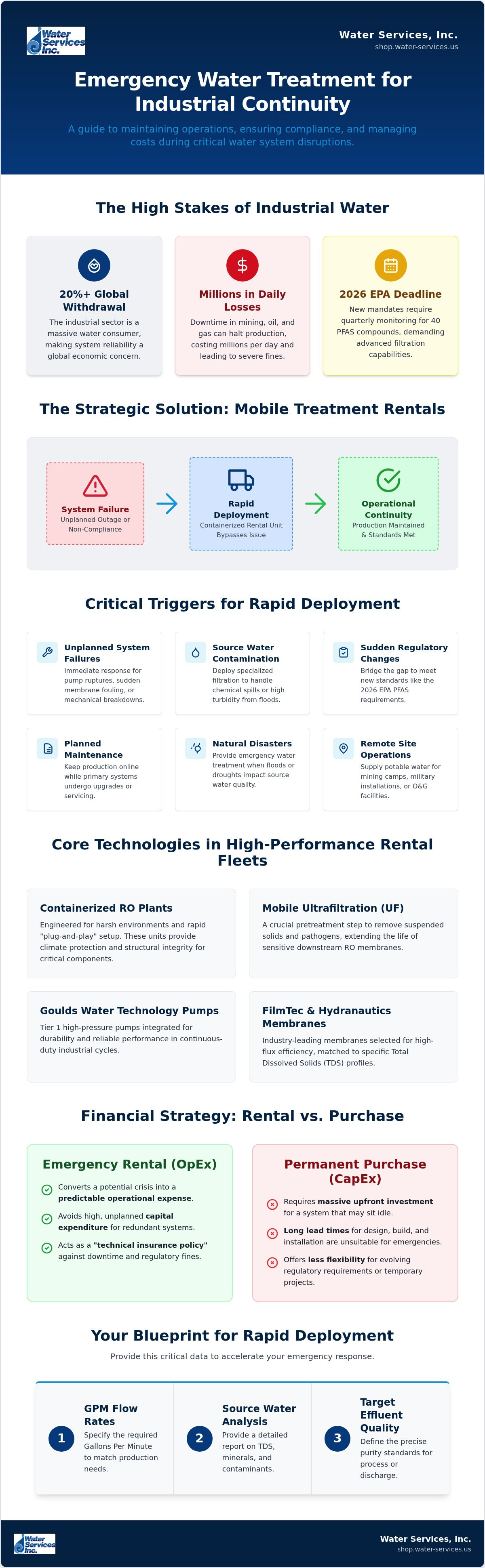
Step-by-Step Guide to Deploying an Emergency Water System
Deploying an emergency water treatment rental begins with a rigorous data exchange. To receive an accurate engineering quote, you must provide three primary metrics: peak flow rate in gallons per minute (GPM), a current source water analysis, and the target effluent quality. If you're treating for 2026 EPA PFAS compliance, specify Method 1633 requirements clearly. These data points dictate the membrane flux and chemical dosing rates for the modular plant. Site preparation must occur simultaneously with equipment dispatch. This includes leveling a designated footprint, establishing inlet and outlet manifold connections, and ensuring a stable power supply.
Commissioning is the final stage of deployment. A technical specialist typically manages the on-site setup, performing hydraulic pressure tests and sensor calibration. This ensures that Ashcroft pressure gauges and Signet flow sensors provide accurate real-time data. Handover includes training your local staff on routine maintenance and Walchem controller operation. This transition ensures your facility maintains technical integrity throughout the rental duration. Don't underestimate the value of having a trained operator who understands the specific alarm setpoints of your temporary system.
Technical Site Assessment Checklist
Site readiness prevents delays during the mobilization phase. Use this checklist to verify your infrastructure before the equipment arrives:
- Electrical Supply: Most containerized units require 460V/3ph power. If utility power is unavailable, ensure your electric power controls are compatible with portable generator integration.
- Hydraulic Compatibility: Verify that on-site centrifugal pumps match the inlet pressure requirements of the rental skid to avoid cavitation.
- Waste Stream Management: Establish a plan for the disposal of RO concentrate or multimedia filter backwash in compliance with local environmental permits.
Logistics and Rapid Deployment
Standardized mobile skids typically achieve a 24–72 hour deployment window from the initial dispatch to arrival at your facility. Pre-deployment factory testing is mandatory to ensure all components, including Viqua UV lamps and FilmTec membranes, are operational. Navigating international customs for remote mining or oil sites in Africa and South America requires precise documentation of all technical specifications. This logistical competence ensures the hardware arrives at your remote site ready for immediate integration. To secure the components needed for your site preparation, you can purchase industrial water treatment hardware directly from our inventory.
Modular Water Solutions from Water Services, Inc.
Water Services, Inc. specializes in the engineering and deployment of modular, containerized treatment systems for the world's most demanding environments. Since 1994, our Provo, Utah-headquartered firm has provided technical solutions for remote mining, military, and oil and gas operations. An emergency water treatment rental from our fleet isn't just a temporary bypass; it's a high-performance system integrated with Tier-1 components. We utilize Goulds Water Technology pumps for high-pressure durability and Pentair filter housings to ensure physical filtration integrity. These systems are designed to withstand the rigors of 24/7 industrial operation in harsh climates where standard commercial equipment often fails. We integrate Harmsco filtration products and Ashcroft pressure gauges to provide the same level of precision found in permanent municipal installations.
Global Reach and Technical Expertise
Our engineering team leverages over 30 years of data from installations in the Middle East and Africa to optimize our emergency response units. We understand that every site has a unique TDS profile and specific contaminant challenges. Our in-house engineers provide rapid system customization to ensure the equipment matches your exact process water requirements. To maintain zero downtime during long-term rentals, we ensure the immediate availability of replacement consumables, such as high-flux RO membranes from FilmTec and Hydranautics. This logistical competence is a core marker of our authority in the global equipment space. We don't just ship hardware; we deploy engineered solutions that are factory-tested for immediate integration into your existing infrastructure.
Support, Safety, and Compliance
Reliability is the central anchor of our service model. We provide comprehensive Operations and Maintenance (O&M) support throughout the rental duration to ensure your system remains within its design specifications. This includes real-time monitoring of Walchem controllers and Pulsafeeder metering pumps to prevent scaling or microbiological fouling. We ensure that every emergency water treatment rental meets the specific discharge or process standards required by your jurisdiction, including the evolving 2026 monitoring requirements. Site safety is a non-negotiable priority. We mandate the use of industrial-grade PPE and strictly adhere to international safety standards during the commissioning and decommissioning phases. Our technical integrity allows you to focus on your core production while we manage the complexities of your water supply.
Contact Water Services, Inc. for an Emergency Rental Quote to secure your facility's operational continuity today.
Securing Industrial Continuity with Modular Engineering
Maintaining a stable water supply during unplanned outages requires a fast-paced, organized response. An emergency water treatment rental provides the necessary technical bridge to bypass failed infrastructure while meeting the rigid 2026 EPA monitoring standards. By utilizing containerized plants equipped with Goulds pumps and FilmTec membranes, facilities ensure technical integrity in remote or harsh environments. This service-based model allows for rapid scalability and predictable operational expenses without the high capital burden of permanent construction. It's a strategic approach that prioritizes production uptime over logistical complexity.
Water Services, Inc. has managed global deployment projects since 1994, providing factory-tested modular units to mining and oil operations across Africa and the Middle East. Our Provo-based headquarters coordinates the logistics for international distribution, ensuring that every skid arrives ready for immediate integration into your workflow. With 24/7 technical engineering support, you can maintain production schedules and regulatory compliance during any system crisis. Technical expertise is the foundation of industrial reliability. It's the most dependable way to secure your facility's future.
Request a Rapid Deployment Quote for Emergency Water Treatment and protect your site from costly operational downtime today.
Frequently Asked Questions
How quickly can an emergency water treatment rental be deployed?
Standardized mobile skids usually arrive within 24 to 72 hours of dispatch. Deployment speed depends on logistical factors like distance and site readiness. Factory-tested units are ready for immediate integration once they arrive. For international remote sites, customs documentation and transport logistics may extend this timeframe; however, pre-configured modular systems are engineered for the fastest possible mobilization to maintain facility production.
What industries typically use mobile water treatment rentals?
High-demand sectors like mining, military, and oil and gas rely on these systems for remote site continuity. Data centers and semiconductor manufacturing facilities also use mobile treatment for high-purity water needs during system outages. Municipalities utilize them for emergency potable water supply during source contamination events. These industries require the durability of Tier-1 components like Goulds pumps and FilmTec membranes to maintain 24/7 production cycles.
Do rental units include operators and maintenance support?
Comprehensive rental agreements typically include technical support and routine maintenance as part of the operational value proposition. While some facilities provide their own staff after initial commissioning training, many opt for full O&M support to manage consumables like antiscalants and replacement filters. Providers handle the calibration of sensors and controllers, ensuring the equipment operates within its technical specifications throughout the duration of the emergency water treatment rental.
Can mobile water treatment systems handle seawater desalination?
Yes, containerized reverse osmosis plants are specifically engineered to treat both brackish water and seawater. These units utilize high-pressure Goulds Water Technology pumps and specialized Hydranautics or FilmTec seawater membranes to remove total dissolved solids. Pretreatment steps like ultrafiltration or multimedia filtration are integrated to protect the RO membranes from fouling in high-turbidity marine environments. This allows for reliable potable or process water production in coastal remote sites.
What power requirements are needed for a containerized RO plant?
Most industrial-scale containerized RO systems require a stable 460V/3ph electrical supply to operate high-pressure pumps and automated control systems. If utility power is unavailable at a remote site, the units are often compatible with portable industrial generators. Facilities must ensure that their electric power controls and distribution panels can handle the peak amperage loads of the treatment train to prevent system trips during 24/7 operation.
How do I determine the right flow rate (GPM) for my emergency rental?
Calculate your required flow rate by analyzing your facility's peak production demand and adding a 10 to 15 percent safety margin for backwashing or membrane cleaning cycles. You must also consider the recovery rate of the specific RO or UF system; the inlet flow must be higher than the target effluent GPM. Providing a current source water analysis helps engineers determine the exact flux rates and system sizing needed for your site.
Are these systems compliant with EPA or local environmental regulations?
Rental units are engineered to meet specific discharge or process water standards, including the 2026 EPA monitoring requirements for PFAS compounds. Systems utilizing Viqua UV sterilization and advanced membrane filtration ensure microbiological safety and chemical compliance. It's essential to share your NPDES permit limits or local discharge requirements with the provider during the quote phase to ensure the emergency water treatment rental configuration satisfies all legal mandates.
What happens if the rental equipment needs repair during the project?
Technical support and repair services are standard components of the rental agreement to ensure industrial continuity. If a component like a Pulsafeeder metering pump or a Signet flow sensor fails, the provider typically dispatches replacement parts or a technician immediately. This minimizes downtime compared to owning equipment, where the facility would be responsible for sourcing specialized parts and labor. Reliability is maintained through 24/7 engineering support and on-site maintenance cycles.
0 comments