

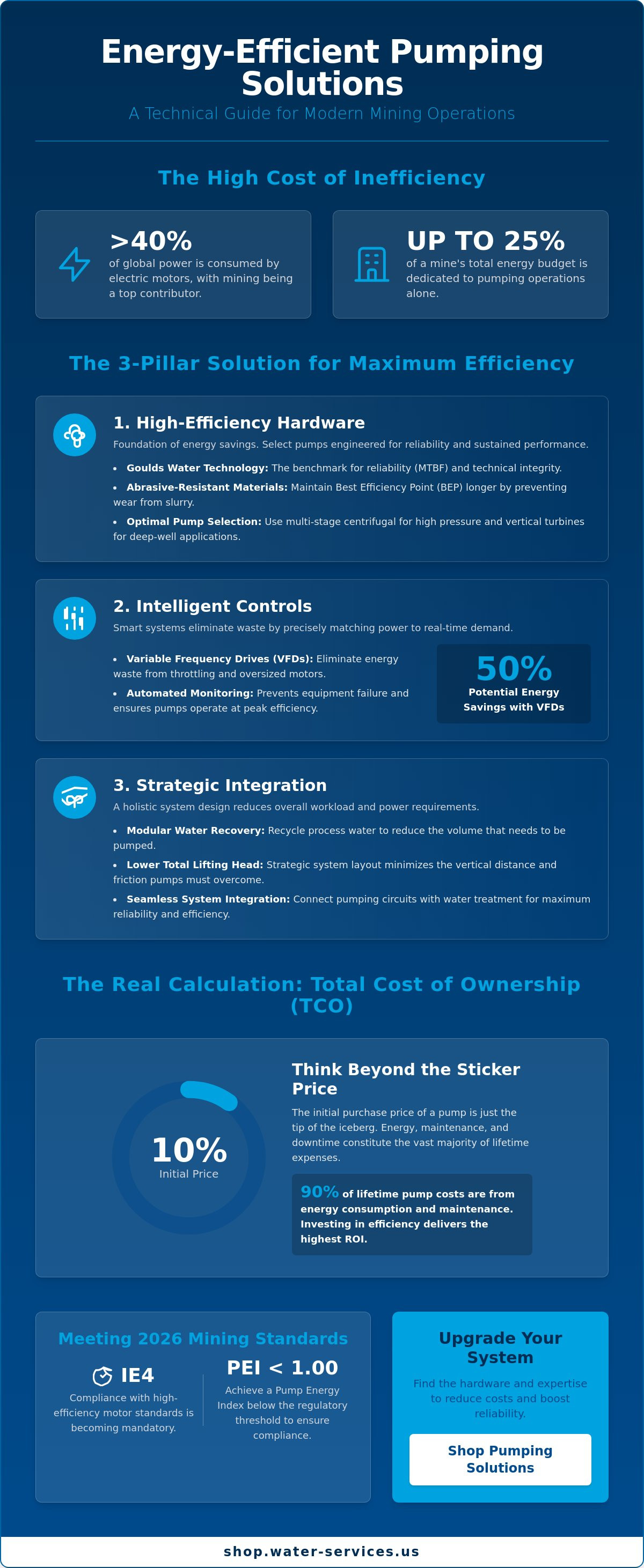
Did you know that electric motors account for more than 40% of global power use, with mining operations often bearing the highest burden of that consumption? You likely recognize that rising energy costs for deep-well dewatering and frequent equipment failure from abrasive slurry are no longer just operational hurdles. They are direct threats to your bottom line. This guide demonstrates how to implement energy efficient pumping solutions for mining to reduce your kilowatt-hour consumption per ton of material moved while stabilizing your infrastructure.
We promise to show you how advanced pump selection and integrated water recovery systems can lower your total cost of ownership. You will learn about the impact of upcoming IE4 motor standards and how automated VFD controls can deliver energy savings of up to 50% in regulated applications. This technical overview covers the specifications of heavy-duty hardware like Goulds XHD slurry pumps and explains how to achieve seamless integration with your existing water treatment plants for maximum reliability in 2026.
Key Takeaways
- Identify the optimal hardware for deep-well dewatering by comparing the hydraulic efficiencies of Goulds Water Technology multi-stage centrifugal and vertical turbine pumps.
- Implement energy efficient pumping solutions for mining by integrating Variable Frequency Drives (VFDs) that eliminate throttling waste and match motor output to real-time demand.
- Lower your total lifting head and power requirements through the strategic integration of modular water recovery and recycling systems.
- Calculate a comprehensive ROI by prioritizing Total Cost of Ownership (TCO), accounting for the fact that initial purchase price typically represents only 10% of lifetime pump expenses.
Defining the Efficiency Gap in Modern Mining Pumping Operations
Energy efficient pumping solutions for mining are defined as systems engineered to minimize parasitic power loss. These configurations utilize optimized hydraulics and smart motor control to ensure that every kilowatt-hour (kWh) consumed contributes directly to fluid transport. In the 2026 industrial landscape, pumping operations often account for up to 25% of a mine's total energy budget. This high percentage makes efficiency a primary lever for reducing operational expenditure (OPEX) and improving site sustainability.
Fluid density plays a critical role in motor demand. Moving high-viscosity slurry requires significantly more energy than standard deep-well dewatering due to increased internal friction and the physical weight of the solid-liquid mixture. When pumps aren't specifically rated for these densities, they operate outside their intended parameters, leading to "Efficiency Leaks." These leaks manifest as friction losses in piping, energy wasted through throttled valves, and the common practice of selecting oversized pumps that run inefficiently at low loads. Understanding foundational pump mechanics and types is the first step in identifying these systemic losses.
The Cost of Inefficiency: Power vs. Performance
Kilowatt-hour waste in deep-pit dewatering translates to substantial financial losses over a standard fiscal year. Beyond the immediate power bill, energy-efficient pumping is now a requirement for modern ESG reporting and Mine Closure Plans. There's a direct correlation between pump wear and energy consumption. As components like impellers and wear plates degrade from abrasive slurry, the pump must work harder and consume more power to maintain the same flow rate. This creates a cycle of increasing costs and decreasing reliability.
2026 Mining Standards and Efficiency Benchmarks
Operating at the Best Efficiency Point (BEP) is the primary goal for any centrifugal pump installation. Tier 1 mining organizations are now mandating high-efficiency motor standards, often requiring compliance with IE4 levels for mid-range motors. This shift is driven by the need to lower the Pump Energy Index (PEI) below the regulatory threshold of 1.00. A system curve is a graphical representation of the total head required to move a specific volume of fluid through a pipe network, including static lift and friction losses. Matching the pump performance curve to the system curve is essential to prevent operational waste. Professionals can find technical specifications for high-efficiency hardware in our pumps collection to ensure their systems meet these modern benchmarks.
High-Efficiency Hardware: Goulds Water Technology Standards
Goulds Water Technology is the benchmark for industrial reliability because their designs focus on technical integrity. Their engineering prioritizes Mean Time Between Failure (MTBF). This reliability is essential in remote mining environments where downtime is expensive. High-efficiency hardware is the foundation of any strategy involving energy efficient pumping solutions for mining. By minimizing internal recirculating flows and mechanical friction, these pumps convert electrical energy into fluid movement with minimal waste.
Precision-engineered impellers reduce hydraulic turbulence. This turbulence is a primary source of energy loss in unoptimized systems. Goulds uses abrasive-resistant coatings to maintain hydraulic efficiency over long duty cycles. Standard pumps lose efficiency as internals erode. Hardened materials ensure the pump operates at its Best Efficiency Point (BEP) for longer periods. This sustained performance is a critical factor in pump system efficiency. Vertical turbine pumps offer a smaller footprint and are ideal for deep-well applications where space is constrained, while multi-stage centrifugal units provide versatility for varying pressure requirements in process circuits.
Selecting the Right Pump for Slurry and Dewatering
Dewatering applications require pumps capable of handling high static head with low power consumption. Multi-stage centrifugal pumps are often preferred for their ability to generate high pressure across several stages. Slurry pumps, such as the Goulds XHD, must balance solids-handling capability with motor efficiency. Heavy-duty liners and specialized impellers prevent clogging while maintaining the flow rates necessary for process water circuits. You can explore our Goulds Water Technology Pumps collection for specific mining hardware that meets these industrial requirements.
Submersible vs. Surface Pumping Systems
Submersible borehole pumps are the standard for groundwater control. These units operate at depth, eliminating the suction lift limitations associated with surface pumps. Their proximity to the water source reduces the energy required to initiate flow. Conversely, surface-mounted horizontal split-case pumps excel in process water circulation where accessibility for maintenance is a priority. Choosing between these configurations depends on your specific lifting head requirements and the available power infrastructure. Surface pumps often allow for easier integration of monitoring sensors, while submersibles provide a compact footprint for deep-pit dewatering. For engineers looking to upgrade their fleet, reviewing the technical datasheets in our pumps inventory provides the necessary metrics for an informed selection.
Intelligent Controls: VFDs and Automated Monitoring Systems
Hardware provides the capacity for movement, but intelligent controls provide the actual savings. Implementing energy efficient pumping solutions for mining requires a shift from static operation to demand-based regulation. Variable Frequency Drives (VFDs) act as the primary interface between the electrical grid and the pump motor. They allow operators to adjust motor speed in real-time, ensuring that power draw matches the actual hydraulic load. This precision is critical as mines integrate with sensitive remote power grids or renewable energy sources.
Traditional mining circuits often rely on throttling valves to manage flow. This practice is inherently wasteful. It forces the pump to work against artificial resistance while consuming maximum power. VFDs eliminate this inefficiency by slowing the motor itself. Industry data indicates that VFDs can deliver energy savings of 20% to 50% in regulated pump applications. This technology is vital for maintaining pumps in mining efficiency while reducing mechanical wear on impellers and seals.
Real-time data integration is the next step in optimizing mining circuits. Signet flow sensors provide precise metrics on liquid transport. When paired with Walchem controllers, these sensors allow for automated process adjustments. This configuration ensures that chemical dosing and water recovery systems operate only when necessary. It prevents the over-processing of water, which is a significant source of hidden energy consumption in modern mine sites.
Variable Frequency Drives (VFD) Implementation
VFDs reduce start-up current and mechanical stress. High inrush currents during motor start-up can strain remote power grids. These drives provide a "soft start" capability that protects both the electrical infrastructure and the pump shaft. In variable-demand dewatering scenarios, the ROI on these systems is often realized in under three years. You can browse our electric power controls to find mining-grade automation hardware designed for these environments.
Predictive Maintenance and Efficiency Analytics
Ashcroft pressure gauges are essential for identifying efficiency drift. A sudden increase in discharge pressure often indicates a downstream blockage or pump clogging. These events waste power by forcing the motor to overcome higher resistance. By monitoring these metrics, operators move from reactive repairs to predictive maintenance. This shift protects high-value assets and ensures the system operates at its Best Efficiency Point (BEP) consistently. Transitioning to data-driven maintenance prevents the 10% to 15% efficiency drop typical of neglected pumping systems.
Strategic Integration: Modular Water Treatment and Recovery
Pumping and water treatment are often managed as separate silos. However, the most energy efficient pumping solutions for mining integrate these processes into a closed-loop circuit. By treating and recycling process water at the point of use, operators significantly reduce the "Lifting Head." This is the vertical distance and friction loss that pumps must overcome to move water from deep pits to surface storage. Reducing this head translates directly into lower kilowatt-hour consumption. Integrating mining wastewater treatment solutions into the primary pumping circuit allows for the immediate reuse of water in processing plants or for dust suppression.
High-efficiency reverse osmosis (RO) is central to this strategy. Modern systems utilize high-pressure pumps paired with energy recovery devices (ERDs). These devices capture the hydraulic energy from the high-pressure reject stream and transfer it back to the incoming feed water. This process reduces the total energy required for desalination or solute removal by up to 60% compared to systems without recovery. The result is a treatment plant that functions as a net energy saver within the broader mine infrastructure. By maintaining high permeate recovery rates, the system minimizes the volume of water that requires high-lift pumping to disposal sites.
Modular and Containerized Treatment Plants
Containerized Reverse Osmosis Plants offer a reduced installation time and a compact energy footprint. These modular units are pre-engineered for rapid deployment in remote environments. Mobile Ultrafiltration Systems provide essential clarification for process water, removing suspended solids that would otherwise cause abrasive wear on downstream pumps. By maintaining water quality, these systems protect the hydraulic efficiency of the entire circuit. Some industrial sites have successfully reduced freshwater intake by 40% through these recovery pumping configurations, lowering the energy costs associated with sourcing and transporting external water.
Zero Liquid Discharge (ZLD) and Resource Recovery
Zero Liquid Discharge (ZLD) systems represent the peak of water management integration. These systems require specialized pumping configurations to handle high-concentration brines and saturated solutions. While ZLD is energy-intensive, the recovery of valuable minerals from wastewater can offset disposal costs and environmental levies. Efficient pumping in ZLD circuits involves managing high osmotic pressures with precision. You can view our water treatment solutions to find modular hardware that supports these advanced recovery goals.
Calculating ROI: The Total Cost of Ownership for Mining Pumps
Evaluating the financial impact of energy efficient pumping solutions for mining requires a shift from Capital Expenditure (CAPEX) to Total Cost of Ownership (TCO). In high-intensity mining environments, the initial purchase price typically represents only 10% of a pump's lifetime cost. The remaining 90% is consumed by energy, maintenance, and operational downtime. Selecting hardware based solely on the lowest bid often results in significantly higher long-term expenses due to poor hydraulic efficiency and frequent component failure.
Reliability is a core component of the efficiency equation. When a pump fails in a deep-well dewatering circuit, the cost of lost production often exceeds the value of the equipment itself. High-performance brands like Goulds Water Technology and Viqua justify their initial investment through increased Mean Time Between Failure (MTBF). By maintaining consistent performance at the Best Efficiency Point (BEP), these systems prevent the energy spikes associated with worn internals and hydraulic drift. For operations with fluctuating capital, rental and leasing options for mobile water treatment plants provide a pathway to implement high-efficiency technology without a large upfront outlay.
The Total Cost of Ownership (TCO) Formula
A standard TCO calculation for industrial pumping includes the following variables:
- Purchase Price: The initial cost of the pump and motor assembly.
- Installation: Costs for site preparation, piping, and electrical integration.
- Energy: The cumulative cost of kilowatt-hours consumed over the service life.
- Maintenance: Routine servicing, replacement parts, and labor.
- Disposal: Decommissioning and environmental compliance costs.
Energy costs typically exceed the initial purchase price within the first 18 months of intensive mining use. This rapid inversion makes energy efficiency the most critical variable in the procurement process. Investing in premium hardware ensures that the pump maintains its rated efficiency longer, protecting the ROI against rising utility rates and abrasive wear.
Project Engineering and Custom Design
Water Services, Inc. provides project engineering to ensure that every installation matches site-specific system curves. Standard off-the-shelf solutions often fail to account for the unique friction losses and static head requirements of a specific mine. Our team designs custom pumping circuits that prioritize process water recovery and power stabilization. This technical precision ensures the hardware operates within its intended parameters, preventing the energy waste caused by over-specification or poor hydraulic matching. Long-term efficiency is further supported through technical maintenance contracts and real-time monitoring support.
To optimize your site operations, contact Water Services, Inc. for a custom mining efficiency audit and technical consultation.
Implementing High-Efficiency Pumping Standards for 2026
Achieving operational sustainability in the mining sector requires a transition from isolated hardware purchases to integrated, data-driven circuits. We've detailed how prioritizing Total Cost of Ownership (TCO) over initial CAPEX ensures that your infrastructure remains profitable throughout its service life. By incorporating modular water treatment and high-performance Goulds Water Technology pumps, operators effectively lower the lifting head and minimize abrasive wear. These energy efficient pumping solutions for mining are essential for meeting the 2026 IE4 motor standards and reducing site-wide OPEX.
Water Services, Inc. has been engineering custom modular plants since 1994. As an Authorized Goulds Water Technology Distributor, we provide the technical integrity required for remote mining sites. Our global logistics and technical support teams ensure that your infrastructure remains reliable in the most demanding environments. It's time to move beyond oversized equipment and embrace right-sized, automated pumping circuits that prioritize process water recovery.
Shop Industrial Pumps and High-Efficiency Controls to begin your site efficiency audit today. We look forward to supporting your next engineering project.
Frequently Asked Questions
What are the most energy-efficient pumps for mine dewatering?
Vertical turbine pumps and multi-stage centrifugal units are the most efficient choices for mine dewatering. Vertical turbines are particularly effective because they operate submerged, which eliminates the energy losses associated with suction lift. These designs are a cornerstone of energy efficient pumping solutions for mining because they allow for precise pressure management across deep-pit applications without wasting power on unnecessary head.
How much energy can a VFD save in a mining pump application?
Variable Frequency Drives (VFDs) can reduce energy consumption by 20% to 50% depending on the variability of the demand. By adjusting the motor speed to match the required flow, VFDs prevent the massive energy waste caused by running a motor at full speed against a throttled valve. This approach also reduces mechanical stress on the pump shaft and bearings, extending the service life of the entire drive train.
Is it better to repair or replace an inefficient mining pump?
Replacement is generally the superior option if a pump's hydraulic efficiency has fallen by more than 10% or if the motor doesn't meet current IE4 standards. While repairs address immediate mechanical failures, they rarely restore the unit to its original Best Efficiency Point (BEP). Modern hardware provides a much higher return through lower energy bills and increased reliability, often paying for itself within two years.
How does slurry density affect the energy efficiency of a centrifugal pump?
Increased slurry density significantly raises the brake horsepower (BHP) required for operation. As solid concentration grows, the fluid's viscosity increases, leading to higher internal friction and accelerated erosion of the impeller and casing. This wear causes a rapid decline in hydraulic efficiency. It makes it harder for the system to maintain its target flow rate without consuming excessive power from the motor.
What role does reverse osmosis play in mining water efficiency?
Reverse osmosis (RO) systems enable the recovery of high-quality permeate from contaminated process water. This capability reduces the mine's reliance on external water sources, which often require high-lift pumping from remote locations. By recycling water on-site, RO systems effectively lower the total energy footprint of the mine's water management circuit by reducing the volume of fluid that must be moved over long distances.
Can automated monitoring reduce the power consumption of remote pumping sites?
Automated monitoring systems using Walchem controllers and Signet flow sensors prevent the energy waste associated with unoptimized run times. These systems detect efficiency drift in real-time, allowing operators to intervene before power consumption spikes. Automation ensures that pumps only operate when necessary. This is critical for remote sites relying on expensive diesel-generated power or limited renewable energy grids.
How do I calculate the ROI of an energy-efficient pump upgrade?
ROI is calculated by comparing the Total Cost of Ownership (TCO) of the existing pump against a high-efficiency replacement. You must factor in the purchase price, installation costs, and projected energy savings over the equipment's lifecycle. In most mining applications, the energy savings alone will pay for a high-efficiency pump upgrade within 18 to 24 months, especially in deep-well dewatering circuits.
Are containerized water treatment systems more efficient than traditional builds?
Containerized water treatment plants are more efficient because they use pre-optimized hydraulic layouts that minimize friction losses. Traditional site-built systems often suffer from inefficient piping runs and mismatched components. Modular units are engineered as a cohesive system, ensuring that pumps, membranes, and filters work together with minimal parasitic power loss. This integration is a key part of modern energy efficient pumping solutions for mining.
0 comments