

A single hour of unplanned downtime in a chemical process or mining facility often costs more than the hardware itself. You recognize that incomplete on-site documentation leads to incorrect restarts, which significantly increases the risk of catastrophic equipment damage. This Goulds pump troubleshooting guide serves as a specialized 2026 manual for operators who require precise technical data to restore system flow without delay.
We provide a structured diagnostic path that maps specific symptoms like cavitation or excessive vibration to verified engineering solutions. This guide incorporates the latest industrial standards, including the API 610 13th Edition and ASME B73.1-2026 specifications for horizontal end suction pumps. You'll learn to validate whether to perform a field repair or opt for a full replacement. We'll examine how to troubleshoot everything from the Goulds 3700i (OH2) series to the newer VIDAR Smart Motors, ensuring your infrastructure returns to peak performance using the most current technical metrics available. This technical overview prioritizes efficiency and precision to minimize operational disruptions.
Key Takeaways
- Establish a systematic diagnostic log for pressure, flow, and amperage to identify hydraulic or mechanical deviations before they lead to failure.
- Distinguish between destructive cavitation and air entrainment to resolve suction leaks and prevent long-term impeller damage.
- Utilize this Goulds pump troubleshooting guide to navigate a clear symptom-to-solution path for common issues like motor trips and insufficient flow.
- Apply specialized diagnostic strategies tailored for high-pressure reverse osmosis feed pumps and abrasive mining dewatering applications.
- Evaluate hardware longevity using a "Repair vs. Replace" matrix that factors in operational efficiency and 2026 replacement part lead times.
Standard Operating Procedures for Goulds Pump Diagnostics
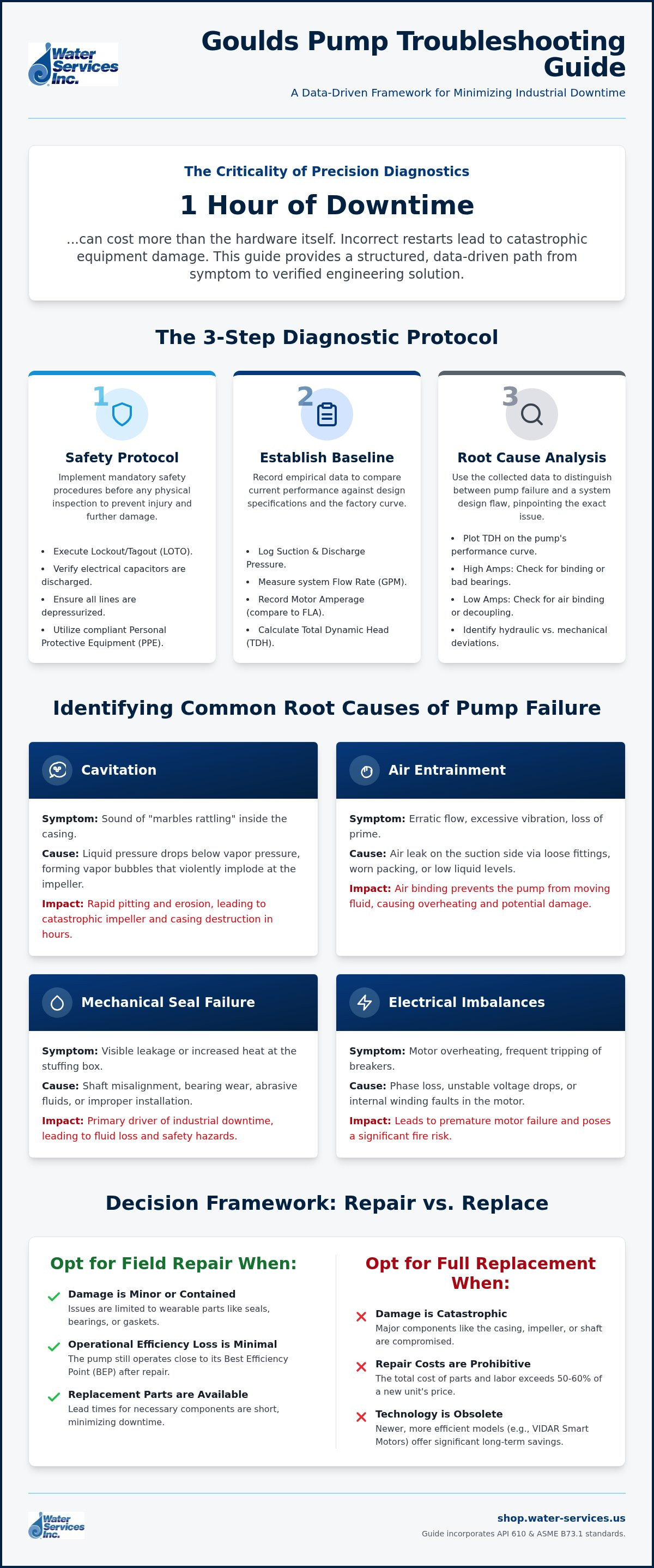
Industrial pump troubleshooting is the systematic identification of hydraulic, mechanical, or electrical deviations from baseline performance. It's not a trial and error process. This Goulds pump troubleshooting guide establishes a framework where every diagnostic step is driven by empirical data. Before any hardware is disassembled, you must verify the operational state of the equipment against its design specifications. Failure to follow a structured SOP often leads to incorrect part replacement and extended system downtime.
The "Diagnostic Log" is your most critical tool during the initial assessment. You must record suction pressure, discharge pressure, flow rates, and motor amperage before intervention. This snapshot allows you to compare current performance against the factory curve. The pump nameplate serves as the primary reference point. It provides the model number, impeller diameter, and Full Load Amps (FLA) required to determine if the pump is operating within its intended hydraulic envelope. Without this data, you cannot distinguish between a pump failure and a system design flaw.
Pre-Troubleshooting Safety Checklist
Safety is the priority when managing high-voltage Goulds motors and pressurized systems. You must implement Lockout/Tagout (LOTO) procedures to ensure the drive remains de-energized during inspection. Verify that all electrical capacitors are fully discharged. In high-temperature applications, allow for a cooling period to mitigate thermal hazards. All technicians must utilize compliant personal protective equipment to guard against chemical exposure and mechanical impact. Always check that isolation valves are secure and lines are depressurized before breaking any seals.
Gathering Baseline Performance Data
Quantifying the current output is essential for root cause analysis. Use calibrated suction and discharge gauges to calculate the system's Total Dynamic Head (TDH). Total Dynamic Head is the sum of static head, friction loss, and pressure head. By applying foundational centrifugal pump principles, you can plot this TDH against the pump's performance curve to identify efficiency loss or cavitation points.
Simultaneously, measure the motor amperage using a calibrated meter. Compare this reading to the nameplate FLA. High amperage typically indicates mechanical binding, bearing failure, or an oversized impeller. Conversely, low amperage may suggest air binding or a decoupled shaft. These metrics provide the technical evidence needed to move from general observation to a specific, actionable repair strategy.
Identifying Root Causes: Why Industrial Centrifugal Pumps Fail
Root cause analysis is the most effective way to prevent recurring failures. This Goulds pump troubleshooting guide identifies the physical and electrical stressors that compromise centrifugal hardware. Understanding why a pump fails allows you to move beyond temporary fixes to permanent solutions. In the 2026 industrial environment, precision diagnostics are mandatory for maintaining operational uptime.
Cavitation is often identified by a sound resembling marbles rattling inside the pump casing. This occurs when liquid pressure drops below vapor pressure at the impeller eye, forming bubbles that implode with extreme force. These implosions cause pitting on the impeller and casing, leading to rapid hydraulic degradation. If left unaddressed, cavitation destroys internal components in a matter of hours.
Air entrainment and air binding are distinct issues. Air entrainment involves a continuous leak on the suction side, often through loose fittings or worn packing. Air binding occurs when a large volume of air is trapped in the casing, preventing the pump from moving fluid entirely. Both conditions lead to erratic flow and excessive vibration. Identifying the source of air ingress is a critical diagnostic step.
Mechanical seal failure remains a primary driver of industrial downtime. Early signs include visible leakage or increased heat at the stuffing box, which often signals shaft misalignment or bearing wear. In 3-phase industrial motors, electrical imbalances such as phase loss or voltage drops lead to overheating. Monitoring these electrical parameters ensures the motor operates within its design limits.
Hydraulic vs. Mechanical Stressors
Operating too far to the right on the performance curve increases flow but reduces head, often triggering cavitation. In mining environments, abrasive solids accelerate impeller wear and erode the casing wall. Understanding these dynamics is critical when managing Industrial Water Treatment Systems, where flow consistency is paramount for process integrity.
The Role of Net Positive Suction Head (NPSH)
Maintaining a sufficient margin between Net Positive Suction Head Available (NPSHa) and NPSH Required (NPSHr) is mandatory for Goulds centrifugal models. Blocked suction strainers or excessively long suction lines reduce NPSHa, causing the fluid to flash into vapor. A safety margin of at least 2 to 3 feet of head is recommended to ensure stable operation. If your system consistently fails to meet these requirements, consider upgrading your technical maintenance and replacement parts to restore factory specifications.
Goulds Pump Troubleshooting: A Symptom-Based Guide
Systematic troubleshooting requires mapping observable symptoms to specific mechanical or hydraulic faults. This Goulds pump troubleshooting guide provides a searchable reference to bypass lengthy manual searches during critical failures. When a pump fails to perform, the symptom usually dictates the diagnostic starting point. Operators must distinguish between electrical trips and hydraulic performance drops to avoid unnecessary disassembly.
If the pump won't start or trips the breaker immediately, investigate electrical integrity first. Check for a blown fuse, tripped thermal overload, or a locked rotor. High-voltage industrial motors often trip due to phase imbalance or voltage drops exceeding 10%. Verify the motor Full Load Amps (FLA) against the recorded amperage at startup. A pump that runs but delivers no water indicates a loss of prime or a severe blockage. Insufficient flow often results from worn impellers or incorrect system head calculations. Excessive noise or vibration signals mechanical distress, such as bearing failure or misalignment. Rapid cycling suggests issues with pressure switches or a leaking foot valve in the suction line.
Step-by-Step Resolution for Flow Issues
Hydraulic failures often stem from suction-side obstructions or priming errors. Follow these steps to restore system flow:
- Step 1: Ensure the pump casing is fully primed and vent any air pockets trapped in the suction volute.
- Step 2: Inspect the suction strainer and foot valve for debris blockage; a partial obstruction can drastically reduce output.
- Step 3: Verify correct motor rotation, as reverse rotation is a common error after electrical maintenance.
- Step 4: Check for a closed or partially obstructed discharge valve that may be restricting the flow path.
Diagnosing Vibration and Noise
Mechanical stability is vital for equipment longevity and safety. Start by checking for loose mounting bolts or an unstable baseplate, which amplify harmonic frequencies. Inspect the coupling alignment between the motor and pump shaft; even minor offsets cause rapid seal and bearing wear. You should identify bearing wear through temperature monitoring or acoustic analysis. A bearing housing temperature exceeding 180°F (82°C) typically indicates imminent failure. For critical components, browse the Goulds Pump Collection for replacement shafts, bearing kits, and high-performance impellers. Maintaining these standards ensures the pump operates within its vibration limits, preventing secondary damage to the piping system.
Troubleshooting Goulds Pumps in Mining and RO Applications
Specialized industrial environments like mining circuits and Reverse Osmosis (RO) plants impose extreme stressors on pumping hardware. Standard diagnostics often fail to account for the unique variables present in these high-stakes applications. This Goulds pump troubleshooting guide focuses on managing abrasive slurries and high-pressure requirements where equipment failure leads to immediate environmental or production risks. In 2026, the integration of smart sensors provides better data, but the mechanical fundamentals of dewatering and membrane protection remain the priority.
Mining operations face the dual challenge of abrasive solids and high-head dewatering. Slurries cause rapid erosion of impellers and volutes, leading to a steady decline in hydraulic efficiency. Troubleshooting these systems requires frequent monitoring of the "wear margin" between the impeller and the wear ring. Chemical resistance is equally critical. Handling aggressive mining wastewater necessitates the use of specialized alloys or lined casings to prevent corrosive failure. If a pump shows a sudden drop in discharge pressure, technicians should first inspect for internal bypass caused by abrasive wear before assuming a motor fault.
Pumping Challenges in Mining Circuits
Fluctuating pH levels and corrosive mine water require constant vigilance to prevent material degradation. Troubleshooting Goulds submersible models in deep-well dewatering involves checking motor lead insulation and monitoring for seal chamber moisture. These units are difficult to access, so identifying electrical deviations early is vital. For comprehensive strategies on managing these complex environments, review our technical analysis of Mining Wastewater Treatment Solutions. Reliable dewatering ensures the safety of the entire mining circuit.
RO Feed Pump Diagnostics
Reverse Osmosis feed pumps must deliver constant, pulse-free pressure to protect FilmTec and Hydranautics membranes from mechanical stress. Any pulsation in the flow, often caused by suction-side air ingress or VFD instability, leads to membrane delamination and premature failure. Troubleshooting VFD-controlled pumps in 2026 requires a dual-track approach: analyzing drive fault codes while verifying hydraulic output. If the system experiences pressure fluctuations, check the VFD ramp speed and ensure the suction stabilizer is functioning. Redundant systems and mobile treatment units are critical for remote site logistics, where a single pump failure can halt a containerized RO plant. For immediate procurement of replacement parts or engineering support, consult our industrial pump and membrane specialists to restore your system efficiency.
Optimizing Performance: Maintenance and Replacement Strategies
Effective troubleshooting shouldn't just be reactive. The final stage of this Goulds pump troubleshooting guide focuses on long-term system optimization through rigorous maintenance and strategic infrastructure upgrades. By shifting from a failure-recovery mindset to a preventive maintenance (PM) framework, you reduce the frequency of emergency repairs and extend the mean time between failures (MTBF) for your centrifugal hardware. This approach ensures that your facility maintains peak hydraulic efficiency throughout the 2026 operational year.
Preventive Maintenance Essentials
Reliability depends on consistent technical oversight. Your PM schedule must include monthly lubrication of bearings and a visual inspection of mechanical seals for early signs of weeping. On an annual basis, perform a full performance test to plot the pump’s current output against its original factory curve. This identifies internal wear that isn't always visible during routine checks. Additionally, you must clean and recalibrate all pressure gauges and flow sensors to ensure the diagnostic data you rely on remains accurate. Precise instrumentation is the foundation of any industrial diagnostic manual.
Integrating smart technology into your existing footprint offers real-time visibility into hydraulic performance. Upgrading to Walchem or Signet sensors allows for automated monitoring of flow, pH, and conductivity. These controllers trigger alarms before a pump reaches a cavitation state or runs dry. Water Services supports these integrations by offering technical design expertise to ensure your control logic matches your specific hydraulic requirements. Leveraging these technical maintenance fees for system optimization prevents the costly downtime associated with catastrophic motor failure.
When to Upgrade Your Pumping Infrastructure
Deciding whether to repair or replace a Goulds pump requires a technical matrix. You must evaluate the pump's age, the cost of specialized replacement parts, and current energy efficiency. If a pump requires frequent seal replacements or if the casing has suffered significant abrasive wear, the "Repair vs. Replace" matrix often favors a full upgrade. Newer Goulds e-SV or centrifugal models provide significantly higher wire-to-water efficiency. This often offsets the capital expenditure through reduced energy costs in the 2026 market.
For facilities with failing fixed infrastructure, consider modular, containerized treatment units. These systems provide a rapid, pre-engineered alternative to complex on-site rebuilds. If your current system no longer meets process demands or if lead times for specific replacement seals are prohibitive, a system-wide upgrade is the logical choice. Contact Water Services for expert pump engineering and replacement support to ensure your facility maintains its flow requirements and operational integrity.
Maximizing Hydraulic Reliability in 2026
Successful industrial operations in 2026 depend on moving from reactive repairs to a data-driven diagnostic framework. By utilizing this Goulds pump troubleshooting guide, you can accurately distinguish between hydraulic stressors like cavitation and mechanical failures such as seal degradation. Maintaining a rigorous preventive schedule and integrating intelligent monitoring ensures your infrastructure meets the demanding requirements of high-pressure RO or abrasive mining applications. Precision in diagnostics is the only way to eliminate the risk of catastrophic equipment damage and restore system flow.
As an Authorized Goulds Distributor, Water Services, Inc. provides global technical support and engineering design to keep your systems operational. We maintain a comprehensive inventory of in-stock industrial components to minimize your lead times and ensure rapid deployment of replacement parts. Shop Goulds Water Technology Pumps and Replacement Parts today to restore your system efficiency and peak performance. Reliable flow is achievable with the right technical partner and a commitment to engineering precision.
Frequently Asked Questions
Why is my Goulds pump humming but not turning?
A humming motor that fails to rotate typically indicates a mechanical bind or an electrical phase issue. Check for debris lodged in the impeller or a seized bearing assembly. In three-phase systems, this symptom often signals a single-phase condition where one leg of power is lost. Use a multimeter to verify voltage across all three phases. If the shaft doesn't rotate freely by hand while de-energized, internal mechanical obstruction is the primary cause.
How do I properly prime a Goulds centrifugal pump?
To properly prime a Goulds centrifugal pump, you must completely fill the pump casing and suction line with liquid while venting all trapped air. Open the vent plug on top of the casing and pour liquid in until it overflows without bubbles. Ensure the foot valve is holding prime in the suction pipe. Never attempt to start the pump until the volute is entirely flooded; otherwise, the mechanical seal will suffer thermal shock.
What causes a Goulds pump to lose pressure after a few minutes of operation?
Pressure loss after several minutes of operation usually points to a suction-side air leak or an obstructed intake. As the pump operates, it creates a vacuum that can pull air through loose fittings or worn packing. Another common cause is a clogged suction strainer that gradually restricts flow as debris accumulates. This Goulds pump troubleshooting guide recommends checking the Net Positive Suction Head (NPSH) to ensure the fluid isn't flashing into vapor.
How can I tell if my pump impeller is worn without disassembling the unit?
You can identify a worn impeller by comparing current discharge pressure and flow rates against the original factory performance curve. If the pump is running at the correct RPM but produces lower head and flow than specified, internal wear is likely. Additionally, monitor motor amperage; a worn impeller often draws less current because it is doing less hydraulic work. Excessive vibration at the casing also suggests an unbalanced, eroded impeller.
What is the standard lifespan of a Goulds mechanical seal in mining applications?
In abrasive mining applications, a Goulds mechanical seal typically lasts between 3,000 and 8,000 hours, depending on slurry concentration and seal flush effectiveness. Abrasives accelerate face wear, so using a clean external flush or a hard-faced silicon carbide seal is mandatory for longevity. If you observe leakage exceeding five drops per minute, the seal has reached its limit. This Goulds pump troubleshooting guide suggests verifying 2026 lead times for replacement components.
Can I run my Goulds pump dry for short periods during testing?
No, you should never run a Goulds centrifugal pump dry, even for short testing periods. The mechanical seal relies on the pumped fluid for lubrication and cooling. Running dry for as little as 30 seconds can cause the seal faces to overheat and crack, leading to immediate failure upon restart. If you must test motor rotation, uncouple the motor from the pump shaft first to prevent damage to the internal hydraulic components.
Why is my pump motor running hot even though the flow is normal?
A motor running hot despite normal flow often indicates an electrical imbalance or high ambient temperatures. Verify that the supply voltage is within 10% of the nameplate rating; low voltage forces the motor to draw higher amperage to maintain torque. Check for restricted airflow around the motor cooling fins or a failing motor bearing that creates internal friction. If the amperage exceeds the Full Load Amps (FLA), the motor is overloaded.
How do I check the motor rotation on a three-phase Goulds pump?
To check motor rotation, perform a "bump start" by momentarily energizing the motor and observing the direction of the cooling fan or shaft. The correct rotation is typically indicated by an arrow on the pump casing. If the rotation is reversed, disconnect the power and swap any two of the three power leads at the motor starter. Always perform this check while the pump is uncoupled or fully primed to avoid mechanical seal damage.
0 comments