

What if the persistent vibration in your Goulds 3196 isn't a mechanical bearing failure, but a hydraulic imbalance triggered by the latest 2026 DOE efficiency mandates? In remote mining and industrial operations, every hour of downtime translates to significant revenue loss and logistical strain. You're likely aware that guesswork during a system failure only extends the window of lost productivity. This Goulds pump troubleshooting guide provides a professional diagnostic framework to help you isolate electrical, hydraulic, and mechanical failures with technical precision.
We recognize that your priority is a fast return to service while maintaining compliance with evolving EPA water reuse standards. This article outlines a systematic approach to identify root causes, from cavitation issues in e-SV series pumps to the integration of new VIDAR motor intelligence. You'll learn how to determine if a failure is repairable on-site and how to maintain the performance metrics required for modern industrial applications. We'll provide the specific data points needed to distinguish between simple component wear and complex system-wide failures, ensuring your operations remain stable and efficient.
Key Takeaways
- Implement essential safety procedures, including Lockout/Tagout (LOTO) and internal pressure relief, to secure industrial pump systems before diagnostic work begins.
- Use this Goulds pump troubleshooting guide to systematically isolate electrical power failures from hydraulic performance issues in complex mining and industrial environments.
- Rapidly diagnose low flow and pressure conditions by verifying system prime and inspecting impellers for industrial debris or slurry-induced clogging.
- Address mechanical seal leaks and excessive vibration by utilizing laser alignment tools and conducting detailed bearing wear inspections to prevent catastrophic failure.
- Optimize operational uptime by maintaining a critical spares inventory and evaluating the cost-efficiency of full unit replacement versus component-level repair.
Essential Safety and Pre-Troubleshooting Steps for Goulds Pumps
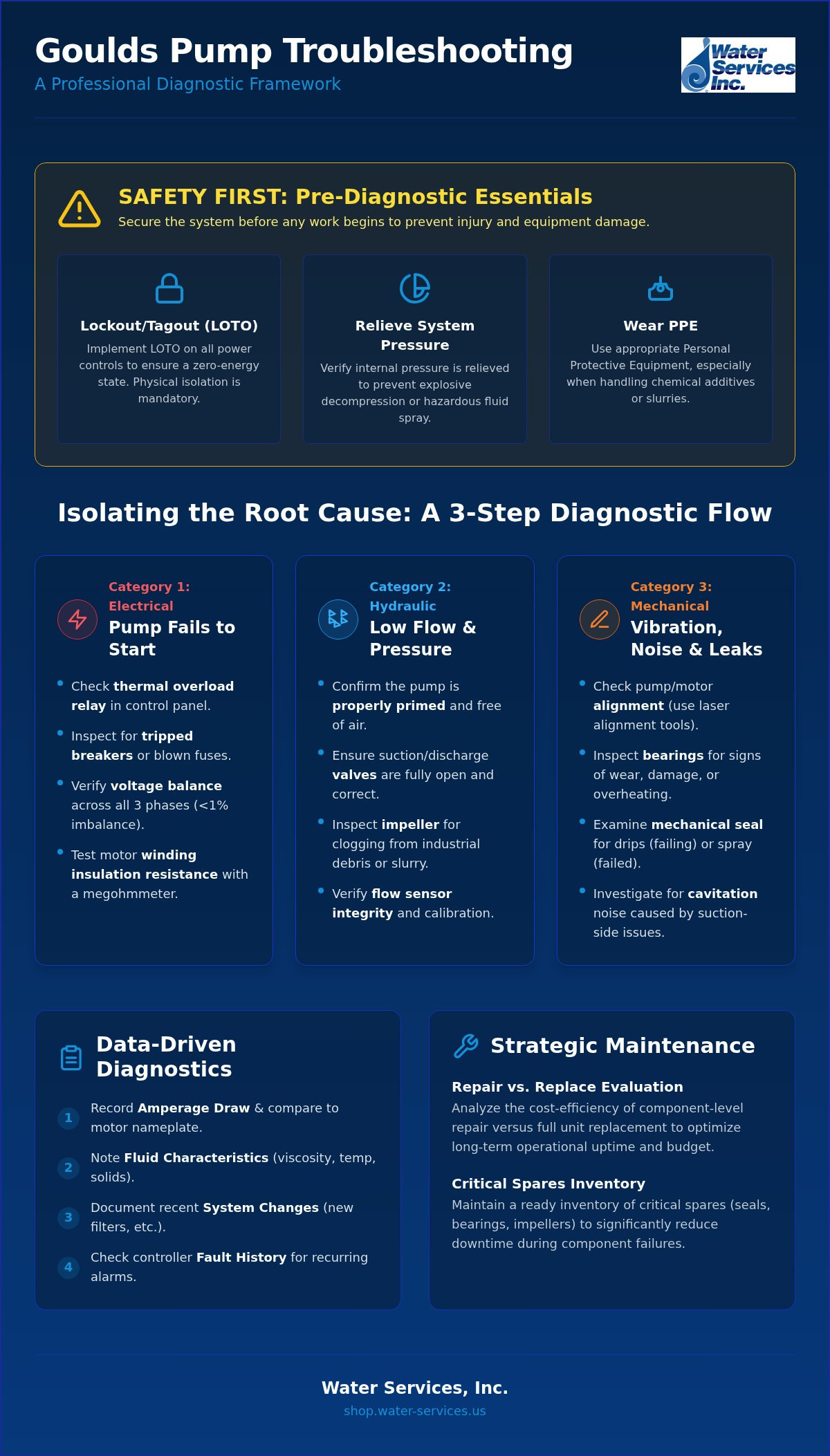
Industrial environments demand rigid adherence to safety protocols before any diagnostic work begins. High-voltage electrical components and high-pressure fluid systems present lethal risks if mishandled. Technicians must implement Lockout/Tagout (LOTO) procedures for all electrical power controls to prevent accidental motor startup. This Goulds pump troubleshooting guide emphasizes that physical isolation is the only way to ensure a zero-energy state. Don't rely on software-level stops alone when performing mechanical inspections.
Before loosening any pump casing bolts, technicians must relieve internal system pressure. Trapped pressure can cause explosive decompression or spray hazardous chemicals. Verify the fluid temperature to prevent thermal shock to the equipment or scalding injuries to personnel. Ensure all maintenance teams are equipped with appropriate personal protective equipment (PPE), especially when working with chemical additives or mining slurries. A deep understanding of Centrifugal pump principles is vital here; knowing how velocity translates to pressure helps technicians respect the stored energy within the volute.
Initial Visual Inspection Checklist
A thorough visual assessment often reveals the root cause before tools are applied. Start by checking for visible leaks at the mechanical seal or packing gland. Small drips may indicate a failing seal face, while significant spray suggests a catastrophic failure. Inspect Ashcroft pressure gauges for physical damage or signs of calibration drift. Ensure all suction and discharge valves are in the correct operating positions. A closed suction valve is a frequent but overlooked cause of cavitation and dry-run damage in Goulds 3196 or e-SV series pumps. Verify the integrity of all Signet flow sensors to ensure the data you're seeing in the control room matches physical reality.
Data Collection for Advanced Diagnostics
Precision diagnostics require baseline data. Record the current amperage draw using a calibrated multimeter and compare it to the motor nameplate specifications. High amperage often indicates mechanical binding or an over-tightened packing gland. Note the specific fluid characteristics, including viscosity, temperature, and solids content, as these directly impact pump performance. Document recent system changes carefully. The installation of new multimedia filter tanks or a recent RO membrane replacement can alter system head pressure. These changes often force the pump to operate outside its designed curve, leading to premature failure. If you're using an Aquavar IPC controller, check the fault history for recurring over-voltage or low-load alarms that might point to upstream power instability.
Diagnosing Goulds Pump Motor and Electrical Power Failures
Electrical failures often masquerade as mechanical issues in high-demand environments. Systematically isolating these faults is a core component of any Goulds pump troubleshooting guide. Begin by evaluating the status of the thermal overload relay within the control panel. If the relay has tripped, it indicates a high amperage draw that requires investigation before you attempt a reset. Check the electric power controls for tripped breakers or blown fuses. In industrial settings, three-phase motors are highly susceptible to phase loss or voltage imbalance. A voltage imbalance exceeding 1% can cause significant heat buildup and motor degradation. Use a digital multimeter to verify that voltage across all three phases is within nameplate specifications.
Testing the continuity of motor windings is the next step for deep diagnostics. Use a megohmmeter to check the insulation resistance. Low readings suggest that moisture, heat, or chemical exposure has compromised the winding insulation, necessitating a motor rebuild or replacement. For more data on optimizing these electrical interactions, the U.S. Department of Energy provides resources on Improving Pumping System Performance. Identifying these issues early prevents the total loss of the motor and reduces overall lifecycle costs.
Motor Fails to Start: Electrical vs. Mechanical Binding
Distinguishing between an electrical open circuit and a locked rotor condition is critical for safety and efficiency. If the motor hums but doesn't turn, it's likely a mechanical binding or a capacitor failure in single-phase units. Attempt to rotate the pump shaft manually while the system is de-energized. If the shaft is seized, the issue is likely a failed bearing or debris in the impeller. If the shaft turns freely, verify the control circuit voltage. Check the signal from the pressure switch or PLC to ensure the "start" command is reaching the motor starter. If parts are needed to restore operation, you can find authorized replacement components to minimize site downtime.
Frequent Tripping of Overload Protectors
Recurring trips usually signal that the pump is operating outside its design parameters. Analyze the system head to see if the pump is operating too far to the right on its performance curve. This occurs when discharge pressure is too low, causing the motor to work harder and draw excess current. Check for changes in fluid density or viscosity. Pumping a heavier slurry than the motor is rated for will cause immediate overheating. Finally, inspect the motor cooling fan and housing. Accumulated dust or industrial debris can insulate the motor, preventing heat dissipation and triggering the thermal protectors.
Solving Low Flow and Pressure Issues in Centrifugal Systems
Performance drops in heavy-duty centrifugal units often signal hydraulic inefficiencies rather than electrical faults. This Goulds pump troubleshooting guide focuses on the specific variables found in mining and large-scale water treatment where system resistance fluctuates. First, verify the pump prime. Air pockets in the suction piping are common after maintenance or system restarts. Even a small pocket can significantly reduce flow rates and lead to erratic pressure readings. Inspect the impeller for clogging from mining slurry or industrial debris. In high-solids applications, sediment builds up in the eye of the impeller, restricting volume and increasing mechanical load.
Assess the wear ring clearances to ensure internal recirculation is minimized. As these gaps widen due to abrasive wear, high-pressure fluid leaks back to the suction side, causing a sharp decline in discharge pressure. Cross-reference current discharge data with the original Goulds Water Technology Pumps performance curve to determine the extent of hydraulic loss. If the pump is operating significantly below its rated curve at a specific RPM, internal wear is the likely culprit.
Addressing Cavitation and Suction Lift Problems
Net Positive Suction Head (NPSH) is the critical margin between the pressure at the suction flange and the vapor pressure of the liquid. If NPSH available drops below the pump's required threshold, cavitation occurs. You'll recognize this by a distinct sound often described as "pumping marbles," accompanied by high-frequency vibration and pitted impellers upon inspection. To resolve this, clean all suction strainers and multimedia filter tanks to minimize friction loss in the intake line. Ensure the suction pipe diameter is at least one size larger than the pump suction flange to maintain low velocity and high pressure at the inlet.
Impact of Downstream Filtration on Pump Performance
Downstream components significantly impact pump load and longevity. Evaluate if fouled reverse osmosis membranes are creating excessive backpressure, forcing the pump to operate near shut-off head. Check for significant pressure differentials across sediment filters or within UV sterilizer chambers. In modular treatment plants, adjust VFD settings to compensate for variable head requirements as filtration media ages. These adjustments ensure the pump stays within its preferred operating range despite changing system resistance, preventing the motor from overworking or the pump from running dry.
Managing Excessive Noise, Vibration, and Mechanical Seal Leaks
Mechanical instability in industrial pumping systems often results from neglected installation tolerances. While previous sections of this Goulds pump troubleshooting guide focused on electrical and hydraulic variables, noise and vibration usually indicate physical degradation or misalignment. Verify the pump and motor alignment using laser alignment tools. Even minor offsets can cause rapid bearing failure and shaft fatigue. For those utilizing well systems, H2O Pump & Well Service LLC provides the professional drilling and installation services necessary to ensure that your equipment is correctly positioned from the outset. Inspect bearings for signs of wear, specifically monitoring for heat buildup or metallic grinding sounds. If you detect temperatures exceeding 180°F (82°C) on the bearing housing, the unit requires immediate service to prevent a locked rotor condition.
Similarly, for specialized wastewater and septic infrastructure, Texas Septic Solutions provides the expert installation and repair services required to ensure your commercial or residential systems remain fully operational.
Monitor the mechanical seal for steady dripping or signs of catastrophic failure. While a packing gland requires a controlled leak for lubrication, a mechanical seal should remain virtually leak-free. Check for "Water Hammer" effects in your industrial loops. Rapid valve closure creates pressure surges that can shatter seal faces and damage the pump volute. If you identify mechanical damage, you can source industrial-grade Goulds replacement parts to restore system integrity quickly.
Root Causes of Mechanical Seal Failure
Seal faces are highly sensitive to operating conditions. Analyze the impact of dry running on seal face integrity; even a few seconds of operation without fluid can cause thermal cracking. In mining wastewater applications, identify chemical incompatibility between seal elastomers and the process fluid. Abrasive solids are another primary failure mode. If your Goulds 3196 is handling slurry, ensure the seal chamber is properly flushed to prevent solids from scoring the delicate seal faces. These microscopic scratches eventually lead to visible leaks and environmental compliance issues.
Vibration Analysis and Foundation Integrity
Vibration is rarely a standalone issue. Inspect the pump baseplate for proper grouting and verify that all anchor bolts meet torque specifications. Loose mounting allows the pump to oscillate, creating a feedback loop of mechanical stress. Determine if the vibration is hydraulic or mechanical. Hydraulic vibration often occurs at the vane pass frequency, while mechanical vibration usually stems from an unbalanced impeller or bent shaft. Ensure all suction and discharge piping is independently supported. If the pump casing is supporting the weight of the piping, the resulting strain will distort the internal clearances and lead to premature failure of both the bearings and the seals.
Strategic Maintenance: When to Source Replacement Goulds Components
Determining the lifecycle limit of a centrifugal unit is a critical operational decision for maintenance managers. This Goulds pump troubleshooting guide facilitates this by identifying when component wear compromises the economic viability of a pump. Evaluate the cost-benefit of repairing an aging unit versus full replacement. If repair costs exceed 50% of a new unit's value or if the pump's energy consumption deviates significantly from modern efficiency benchmarks, a full upgrade is often the more sustainable choice. Upgrading to high-efficiency Goulds models allows you to reduce long-term operational expenditure while meeting the 2026 federal motor efficiency standards that favor electronically commutated motors (ECMs).
Maintain a critical spares inventory to minimize downtime in remote locations. This inventory must include mechanical seals, gaskets, and impellers specific to your model series. For complex installations, leverage Water Services, Inc. technical support for system commissioning. Professional oversight ensures the pump is operating at its best efficiency point (BEP) from the first hour of service. This proactive approach prevents common issues like shaft deflection and premature bearing wear often caused by improper initial setup or incorrect pipe strain management.
Sourcing Genuine Goulds Parts Globally
Sourcing genuine components is non-negotiable for critical industrial applications. Using "will-fit" or generic parts introduces risks such as inferior metallurgy and imprecise tolerances, which lead to accelerated wear and potential catastrophic failure. Authentic components are engineered to withstand the specific chemical profiles and pressure ratings of your installation. We facilitate the global distribution of authentic parts, ensuring that remote sites in Africa and South America maintain operational continuity despite harsh environmental conditions. View our full pumps collection to source components that meet the original equipment manufacturer's specifications.
Integrating Pumps into Modern Treatment Plants
Pumps serve as the backbone of mining wastewater treatment solutions, where they must handle fluctuating volumes and abrasive slurries. Prepare for future capacity requirements by selecting pumps with trimmed impellers, which offer the flexibility to increase flow as site demands grow. Modular design allows for rapid pump swap-outs in containerized systems. This approach ensures that even during a catastrophic failure, your water treatment process remains online with minimal interruption. By selecting pumps designed for modular integration, you simplify the logistics of maintenance and reduce the specialized labor required for field repairs.
Optimizing Industrial Pumping Reliability for 2026 and Beyond
Integrating a systematic diagnostic framework ensures that your industrial water systems remain compliant and efficient. This Goulds pump troubleshooting guide has outlined the critical steps for isolating motor failures, hydraulic inefficiencies, and mechanical wear. By prioritizing safety and using precision tools like laser alignment, you protect both your personnel and your long-term capital investments. You're now equipped to distinguish between repairable site issues and the need for full unit upgrades based on the latest performance standards.
Water Services, Inc. serves as an authorized Goulds Water Technology distributor specialized in high-performance modular water systems. We leverage global logistics expertise to deliver critical components to remote mining and industrial sites across Africa, South America, and the Middle East. If you're facing persistent downtime or need to upgrade to high-efficiency models, our technical support team is ready to assist with your system commissioning and parts selection. Browse Genuine Goulds Water Technology Pumps and Replacement Parts to secure your facility's operational uptime and performance metrics. Stay proactive with your maintenance to keep your systems running at peak efficiency.
Frequently Asked Questions
Why is my Goulds pump running but not pumping any water?
A loss of prime or a closed suction valve is the most common cause of this failure. Air trapped in the casing prevents the impeller from creating the necessary pressure differential to move fluid. Check the suction line for leaks and ensure the foot valve is operational. This Goulds pump troubleshooting guide recommends verifying that the suction lift doesn't exceed the pump's design capability.
How do I know if my Goulds pump mechanical seal is failing?
Look for steady dripping from the seal chamber or visible moisture around the shaft sleeve. A failing seal often leaves a crusty residue of dried process fluid or chemical additives on the pump baseplate. If you notice a sudden increase in bearing temperature or a drop in discharge pressure, the seal faces may be scored or thermally cracked from dry running.
What causes a Goulds pump motor to trip the circuit breaker repeatedly?
This usually indicates an over-amperage condition caused by mechanical binding or an electrical phase imbalance. If the pump is operating too far to the right of its performance curve, the motor works harder and draws more current than the nameplate rating. Inspect the control panel for loose connections or failing contactors that create high resistance and heat within the circuit.
How can I tell if my centrifugal pump is cavitating?
Cavitation produces a distinct sound similar to pumping marbles or gravel through the system. You'll also observe erratic pressure gauge readings and high-frequency vibration that can damage internal components. This occurs when the Net Positive Suction Head available (NPSHA) is lower than the pump's requirement. Check for clogged suction strainers or excessively high fluid temperatures that increase vapor pressure.
Can I replace a Goulds pump impeller without disconnecting the piping?
Yes, provided your model features a back pull-out design like the Goulds 3196 process pump. This configuration allows technicians to remove the entire power end and impeller assembly while the casing remains bolted to the system piping. It significantly reduces maintenance hours and prevents the need to realign heavy industrial piping during a routine impeller swap or seal replacement.
What is the standard maintenance schedule for industrial Goulds pumps in 2026?
Perform monthly vibration analysis and bearing temperature checks to establish a performance baseline. Semi-annually, verify the pump-to-motor alignment and inspect the mechanical seal for signs of weeping. By 2026, new efficiency standards require closer monitoring of motor performance. Ensure you're documenting amperage draw to detect internal wear or hydraulic degradation before a catastrophic failure occurs at your site.
Why is my pump making a loud rattling noise during operation?
A rattling noise often points to a loose impeller, failing bearings, or severe cavitation issues. If the sound is metallic and rhythmic, the bearings are likely reaching the end of their service life and require immediate replacement. If the noise is intermittent, check for large debris trapped in the volute or loose mounting bolts that allow the pump to vibrate against the baseplate.
Does Water Services, Inc. provide technical support for Goulds installations in remote areas?
Water Services, Inc. provides specialized technical support for Goulds installations in remote industrial and mining sites globally. We assist with system commissioning and complex troubleshooting via our international logistics networks. Our expertise covers modular systems in harsh environments, including Africa and the Middle East, ensuring your equipment meets the rigorous performance metrics required for continuous industrial operation.
0 comments