

Could a finer sediment filter leave your system with less usable flow and more frequent maintenance? That’s why how to choose the right sediment filter involves more than reading the micron rating on the label. The rating helps indicate particle size, but selection also depends on the solids entering the system, required flow, and how the filter will be serviced.
A suitable filter captures the particles you need removed without clogging too quickly or restricting operation. This guide explains how to assess sediment load and particle characteristics, interpret micron ratings, and compare cartridge filters with multimedia filter tanks against your system requirements. You’ll also learn which operating details matter when matching a cartridge to its housing, so your selection supports reliable filtration and a maintainable treatment setup.
Key Takeaways
- Start with the sediment your system needs to remove and the filter’s purpose, such as protecting downstream equipment.
- Compare micron rating alongside flow demand, pressure drop, construction, and service conditions rather than choosing by rating alone.
- Learn how to choose the right sediment filter by weighing cartridge and multimedia options against solids loading, footprint, and maintenance needs.
- Use a practical selection checklist to organize water analysis, operating conditions, and housing compatibility before narrowing your options.
- Set filter service criteria using system performance data and manufacturer guidance, not a one-size-fits-all replacement schedule.
How to Choose the Right Sediment Filter: Start with What the Water Contains
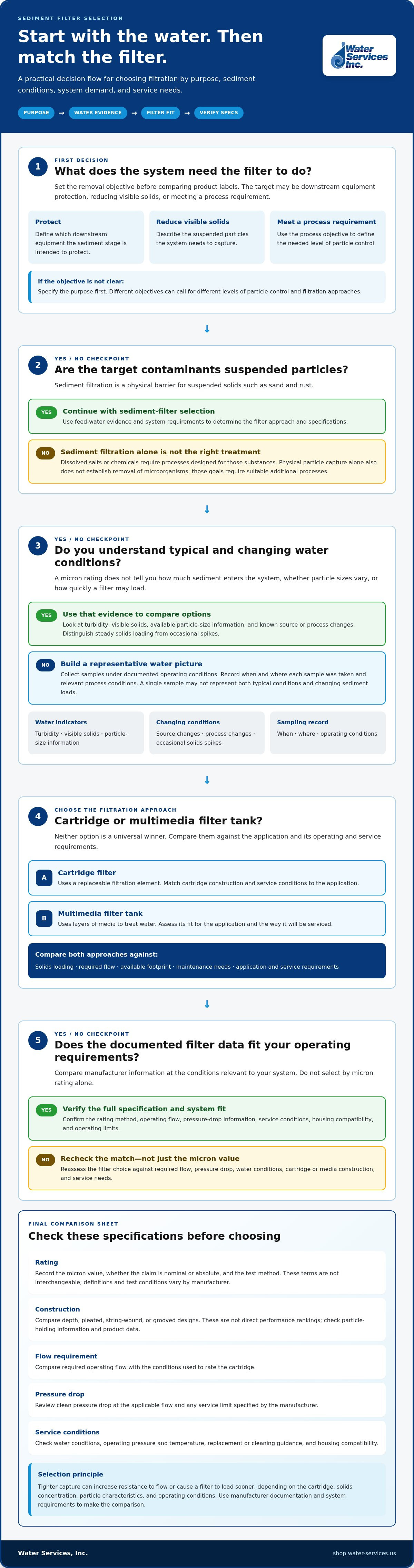
A sediment filter is a physical barrier that captures suspended particles as water passes through it. First define what the system needs to achieve: protect downstream equipment, reduce visible solids, or meet a process requirement. Each objective can call for a different level of particle control and filtration approach.
Start with the feed water, not a label. A cartridge’s micron rating doesn’t tell you how much sediment enters the system, whether particle sizes vary, or how quickly the filter may load. Those details affect equipment selection, operating performance, and maintenance planning. They also help distinguish sediment filtration from treatment for dissolved contaminants. Sand, rust, and other suspended solids may be captured physically; dissolved salts or chemicals require processes designed for those substances.
Which water conditions should you identify first?
Build a picture of typical and changing water quality. Record turbidity, visible solids, available particle-size information, and known changes in the source or process. Distinguish steady solids loading from occasional spikes, such as those following a source-water change or operating event. A single sample may not represent both conditions.
Collect samples under documented, representative operating conditions. Record when and where each sample was taken and note relevant process conditions. This gives you a more useful basis for comparing filtration options than an isolated observation or product label.
What a sediment filter can, and cannot, do
A sediment filter targets suspended particles. Physical particle capture alone does not establish removal of dissolved chemicals or microorganisms. Those treatment goals require suitable additional processes. A sediment stage can help protect downstream equipment when the system is designed for that role, but effectiveness depends on water conditions and operating requirements.
Filtration options also differ in how they capture solids. Cartridge filters use a replaceable filtration element, while multimedia filtration uses layers of media to treat water. The multimedia filtration overview describes this general principle. The appropriate approach depends on the application and its service requirements. For a broader look at treatment technologies, see industrial water filtration systems.
In short, how to choose the right sediment filter begins with defining the removal objective and understanding the feed water. That evidence provides a sound basis for comparing filter specifications and system fit.
Compare Sediment Filter Specifications: Micron Rating, Flow, and Pressure Drop
A micron rating is only one part of a filter specification. To compare options, evaluate the rating method alongside cartridge construction, required flow, clean and loaded pressure drop, and service conditions. “Nominal” and “absolute” are not interchangeable terms. Nominal generally describes a filter’s stated capture performance under a specified test method, while absolute indicates a more stringent capture claim defined by the manufacturer’s test method. Definitions and test conditions vary, so use product documentation rather than assuming a universal meaning.
Match stated particle-capture performance to the downstream protection or process objective. A micron rating alone doesn’t establish removal of every particle at that size, nor does it indicate performance for dissolved substances. Tighter capture can increase resistance to flow or cause a filter to load sooner, depending on the cartridge, solids concentration, particle characteristics, and operating conditions.
How should you compare filter specifications?
Use a consistent comparison sheet. Enter values from the relevant manufacturer documentation, and treat any example rating or flow value as application-specific rather than a system-wide recommendation.
| Specification | What to compare | Why it matters |
|---|---|---|
| Rating | Micron value, nominal or absolute claim, and test method | Shows how the stated capture performance relates to the target particle size. |
| Construction | Depth, pleated, string-wound, or grooved design | Construction affects how particles are captured and held. Confirm capacity and intended service conditions in the product data. |
| Flow requirement | Required operating flow and the conditions used to rate the cartridge | Helps establish whether the filter can meet system demand without relying on an unmatched rating. |
| Pressure drop | Clean pressure drop at the applicable flow, plus any service limit specified | Provides a basis for assessing resistance and monitoring performance as the filter loads. |
| Service conditions | Water conditions, operating pressure and temperature, and replacement or cleaning guidance | Confirms the cartridge’s fit with actual system operation and maintenance practices. |
How do construction and pressure drop affect fit?
Depth cartridges capture particles within the filter structure; pleated designs use a folded surface; string-wound cartridges use wound layers; and grooved cartridges have a shaped surface. These categories aren’t direct performance rankings. Compare the specific cartridge’s particle-holding information and pressure-drop data at the intended flow. Verify housing compatibility and operating limits before selection.
When comparing water treatment equipment, use these operating requirements to assess filtration components. This is the practical basis for how to choose the right sediment filter: weigh documented capture performance against flow, pressure drop, and service needs, then confirm each figure against the manufacturer’s specifications.
Sediment Filter Types Compared: Cartridge Filters or Multimedia Filtration?
Cartridge filters and multimedia filter tanks are distinct system options, not simply different sizes of the same device. A cartridge uses a replaceable element inside a housing. A multimedia tank passes water through a bed of selected filter media and may use backwashing as part of its service method. The right fit depends on feed-water conditions, solids loading, flow demand, available space, and how the system can be maintained.
When might a cartridge sediment filter fit the application?
A cartridge can be practical when the system is designed around a compatible housing and operators can access the element for inspection and changeout. Its modular format may suit a treatment train that uses a replaceable filter stage. However, frequent loading can mean more service interruptions and replacement work. Consider these operating factors together:
- Solids loading: Estimate how quickly particles accumulate under normal conditions and during spikes.
- Flow demand: Compare the required operating flow with the cartridge and housing specifications.
- Access: Allow enough room and safe access to isolate the housing and remove the element.
- Service plan: Consider how often inspection or changeout may be needed based on actual operating data.
Replacement sediment filters and Pentair filter housings are available as product categories. Match compatibility, operating limits, and performance to the particular cartridge and housing documentation. Don’t assume that a cartridge’s physical fit alone establishes its suitability for the system.
When should multimedia filtration be evaluated?
Evaluate a multimedia filter tank when the process design calls for a media bed and the site can support its operating requirements. Selection involves more than the tank: system flow, media choice, backwash supply and discharge arrangements, controls, and available footprint all affect fit. Account for how backwashing may interact with plant operation and whether the required service resources are available.
Neither approach is automatically better. A cartridge may simplify element replacement in a suitable setup, while a multimedia tank requires planning for its media bed and service method. Compare expected solids load and process duty against the complete system design, not just the initial equipment footprint or product category label.
That system-level comparison is central to how to choose the right sediment filter. Review water treatment equipment alongside your operating requirements, and use product documentation to verify specifications before selecting a cartridge or multimedia filtration approach.
A Practical Sediment Filter Selection Checklist for Your Water System
Turn water-quality information and filter requirements into a documented selection. Comparing candidates on the same basis helps reveal compatibility issues before installation.
What operating data should you gather before sizing?
Record minimum, normal, and peak flow in consistent units, and note the operating conditions for each reading. Document inlet pressure, water temperature, source, available water-analysis results, and process changes that could affect solids loading. Include service constraints such as changeout access, available maintenance time, and whether backwashing is practical for a media system.
- Define the objective. Specify which downstream equipment or process needs protection and what particle-removal outcome is required.
- Characterize the feed water. Gather representative analysis and observations of turbidity, visible solids, and particle-size information. Note whether solids loading is steady or varies with source or process conditions.
- Set the operating envelope. Record minimum, normal, and peak flow, inlet pressure, and temperature. Keep units and sampling conditions consistent.
- Establish acceptance criteria. Identify the required particle capture and the pressure drop the system can tolerate, using process requirements and equipment limits.
- Compare options and verify fit. Review cartridge or multimedia filter candidates against the operating data, then confirm compatibility and service requirements using product documentation.
How do you confirm a candidate filter fits the system?
Check physical and operating compatibility, not just the filtration claim. For a cartridge, verify housing dimensions and connections, along with materials and operating limits stated by the manufacturer. Compare clean pressure-drop data at the relevant flow with the system’s acceptable pressure drop. Identify the manufacturer’s terminal pressure-drop or service criteria, and don’t substitute an assumed threshold.
| Application condition | Technical evaluation question |
|---|---|
| Peak flow differs from normal operation | Does the candidate’s documented flow performance suit the full operating range? |
| Feed water has variable or heavy solids loading | How could loading affect service frequency, pressure drop, and maintenance access? |
| Particle capture is process-critical | Does the rating method and supporting documentation meet the stated objective? |
| Existing cartridge housing will remain in service | Do dimensions, connections, materials, and operating limits match the housing and system? |
| A multimedia tank is under consideration | Can the process support its media selection, flow conditions, and backwash arrangements? |
Use the same evidence to compare each option. This is how to choose the right sediment filter without relying on a label alone. For wider process context, review industrial water filtration technology alongside the system’s operating requirements.
Operate and Maintain a Sediment Filter for Reliable System Performance
Filter performance depends on more than the initial selection. A maintenance plan based on operating data can help identify loading trends and schedule service before pressure loss interferes with the process. Use the filter and system manufacturer’s guidance to set criteria rather than applying a universal replacement calendar.
How can you monitor clogging and plan filter service?
If the system design supports it, monitor pressure before and after the filter. The difference between those readings is differential pressure. A rising differential pressure can indicate increasing resistance as solids collect, but interpret it alongside flow and operating conditions. A change in flow, for example, can also affect pressure readings.
Use suitable instrumentation and keep a consistent operating log. Record:
- Inlet and outlet pressure, or differential pressure, at comparable operating conditions.
- Flow rate and operating hours when readings are taken.
- Changes in source-water conditions or solids loading.
- Cartridge inspections, replacements, and any process effects observed.
Review these records to identify patterns and set service thresholds using verified equipment guidance and process requirements. Follow specified terminal pressure-drop criteria where provided. If the filter loads faster after a source-water or process change, investigate the cause instead of relying on the previous service interval.
How does sediment filtration fit into a treatment train?
A sediment stage may be installed upstream of other treatment equipment when the system is designed for that role. Removing suspended particles can support downstream operation, but the benefit depends on the complete treatment design, feed-water conditions, and equipment requirements. Sediment filtration does not replace processes intended for other treatment objectives.
Carbon filtration, ultraviolet treatment, and reverse osmosis address different treatment needs. Consider their placement and operating requirements as part of the overall system design, rather than assuming them from the presence of a sediment filter. A system diagram can clarify which stage handles suspended solids and what each downstream process is intended to treat.
Organize your flow, pressure, temperature, water-analysis, and service records, then compare compatible filtration components against those operating conditions. Explore water-treatment filtration components to review relevant options. This turns how to choose the right sediment filter into an ongoing, evidence-based decision, from selection through maintenance.
Make Your Filter Selection Fit the System
Reliable sediment filtration starts with representative water data and a clear treatment objective. Use the target particle capture to assess micron rating, then compare flow requirements, pressure drop, filter construction, and service conditions. Cartridge filters and multimedia filter tanks serve different system designs, so weigh solids loading, available space, and maintenance needs before choosing an approach. Manufacturer specifications should guide decisions on performance and compatibility.
That’s the practical answer to how to choose the right sediment filter: match the equipment to actual operating conditions, then use performance records to guide maintenance. Water Services, Inc. supports industrial water-treatment projects and equipment selection, with replacement sediment and carbon filters, Pentair filter housings, and Harmsco filtration products among its offerings. Compare water-treatment filtration components to explore options for your system.
Frequently Asked Questions
How do I choose the right micron rating for a sediment filter?
Choose a micron rating by defining the particle-removal objective and the downstream equipment that needs protection. A lower rating generally indicates finer capture only when compared under equivalent rating methods. Nominal and absolute claims aren’t interchangeable; use their definitions and test conditions as stated in product documentation. Finer capture can increase pressure drop or shorten service life, so compare the rating with flow, solids loading, and verified manufacturer specifications.
Is a higher micron rating better for a sediment filter?
No, a higher micron rating isn’t inherently better. A higher number generally refers to larger particles, while a lower number indicates finer capture when ratings use comparable methods. The appropriate choice depends on the target particles, required flow, solids loading, and downstream equipment. Compare documented rating methods and operating data rather than choosing by the number alone, and confirm that the selected filter meets the process objective.
What is the difference between a sediment cartridge and a multimedia filter?
A sediment cartridge is a replaceable filter element installed in a compatible housing, while multimedia filtration uses a bed of selected media in a filter tank. The cartridge’s service method involves inspecting or replacing the element; a media bed has its own operating and service requirements, which may include backwashing. Compare system design, flow needs, solids loading, footprint, and maintenance resources. Neither option is universally preferable; the process and operating conditions determine which to evaluate.
How do I know when a sediment filter needs to be replaced?
Replacement timing depends on solids loading, flow, and operating conditions, so there’s no universal schedule. Monitor differential pressure or other indicators specified for the system, and log readings alongside flow conditions and service history. Follow the filter and system manufacturer’s guidance for service thresholds. A sustained change in pressure or overall system performance should prompt a review of operating data and filter condition before setting the next service interval.
Can a sediment filter remove dissolved contaminants?
A physical sediment filter is designed to capture suspended particles within its documented capability, not to provide general treatment for dissolved contaminants. Dissolved substances are present in the water rather than as suspended particles, so treating them requires a process suited to the specific contaminant and objective. Use water analysis to identify treatment needs, then select appropriate processes based on that evidence and the requirements of the complete system.
What information do I need to size an industrial sediment filter?
Gather the minimum, normal, and peak flow range, inlet pressure, temperature, water analysis, particle characteristics, solids loading, and operating schedule. Include service constraints and the acceptable pressure drop for the process. For cartridge systems, check housing compatibility as well. Use representative water and operating data, then compare them with manufacturer specifications. Don’t size from a nominal flow or micron figure in isolation, since neither describes the complete system duty.
Does a sediment filter reduce water pressure?
A sediment filter creates pressure drop as water passes through it, but the amount depends on filter design, flow, solids loading, and operating conditions. A loaded filter may have a different pressure drop from a clean one. Review the manufacturer’s documented performance for the relevant operating conditions and monitor pressure as the system is designed to do. Don’t assume a single pressure-loss value applies to every installation.
0 comments