

What if the cleaner chosen to restore flow is mismatched to the foulant? Membrane cleaning chemical selection starts with identifying what has accumulated on the membrane and matching the chemistry to that deposit. CIP, or clean-in-place, means cleaning the membrane within its system rather than removing it for cleaning. Alkaline cleaners are generally used for organic fouling and biofilm, while chelating agents can help address deposits containing metals.
Choosing the right membrane cleaning chemical matters because it must act on the foulant without damaging the membrane or other wetted materials. This guide explains how to identify common foulants, when alkaline cleaners and chelating agents may be relevant, and how cleaning can help restore flow and water quality. It also outlines signs that may indicate cleaning is needed and factors to consider when planning a clean-in-place (CIP) procedure.
Key Takeaways
- Match cleaner chemistry to the foulant: alkaline formulations suit organic deposits and biofilm, while mineral and metal-bound deposits call for a different approach.
- Track normalized flow, pressure drop, and product quality to recognize when fouling may warrant cleaning.
- Account for membrane and system-material compatibility, cleaning conditions, and rinse quality when planning a CIP procedure.
- Explore how Water Services’ water treatment antiscalants and chemicals and reverse osmosis membrane offerings fit into membrane treatment decisions.
Alkaline cleaners for organic fouling and biofilm
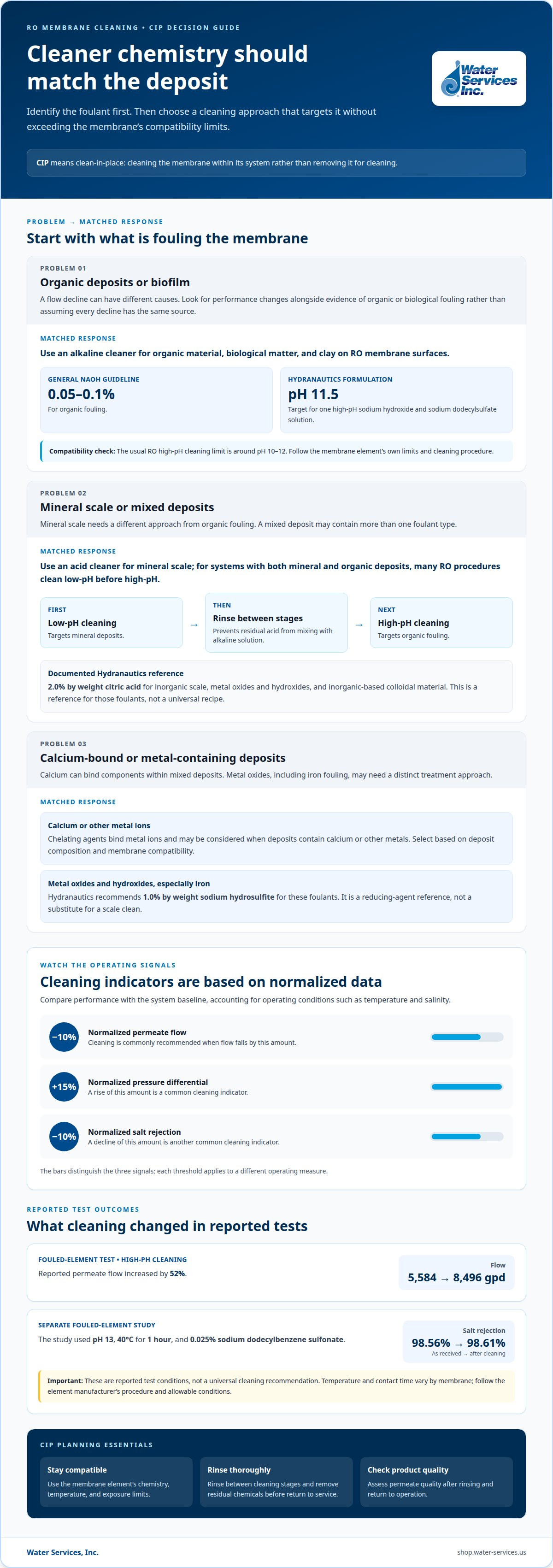
For organic or biological fouling, use an alkaline cleaner; a general guideline gives sodium hydroxide at 0.05-0.1%, while Hydranautics targets pH 11.5 for one high-pH formulation. No single temperature or contact time applies to every membrane: a reported test used 40°C for one hour, which is an example, not a universal recommendation.
Identify Organic Fouling and Biofilm
- Identify the likely deposit. Alkaline cleaning targets organic material, biological matter, and clay on RO membrane surfaces. Look for performance changes alongside evidence of organic fouling or biofilm; don’t assume every flow decline has the same cause. Mineral scale calls for a different cleaning approach, so matching the chemistry to the deposit is essential.
- Choose the cleaning stage. For systems with both mineral and organic deposits, many RO cleaning procedures use low-pH cleaning before high-pH cleaning. Rinse between stages to prevent residual acid from mixing with the alkaline solution. This sequence addresses distinct foulant types rather than treating every deposit with one cleaner.
Set Alkaline Cleaning Conditions
- Set pH and concentration within membrane limits. High-pH cleaning is generally used for organics and biofouling, with the usual RO cleaning limit around pH 10-12. A general sodium hydroxide concentration guideline for organic fouling is 0.05-0.1%; Hydranautics gives a target pH of 11.5 for its high-pH sodium hydroxide and sodium dodecylsulfate solution. Follow the membrane element’s compatibility limits.
- Control temperature and contact time. Use the element manufacturer’s cleaning procedure, since the reported 40°C, one-hour test does not establish a standard for every membrane. Keep temperature and exposure within the element’s allowable operating conditions. After cleaning, rinse the system thoroughly to remove residual chemicals before returning it to service.
A fouled-element study used pH 13 at 40°C for 1 hour, with 0.025% sodium dodecylbenzene sulfonate; salt rejection was 98.56% as received and 98.61% after cleaning.
Benefits of membrane cleaning for flow, water quality, and equipment life
Use normalized operating data to judge cleaning outcomes, not flow alone. In a reported fouled-element test, high-pH cleaning raised flow from 5,584 gpd to 8,496 gpd, a 52% increase.
- Track normalized performance. Compare permeate flow, pressure drop, and water quality against the system’s baseline, accounting for operating conditions such as temperature and salinity. Cleaning is commonly recommended when normalized permeate flow falls by 10%, normalized pressure differential rises by 15%, or normalized salt rejection falls by 10%. These indicators help identify fouling before performance declines further.
- Assess water quality after cleaning. Check permeate quality after the rinse and return to operation. A quality rinse helps product water return within acceptable operating conditions. For a membrane system with an SDI value between 3 and 5, check feedwater quality as well; cleaning the membrane surface cannot correct an upstream water-quality problem. Review the feed and pretreatment stages, including any carbon filtration, when performance remains outside the operating target.
- Apply practical chemical safety controls. In the United States, base handling precautions on the chemical label, its safety data sheet, and the membrane manufacturer’s procedure. Use compatible protective equipment, prevent unintended chemical mixing, and contain cleaning and rinse solutions for appropriate handling. The applicable controls depend on the chemical, the worksite, and how spent solution is managed. These steps support safe cleaning without exposing the membrane to incompatible chemistry.
- Calculate dose before estimating cost. Determine the cleaning-solution volume from the system configuration, then calculate chemical quantity using the required concentration. Fouling type, severity, and membrane compatibility guide that concentration. Cost depends on the chosen chemical and the amount needed for the cleaning volume; avoid estimating from membrane area alone. Where cleaning chemicals and water-treatment products are part of the same process review, water-treatment products are a relevant category to consider.
Chelating agents and calcium-bound foulants
For reverse osmosis membranes, match the cleaner to the deposit: acids target mineral scale, alkaline cleaners target organic fouling, and reducing agents can address some metal oxides. Chelating agents bind metal ions and may be considered for deposits containing calcium or other metals. The right choice depends on the foulant’s composition and compatibility with the membrane.
- Determine whether calcium is part of the deposit. Distinguish calcium-associated scale from organic material or metal oxides before selecting a chelating cleaner. Calcium can bind components within mixed deposits, so identifying the foulant helps avoid relying on a chemistry that addresses only one part of the problem. Use changes in permeate flow and quality alongside process evidence.
- Match mineral scale with an appropriate acid cleaner. Hydranautics specifies a 2.0% by-weight citric acid solution for inorganic scale, metal oxides and hydroxides, and inorganic-based colloidal material. This formulation provides a documented reference for those foulants, not a universal recipe. Apply the membrane manufacturer’s compatible cleaning procedure.
- Separate iron fouling from calcium scale. Hydranautics recommends sodium hydrosulfite at 1.0% by weight for metal oxides and hydroxides, especially iron fouling. Don’t treat that reducing solution as a substitute for a scale cleaner. Selecting by deposit type helps target the foulant without combining chemicals unnecessarily.
- Plan for mixed foulants in stages. If deposits include both mineral scale and organic matter, use a staged cleaning approach rather than assuming one chemical will remove everything. Separate cleaning stages with rinsing, and follow the element’s compatible sequence. This limits carryover between chemistries and helps assess which deposit responds to each treatment.
- Review results after each cleaning stage. Compare normalized operating data before and after treatment. If permeate performance improves after one chemistry but remains impaired, another foulant may still be present. Avoid increasing concentration or contact time without manufacturer limits; cleaning conditions must suit the membrane and wetted materials.
Technical support and membrane treatment products
Connect membrane condition, cleaning chemistry, and pretreatment when evaluating a fouling problem. The right chemical depends on the foulant, membrane material, and compatibility with wetted components.
- Set a performance trigger. Review normalized permeate flow, product quality, and pressure drop together. Hydranautics recommends cleaning before normalized flow or quality decreases by 10%, or normalized pressure drop increases by 15%. Normalization accounts for operating changes such as temperature and salinity, helping separate fouling from routine process variation.
- Confirm material compatibility. Identify the membrane type and wetted materials before choosing a cleaning solution. Halogen-based oxidants, including chlorine, chlorine dioxide, and bromine, are not allowed for composite polyamide reverse osmosis membranes. Hydranautics describes pH 4 to 10 as a gentle cleaning range and pH 2 to 12 as the harshest range.
- Investigate persistent performance loss. Chemical cleaning is appropriate when physical methods cannot remove fouling. If the foulant remains unclear, a membrane autopsy can identify deposits on the membrane surface and inform the removal strategy. This helps distinguish deposits requiring different treatment from damage that cleaning cannot resolve.
- Adjust the cleaning procedure as a system. Optimize chemistry, contact time, temperature, and mechanical action together. Hydranautics recommends the shortest chemical contact time needed to optimize membrane life. Keep cleaning pressure low and follow the element manufacturer’s limits; excessive pressure or incompatible conditions can damage sensitive membrane materials.
- Address recurring fouling upstream. Review feedwater quality and pretreatment when the same deposits return after cleaning. Antiscalant use, filtration, and operating conditions can affect what reaches the membrane and how deposits form. Match each water treatment measure to the feed and identified foulant, then monitor normalized performance after changes.
Hydranautics advises contacting its technical department when phosphate in the RO feed is 5 ppm or higher. Select cleaning chemicals and concentrations according to the type and intensity of fouling and their compatibility with the membrane and wetted materials in the membrane unit. A membrane cleaner should be low in aggressiveness toward different membrane materials while providing effective cleaning activity.
Acid cleaning in an RO plant generally dissolves mineral scales or metals on the membrane system. For RO membranes fouled by wastewater treatment plant effluent, an individual NaCl cleaning solution without pH adjustment achieved 65% cleaning efficiency; after increasing the pH of an NaCl cleaning solution, cleaning efficiency reached 94%.
Water Services: Water Treatment Antiscalants and Chemicals
Water Services, Inc. supplies water treatment antiscalants and chemicals for membrane-system treatment. Consider antiscalants when scale forms during operation, and cleaning chemicals when deposits are already present. Antiscalants help control scale formation but do not replace a cleaner selected for existing deposits. Keep these roles distinct when planning treatment.
For reverse osmosis projects, Water Services, Inc. also offers FilmTec Reverse Osmosis Membranes. Membrane material and operating conditions inform compatible cleaning choices, so include them in the treatment decision. Review the foulant, system performance, and membrane requirements together before selecting chemicals.
Turn cleaning decisions into a maintenance plan
Use each cleaning cycle to inform the next maintenance decision. Record the foulant diagnosis, chemistry used, operating conditions, rinse results, and normalized performance after restart. These records can help reveal recurring feedwater or operating issues and distinguish them from a one-off fouling event. This makes membrane cleaning chemical selection part of a broader treatment plan, not just a response to reduced output.
Water Services, Inc. offers Goulds Water Technology Pumps, Viqua UV Water Purification Systems, and FilmTec Reverse Osmosis Membranes for water-treatment systems. If you’re reviewing membrane products or treatment equipment alongside your cleaning approach, contact Water Services, Inc. for product support. Bring the membrane type, observed performance changes, and suspected foulant into the discussion so the next step can focus on your system’s needs.
A consistent maintenance record gives your team a clearer basis for action. Document the process and what changes, then use those findings to guide the next operating decision.
Frequently Asked Questions
What Is Membrane CIP?
Membrane CIP, or clean-in-place, means cleaning membrane elements within the system instead of removing them. In reverse osmosis systems, the procedure may include a pre-rinse, separate chemical cleaning stages, intermediate rinses, and a final rinse. The cleaning solution circulates through the membrane flow path. The sequence and operating conditions must follow the element manufacturer’s instructions.
What can I do to prevent biofouling?
Reduce the conditions that allow microbial growth to accumulate on the membrane. Maintain effective pretreatment, monitor feedwater changes and normalized system performance, and address developing fouling before deposits mature into biofilm. Biocides may be used alongside cleaning procedures to control microbial growth. Select any biocide and its use conditions for compatibility with the membrane and treatment process.
Which cleaning chemicals are compatible with RO, NF, UF, and MF membranes
There is no single cleaner compatible with all RO, NF, UF, and MF membranes; choose chemistry based on the foulant and the membrane and wetted materials. For composite polyamide RO membranes, halogen-based oxidants are not allowed; cellulose acetate membranes have a stated cleaning pH range of 3-8. Follow the element manufacturer’s compatibility limits.
0 comments