

Horsepower alone won’t size a commercial sump pump correctly. Sizing a sump pump for a commercial building starts with the required flow rate and total dynamic head, then uses the pump’s performance curve to confirm it can deliver that flow at the calculated head. A sump basin that fills in under 60 seconds during heavy rain signals significant water intrusion and a need for greater pumping capacity.
Building conditions matter as much as pump capacity. Inflow, liquid type, vertical lift, pipe length and diameter, fittings, and discharge destination all affect pump selection. A pump that cannot keep pace with incoming water risks flooding, while a mismatch between the pump and system conditions can cause inefficient operation.
This guide explains how to establish design flow, calculate head losses, and use a performance curve before selecting horsepower. It also covers how water conditions and building use affect requirements, helping you narrow the options to equipment suited to the commercial application.
Key Takeaways
- Establish the application and incoming-water conditions first, including whether the liquid is clean groundwater or raw, unfiltered waste.
- Account for vertical lift, pipe dimensions, discharge length, and fittings when working out the head the pump must overcome.
- Use the performance curve to assess the pump’s flow at the system’s operating head, rather than choosing by horsepower alone.
- Consider how building conditions and basin capacity affect pump requirements, especially where water intrusion changes during heavy rain.
Sump pump horsepower and flow-rate selection
Size the pump for incoming flow and required head, not horsepower alone. The steps below connect building conditions to pump capacity and backup requirements.
- For commercial sump pump sizing, applicable building, plumbing, and electrical codes depend on the jurisdiction and installation. Confirm local requirements for the project. For contractors and maintenance teams looking to broaden their practical trade capabilities across building and plumbing installations, YTA Training provides hands-on, multi-skill construction courses. No single horsepower, voltage, or phase suits every commercial application. Required flow, head, and available electrical service determine the selection. Alarms, backup power, and scheduled inspections can help identify or manage failures. Include checks of pump operation, float movement, and alarm function in the maintenance plan.
-
Assess Required Pump Flow Capacity
Measure inflow over time, then select a pump that moves water faster than it enters the basin. Compare rated capacity at the actual vertical lift, because flow falls as lift increases. At a 10-foot lift, listed capacities are 1,400 GPH for a 1/4-horsepower pump, 2,200 GPH for 1/3 horsepower, and 3,200 GPH for 1/2 horsepower. Don’t size from a low-lift rating alone.
-
Match Horsepower to Flow Capacity
Match horsepower to the required flow at operating head, then confirm the pump curve supports that duty point. Horsepower indicates motor power, but it doesn’t state delivered capacity by itself. At 15 feet of lift, listed 1/4-, 1/3-, and 1/2-horsepower capacities are 800, 1,500, and 2,400 GPH, respectively. These examples show why lift and flow must be considered together.
- Size backup equipment against required flow, vertical lift, and desired runtime. At a 10-foot vertical lift, the 30AC Series is listed for up to 45 GPM, the 35AC Series up to 55 GPM, and the 55AC Series up to 65 GPM. Select by the system’s demand, not by model rating alone. An undersized backup may not keep pace with inflow.
Residential and commercial pump applications
Match the pump and basin to the building’s use, installation conditions, and water-management needs. Residential sizing examples can provide a point of comparison, but they do not replace application-specific selection for commercial or municipal sites.
-
Compare Commercial and Residential Applications
Separate the building’s application from residential sizing assumptions before selecting equipment. A 1/3 HP sump pump is typically needed for an average home, but commercial and municipal systems can face different inflow patterns, basin requirements, and operating demands. For sizing a sump pump for a commercial building, define the actual use and site conditions first. Don’t treat a residential horsepower rating as a universal commercial specification.
-
Choose a Submersible or Pedestal Pump
Choose the pump configuration to suit the sump layout and access requirements. A submersible pump operates in the basin, while a pedestal pump places its motor above it. Compare available space, inspection access, and exposure to water. The right choice depends on the installation and required performance, not just the building type. Configuration is part of sizing a sump pump for a commercial building because it must suit site conditions.
- Assess basin capacity alongside pump selection. Commercial applications or homes with extreme water issues are listed with a sump basin of 30 gallons or larger. Basin volume provides temporary storage as water enters, but it doesn’t replace adequate pumping capacity. Consider how the basin and pump work together to manage incoming water; basin size alone doesn’t establish the required pump duty.
- Document the application, basin configuration, and operating conditions as one selection brief. That information distinguishes commercial requirements from residential examples and supports a suitable equipment match. For a commercial installation, review pump options alongside the system’s defined requirements. Select a pump type that suits both the installation space and intended use.
Selecting a pump from its performance curve
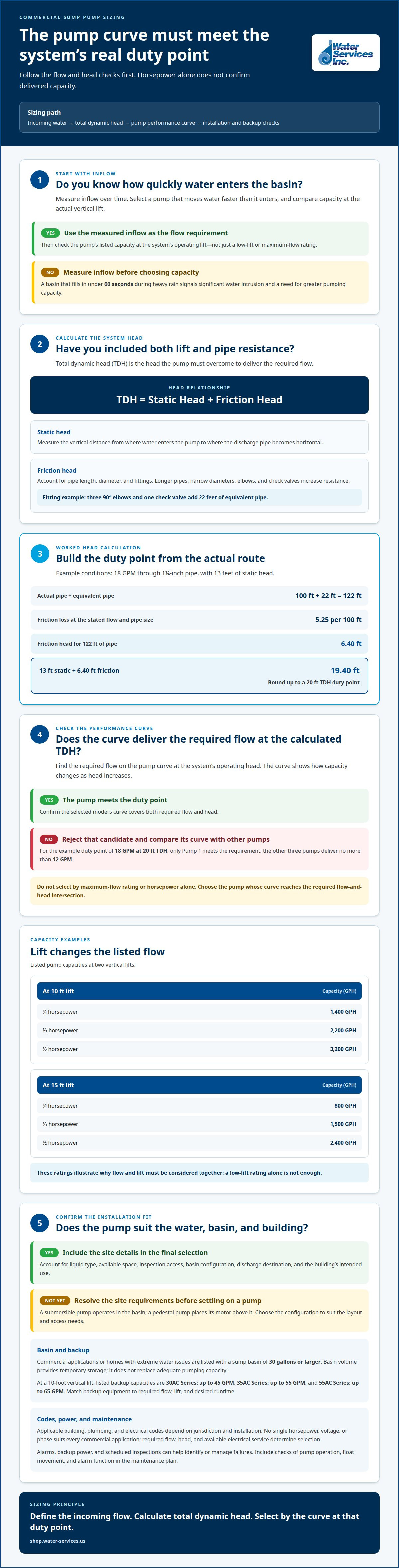
Calculate total dynamic head by adding static head and friction head. Static head is the vertical distance from the point where water enters the pump to the point where the discharge pipe becomes horizontal. Friction head accounts for resistance from pipe length, diameter, and fittings.
- Measure the vertical rise to establish static head, then record the discharge route. Longer pipes, narrow diameters, elbows, and check valves increase friction, so include the actual pipe and fittings. For example, three 90-degree elbows and one check valve add 22 feet of equivalent pipe in the stated fitting example.
- Calculate friction at the required flow and pipe size, then add it to static head. In one example, 100 feet of actual pipe plus 22 feet of equivalent pipe equals 122 feet. With 1¼-inch pipe carrying 18 GPM, friction loss is 5.25 per 100 feet. This produces 6.40 feet of friction head; added to 13 feet of static head, total dynamic head is 19.40 feet, rounded up to 20 feet.
- Find the required flow on the pump’s performance curve at the calculated total dynamic head. The curve shows how capacity changes as head increases. Do not select a pump using its maximum-flow rating alone, since that rating may not reflect output at the system’s operating head.
- Compare candidate curves at the same duty point. In the 18 GPM, 20-foot total dynamic head example, only Pump 1 can meet the requirement; the other three pumps deliver no more than 12 GPM. Choose a pump that reaches the required intersection, rather than assuming similar horsepower means similar performance. Confirm the selected model’s curve covers both required flow and head.
- After selecting the pump, check the controls. The float switch must operate within the basin’s working range, and the pump must meet the calculated duty point. Selecting from the performance curve connects the discharge layout to actual capacity and helps prevent choosing a pump that falls short under operating conditions.
Water intrusion and building conditions affecting pump requirements
Size the pump system for measured inflow and site conditions, not building type alone. A sump basin filling in under 60 seconds during heavy rain indicates significant water intrusion.
- Track how quickly the basin fills during heavy rain, then use that rate to assess incoming flow. A fill time under 60 seconds signals that the system needs greater pumping capacity. Compare this condition with normal inflow, since a pump selected only for ordinary conditions may struggle during a storm.
- Identify the water source and liquid type before finalizing the application. Groundwater and rainwater are mainly clean water without solids, while raw, unfiltered waste is categorized as sewage for pump selection. This distinction affects equipment requirements. Include expected liquid conditions in the design brief rather than treating every sump as a clean-water basin.
- Match basin storage to the site’s water conditions. Commercial applications or homes with extreme water issues are listed with a basin capacity of 30 gallons or larger. Sizing guidance also specifies a basin at least 24 inches deep and 18 inches wide. The basin water level should remain below the bottom of the foundation drain-tile inlet pipe.
- Use pump cycling as an operating signal. Guidance recommends no more than 4-6 cycles per hour during moderate rain. Frequent cycling can point to a mismatch between inflow, basin storage, and pump capacity; compare those conditions before changing equipment. The float should move up and down easily during inspection, so a restricted float doesn’t prevent normal switching.
- Apply the measurements to the next equipment decision. Record heavy-rain fill time, water type, basin dimensions, and observed cycling. These conditions help define the duty the pump must handle. For a system affected by changing inflow, review commercial pump options against its operating requirements.
Water Services, Inc.
Water Services, Inc. offers equipment for commercial water-management projects, including Goulds Water Technology Pumps. Once flow demand, total dynamic head, and site conditions are defined, use them to evaluate pump options. Select equipment by matching its performance to the system’s duty point, not by horsepower alone.
Water Services, Inc. also offers water-treatment equipment, including Viqua UV Water Purification Systems, Hydranautics RO Membranes, and Water Treatment Antiscalants and Chemicals. These products address different water-management needs and do not replace a sump pump selected for drainage requirements. Contact Water Services, Inc. to discuss equipment for your commercial water-management project.
Plan for the Building’s Next Operating Conditions
Make pump sizing part of the building’s ongoing water-management plan. Renovations, changes in site drainage, or a revised discharge route can alter the conditions the system must handle. Keep the design basis with facility records so future equipment decisions reflect current operating information rather than outdated assumptions.
When sizing a sump pump for a commercial building, the next step is to match the calculated duty to site operating needs and equipment performance. Water Services, Inc. can help you consider pump options for the application, as well as other water-treatment requirements where relevant.
Contact Water Services, Inc. for pump sizing to discuss your project’s requirements. A clear design basis gives your team a useful starting point for the next decision.
Frequently Asked Questions
How do you calculate required sump pump capacity in GPM for a commercial building?
Measure how much water enters the basin over a timed interval, then convert that volume to gallons per minute. For an 18-inch-diameter basin, one inch of water depth corresponds to one gallon; an 18-inch rise in 60 seconds represents 18 GPM. Treat that as the observed inflow, then select pump capacity for the required operating head, not just the pump’s maximum-flow rating.
How do you estimate peak groundwater inflow and drainage load for a commercial sump?
Record basin volume changes during heavy rain and other high-inflow periods, then compare the results across operating conditions. Include water reaching the sump from foundation drains and other connected drainage paths. Residential soil benchmarks can provide context, not a commercial design rate: suggested capacity is 14 GPM per 1,000 square feet for a sandy-soil home and 8 GPM for a clay-soil home.
Should a commercial sump system use duplex pumps, alternating controls, and a backup pump?
How do flood risk, soil conditions, and local rainfall affect sump pump sizing?
Greater flood exposure and intense local rainfall can increase peak inflow, while soil affects how quickly water reaches foundation drains. Use site-specific rainfall and drainage conditions to establish the design load instead of applying a residential soil benchmark directly to a commercial property. The building’s footprint, grading, connected drains, and discharge route also affect how much water the sump must manage.
0 comments