

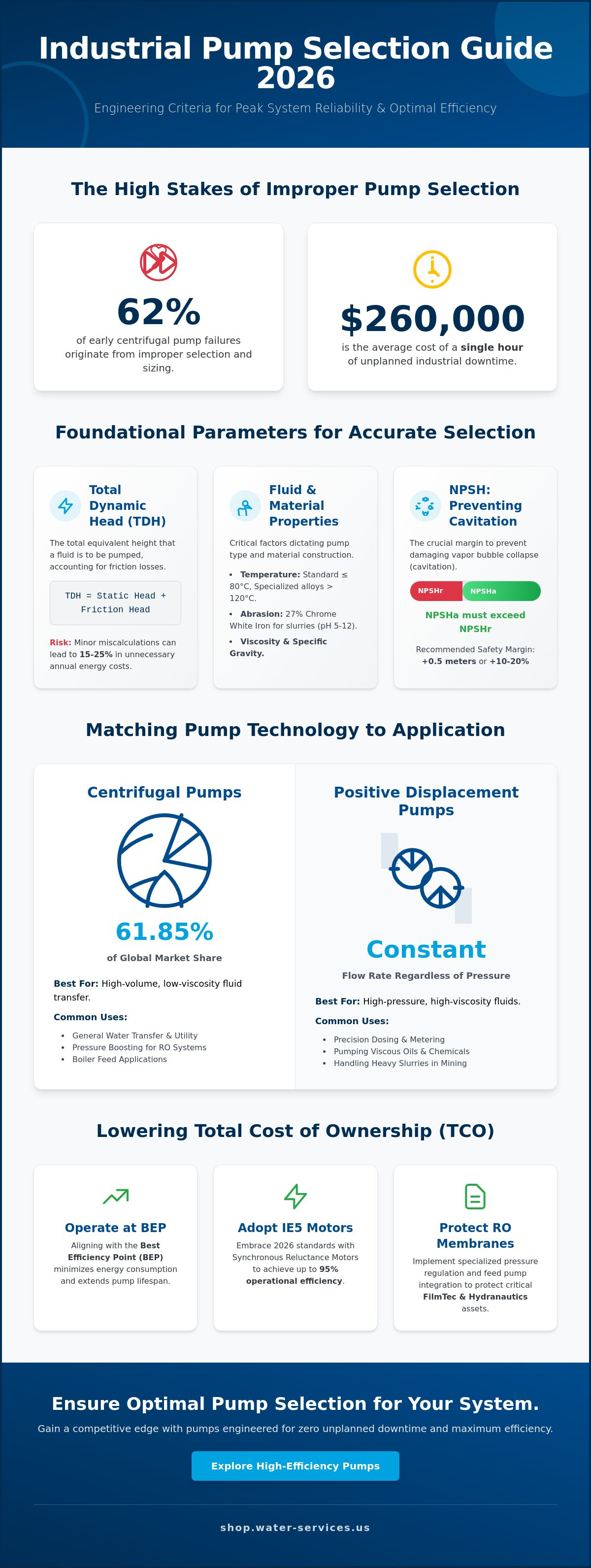
Recent data confirms that 62% of early centrifugal pump failures originate from improper selection, while a single hour of unplanned downtime now costs industrial manufacturers an average of $260,000. These figures highlight the critical need for technical precision in hydraulic system design. This industrial pump selection guide 2026 delivers the engineering criteria required to master your fluid transfer specifications and ensure peak system reliability. We understand the operational burden of high energy costs from oversized equipment and the frequent maintenance required when pump materials fail to withstand corrosive fluids.
By following this guide, you will gain the expertise to achieve zero unplanned downtime and optimal energy efficiency. We provide a detailed overview of 2026 industry standards, including ISO 15783 for seal-less pumps and the adoption of IE5 synchronous reluctance motors for 95% efficiency. The following sections analyze specific metrics for NPSH margins, 27% chrome white iron slurry liners, and high-temperature alloy requirements for fluids exceeding 120°C. This technical roadmap ensures your pumping hardware integrates seamlessly with existing water treatment systems and downstream processes.
Key Takeaways
- Calculate core hydraulic requirements, including Total Dynamic Head (TDH) and Net Positive Suction Head (NPSH), to prevent cavitation and ensure mechanical reliability.
- Reference this industrial pump selection guide 2026 to specify the correct pump technology, from high-flow centrifugal units to precision positive displacement models.
- Protect critical FilmTec and Hydranautics RO membranes by implementing specialized pressure regulation and feed pump integration strategies.
- Lower Total Cost of Ownership (TCO) by aligning equipment with the Best Efficiency Point (BEP) and 2026 IE5 energy standards.
- Streamline deployment with modular, containerized pumping solutions engineered for rapid integration and international logistical efficiency.
Foundational Parameters for Industrial Pump Selection in 2026
Precise hydraulic modeling is the technical foundation of any reliable system. This industrial pump selection guide 2026 prioritizes accuracy to eliminate the 62% failure rate associated with improper sizing. Engineers must first define the required flow rate in Gallons Per Minute (GPM) or cubic meters per hour. Current 2026 standards define high-flow industrial transfer as no less than 100m³/h. Selecting the right industrial pump technologies requires balancing this flow against the Total Dynamic Head (TDH).
Fluid properties are equally critical. You must account for viscosity, specific gravity, and vapor pressure. For example, abrasive resistance in slurry pumps now requires High-Chrome White Iron (27% Cr) for slurries with pH values between 5 and 12. Environmental constraints, such as site altitude and hazardous zone classifications, further narrow the selection. Standard pumps shouldn't transport fluids exceeding 80°C; applications over 120°C require specialized alloys and preheating functions. These variables dictate whether a standard centrifugal unit or a specialized positive displacement pump is necessary.
Calculating Total Dynamic Head (TDH) Accurately
TDH is the sum of static head and friction head. Static head measures the vertical distance the fluid travels. Friction head accounts for the resistance caused by pipe walls, valves, and fittings. 2026 systems require tighter tolerances in these calculations to meet IE5 efficiency standards. Even minor miscalculations in system resistance can lead to 15-25% in unnecessary annual energy costs. To minimize friction losses, design suction piping at least one size larger than the pump's suction flange. This ensures the pump operates within its intended performance envelope without excessive wear.
NPSHa vs. NPSHr: The Safety Margin
Preventing catastrophic cavitation depends on the relationship between Net Positive Suction Head Available (NPSHa) and Required (NPSHr). NPSHa is a calculation based on your specific site elevation, fluid temperature, and suction piping design. Conversely, NPSHr is a fixed performance metric provided by manufacturers like Goulds Water Technology. Industry standards in 2026 recommend that NPSHa exceed NPSHr by at least 0.5 meters (1.6 feet) or a 10% to 20% margin. If the margin is too thin, vapor bubbles will implode against the impeller. This causes pitting and premature mechanical failure. Increasing the diameter of suction lines or elevating the source tank are effective strategies for boosting NPSHa in low-pressure environments.
Matching Pump Technology to Industrial Applications
Selecting the correct hardware requires aligning hydraulic capabilities with specific application demands. Centrifugal pumps remain the industrial standard for high-volume, low-viscosity applications, accounting for 61.85% of the global market share. This industrial pump selection guide 2026 categorizes these technologies based on their mechanical design and fluid compatibility. When evaluating these technologies, conducting a Lifecycle Cost Analysis for Pumping Systems ensures that the chosen equipment remains cost-effective over its operational life.
Positive displacement pumps offer the precision necessary for high-pressure and high-viscosity fluids. Unlike centrifugal models, they deliver a constant flow regardless of system pressure changes. This makes them ideal for viscous oils or heavy slurries. For mining operations, specialty configurations utilizing 27% chrome white iron provide the abrasive resistance required for slurries with a Brinell hardness of 600+. Deciding between submersible and surface-mounted units depends on source accessibility and suction lift limitations. Submersible units eliminate NPSH issues by operating directly in the fluid, while surface-mounted pumps offer easier maintenance access.
Goulds Water Technology: Centrifugal Excellence
For standard water transfer and pressure boosting, Goulds Water Technology Pumps provide reliable end-suction and multistage centrifugal models. End-suction pumps are the workhorses for general utility, while multistage models generate the high pressures required for boiler feed and reverse osmosis systems. Material selection is critical for durability. Cast iron units provide cost-effective service for neutral water, but 316 stainless steel or bronze fitted options are mandatory when handling brackish water or mildly corrosive process fluids. Review our curated selection of industrial pumps to find the exact match for your facility.
Precision Dosing with Pulsafeeder Metering Pumps
Chemical injection requires the extreme accuracy found in Pulsafeeder metering pumps. These diaphragm pumps are essential for delivering water treatment antiscalants and pH adjusters without variance. Precise dosing protects downstream equipment from scaling and corrosion. For fully automated systems, these pumps integrate with Walchem controllers and Signet flow sensors. This combination allows for real-time adjustments based on system demand or water quality fluctuations. Using high-quality metering hardware prevents the chemical waste and system instability associated with lower-grade dosing equipment.
System Integration: Pumps in Water Treatment and RO Contexts
System performance depends on the synchronization between the primary mover and the treatment media. This industrial pump selection guide 2026 emphasizes that a pump is not an isolated component but a driver for critical downstream processes. In water treatment, the feed pump determines the efficiency of the entire purification train. Improperly matched pumps lead to pressure fluctuations that compromise the structural integrity of high-performance membranes, a core concern in any industrial pump selection guide 2026. For containerized and mobile reverse osmosis plants, pumps must meet strict footprint requirements while maintaining the high head pressures necessary for desalination.
Integration also requires ensuring compatibility with UV sterilization and filtration flow rates. If the pump's discharge velocity is inconsistent, it can disrupt the sediment layers in multimedia tanks or bypass the necessary contact time in UV reactors. Engineers must evaluate the entire hydraulic circuit to prevent surges that could damage sensitive sensors or filter housings. This system-first approach ensures that the hardware selected supports the long-term operational goals of the facility rather than just meeting a single flow point.
Optimizing Feed Pressure for RO Systems
Consistent feed pressure is the most critical variable for maintaining the flux and rejection rates of FilmTec Reverse Osmosis Membranes. Pressure instability causes mechanical stress on the membrane layers, leading to premature fouling or telescoping. Selecting the right pump depends on the feed water salinity. Brackish water applications typically require pressures between 200 and 400 PSI, while seawater desalination demands specialized high-pressure multistage pumps capable of exceeding 800 PSI. Utilizing Variable Frequency Drives (VFDs) is now an industry standard for new installations. VFDs allow the system to adjust pump speed in real-time. This matches membrane flux demands as water temperature or feed quality changes, preventing the over-pressurization that voids manufacturer warranties.
Pumps for Filtration and UV Sterilization
Downstream treatment components have narrow flow windows that dictate pump selection. For example, Viqua UV Water Purification systems require a specific contact time to achieve the necessary UV dose. If the pump flow exceeds the reactor's rated capacity, the disinfection process fails. Conversely, industrial water filtration systems using multimedia filter tanks require high-flow pumps for effective backwashing. During the backwash cycle, the pump must provide enough velocity to lift and expand the filter bed to remove trapped particulates. This often requires a pump capable of delivering twice the standard service flow rate. Balancing these conflicting flow requirements requires a multi-pump strategy or sophisticated control valves to manage system resistance across different operational modes.
Evaluating Lifecycle Costs and 2026 Efficiency Standards
Industrial procurement must prioritize Total Cost of Ownership (TCO) over initial capital expenditure. This industrial pump selection guide 2026 emphasizes that energy and maintenance account for more than 85% of a pump's lifecycle cost. As of 2026, global regulations mandate the adoption of IE5 synchronous reluctance motors. These motors achieve over 95% efficiency, significantly reducing the operational burden on large-scale facilities. Failing to align with these standards leads to regulatory non-compliance and inflated energy bills. It's critical to maintain established maintenance intervals to avoid the $260,000 hourly cost of unplanned downtime. For remote mining or military water installations, stocking critical wear parts like mechanical seals and impellers is a logistical necessity. We prioritize technical integrity by ensuring spare parts are accessible for every unit we supply, supporting continuous operation in demanding environments.
Operating at the Best Efficiency Point (BEP)
Precision sizing involves more than just meeting flow requirements. You must select a pump that operates near its Best Efficiency Point (BEP). Running a pump too far to the left or right of its performance curve causes excessive radial loads. This leads to shaft deflection and premature bearing failure. The BEP is the specific flow rate on a pump curve where hydraulic efficiency is maximized, resulting in minimal impeller vibration and the longest possible mechanical seal life. Correctly matching the pump to the system resistance prevents the 15-25% energy waste typically caused by oversized equipment. This industrial pump selection guide 2026 recommends maintaining a 10% to 15% performance margin to accommodate future system expansion without moving the operating point too far from the BEP.
Digital Monitoring and Predictive Maintenance
Modern hydraulic systems rely on real-time data to prevent catastrophic failures. Integrating Signet flow sensors and Ashcroft pressure gauges allows operators to monitor system health continuously. These instruments provide early warning signs of suction blockages or discharge surges. Specifically, Ashcroft pressure gauges prevent dry-run failures by triggering automated shutdowns if suction pressure drops below critical thresholds. Remote monitoring is now essential for managing distributed assets in demanding environments. Smart technology integration in 2026 also includes sensors for real-time monitoring of liner thinning in slurry pumps. This data-driven approach allows for predictive maintenance, replacing components before they fail. For comprehensive system protection, browse our selection of industrial controls and sensors to secure your facility's operational integrity.
Procurement and Implementation: The Water Services, Inc. Advantage
Successful hydraulic integration concludes with efficient procurement and logistical execution. This industrial pump selection guide 2026 has detailed the technical parameters required for system reliability. Now, the focus shifts to sourcing hardware that meets these specifications without lead-time delays. We provide a streamlined path to acquisition through the Water Services, Inc. online store. This platform allows professional buyers to bypass traditional procurement bottlenecks. It offers direct access to technical data and stock availability for critical components. Our logistical network ensures that high-performance pumps reach remote international sites, maintaining the technical integrity of your water infrastructure regardless of geographic location.
Technical support from Water Services, Inc. extends beyond the initial sale. We offer ongoing maintenance contracts and consulting to ensure equipment continues to operate at the Best Efficiency Point (BEP). Our team understands the rigors of industrial environments. We prioritize the availability of spare parts to prevent the high costs of unplanned downtime mentioned earlier. By partnering with a specialist provider, you secure a supply chain capable of delivering both hardware and the engineering expertise required for complex installations.
Custom Modular Solutions for Global Projects
Modular engineering simplifies the deployment of complex pumping systems in challenging environments. Water Services, Inc. specializes in pre-integrated, skid-mounted pumping and filtration systems. These units are factory-tested and ready for immediate onsite integration. For mining projects in Africa and South America, these modular solutions reduce installation time significantly compared to traditional field-built systems. We also ensure full compliance with local engineering standards in regions such as the Middle East. Our containerized reverse osmosis plants and mobile ultrafiltration systems provide a plug-and-play solution for remote sites where local infrastructure is limited. This approach guarantees that the hydraulic performance defined in your industrial pump selection guide 2026 is realized in the field.
Your Partner for Industrial Water Infrastructure
Water Services, Inc. provides direct access to Tier 1 brands, including Goulds Water Technology and Pulsafeeder. This ensures every component in your system meets the highest standards of industrial reliability. Our expertise is particularly deep in specialized sectors, such as mining wastewater treatment solutions. We help engineers navigate the complexities of resource recovery and environmental compliance. Our consultants provide exact pump specifications based on your specific TDH and NPSH requirements. This technical precision prevents the premature failures and energy waste associated with improper sizing. Contact Water Services, Inc. for a custom pump specification today to ensure your 2026 projects meet peak performance benchmarks.
Securing Your Industrial Hydraulic Infrastructure for 2026
Mastering the technical requirements of fluid transfer is essential for long-term operational stability. This industrial pump selection guide 2026 has provided the engineering framework necessary to align hydraulic flow with system resistance and membrane flux requirements. Success in 2026 requires a rigorous approach to suction head margins and the immediate adoption of high-efficiency motor standards to minimize total cost of ownership. Since 1994, Water Services, Inc. has applied this technical focus to global projects, specializing in modular water treatment for the mining and military sectors. As an authorized distributor for Goulds, Viqua, and FilmTec, we provide the hardware and expertise needed to protect your infrastructure and optimize energy consumption. Relying on verified performance data ensures your facility remains competitive in a demanding global market.
Acquiring the right equipment is the final step in engineering a reliable system. Browse our full catalog of Goulds Water Technology Pumps to select the hardware that meets your specific technical parameters. The team at Water Services, Inc. is ready to support your procurement needs with precise specifications and efficient logistical delivery. We look forward to helping you achieve peak performance in your upcoming industrial projects.
Frequently Asked Questions
How do I calculate Total Dynamic Head (TDH) for my pump system?
Total Dynamic Head is calculated by summing the static head, friction head, and the required discharge pressure head of the system. Static head represents the total vertical distance the fluid must be lifted, while friction head accounts for the resistance encountered in piping, valves, and fittings. You must also include the pressure head if the fluid is being discharged into a pressurized vessel or through a specific nozzle.
Accurate TDH calculation is a cornerstone of this industrial pump selection guide 2026. Using a pressure gauge on both the suction and discharge sides during operation can help verify your theoretical calculations against real-world system resistance. This ensures the pump operates at its Best Efficiency Point (BEP).
What is the difference between a centrifugal pump and a positive displacement pump?
Centrifugal pumps use an impeller to impart kinetic energy to the fluid, making them the primary choice for high-flow, low-viscosity applications. They are highly efficient for water transfer but their flow rate decreases as system pressure increases. Conversely, positive displacement pumps move fluid by trapping a fixed volume and forcing it into the discharge pipe. This mechanical action ensures a constant flow rate regardless of pressure changes, which is ideal for high-viscosity fluids or precision dosing.
Why is NPSH available (NPSHa) critical in industrial pump selection?
NPSHa is critical because it determines whether the pump will experience catastrophic cavitation. Cavitation occurs when the suction pressure drops below the fluid's vapor pressure, causing vapor bubbles to form and implode against the impeller. To prevent this, your system's NPSHa must exceed the pump's NPSH requirement (NPSHr) by at least 0.5 meters or a 10% safety margin. Maintaining this buffer protects the internal components from the pitting and vibration that lead to premature mechanical failure.
Can I use a standard water pump for chemical dosing in wastewater treatment?
Standard water pumps are unsuitable for chemical dosing because they lack the necessary material compatibility and volumetric precision. Aggressive chemicals like sodium hypochlorite or sulfuric acid will rapidly degrade standard cast iron or bronze internals. For these applications, you must use specialized metering pumps, such as Pulsafeeder diaphragm models, which utilize chemically resistant plastics and elastomers. These units integrate with Walchem controllers to provide the exact dosing rates required for environmental compliance.
How often should industrial pumps be serviced to prevent unplanned downtime?
Critical industrial pumps should undergo a comprehensive inspection at least quarterly, though heavy-duty applications may require monthly checks. Maintenance teams should focus on mechanical seal integrity, bearing lubrication, and coupling alignment. Utilizing Ashcroft pressure gauges and Signet flow sensors allows for a predictive maintenance strategy. By monitoring for subtle drops in performance or increases in vibration, you can schedule repairs before a component fails and causes expensive unplanned downtime.
What are the most common causes of industrial pump failure in 2026?
Improper hydraulic sizing and dry-running are the most frequent causes of pump failure in modern facilities. When a pump is oversized for the system, it operates far from its BEP, causing shaft deflection and seal damage. Dry-running occurs when the pump loses prime or the suction source is depleted, leading to rapid heat buildup and the seizure of internal rotating parts. Implementing automated low-pressure shut-off switches is the most effective way to mitigate these risks.
Does fluid temperature affect pump selection?
Fluid temperature significantly impacts pump material selection and mechanical seal design. As temperature increases, fluid viscosity drops and vapor pressure rises, which increases the risk of cavitation. Standard industrial pumps are typically rated for fluids up to 80°C. For processes exceeding 120°C, you must specify pumps with specialized high-temperature alloys and cooling jackets for the seal chamber. Thermal expansion of the shaft and housing must also be accounted for to maintain internal clearances.
How do I size a pump for a reverse osmosis system?
Sizing a pump for reverse osmosis requires matching the discharge pressure to the specific osmotic pressure and flux requirements of the membranes. For example, systems utilizing FilmTec or Hydranautics membranes require high-pressure feed pumps capable of overcoming the resistance of the membrane layers. You must calculate the required feed pressure based on the total dissolved solids (TDS) of the source water and the desired permeate recovery rate. Integrating a Variable Frequency Drive (VFD) is essential to maintain constant flux as water temperatures fluctuate throughout the year.
0 comments