

A single pump failure at a remote industrial site does more than stop the flow; it halts your entire operational timeline and drains your maintenance budget through emergency repair fees. You've likely dealt with the frustration of frequent clogs and the technical confusion of sizing power systems for distant lift stations. It's a common challenge for facility managers who need equipment that functions without constant manual intervention. Selecting the right industrial submersible grinder pumps requires looking beyond simple horsepower to the synergy of cutter metallurgy and hydraulic efficiency.
This guide provides the technical framework you need to master selection criteria, ensuring your wastewater management remains clog-free in the most demanding environments. We'll examine the critical metrics of Total Dynamic Head (TDH) and compare cutter blade durability to provide a reliable, set-and-forget solution. You'll gain a clear understanding of power requirements and sizing specifications for Tiger Pumps and Goulds Water Technology. By the end of this article, you'll have the confidence to specify a system that eliminates downtime and stabilizes your long-term operational costs.
Key Takeaways
- Understand why integrated cutting mechanisms are necessary for industrial waste streams where standard centrifugal pumps fail.
- Learn to calculate Total Dynamic Head (TDH) accurately to ensure your industrial submersible grinder pumps meet specific facility discharge requirements.
- Evaluate material specifications like cast iron housing and hardened cutter metallurgy to ensure equipment reliability in high-demand environments.
- Identify specific Tiger Pumps and Goulds Water Technology models designed for high-head and high-flow applications.
- Implement guide rail systems to facilitate safe equipment retrieval and reduce long-term maintenance costs.
Industrial Submersible Grinder Pumps: Solving High-Solid Wastewater Challenges
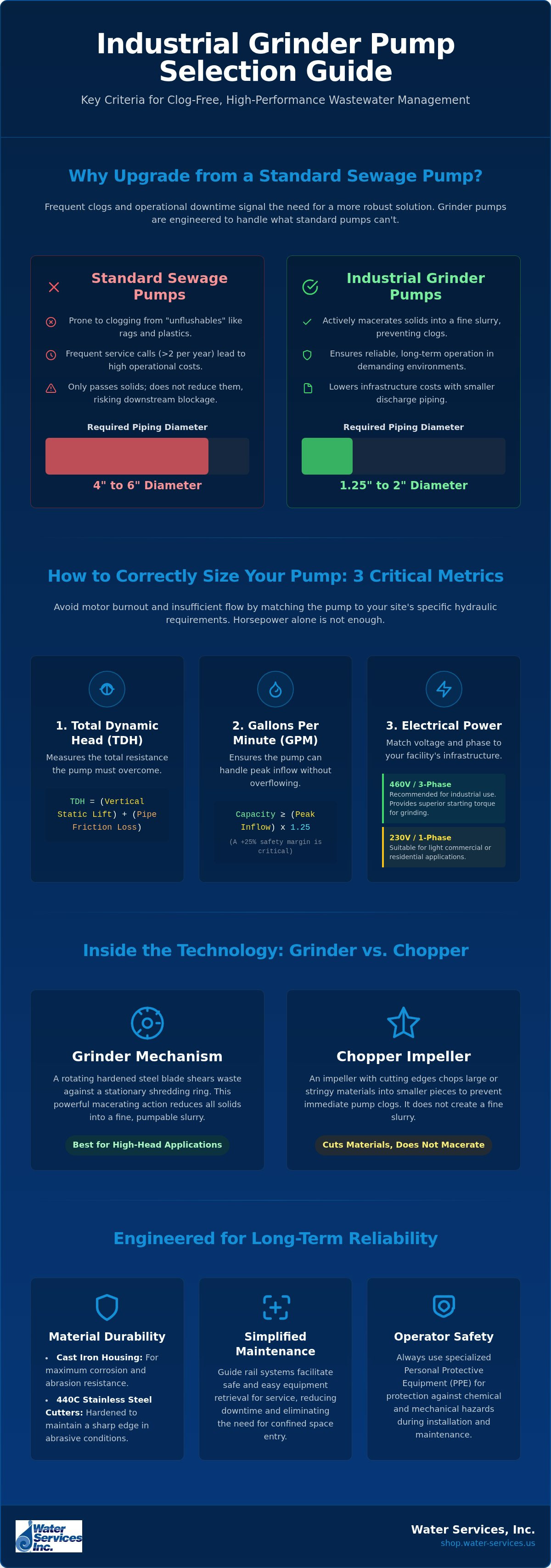
Industrial submersible grinder pumps are specialized centrifugal units engineered with an integrated cutting mechanism at the suction intake. Unlike standard submersible pumps that attempt to pass solids through the impeller, these units actively reduce debris into a fine slurry. This capability is critical in environments like mining camps, military installations, and commercial processing facilities. In these sectors, waste streams often contain "unflushables" such as rags, plastics, and high-density organic matter that would immediately seize a standard sewage pump. Tiger Pumps serves as the heavy-duty standard for these high-solids applications, providing the mechanical torque necessary to maintain flow in harsh conditions.
The Mechanics of Grinding: Cutter Blades vs. Chopper Impellers
The core of a grinder's performance lies in its radial cutter design. This mechanism typically features a rotating hardened steel blade that shears against a stationary shredding ring. This action macerates waste into a fine slurry, which is then pumped through the discharge at high pressure. It's different from a chopper impeller. Choppers are designed to cut large, stringy materials into smaller pieces to prevent pump clogging, but they don't refine the waste into a slurry. For high-head applications, the macerating action of a grinder is superior. You should prioritize cutter components manufactured from high-chrome alloys or 440C hardened stainless steel. These materials ensure the blades maintain a sharp edge even when processing abrasive industrial grit.
Grinder Pumps vs. Standard Sewage Pumps: When to Upgrade
Deciding when to switch to an industrial submersible grinder pump involves analyzing your current maintenance frequency. If service calls for standard sewage pumps occur more than twice a year due to clogs, the operational cost of the "standard" solution has already exceeded its value. Grinder pumps allow for the use of 1.25 inch or 2 inch discharge piping. This is a massive reduction from the 4 inch or 6 inch lines required for solids-handling sewage pumps. Smaller piping translates to lower infrastructure costs and easier installation in remote sites. Don't fall for the myth that a larger sewage pump is a substitute for a grinder. A larger pump only offers a larger passage; it cannot shred the tough solids that eventually block valves and fittings further down the line. You can find high-durability options in our pump collection to solve these specific challenges.
Critical Selection Criteria: How to Size Your Industrial Pump
Sizing is the most common point of failure in industrial procurement. Buying based on horsepower alone often results in motor burnout or insufficient flow velocity. You must match the pump curve specifically to the lift station's hydraulic requirements. Duty cycles in mining or military settings are punishing; they require motors rated for continuous or high-frequency intermittent use. Before conducting a physical site assessment or beginning installation, verify that all personnel have specialized PPE for protection against chemical exposure and mechanical hazards. Choosing the wrong unit leads to sedimentation in the discharge lines or premature mechanical seal failure.
Understanding Total Dynamic Head (TDH) and GPM
Total Dynamic Head (TDH) measures the total resistance the pump must overcome. It's the sum of the vertical static lift and the friction loss within the piping system. Calculating friction loss is critical because industrial submersible grinder pumps use smaller diameter pipes, which increases resistance compared to standard sewage lines. To determine the required Gallons Per Minute (GPM), measure the peak inflow rates during your facility's highest usage periods. Industrial lift stations generally require a pump capacity that exceeds the peak inflow by at least 25% to maintain a safe drawdown rate in the wet well. If the GPM is too low, the basin will overflow during surge events; if it's too high, the pump will short-cycle and overheat.
Electrical Specifications: Voltage and Phase Considerations
Electrical requirements vary based on the scale of the facility. Single-phase 230V power is common for light commercial drainage, but heavy-duty industrial applications rely on 460V three-phase power. Three-phase motors offer superior starting torque. This torque is essential for the initial grinding action when the basin contains high-density solids or settled debris. Without sufficient torque, the cutter mechanism might jam upon startup, leading to a tripped breaker or a burned-out winding. To prevent electrical failure, always install dedicated electric power controls that monitor for thermal overloads and phase imbalances. These control panels act as the primary defense for your hardware investment in remote or unmonitored sites.
Proper sizing ensures a reliable wastewater solution that minimizes emergency repairs and extends the life of your equipment. If you're unsure of your TDH requirements or friction loss calculations, our technical team can help you select the right unit from our industrial pump collection.
Durability and Material Science in Harsh Environments
Industrial reliability is the primary metric for equipment deployed in remote mining camps or military installations. In these locations, a pump failure isn't just a maintenance issue; it's a critical system collapse. High-quality industrial submersible grinder pumps must feature housings that withstand both internal hydraulic pressure and external environmental stress. Cast iron remains the industry standard for heavy-duty housings because it provides superior vibration dampening and structural rigidity. When waste streams contain corrosive chemicals, 316 stainless steel housings become necessary to prevent pitting and structural degradation. These units are often integrated into larger Industrial Water Treatment Systems where consistent performance is mandatory for downstream processes.
Modern industrial units include moisture sensors in the seal chamber and thermal overload protection within the motor windings. These sensors act as an early warning system, shutting down the unit before a minor seal leak turns into a catastrophic motor failure. This proactive protection is essential for maintaining uptime in unmonitored lift stations where daily manual inspections aren't feasible.
Cutter Metallurgy: Hardened Stainless Steel vs. Alloys
The cutting mechanism is the most vulnerable component of any grinder pump. Industrial cutters require 440C stainless steel or similar hardened alloys that reach a high Rockwell C hardness rating. This hardness allows the blades to maintain a sharp "scissor action" against the shredding ring. This shearing method is more efficient than impact-style cutting, which relies on brute force and is more susceptible to dulling from contact with tough solids. Abrasive solids like sand and grit are common in industrial wastewater. Without hardened metallurgy, these abrasives quickly round off the cutting edges, leading to increased torque requirements and eventual motor jams. Hardened alloys ensure the industrial submersible grinder pumps maintain their shredding efficiency over thousands of duty cycles.
Mechanical Seals and Motor Insulation
Motor longevity depends on keeping the electrical windings dry and cool. Dual mechanical seals with an independent oil chamber provide two layers of protection against liquid ingress. The oil chamber lubricates the seal faces and helps dissipate heat away from the motor shaft. Insulation class is another critical specification. While Class F insulation is rated for 155 degrees Celsius, Class H insulation provides protection up to 180 degrees Celsius. This higher rating is preferred for heavy industrial duty where frequent starts or high ambient temperatures are expected. Goulds Water Technology Pumps utilize these high-specification materials to set the benchmark for motor reliability in harsh submersible applications.
Top Picks: Standout Models from the Tiger Pumps Collection
Tiger Pumps represents the heavy-duty standard for solids handling in the most demanding industrial wastewater applications. These industrial submersible grinder pumps are engineered for reliability where system failure isn't an option. We maintain stock for immediate procurement through our Shopify store to support rapid deployment in remote sites. Tiger Pumps has established a documented 3-year reliability record in the mining and military sectors. This history proves their durability in environments with high concentrations of abrasive solids and unpredictable waste streams. For personnel working in such extreme environments, Green Team Express, Llc provides reviews of functional outdoor gear like heated jackets to maintain comfort and safety. Each model in the Tiger lineup is built with specialized metallurgy to ensure long-term performance under continuous duty cycles.
For applications requiring over 100 feet of vertical lift, specific Tiger Pump models provide the necessary pressure to overcome significant static head and pipe friction. These units are frequently specified for mining wastewater treatment where the lift station is located far from the primary processing facility. High-head performance is critical for decentralized sewer systems moving slurry across rugged terrain. Without this specialized hydraulic capability, standard pumps operate at the end of their curve. This leads to motor overheating and insufficient scouring velocity in the discharge lines. These high-head units utilize radial cutters to refine solids into a slurry that moves efficiently through small-diameter piping.
Compact Grinder Pumps for Commercial Lift Stations
Retrofitting existing basins requires a balance of power and physical footprint. The Tiger Pumps lineup includes 2HP and 3HP models specifically designed for these compact industrial environments. These units integrate with standard slide-rail systems, allowing for safe and efficient pump retrieval during scheduled maintenance. The compact design doesn't compromise on cutter metallurgy, utilizing the same hardened stainless steel components found in larger models. You can explore the full Tiger Pumps collection here for specific model specs to find the exact match for your facility's dimensions.
High-Flow Models for Large-Scale Processing
When peak inflow rates exceed standard capacity, high-flow Tiger Pumps provide the necessary GPM to prevent basin overflows. These models are built with larger oil chambers and enhanced thermal dissipation for high-duty cycles. They maintain the same precision grinding action while moving larger volumes of refined slurry through the system. We recommend these units for commercial processing plants where waste volume fluctuates throughout the production day. If your project requires high-torque starting and verified solids reduction, you can purchase industrial submersible grinder pumps directly from our authorized inventory.
Implementation and Maintenance for Long-Term Reliability
Ownership of industrial submersible grinder pumps requires a shift from procurement to proactive maintenance. Reliability isn't guaranteed by the purchase alone; it's maintained through correct installation and scheduled oversight. A stainless steel or galvanized guide rail system is a critical component for any industrial basin. These systems allow for safe equipment retrieval without requiring personnel to enter the wet well. This design feature reduces downtime during inspections and ensures that your maintenance team remains protected from hazardous wastewater. While grinding technology reduces solids to a manageable slurry, the basin environment still requires management. You might need specialized water treatment chemicals to manage hydrogen sulfide odors and prevent grease buildup in the wet well.
These units are ideal for integration into containerized reverse osmosis plants or mobile ultrafiltration systems. They provide the necessary waste handling for modular treatment sites where space is limited and reliability is paramount. Proper integration ensures that the industrial submersible grinder pumps function as a seamless part of the broader water management infrastructure.
Proper Installation in Wet Well and Basin Systems
Correct float switch settings are the first line of defense against motor failure. You must calibrate these level controls to prevent short-cycling, which is the most common cause of thermal overload in submersible motors. Ensure that the "off" level remains high enough to keep the motor housing submerged for cooling. Industrial codes also mandate proper basin venting to prevent the buildup of explosive gases and to ensure correct atmospheric pressure for pump operation. We recommend integrating Ashcroft Pressure Gauges on the discharge manifold. A sudden increase in pressure often indicates a downstream blockage, while a drop in pressure suggests a worn impeller or a leak in the check valve.
Preventive Maintenance: Keeping Cutter Blades Sharp
Establish a quarterly inspection schedule to maintain peak shredding efficiency. You don't always need to dismantle the pump to check for wear. Inspect the cutter mechanism for rounded edges or visible nicks that suggest contact with non-grindable debris. If the motor's moisture sensor trips, it's a sign of seal failure that requires immediate intervention. Replacing a mechanical seal is a standard maintenance task; ignoring a leak leads to a total motor rewind. Check the oil in the seal chamber for milkiness, which indicates water ingress. Early detection keeps your system operational and protects your long-term capital investment. To ensure every aspect of your facility's wet areas is built to last, you can discover Pro Supply Center and their selection of professional installation materials.
Contact our technical team for an expert consultation on sizing and system design. We provide the technical support necessary to ensure your wastewater infrastructure remains reliable and efficient.
Ensuring clog-free wastewater management in demanding environments requires a technical approach to equipment selection. Successful deployment of industrial submersible grinder pumps depends on matching hydraulic curves to specific site requirements and prioritizing hardened cutter metallurgy. Reliability isn't a result of chance; it's the outcome of precise sizing and a rigorous preventive maintenance schedule. By implementing guide rail systems and monitoring discharge health with accurate pressure gauges, you can significantly reduce the risk of catastrophic system failure in remote industrial sites.
Water Services, Inc. serves as an authorized Tiger Pumps distributor, providing the expert technical sizing support and global shipping capabilities necessary for your next industrial project. We understand that stability in your wastewater stream is essential for operational continuity. Our team is ready to help you specify a system that handles the toughest solids without the high cost of emergency repairs. You don't have to navigate complex TDH requirements alone.
Shop the Full Collection of Tiger Grinder Pumps & Industrial Sewage Solutions today to find a durable, set-and-forget solution for your facility.
Frequently Asked Questions
What is the difference between a grinder pump and a chopper pump?
Grinder pumps use a radial cutter to macerate solids into a fine slurry for small-diameter discharge piping. Chopper pumps use an impeller with sharp leading edges to cut larger debris into pieces; this primarily prevents pump clogging in large-volume systems. Grinders are preferred for high-head applications where solids must move through 1.25 inch pipes. Choppers are better for high-flow systems where refining waste into a slurry isn't necessary for transport.
Can an industrial grinder pump handle feminine hygiene products and wipes?
Yes, industrial submersible grinder pumps are specifically designed to shred "unflushables" like wipes, rags, and feminine hygiene products. Standard sewage pumps often fail when these materials wrap around the impeller, but the integrated cutting mechanism in a grinder macerates them before they enter the pump volute. This prevents the clogs that cause downtime in commercial processing plants and military installations. Constant intake of these materials will, however, accelerate cutter blade wear.
Do I need a specific control panel for my 3-phase grinder pump?
Every three-phase grinder pump requires a dedicated control panel to manage motor protection and operation. These panels monitor for phase imbalance, thermal overload, and moisture ingress. Without a properly configured panel, the motor is vulnerable to damage from power surges or mechanical jams. Integrating advanced electric power controls ensures the pump operates within its design parameters; this extends the life of the unit in remote or unmonitored industrial sites.
How often should the cutter blades be replaced in a Tiger Pump?
Blade replacement frequency depends on the concentration of abrasive solids in your waste stream. While we recommend a quarterly inspection, high-use Tiger Pumps in mining environments might require blade replacement every 12 to 18 months. If you notice a decrease in flow or an increase in motor amperage, it often indicates the blades are dull. Regular sharpening or replacement maintains the shredding efficiency and prevents unnecessary stress on the submersible motor.
What is the maximum head capacity for a standard industrial grinder?
Standard industrial grinder pumps typically handle vertical lifts between 100 and 150 feet of Total Dynamic Head (TDH). Specialized high-head models within the Tiger Pumps lineup are engineered to exceed these figures for long-distance ejection scenarios in rugged terrain. Always verify the specific pump curve to ensure the unit provides sufficient pressure at your required GPM. Operating a pump beyond its maximum head rating results in zero flow and potential motor damage.
Can these pumps be used for pumping abrasive mining slurry?
These pumps are engineered for wastewater with high solids content, but they aren't dedicated slurry pumps for heavy mining tailings. However, they excel in handling mine site wastewater that contains grit and light sand. The use of high-chrome or hardened stainless steel cutters provides the necessary durability for these abrasive environments. For heavy mineral slurries, a specialized slurry pump is required, but for camp wastewater and site drainage, a grinder is the standard.
What happens if a grinder pump runs dry?
Running a grinder pump dry will cause the mechanical seals to overheat and fail. Submersible motors rely on the surrounding liquid to dissipate heat. Most modern industrial submersible grinder pumps include thermal overload sensors and float switches to prevent dry-run conditions. If the pump operates without fluid, the friction in the seal chamber quickly destroys the seal faces; this allows liquid ingress into the motor housing once the basin refills.
Are Tiger Pumps compatible with existing Goulds guide rail systems?
Tiger Pumps are designed to be compatible with most industry-standard guide rail systems, including those from Goulds Water Technology. This allows for easy retrofitting into existing lift stations without the need for basin modification. You should verify the discharge flange dimensions and the rail spacing before installation. Using a compatible slide-rail system ensures safe pump retrieval and simplifies the maintenance of your wastewater infrastructure in demanding commercial settings.
0 comments