

What if a remote site could recover usable water instead of relying entirely on fresh deliveries? Mobile reverse osmosis systems turn feedwater into treated product water while separating a concentrate stream, helping conserve water where supply and disposal are operational concerns. Recovery rates vary with the system’s design and operating conditions.
Water conservation matters in remote operations, and choosing mobile reverse osmosis systems involves more than comparing treatment capacity. This guide explains how RO recovery works and how transport, capacity, custom design, and trailer configurations affect deployment. It also covers feedwater quality, pretreatment, and system sizing, helping you understand what a professional design must account for before installation.
Key Takeaways
- Plan transport and site setup around access to feedwater, power, and the space required to operate the treatment unit.
- Match treatment capacity to the site’s water demand and operating conditions, not just the equipment footprint.
- Use feedwater analysis to guide membrane selection, pretreatment, and chemical dosing for a custom system design.
- Consider a trailer configuration when mobility matters, and assess how treatment and recovery can reduce reliance on fresh water.
Transport and setup of mobile RO equipment
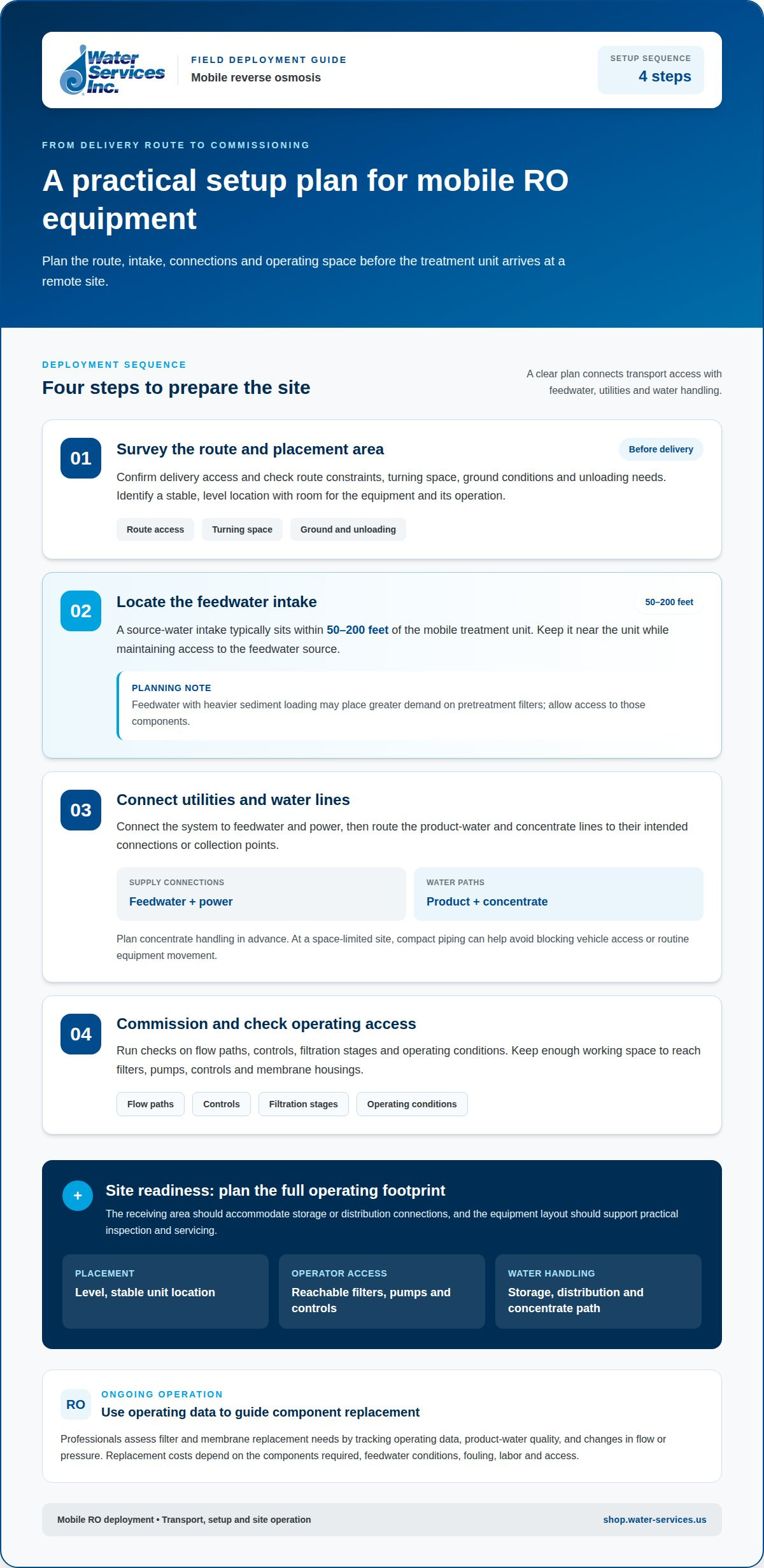
For remote deployments, transport planning starts with the route, source-water point, and operating footprint. A source-water intake typically sits within 50-200 feet of a mobile treatment unit. Keeping the intake close to the unit can make setup more practical while maintaining access to feedwater. Route surveys also identify access constraints, turning space, ground conditions, and unloading needs before delivery.
At the site, setup connects the unit to feedwater, power, and the required product-water and concentrate lines. The treatment layout needs to leave operators room to reach filters, pumps, controls, and membrane housings. A level, stable placement supports operation, while clear access makes inspection and servicing more practical. The receiving area must also accommodate water storage or distribution connections.
A professional setup plan typically addresses these steps:
- Confirm the transport route, delivery access, and equipment placement area.
- Position the intake near the feedwater source, allowing for the 50-200-foot guideline.
- Connect feedwater, power, product-water, and concentrate lines to the system.
- Run commissioning checks on flow paths, controls, filtration stages, and operating conditions.
Professionals determine filter and membrane replacement needs by tracking operating data, product-water quality, and changes in flow or pressure. Replacement costs depend on the components needed, feedwater conditions, fouling, and the labor and access involved. When shipping delicate replacement membranes, spare gauges, and sensitive instrumentation to remote worksites, teams often utilize custom protective packaging from foampackagingdirect.com to prevent shock and vibration damage along rough access roads.
Feedwater quality can affect transport planning as well as treatment setup. Water with heavier sediment loading may place greater demand on pretreatment filters, so the layout should allow access to those components. Concentrate handling also needs a defined route or collection point. For example, a remote worksite with limited space may need compact piping that avoids blocking vehicle access or routine equipment movement.
These details help professionals prepare a mobile reverse osmosis system for practical site operation. A clear delivery route, nearby intake, accessible equipment, and planned discharge path can simplify setup. The final arrangement should reflect the site’s feedwater source and operating needs.
Containerized RO system capacity
Capacity is the volume of treated product water a system can deliver over time. A container’s footprint alone does not show whether its output will meet a remote operation’s demand. Engineers size the treatment train to the required product-water flow, feedwater characteristics, and expected operating schedule.
Start with the end use. A camp, processing site, and emergency operation can have different demand patterns, even when each needs potable water. The design must account for steady consumption and periods of higher demand. Storage can help bridge gaps between production and use, but it does not increase the RO plant’s treatment rate.
A listed seawater reverse-osmosis desalination kit has an output of 2 liters per hour. That is a specific kit’s rating, not a benchmark for containerized plants. Capacity figures only help when they describe the equipment and operating conditions relevant to the application.
Professionals assess capacity through several connected inputs:
- Demand profile: Required product-water volume and the timing of peak use.
- Feedwater: Source quality and composition, which influence pretreatment and membrane operation.
- Operating schedule: Available run time and planned interruptions for maintenance.
- Recovery and concentrate: The share of feedwater recovered as product water and the volume requiring management.
These factors also shape water conservation. A system’s recovery rate affects how much feedwater becomes product water and how much leaves as concentrate. The design must balance usable output with feedwater conditions and concentrate handling, rather than maximizing one figure in isolation.
For a remote site, capacity planning should connect treatment output to storage, distribution, and actual demand. If demand changes by shift or season, the design can account for those patterns. Reviewing capacity planning for containerized RO helps frame the key sizing decisions before selecting equipment.
Custom system design
Custom design starts with a baseline water analysis. This helps determine membrane selection, pretreatment intensity, and chemical dosing rates for each feedwater source. A system designed for one source may not suit another, even when both serve the same operation. Feedwater data gives engineers a basis for selecting treatment components and configuring the process.
The design also links source-water conditions to the required product-water use. For example, an industrial process and a remote workforce may have different water-quality requirements. Those requirements influence the treatment sequence and the role of each stage. Engineers assess intended use alongside feedwater composition, expected demand, and the operating environment.
Key design inputs include:
- Feedwater analysis: Identifies characteristics that affect membranes and pretreatment.
- Membrane selection: Matches membrane type to the source and treatment objective.
- Pretreatment intensity: Addresses feedwater conditions before water reaches the RO membranes.
- Chemical dosing: Sets dosing requirements based on the source-water analysis.
These choices work together. Pretreatment protects the membrane process from feedwater conditions that can interfere with operation. Chemical dosing is also specific to the source, so a generic setting cannot replace analysis. If a site changes its water source, the design basis may need review because the new feedwater may require different membrane or pretreatment choices.
Custom configuration also considers how equipment will operate at the site. Engineers align treatment stages, controls, and connections with the workflow and available utilities. For example, a remote facility with variable source-water quality needs a design that reflects those conditions, rather than assumptions based on another location. The design must also account for how operators monitor performance and access filtration components.
A clear design basis links source-water analysis, treatment objectives, and operating conditions. This helps define the system configuration before equipment selection and commissioning. For mobile treatment, each decision should reflect the actual feedwater and use case, not a standard layout applied without adjustment.
Mobile reverse osmosis trailer systems
Trailer-mounted RO units combine treatment equipment with mobility for changing sites. Their configuration should reflect the water source, required output, power supply, and operating environment.
System Types for Different Uses
For RVs, boats, and off-grid operations, the design depends on available space, feedwater, and power. A boat using seawater has different treatment needs from an RV drawing from a freshwater source. Off-grid layouts must also account for available electrical power and product-water storage—often pairing treatment units with dedicated renewable energy systems designed by providers like SolariQ to ensure uninterrupted power in isolated locations. The key is matching the configuration to the vehicle’s or site’s actual operating conditions.
Size, Power Use, and Water Quality
A provider matches system size to required product-water flow, available operating time, and installation space. Power requirements depend on the selected equipment and operating conditions, while water quality depends on feedwater and treatment design. Baseline water analysis can guide membrane selection, pretreatment, and dosing. This helps align treatment choices with the source and intended use, rather than choosing by footprint alone.
Desalination and Emergency Applications
For seawater desalination, the design must suit saline feedwater and the operation’s product-water demand. Emergency systems also need a deployment plan suited to the response site and available utilities. According to the CDC, reverse osmosis systems remove parasites, bacteria, and viruses. Maintenance planning should address membrane fouling, filter changes, pressure control, electrical connections, and safe handling of treatment chemicals.
Permits, Regulations, and Costs
In the United States, permit requirements depend on the installation’s location, water use, and concentrate or wastewater handling. The intended application and discharge route are key considerations in determining which local or state requirements apply. Costs also depend on capacity, feedwater conditions, pretreatment, power needs, trailer configuration, and installation scope. A reliable design process defines these factors before equipment selection.
Ask a professional to size a trailer system around your feedwater, demand, and site constraints. Discuss mobile RO system design for remote or emergency operations.
Water Services, Inc.: Mobile Ultrafiltration Systems
Water Services, Inc. offers Mobile Ultrafiltration Systems for operations that need mobile water treatment. For remote-site projects, ultrafiltration may be suitable depending on the feedwater and required treatment process. For reverse osmosis applications, Water Services also offers FilmTec Reverse Osmosis Membranes, Goulds Water Technology Pumps, and Viqua UV Water Purification Systems as treatment components.
The right configuration depends on the water source, intended use, operating conditions, and treatment goals. Share those project details when discussing equipment options. This keeps the conversation focused on the process and components relevant to your operation, rather than a generic equipment package.
Contact Water Services, Inc. to discuss mobile water treatment equipment for your operation.
Move Your Remote Water Project Forward
The next step is to turn site requirements into a treatment design that supports daily operations. Define the water’s intended use, operating environment, and available utilities. These details help shape equipment selection and clarify how treatment components work together. Mobile reverse osmosis systems must fit the operation, not just the transport platform.
Water Services offers Goulds Water Technology Pumps, Viqua UV Water Purification Systems, and FilmTec Reverse Osmosis Membranes for water treatment applications. These components can help inform planning for a system suited to your project’s treatment objectives.
Bring your operational requirements into the next discussion, including the feedwater source and the role treated water needs to serve. A focused conversation can help identify relevant equipment for the application. Contact Water Services, Inc. to discuss your remote water treatment requirements, and take the next step toward a practical system design.
Frequently Asked Questions
What industries use mobile RO filtration systems?
Mobile RO filtration systems are used in disaster relief, commercial water treatment, industrial filtration, breweries, municipalities, and semiconductor manufacturing. Mobile reverse osmosis systems can support temporary or changing operations where a fixed treatment plant is not practical. For example, a municipality may need a relocatable treatment unit during a short-term project. The water source and intended application determine the process configuration.
What is a mobile reverse osmosis trailer?
A mobile reverse osmosis trailer is a transportable platform carrying treatment equipment for use at different sites. This configuration can help operations relocate treatment capacity as project needs shift. At each location, the unit needs connections for feedwater, power, product water, and concentrate management. Its design should also account for road access, unloading, and adequate working space around the equipment.
What is a mobile reverse osmosis system and how does it work?
A mobile reverse osmosis system pressurizes feedwater and passes it through a semipermeable membrane. The membrane separates product water from a concentrated reject stream. Pretreatment prepares incoming water for the RO stage, while system controls support operational monitoring. Mobile reverse osmosis systems package these treatment components for use away from permanent infrastructure, with configuration determined by feedwater and the intended application.
What capacity and water production rates do portable reverse osmosis systems offer?
Production rates vary with system design, feedwater, and operating conditions. One listed seawater desalination kit produces 2 liters per hour, a rate specific to that kit rather than a general portable-system standard. To assess capacity, compare the required product-water volume with operating time and demand patterns. A compact kit may not provide enough output for a continuous industrial process or a larger remote operation.
How does a provider install and commission a mobile reverse osmosis system, and what does operation involve?
A provider positions the unit, connects its intake and water lines, and integrates the required power supply. During commissioning, the provider checks system operation and records baseline pressure, flow, and product-water quality. Operators then monitor those readings during routine use. Operating procedures should cover controls, alarms, membrane and filter maintenance, chemical handling, and shutdown, helping staff manage the system consistently at remote sites.
Which mobile reverse osmosis systems are best for seawater desalination or emergency use?
Choose a system designed for saline feedwater and sized to meet the required product-water demand. For emergency use, plan deployment around the response site and available utilities.
0 comments