

NSF/ANSI/CAN 60-2025 sets health-effects requirements for treatment chemicals added to drinking water. NSF certified chemicals for potable water are evaluated for the contaminants and impurities they may contribute, including at the maximum dosage assessed. The standard covers corrosion and scale control alongside disinfection, oxidation, pH adjustment, softening, and other treatment uses.
That certification provides a defined basis for assessing chemical suitability, but it doesn’t determine which treatment program fits a water system. The chemical’s intended use, dosage, and the system’s water conditions also matter. This article explains what NSF/ANSI/CAN 60-2025 covers, how it differs from the standard for drinking water system components, and how third-party certification and product listings can support chemical selection and vendor qualification. It also outlines how corrosion and scale-control chemicals fit within potable-water treatment, so you can apply certification information to a practical procurement decision.
Key Takeaways
- Use the certification scope and product’s intended treatment role to assess whether a chemical fits your water system and procurement requirements.
- Distinguish NSF/ANSI/CAN 60 for treatment chemicals from NSF/ANSI/CAN 61 for drinking water system components.
- Third-party certification and ongoing facility audits provide a structured basis for vendor qualification.
- Find a product listing by searching the manufacturer or trade name, or selecting a chemical name from the listing’s menu.
What is NSF/ANSI 60-2025?
NSF/ANSI/CAN 60-2025 sets health-effects requirements for chemicals added to drinking water during treatment. It defines the single-product allowable concentration, or SPAC, as the maximum contaminant concentration that a product may contribute. Laboratory testing evaluates contaminants and impurities, including metals and volatile compounds, at the chemical’s maximum dosage. This gives water system operators a basis for assessing chemical contributions to finished water.
The standard covers treatment chemicals used for coagulation and flocculation, softening, precipitation, sequestering, pH adjustment, corrosion and scale control, disinfection, oxidation, and other treatment purposes. Examples include chlorine for disinfection and oxidation, and phosphoric acid or orthophosphates for corrosion and scale control. NSF-certified chemicals for potable water are evaluated for specific intended uses; they are not interchangeable simply because they are certified.
NSF/ANSI/CAN 60 certification supports regulatory compliance for drinking water treatment chemicals across markets, but local requirements still govern use. Public NSF/ANSI/CAN 60 listings identify certified products and their manufacturers. Users can search by manufacturer or trade name, or select a chemical name from the listing. A listing helps connect a chemical’s certification status with its stated treatment application.
Certification involves laboratory assessment and ongoing oversight. Testing examines samples for metals, volatile compounds, and other impurities, evaluating contaminant contribution at the maximum dosage. NSF certification also includes annual facility audits to assess continued compliance. Maximum use levels matter because a chemical’s contribution to drinking water can vary with dosage. Certification does not authorize unlimited application.
For private wells and residential treatment, NSF/ANSI/CAN 60 does not itself establish a blanket requirement for every installation. Whether certification is required depends on applicable local rules and the system’s use. Chemical cost also has no single standard figure; product formulation, treatment purpose, dosage, and purchase volume affect the price. Using an unlisted chemical or exceeding its evaluated dosage can introduce contaminants beyond the assessed contribution or impair treatment performance. Certification and correct application help control those risks.
NSF/ANSI/CAN 60 certification for the United States and Canada
For public drinking water systems, NSF/ANSI/CAN 60 sets health-effects requirements for treatment chemicals. Most states and provinces in the United States and Canada require compliance, though the applicable rules depend on the jurisdiction.
Health-Effects Requirements
NSF/ANSI/CAN 60 establishes minimum requirements for chemicals, contaminants, and impurities added to drinking water through treatment chemicals. Certification evaluates potential health effects from those contributions. This assessment helps system operators consider chemicals as possible sources of contaminants in finished water. For procurement, focus on whether the certified product and its intended application match the treatment process, rather than treating certification as approval for every use.
Relationship Between Standards 60 and 61
NSF/ANSI/CAN 60-2025 applies to chemicals imparted to drinking water systems. NSF/ANSI/CAN 61-2025 addresses health effects from drinking water system components. The distinction follows the product’s role: treatment chemicals are assessed under Standard 60, while system components are assessed under Standard 61. A treatment program that uses chemicals and equipment may therefore involve both standards, depending on the products being evaluated.
In the United States, certification against NSF/ANSI/CAN 60 is widely recognized and described as obligatory for product commercialization in North America. The standard provides a health-effects basis for chemical qualification; it does not replace applicable drinking water regulations. Requirements can vary by state, so certification should be considered alongside the rules governing the specific public water system.
For a practical review, identify whether the product is a treatment chemical or a system component, then match it to Standard 60 or 61. Check the relevant certification and application for the intended use. This separation clarifies which health effects are evaluated and helps keep chemical and component qualifications distinct in United States and Canadian procurement.
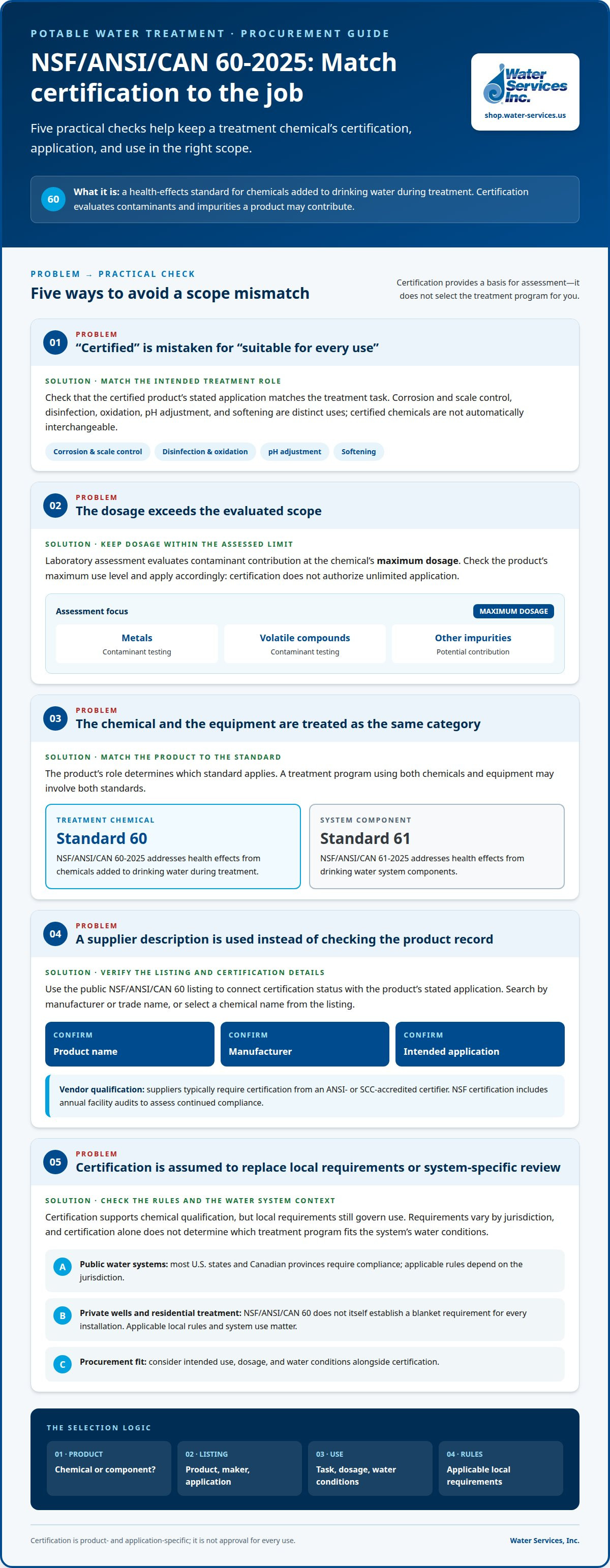
Third-party certification and vendor qualification
Third-party certification gives water suppliers an independent basis for evaluating treatment chemicals. In North America, suppliers typically require NSF/ANSI/CAN 60 certification from a certifier accredited by ANSI or SCC before considering a chemical for vendor qualification. This connects product approval with a recognized certification process, rather than relying only on a supplier’s description.
Certification organizations also have criteria. NSF/ANSI 223 establishes minimum requirements for organizations that certify products against NSF/ANSI/CAN 60. A qualifying review should therefore consider both the chemical’s listing and the certifier’s role. NSF certification includes annual facility audits to assess continued compliance. These audits add ongoing oversight beyond the initial evaluation, while certification remains specific to the listed product and its use.
Qualifying a product still means matching it to the treatment task. A corrosion inhibitor, for example, serves a different purpose from a pH adjustment chemical. Confirm the product name, manufacturer, and application in the certification record, then match those details to procurement documents. Certification provides evidence of a health-effects evaluation, not a substitute for process design, dose control, or site operating procedures.
To select and handle a certified chemical safely, match its listed application to the system’s treatment need, then follow the product directions and site handling procedures. Keep the product identity and dosage information consistent across purchasing and operating records. This supports traceability if the product, application, or treatment plan changes.
NSF consulting services and training sessions do not give an advantage in obtaining certification and are separate from certification decisions. Treat certification status as the relevant qualification evidence. For a chemical used in drinking water treatment, verify its product listing and certification scope, then assess whether its intended function suits the system. This prevents certification for one application from being mistaken for approval for another.
How can I verify a chemical supplier's NSF certification and product listing?
Use the NSF certified drinking water treatment chemicals search to check a product’s public listing. Certified products appear in the listing after testing and approval. Search by manufacturer name or trade name, then confirm the result matches the chemical being considered. A similar name alone doesn’t establish that the specific product has the relevant certification.
Search by manufacturer name or trade name using at least three letters. Enter a distinctive part of the name, then review the matching results. You can also choose a chemical name from the drop-down menu. This is useful when the chemical category is clearer than the supplier’s branding. For example, search for a corrosion-control chemical by its listed chemical name.
Compare the result’s manufacturer, product or trade name, and treatment category with the supplier’s documentation. Confirm that the listing matches the exact product, not another formulation from the same manufacturer. Then check that its stated use aligns with the intended application. This is important because certification applies to the listed product and its evaluated use.
Facility location is another useful search filter. The listing lets users filter facilities by US state, country, or region, which can help distinguish manufacturers or facilities with similar names. Record the listing details alongside the product information used in procurement so purchasing and treatment records refer to the same chemical.
A listing helps verify certification status; it does not determine the right chemical or dosage for a particular system. Keep the product identity, intended application, and operating instructions aligned. For corrosion and scale control, compare the listed treatment role with the system’s actual need before selecting a product. This connects certification evidence to the intended application rather than relying on a supplier name alone.
For treatment planning, review water treatment chemical options alongside the system’s intended use and operating requirements.
Water Services: Water Treatment Antiscalants and Chemicals
Water Services, Inc. offers Water Treatment Antiscalants and Chemicals for treatment programs that need corrosion or scale control. Consider this offering when you’re matching a chemical treatment need with system conditions and procurement requirements. NSF/ANSI/CAN 60 certification helps evaluate a product’s health effects, while the intended application and dosage remain central to selection.
Use the product listing to confirm a chemical’s identity and certified use before purchase. Then assess how the treatment fits the operating process and whether supporting equipment is needed. Water Services, Inc. also offers Goulds Water Technology Pumps, Viqua UV Water Purification Systems, and Hydranautics RO Membranes for related water-treatment applications.
Make the Next Treatment Decision With Confidence
Make certification information practical by connecting the treatment objective with the system’s operating needs. For corrosion and scale control, consider the chemical’s intended use alongside the equipment and treatment stages it must work with. NSF certified chemicals for potable water provide a basis for evaluating products, while application fit remains central to a sound procurement decision.
Water Services, Inc. offers treatment chemicals and equipment for water-treatment applications, including Goulds Water Technology Pumps, Viqua UV Water Purification Systems, and FilmTec Reverse Osmosis Membranes. These products serve different roles in a treatment setup, so begin by defining the requirement your system needs to address. A focused discussion can help frame the decision without treating certification as a substitute for system-specific selection.
Contact Water Services, Inc. to discuss your water treatment requirements and identify a suitable next step.
Frequently Asked Questions
Why work with NSF?
NSF certification gives water-treatment teams a structured way to assess products for health effects and regulatory needs. NSF offers certification for treatment chemicals and media, supporting product evaluation across markets. For procurement, this framework can support product review, supplier qualification, and documentation. Certification does not establish that a chemical is right for every treatment process.
What does NSF/ANSI/CAN 60 certification mean for chemicals used in drinking water?
It means a drinking water treatment chemical has been assessed against health-effects requirements for contaminants and impurities it may contribute. The review considers the product’s intended application and evaluated maximum dosage. Certification addresses health effects, not treatment effectiveness or system performance. A certified product still needs to suit the process and be used within its listed conditions.
Which chemicals are NSF/ANSI/CAN 60 certified for potable water treatment?
Certified products can include corrosion inhibitors, disinfection and oxidation chemicals, pH adjustment agents, softening chemicals, precipitation and sequestering products, well-drilling aids, and other specialty treatment chemicals. Certification is product-specific, not blanket approval for every chemical in a category. A product listing identifies the certified chemical and its use, helping distinguish it from similar formulations or trade names.
What NSF certification standards apply to potable water contact materials besides NSF/ANSI/CAN 60?
NSF/ANSI/CAN 61 addresses health effects from drinking water system components, rather than treatment chemicals. NSF/ANSI/CAN 600 is a companion standard to Standards 60 and 61; it focuses on health-effects evaluation and criteria for drinking water chemicals. The relevant standard depends on the product’s role. A chemical added during treatment and a component contacting water are evaluated under different standards.
What are the maximum use levels and dosage limits for NSF-certified water treatment chemicals?
There is no universal dosage limit for all certified chemicals. The applicable use level depends on the product and its listed application. Certification testing evaluates contaminant contribution at the chemical’s maximum dosage, while SPAC describes the maximum contaminant concentration a single product may contribute to drinking water. Use the product listing and application instructions to determine the relevant limit.
0 comments