

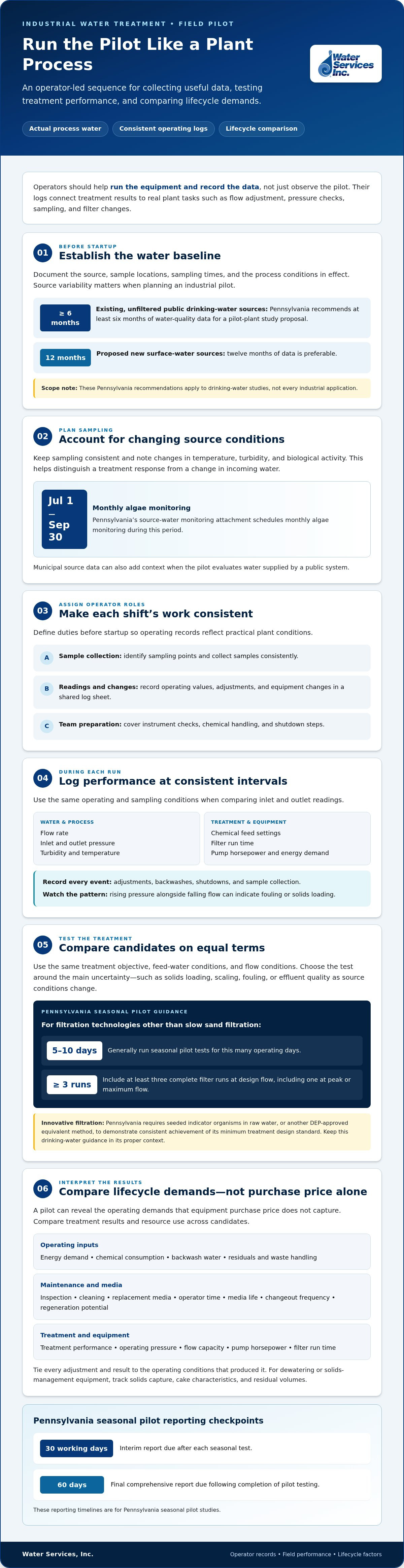
Operators should be part of the pilot, not just its audience. They can help run the equipment and record the data needed to compare treatment options. Pilot testing for industrial water treatment can reveal media life, changeout frequency, regeneration potential, operating pressure, pump horsepower, and energy demand.
Comparing technologies by purchase price alone can overlook the operating demands that drive lifecycle cost. A field pilot lets teams evaluate treatment performance with actual process water and see how equipment behaves under real operating conditions.
This article explains how operators can take part, which performance measures to track, and how to compare lifecycle costs without relying on unsupported price estimates. It also covers filter media, operating time, and other factors that shape pilot design and duration. Use the resulting data to make a more informed treatment technology decision.
Key Takeaways
- Give operators defined roles in running the pilot and recording operating data, so results reflect practical plant conditions.
- Compare treatment options across energy demand, maintenance, media replacement, and other lifecycle factors, not equipment purchase cost alone.
- Track filter performance across complete runs and changing water conditions to assess media behavior and treatment consistency.
- Plan field testing around the actual water, process conditions, monitoring needs, and performance measures the project must evaluate.
- Identify operational risks early, including unstable flow, fouling, sampling gaps, and safe handling of process water and treatment chemicals.
Can operators participate in pilot operation?
Yes. Operators can collect water data, run pilot equipment, and record treatment performance under actual operating conditions. Their involvement connects engineering assumptions with daily tasks such as adjusting flow, checking pressure, and documenting filter changes. In pilot testing for industrial water treatment, these operating records help teams assess media life, changeout frequency, regeneration potential, pump horsepower, and energy demand.
Start with a baseline for the water supply. Record sample locations, sampling times, and the process conditions in effect. For existing unfiltered public drinking-water sources, Pennsylvania recommends at least six months of water-quality data for a pilot-plant study proposal. For proposed new surface-water sources, twelve months of data is preferable. These recommendations apply to drinking-water studies, not every industrial application, but source variability matters when planning industrial pilots.
Seasonal conditions can change the sample plan. Pennsylvania’s source-water monitoring attachment schedules monthly algae monitoring only from July 1 through September 30. Operators can coordinate sampling with those conditions and note changes in temperature, turbidity, and biological activity. A consistent log helps engineers distinguish a treatment response from a change in incoming water. Municipal source data can also provide useful context when the pilot evaluates water supplied by a public system.
Build an operating log around the treatment process. At consistent intervals, record flow rate, inlet and outlet pressure, turbidity, temperature, chemical feed settings, and filter run time. Note every adjustment, backwash, shutdown, and sample collection. For example, rising pressure alongside falling flow can indicate fouling or solids loading. Pair these readings with pump horsepower and energy demand to support operating and maintenance cost planning.
- Operating costs: Track energy demand, treatment chemical use, backwash water, and waste handling.
- Maintenance: Log inspections, cleaning, replacement media, and operator time.
- Performance: Compare inlet and outlet readings under the same flow and sampling conditions.
Assign operators clear pilot duties before startup. One operator can collect samples, while another records readings and equipment changes. Train the team on sampling points, instrument checks, chemical handling, and shutdown steps. Use a shared log sheet so each shift records the same fields. For Pennsylvania seasonal pilot studies, an interim report is due within 30 working days after each seasonal test; the final comprehensive report is due within 60 days following completion of pilot testing.
Keep the data plan beside the equipment plan. A water-treatment equipment selection should reflect the source-water profile, target performance, and operating tasks the pilot measures. That connection helps operators and engineers interpret results as practical plant requirements, rather than isolated test readings.
Comparing treatment technologies and lifecycle costs
A pilot gives engineers a shared basis for evaluating treatment technologies under comparable feed-water and flow conditions. Select methods against the same treatment objective, then record performance and resource use. Filtration and membrane processes, for example, may address different contaminants. Compare them against the project’s actual water chemistry and discharge or reuse requirements.
Lifecycle cost planning extends beyond equipment purchase. Build a cost model around inputs the pilot can measure: energy demand, chemical consumption, cleaning frequency, replacement media, residuals handling, and operator workload. A pilot trailer can also test dewatering or solids-management equipment near the process stream. Track solids capture, cake characteristics, and residual volumes to connect performance with disposal and maintenance demands, rather than relying on purchase price alone.
Choose technologies that address the main uncertainty in the proposed treatment train. If solids loading is the concern, test filtration and monitor pressure changes, flow, and run length. If water chemistry drives scaling, evaluate chemical treatment alongside the membrane or filtration method. Define the question the pilot must answer, such as whether pretreatment reduces fouling or a media choice maintains effluent quality as source conditions change.
Innovative filtration needs a stronger demonstration plan than a familiar process. Pennsylvania requires seeded indicator organisms in raw water, or another DEP-approved equivalent method, to demonstrate consistent achievement of its minimum treatment design standard for innovative filtration technologies. Keep that drinking-water guidance in its proper context. For filtration technologies other than slow sand filtration, seasonal pilot tests should generally run for 5 to 10 operating days and include at least three complete filter runs at design flow, including one at peak or maximum flow.
Compare the same measures across each candidate: flow capacity, operating pressure, energy demand, chemical feed, maintenance tasks, and treatment results. Pump horsepower affects energy demand, while filter media influences run time and replacement needs. Record every adjustment and its operating conditions so results remain tied to the circumstances that produced them.
- Define: Identify the water-quality target and the decision the pilot must support.
- Measure: Use consistent flow, sampling, and operating records across candidate methods.
- Evaluate: Compare treatment performance with energy, chemicals, maintenance, and residuals handling.
When a project requires filtration or treatment equipment for a pilot comparison, review water treatment equipment options against the process requirements. The most useful comparison links each performance result to a practical operating and maintenance consequence.
Filter media, run times, and performance evaluation
Filter media affects solids capture, pressure loss, run length, and cleaning requirements. Test proposed media with representative source water under the intended operating conditions. Track inlet and outlet turbidity, flow, differential pressure, and time between cleaning or backwashing. For wastewater, record suspended solids and sludge characteristics alongside filtration results. Organic matter and seasonal changes in water chemistry can affect fouling, so log these conditions for each run.
Tertiary filtration with free-fiber cloth filters can be evaluated as a polishing step after biological or other upstream treatment. Measure solids carryover, flow stability, pressure changes, and cleaning frequency. Compare effluent before and after the cloth filter under similar feed conditions to see whether it addresses the target solids and how operating demands respond to upstream variation. Document cloth condition and any blinding or uneven flow.
Loading rate must match the proposed design and the applicable approval basis. Kansas Department of Health and Environment regulations stipulate a maximum loading rate of 4 gallons per minute per square foot for a dual-media filter. The Wichita proposal used 5 GPM/SF, so its pilot tested that higher rate directly. The Wichita pilot used unfiltered water with turbidity of 2.0 NTU or higher and had to process it successfully for 30 continuous days. Its design change reduced the planned filter count from 20 to 16.
For drinking-water filtration, Pennsylvania guidance generally calls for 5 to 10 operating days per seasonal pilot test for technologies other than slow sand filtration. Each test should include at least three complete filter runs at design flow, including one at peak or maximum flow. Pennsylvania also specifies that a pilot filter diameter must be at least 50 times the media diameter. These criteria help assess repeatability and reduce wall effects that could distort results in a small column.
Interpret results against the intended application, not a single reading. The U.S. Environmental Protection Agency states that filtered drinking water must have turbidity below 0.3 NTU. Pennsylvania describes slow sand filtration as generally operating below 0.4 meters per hour. Those values apply to drinking-water guidance, not every industrial process. In Wichita, the pilot tested a design loading rate above the Kansas dual-media limit, making documented performance central to the design decision.
- Compare: Record flow, pressure change, effluent quality, and run duration for each media.
- Repeat: Include complete runs at design and peak flow to reveal performance variation.
- Size: Relate media diameter and pilot geometry to the intended filter design.
Pilot equipment field testing
Field testing places a small, functional treatment system beside the process it is designed to serve. The pilot treats the facility’s actual water under real operating conditions, revealing variations that bench tests may not reproduce. Pilot testing for industrial water treatment can also help determine industrial wastewater flow rates during project planning, before the full treatment train is designed.
Begin by defining the decision the field test must support. Identify the process stream, treatment objective, sampling points, and operating limits. For industrial wastewater, measure suspended solids, phosphorus, nitrogen, BOD, and COD before treatment design. These indicators describe different aspects of the water and help focus the test on relevant treatment stages. Record influent conditions alongside treated-water results so performance is assessed against the feed actually tested.
Next, prepare the test location and connections. Check the pilot’s feed, discharge, drainage, power, and space requirements against the facility layout. Map sample points and identify how operators will isolate equipment for maintenance. Use a field log to capture flow, pressure, temperature, chemical additions, alarms, and process adjustments. Keep sampling locations consistent throughout the run, since moving a sample point can make readings difficult to compare.
Duration depends on the process and the evidence required. Industrial wastewater pilot trials may run from two weeks to six months. Municipal water and wastewater pilots commonly run 6-12 weeks. PFAS pilots often continue for several months to capture breakthrough curves. For a Wichita water-treatment pilot, continuously operating processes required 24/7 monitoring. These examples show why test duration and monitoring schedules should match process behavior, not a convenient calendar window.
Column testing and field pilots answer different questions. Engineering consultants commonly use column testing to select treatment media, then pilot testing to validate the overall treatment train. Media that performs well in a column may behave differently in an assembled process, where pretreatment, filtration, and downstream stages interact. Test the complete sequence when integration is the main uncertainty. Isolate an individual stage when the question concerns its specific contribution.
- Before startup: Document the feed source, target parameters, flow path, sampling locations, and shutdown method.
- During operation: Log process readings, sample results, alarms, adjustments, and interruptions against operating conditions.
- At review: Compare treated-water quality and flow with the project objectives and observed process changes.
Close the test with a data review that connects readings to design decisions. Compare operating periods, identify interruptions, and distinguish normal process variation from equipment issues. For example, a change in influent solids may explain a shift in filtration performance. Keep raw readings and the operating log together so engineers can trace each conclusion to the field conditions behind it.
What are common pilot-testing risks, failure modes, and safety considerations?
A field pilot can produce misleading results if feed water, flow, or sampling changes without being recorded. A solids spike, for example, may look like filter failure when influent samples are missing. Keep sample points fixed, record process adjustments, and note interruptions alongside each reading. This helps distinguish equipment behavior from changing wastewater conditions.
Hydraulic problems can also distort performance. Air in a line, unstable feed pressure, leaks, or a blocked sample port can change flow through the treatment train. Before startup, trace the flow path from feed connection to discharge. Check valve positions and compare indicated flow with operating data. If pressure rises while flow falls, inspect for fouling, blockage, or media compaction before changing treatment settings.
Sampling and measurement errors can undermine a pilot. A poorly mixed sample, dirty container, or instrument outside its calibration process can compromise comparisons between influent and effluent. Use the same sampling locations and documented procedure throughout the test. Record instrument identification, calibration status, sample time, and unusual water appearance. For BOD, COD, phosphorus, nitrogen, and suspended solids, tie results to the operating conditions at collection.
Plan physical safeguards around the pilot layout. Before startup, inspect hoses, fittings, electrical connections, drains, and access routes. Route hoses to reduce trip hazards and protect connections from vehicle traffic. Identify isolation points so operators can stop feed and relieve process pressure before maintenance. Spills or leaks can affect nearby workers and the facility floor, so keep process-appropriate containment and cleanup materials close to the test area.
Chemical handling requires controls specific to each treatment chemical. Keep containers identified, follow the chemical’s safety information, and train assigned operators in transfer and spill response. For example, inspect antiscalant feed equipment for leaks and secure tubing connections. Never combine chemicals based on assumption. Confirm compatibility and follow established site procedures before changing chemical feed or cleaning equipment.
Long runs introduce staffing and data-continuity risks. The Wichita pilot required 24/7 monitoring of continuously operating processes. Use shift handovers to record alarms, flow changes, sample collection, maintenance, and shutdowns. A missing overnight entry can obscure when a process deviation began. Define who responds to abnormal readings and who authorizes restart, then preserve those records with the pilot results.
- Before operation: Inspect connections, sample points, access, and isolation controls.
- During the test: Log deviations, alarms, chemical changes, and equipment interventions.
- Before maintenance: Isolate the relevant process and follow site procedures for pressure and chemical hazards.
For field teams reviewing protective equipment needs, review personal protective equipment relevant to the pilot’s tasks and site conditions.
Water Services, Inc.: Goulds Water Technology Pumps
Water Services, Inc. can help connect pilot findings to equipment choices when a project moves from testing toward treatment-system planning. Goulds Water Technology Pumps are relevant when pilot results identify pumping requirements, while Viqua UV Water Purification Systems, Hydranautics RO Membranes, and Water Treatment Antiscalants and Chemicals relate to other treatment stages. Match each product category to the process need identified by the pilot, such as flow, membrane treatment, UV purification, or scaling control. This keeps equipment selection tied to measured operating conditions rather than assumptions. For pump and water-treatment product information, visit Water Services, Inc.’s pump collection.
Turn pilot results into a defined equipment plan
Use the pilot’s operating record to define the next project decision. Identify which treatment stages met their targets, the conditions that shaped performance, and the equipment requirements that follow. This gives engineering and operations teams a shared basis for moving from pilot testing for industrial water treatment to a practical system specification.
Water Services, Inc. offers Goulds Water Technology Pumps, Viqua UV Water Purification Systems, and FilmTec Reverse Osmosis Membranes for industrial water-treatment applications. These products can support projects where pilot findings point to pumping, UV purification, or reverse osmosis requirements. Match equipment to the process duty and the project’s measured needs.
Bring your process requirements and pilot findings into the next equipment-planning conversation. Contact Water Services, Inc. about equipment options and take the next step toward a treatment plan grounded in field data.
Frequently Asked Questions
How long does a pilot test need to run?
A pilot may run from around a month to more than a year, depending on what it must demonstrate. A short evaluation can assess immediate treatment response, while seasonal variation or membrane breakthrough may require longer observation. Set the endpoint around measurable evidence, such as stable effluent quality or a defined change in operating performance. Duration alone does not show whether the test answered its engineering question.
Is the pilot expensive?
Pilot costs depend on equipment configuration, site preparation, instrumentation, staffing, sampling, treatment chemicals, and residuals handling. Continuous monitoring or a longer operating period also requires more operating resources. Compare the pilot scope with the decisions it can inform, including equipment sizing, energy demand, maintenance, and replacement needs. This helps determine whether the information gained supports a better-informed lifecycle assessment.
What Is Pilot-Scale Testing?
Pilot-scale testing uses a small, functional treatment system to evaluate a process before full-scale implementation. Unlike a laboratory test, it can use actual source water and operating equipment. Unlike a full facility, it assesses a treatment method on a limited scale. For example, a pilot can reveal whether upstream solids affect downstream filtration before the complete treatment train is designed.
What is pilot testing in industrial water treatment?
Pilot testing in industrial water treatment is a controlled field evaluation of equipment or a treatment train using process water. It helps engineers connect treatment results with operating requirements before final system design. The test can investigate a specific uncertainty, such as whether pretreatment reduces fouling before reverse osmosis. Useful results link influent conditions, process settings, and treated-water quality.
When should an industrial facility conduct a water-treatment pilot study?
Conduct a pilot study when existing data cannot resolve a design decision with confidence. Common triggers include a changing source, a new wastewater stream, an unfamiliar treatment method, or uncertainty about how process stages interact. A facility considering water reuse, for example, may pilot the proposed treatment sequence before selecting full-scale equipment. A clearly defined decision keeps the test focused on relevant evidence.
What water quality data and samples are needed before a treatment pilot?
Collect representative samples and document process conditions at each sampling point. For industrial wastewater, relevant parameters can include suspended solids, phosphorus, nitrogen, BOD, and COD. Include source location, operating state, and upstream process changes in the sample record. A sample from one stable production period may not represent another operating condition, so capture the conditions the pilot is designed to evaluate.
How to design and size an industrial water-treatment pilot system?
Start with the treatment objective and the flow conditions the pilot must represent. Use these requirements to determine vessel sizing, media volume, and contact time. Include peak-day flow planning and account for water chemistry, temperature shifts, solids loading, and fouling. The design should reproduce conditions relevant to the decision, rather than simply scaling down full-size equipment. Document the assumptions behind each sizing choice.
How long does an industrial water-treatment pilot test take?
Industrial wastewater pilot trials may run from two weeks to six months. Duration depends on process behavior and the evidence sought. A test focused on immediate treatment response may require less observation than one tracking fouling or breakthrough over time. Define measurable completion criteria before startup, then check that the operating record captures representative feed conditions and treatment changes important to the design.
0 comments