

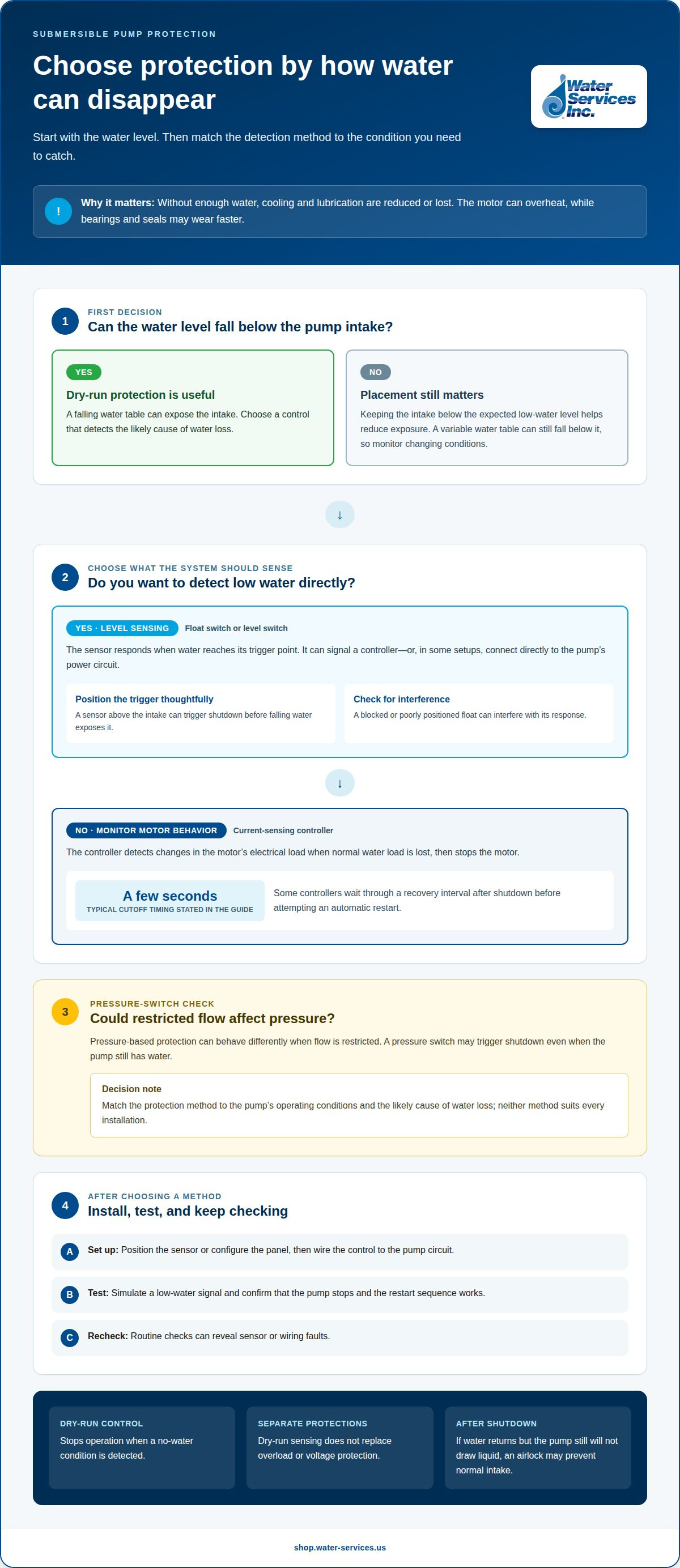
A pressure switch isn’t automatically the right safeguard for every submersible pump. Dry-run protection is needed when the water supply can fall below the pump intake. Current-sensing systems typically detect dry running and cut power within a few seconds. Protecting submersible pumps from running dry starts with matching the protection method to how water loss can occur.
Before choosing a controller or sensor, consider what happens when water levels fall. Dry operation can leave a pump without the liquid that helps cool and lubricate its moving parts, so a suitable cutoff can help limit damage.
This guide explains when dry-run protection is useful, how pump savers, water-level sensors, and pressure switches work, and what affects their response. It also covers why pressure-based protection can behave differently when flow is restricted, and how to choose an approach that fits the pump’s operating conditions.
Key Takeaways
- Assess whether the water level can drop below the pump intake to decide if dry-run protection is needed.
- Compare current-sensing controls with float switches: one monitors motor behavior, while the other responds to a low-water level.
- Understand how dry operation can contribute to overheating and wear, and why stopping the pump promptly matters.
- Pressure switches can provide protection, but restricted flow may trigger a shutdown even when the pump has water.
Pump savers to prevent pump from running while dry?
A pump saver can help when changing water levels might expose the intake. Current-sensing protection detects dry running and can cut power within a few seconds.
Damage From Dry Running
Dry running occurs when a submersible pump operates without enough water around its intake. If the water table in a borewell falls, the intake may become exposed, interrupting the water that cools and lubricates moving parts.
Without that liquid, the motor can overheat, and bearings and seals may wear faster. Air entering the impeller can reduce pumping efficiency and cause vibration that stresses internal components. Replacement costs may include the pump and the labor needed to reach and remove a unit installed deep in a well. Difficult access can also add to installation costs.
Pump Placement and Submergence
A variable water table can still fall below the intake, so placement alone may not address every risk. Regularly monitoring the water level and pump operation helps identify changing conditions. For pump systems, the pump selection range is relevant when considering equipment for the application.
Protection Panels and Methods
A control panel can monitor motor current, apply operating thresholds, and stop the pump when it detects dry running. Current-sensing controls respond to changes in the motor’s electrical load. A water-level sensor instead signals when water drops below its set point. Reliability depends on matching the detection method to the likely cause of water loss and the installation.
Which method offers the right balance of reliability and cost? A sensor detects low water directly, while current-sensing controls infer dry running from motor behavior. Neither method suits every installation.
Installation involves positioning the sensor or configuring the panel, then wiring the control to the pump circuit. Test the setup to confirm that a simulated low-water signal stops the pump and that the restart sequence works. Routine checks can reveal sensor or wiring faults.
How fast does dry-run protection actually react?
Response depends on what the protection system senses. A water-level float acts when water reaches its trigger point, while current-sensing controllers detect changes in motor load and can cut power within a few seconds.
Float and Level Switches
A float switch detects water level through the movement of a buoyant float. A level switch signals when liquid crosses its set point. Both can tell a controller to stop the pump before water drops below a safe threshold.
Some float switches connect directly to the pump’s power circuit and switch it on or off as the liquid level changes. Others send a signal to a control panel, which then interrupts power. Position matters: a sensor above the pump intake can trigger shutdown before falling water exposes it.
Unlike a current-sensing controller, a float responds to the water level itself. It activates when the level reaches its trigger point and the float moves, so the installation’s threshold determines when shutdown begins. A blocked or poorly positioned float can interfere with the response.
Electronic Controller Detection
An electronic dry-run controller can detect low-water conditions by monitoring changes in the motor’s electrical current. When the pump loses its normal water load, the change in current signals the controller to stop the motor. Current-sensing protection typically cuts power within a few seconds.
After shutdown, some controllers wait through a recovery interval before attempting an automatic restart. This can restore operation if water returns while preventing continuous running during a temporary shortage. Dry-run sensing addresses a no-water condition; it doesn’t replace separate overload or voltage protection.
For systems using electronic controls, the control method and the pump’s operating conditions should be considered together. Explore electric power controls for components relevant to pump control applications.
Motor overheating during dry running
Water surrounding a submersible motor carries heat away during normal operation. When the water level drops below the pump intake, this cooling is reduced or lost. The motor remains inside its waterproof casing, but the casing doesn’t replace the cooling effect of moving liquid. For example, a pump running in an exposed section of a well can continue operating without adequate water around its motor.
Heat buildup matters because prolonged high temperatures stress motor components and can shorten operating life. Dry running also removes the liquid that lubricates moving parts, increasing bearing and seal wear. These effects can occur together: a pump may lose cooling while its impeller continues rotating and moving little or no water. The risk is especially relevant where water levels vary and the pump runs unattended.
A controller reduces this exposure by stopping the motor when it detects a no-water condition. Current-sensing protection monitors changes in the motor’s electrical load, while a water-level sensor responds to the level itself. Neither method cools the motor; both interrupt operation so the pump isn’t left running dry. Dry-run protection differs from overload and voltage protection, which address other electrical faults.
After shutdown, a controller may wait for water to recover before attempting an automatic restart. This pause can prevent repeated operation during a continuing shortage. If water returns but the pump still fails to draw liquid, an airlock may be preventing normal intake. Repeated restart attempts won’t restore cooling in that case; assess the water supply and pump condition before continued operation.
Pressure switches for dry-running protection
A pressure switch may respond to changes in system pressure or flow and stop the pump. Unlike a float switch, it responds to system conditions, not directly to water level. Pressure-based protection can be useful in some installations, but its performance depends on normal system behavior.
During dry running, a pump may fail to build its usual pressure or flow. The switch detects the change and signals the pump to stop. However, low flow can have other causes. A partially silted borewell, for example, may restrict flow and trigger a shutdown even when water is available. Pressure alone doesn’t identify the cause of the change.
Controller specifications show why matching the device to the pump matters. One listed 110-120 V pressure controller is rated at 0.75 kW and 10 A, with a 1.5-3.0 bar start pressure and a G1-inch connection. Those ratings describe that controller, not a universal setting for submersible pumps. The pump’s electrical load, normal pressure, flow, and system connections all affect suitability.
A pressure gauge can help interpret system behavior by showing pressure during operation. An Ashcroft pressure gauge measures pressure; the switch or controller performs the shutdown function. Keeping those roles clear prevents mistaking a gauge for dry-run protection.
The practical takeaway: pressure switches can protect against abnormal operating conditions, but they may respond to restricted flow as well as water loss. Where water level can fall below the intake, direct level sensing detects that condition more directly. For pressure-based protection, select a controller whose electrical and hydraulic ratings match the installation, and set its operating threshold against normal pump performance. Review pressure-control options for pump system applications.
Water Services, Inc.
Water Services, Inc. offers Goulds Water Technology Pumps for water-system applications. If you’re evaluating pump equipment, consider the dry-run risks, water levels, and control options alongside the application and operating conditions, including the risk of changing water levels.
Water Services, Inc. also offers Viqua UV Water Purification Systems, Hydranautics RO Membranes, and Water Treatment Antiscalants and Chemicals for broader water-treatment needs. These products serve different purposes from dry-run controls. Choose based on whether your priority is pumping equipment, purification, membrane treatment, or water chemistry.
Contact Water Services, Inc. to discuss water-system products for your application.
Make pump protection part of the next design decision
Make dry-run risk part of the system design record, not a late control-panel decision. Protecting submersible pumps from running dry starts with documenting the application, water-source behavior, and operating priorities. This record can guide equipment selection and help keep future system changes aligned with the original requirements.
For a new installation or system change, consider pump operation and water-treatment needs together. This gives the people responsible for equipment selection and maintenance a shared reference when reviewing the setup. It also clarifies the pump’s role within the wider water system.
Contact Water Services, Inc. for pump advice. A clear next step can help you move forward with confidence.
Frequently Asked Questions
Does every pump need this?
No, dry-run protection is most useful when the water supply can fall below the pump intake. A pump drawing from a variable-level well faces a different risk from one supplied by a stable, continuously flooded source. Consider how water availability changes during normal operation, seasonal shifts, or interruptions. That operating context helps determine whether a cutoff adds meaningful protection.
Does dry-run protection work the same on AC and DC motors?
The detection principle can be similar for AC and DC motors, but implementation differs by motor type. A controller must interpret electrical behavior using a method suited to the motor’s power system. For example, don’t assume an AC control arrangement is suitable for a DC pump. The motor and controller need compatible sensing and switching arrangements.
What Happens If a Submersible Pump Runs Dry?
A pump may continue operating without delivering water, and air entering the impeller can cause vibration or reduced performance. Even if water returns, an airlock can prevent the pump from drawing liquid again. Restoring the water level alone may not restore pumping. The immediate concern is continued operation without normal liquid movement through the pump.
Will dry-run protection cause false shutdowns?
It can, particularly when a controller interprets restricted flow as a no-water condition. For example, a partially silted borewell may reduce flow enough to trigger a pressure-based cutoff, even though water remains present. The detection method matters: pressure switches respond to system pressure or flow, while a level sensor responds to water height. Match the trigger to the likely fault.
What damage can dry running cause to a submersible pump?
Dry operation can accelerate bearing and seal wear because liquid is no longer available to lubricate moving parts. Air entering the impeller can affect pump performance and cause vibration. Repeated exposure increases the chance of internal component damage or structural failure. The extent depends on the pump’s operating conditions and how long it runs without water.
What is the best low-water cutoff switch for a submersible pump?
There isn’t one cutoff switch that suits every installation. Where water levels can fall, a float or level sensor detects low water directly. Current-sensing controllers detect changes in motor load, while pressure switches respond to system behavior and may react to restricted flow. Choose based on the pump’s motor type, installation, and likely cause of water loss.
0 comments