

A pump that rattles, vibrates, or suddenly loses flow may be cavitating, not simply wearing out. In industrial centrifugal pump troubleshooting, consider noise and vibration alongside reduced flow or pressure. Low pressure can form vapor bubbles that collapse inside the pump and damage the impeller or housing. These signs suggest cavitation, but other faults can produce similar symptoms and need investigation.
It’s easy to focus on the sound and miss the operating conditions behind it. Pump sizing, suction conditions, and operation near the best efficiency point all affect cavitation risk; seal wear and shaft misalignment can cause separate performance problems. This guide explains how to recognize cavitation, assess sizing and seals, and investigate vibration, noise, and alignment. Follow a practical sequence to narrow down the cause and identify the next maintenance step.
Key Takeaways
- Use scheduled maintenance intervals to inspect mechanical seals and O-rings, and treat visible wear or leakage as a reason to assess repair or replacement.
- Trace falling flow or pressure to possible suction restrictions, solids buildup, or impeller wear before settling on cavitation as the cause.
- Match pump selection and operating conditions to system demand, then assess available NPSH and operation near the best efficiency point.
- Investigate vibration and unusual noise systematically: misalignment, bearing wear, and impeller damage can produce similar symptoms.
1. How often should industrial pump seals be replaced?
For general industrial service, inspect mechanical seals every 6 to 12 months. Also inspect seals and O-rings during each scheduled maintenance interval. Replace a seal when inspection shows wear or damage. A visible leak may require tightening or replacement, depending on seal condition. Record leakage, temperature, vibration, pressure, and flow readings during each maintenance visit.
Treat the pump and motor as one operating combination. A change in pump load can affect motor temperature and power consumption. Compare motor amperage with its normal readings and specifications. Rising power use may indicate increased friction, hydraulic problems, or inefficient motor operation. Pump faults can place extra load on the motor, while motor problems can disrupt pump operation.
If the motor overheats, inspect lubrication, cooling, and rotating parts for drag. Insufficient lubrication or rubbing components can increase friction and heat. When performance changes, check motor connections, voltage, and amperage. Confirm that the power supply matches the motor specifications and that the motor suits its operating duty. If the motor struggles to start, check for rubbing and incorrect assembly before returning the pump to service.
Repair or replacement costs depend on the failed component and the extent of damage. Replacing a seal differs from work on worn bearings, an impeller, or a failed motor. Diagnosis should identify the fault and whether it has affected connected components. That assessment provides a better basis for comparing repair with pump replacement than a generic price estimate.
Start troubleshooting by recording symptoms, then inspect the seal, coupling, bearings, and motor readings. Check for leaks, unusual heat, vibration, and changes in power use. Before opening equipment, isolate electrical power, relieve system pressure, and drain the pump as required. Return it to service only after assembly and operating checks. These steps help distinguish a seal leak from an electrical fault, overload, or mechanical drag.
2. How do I know if my pump is cavitating?
Cavitation can occur when suction flow is insufficient. Low pressure forms vapor bubbles near the impeller eye; when they collapse, they can damage the impeller and housing. Listen for unusual noise and watch for increased vibration, reduced flow, or falling pressure. Together, these symptoms raise concern, but vibration alone can also indicate misalignment, worn components, or an unbalanced impeller. A change in sound is a clue, not proof.
Check suction and discharge filters or strainers for clogs. A blockage can create a pressure imbalance inside the pump, while solids buildup can restrict flow and contribute to impeller wear. Match the impeller type to the liquid: an open-blade impeller suits liquids with minimal solids, while a semi-open blade can handle sediment and other solids. Worn impellers, seal leaks, and piping blockages can also reduce flow, so assess operating conditions before diagnosing cavitation.
Confirm that the impeller rotates in the direction needed to move liquid along the top of each blade’s curve. If the pump does not move liquid, fill the casing, check for obstructions, and verify the direction of rotation. After stopping and isolating the equipment, inspect the impeller for visible wear, damage, or lodged material. In industrial centrifugal pump troubleshooting, compare its condition with the operating history to distinguish gradual wear from sudden damage.
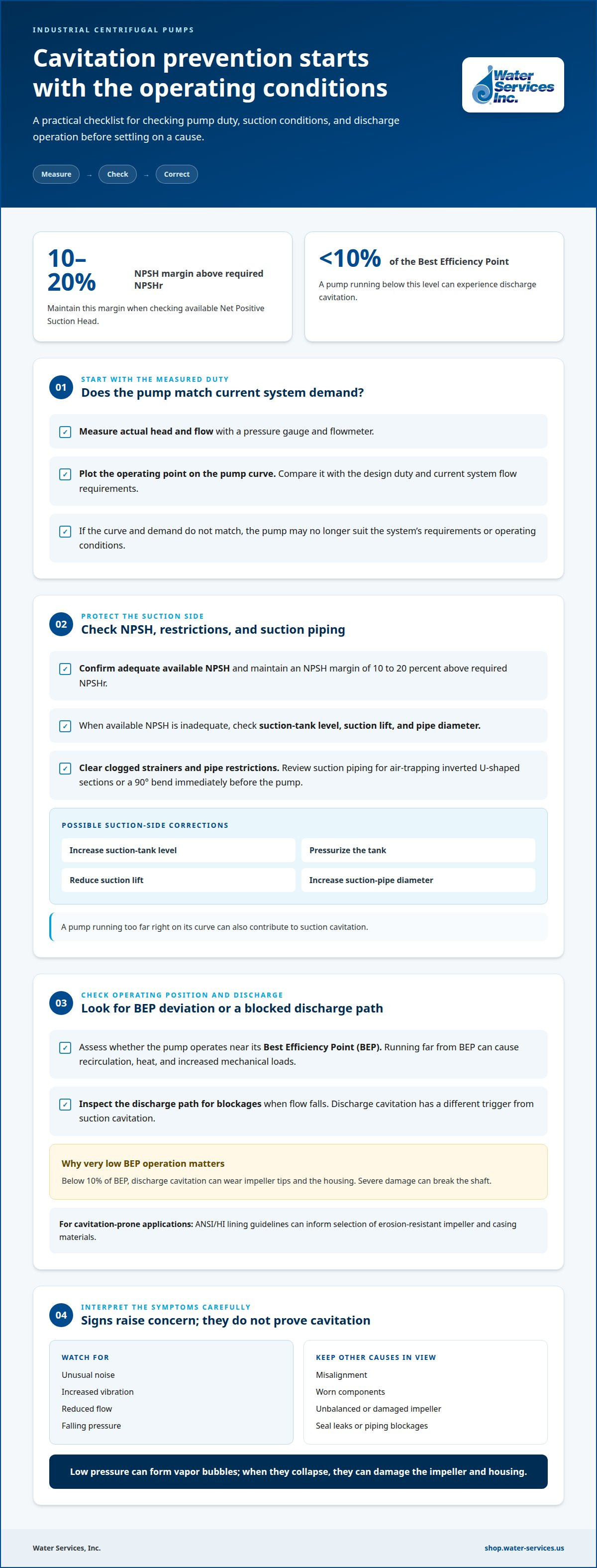
To interpret a performance curve, use a pressure gauge and flowmeter to measure actual head and flow, then plot that operating point on the pump curve. Compare it with the design duty and current system flow requirements. A mismatch may indicate that the pump no longer suits demand or operating conditions. If delivery is low, check the curve, suction restrictions, and impeller condition rather than assuming cavitation is the cause. This measured approach makes industrial centrifugal pump troubleshooting more precise.
3. Proper pump sizing and cavitation prevention
Common centrifugal pump failures include cavitation, clogged suction lines, seal leaks, worn impellers, and bearing problems. Cavitation starts when pressure drops enough for liquid to form vapor bubbles. As the bubbles collapse, they can damage the impeller and casing, increase vibration, and reduce flow or pressure. A pump running far from its Best Efficiency Point (BEP) can also experience recirculation, heat, and increased mechanical loads.
Start sizing checks by comparing actual system flow and pressure with the pump curve. Use a pressure gauge or flowmeter to locate the operating point, then assess whether the curve matches current demand. Confirm adequate Net Positive Suction Head (NPSH); industrial pumps should maintain an NPSH margin of 10 to 20 percent above required NPSHr. Check suction-tank level, suction lift, and pipe diameter when available NPSH is inadequate.
Correct suction problems before changing materials. Clear clogged strainers, remove pipe restrictions, and review suction piping for air-trapping inverted U-shaped sections or a 90° bend immediately before the pump. Increasing suction-tank level, pressurizing the tank, reducing suction lift, or increasing suction-pipe diameter can improve conditions. A pump running too far right on its curve can also contribute to suction cavitation.
Discharge cavitation has a different trigger: a blockage in the discharge pipe can create damaging conditions. Inspect the discharge path when flow falls, and assess whether the pump operates near its BEP. A pump running at less than 10% of its BEP can experience discharge cavitation. This can wear impeller tips and the housing, and severe damage can break the shaft. ANSI/HI lining guidelines can inform the selection of erosion-resistant impeller and casing materials for cavitation-prone applications.
4. Pump vibration, noise, and shaft alignment
Vibration is a symptom, not a diagnosis. Centrifugal pump vibration can point to pump-motor misalignment, cavitation, an unbalanced impeller, worn bearings, or blade damage. Rattling or grinding also warrants inspection for worn bearings and rubbing parts. Record vibration readings and operating conditions, then compare results with earlier measurements. Readings above 0.3 in/s are identified as a symptom of excessive pump vibration or noise.
Separate likely causes before starting repairs. Check for blade obstructions or visible damage, then inspect bearing condition and lubrication. Hot bearings may indicate lubrication problems or pump-motor misalignment. If the motor struggles, check whether rotating parts rub and whether the equipment is assembled correctly. Operation away from the Best Efficiency Point can also contribute to heat, radial loads, vibration, and high seal temperatures.
For a structured inspection, isolate the equipment before opening it. Examine seals for leaks, the impeller for wear or damage, bearings for roughness, and clearances against the manufacturer’s specifications. Take measurements and run tests to narrow down the fault; don’t assume vibration means misalignment. Check for leaks and record shaft alignment, vibration, temperature, pressure, and flow so repairs address the cause, not just the symptom.
If vibration points to a pump selection or duty mismatch, review centrifugal pump options against the system requirements.
Water Services
Water Services is a practical next step when troubleshooting points to pump selection or a broader water-system need. Its Goulds Water Technology Pumps may suit systems that need a pump change, while Water Treatment Antiscalants and Chemicals address water-treatment needs. The right option depends on the liquid, system demand, and operating conditions identified during diagnosis.
For a pump-related discussion, bring measured flow and pressure, the pump’s operating symptoms, and any changes in system demand. These details help focus the conversation on equipment needs rather than treating noise or reduced delivery as isolated symptoms. Contact Water Services to discuss your pump or water-treatment requirements.
Turn Pump Findings Into a Clear Next Step
Use inspection records to build a clear picture of the pump’s condition and system demands. Consistent records of operating symptoms, maintenance findings, and performance measurements help teams distinguish a recurring fault from a one-time event. They also provide a stronger basis for pump-selection discussions than sound or vibration alone.
For industrial centrifugal pump troubleshooting, connect equipment decisions to the wider water process. Water Services offers Goulds Water Technology Pumps, Viqua UV Water Purification Systems, and FilmTec Reverse Osmosis Membranes. These products address different equipment needs, so focus the discussion on your application and the system requirements identified during diagnosis.
Bring the relevant operating information and the specific decision your team is weighing. Contact Water Services for pump support and take the next step with a clearer basis for action.
Frequently Asked Questions
How do I know if my pump is cavitating?
Suspect cavitation when unusual noise or vibration occurs alongside reduced flow or pressure. Check whether symptoms change with suction conditions or system demand. Record the operating state when the sound starts, then compare flow and pressure readings across those conditions. Misalignment or worn components can produce similar symptoms, so use several indicators rather than diagnosing by sound alone.
Can a pump be repaired on-site or does it need to be removed?
Whether a repair can be done in place depends on the fault and equipment access. External piping, connections, and operating readings may be checked without removing the pump. Internal damage to an impeller, bearing, or seal may require disassembly and suitable workspace. First, document the symptoms and equipment layout, then identify which components need direct inspection.
How often should industrial pump seals be replaced?
Inspect mechanical seals every 6 to 12 months in general industrial service, and during each scheduled maintenance interval. Replace a seal when inspection shows wear or damage; leakage calls for assessing whether it needs adjustment or replacement. For example, a new leak after a process change should be considered alongside pressure and temperature records, not treated as an isolated seal issue.
What is the most damaging pump problem?
Cavitation can cause severe damage as collapsing vapor bubbles erode the impeller and housing. In severe discharge cavitation, impeller wear can progress to shaft breakage. The extent of damage depends on operating conditions and how long the fault continues. Investigate a sudden change in vibration, flow, or pressure before continued operation adds further stress to pump components.
How do you troubleshoot a centrifugal pump that will not start or prime?
If a pump will not start, check motor connections, supply voltage, and amperage against the motor specifications. If it starts but fails to prime, confirm that the casing contains liquid, inspect suction piping for air leaks, and verify there is adequate liquid at the suction source. If the pump stops shortly after startup, look for trapped air or piping leaks before restarting.
What causes low flow or low discharge pressure in a centrifugal pump?
Low flow or pressure can result from a worn impeller, clogged piping, blocked filters, or seal leakage. Compare actual flow and head with the pump curve to see whether the operating point meets system demand. A suction restriction may starve the pump, while a discharge blockage can also disrupt performance. Check both sides of the pump before concluding that the impeller is the only cause.
0 comments