

Chemicals are used throughout conventional water treatment, not just for disinfection. Coagulants help remove particles, while chlorine or chloramine may disinfect water. Reducing chemical consumption in water treatment starts with matching doses to changing water quality and process needs.
Lower chemical use can be worth exploring when hard water, scale control, or membrane cleaning complicates operations. The goal is not simply to reduce dosing, but to maintain treatment performance while avoiding unnecessary chemical feed.
This article explains how conventional treatment uses chemicals and how process data can guide dosing adjustments. It also covers hard-water controls, antiscalants, and membrane cleaning practices that can limit avoidable chemical use. Understanding how these factors work together helps clarify where filtration and reverse osmosis equipment fit into a treatment plan.
Key Takeaways
- Conventional treatment applies chemicals at different stages, so accurate dosing matters for treatment performance and environmental impacts.
- Use water-quality and system-performance data to identify dosing adjustments and process improvements.
- Hard-water controls and antiscalants can help manage scale, while softening methods may require chemical regeneration.
- Membrane filtration separates impurities from the treatment stream; sound cleaning practices can help avoid unnecessary chemical use.
How are chemicals used in conventional water treatment?
Conventional treatment applies chemicals at distinct stages to remove particles, control pathogens, and prepare water for distribution. Dose control connects treatment performance with environmental effects.
Wastewater Plants and Treatment Chemicals
Wastewater plants use treatment processes to remove contaminants, chemicals, and pathogens before discharge into natural water bodies. Their environmental impact depends partly on what remains in treated wastewater. Excess nitrogen and phosphorus can accelerate algae growth, reduce oxygen availability, and harm aquatic habitats and food resources. Even wastewater meeting federal and state standards can still contain harmful amounts of these nutrients. Chemical materials that contact drinking water can also affect supplied-water quality, making careful selection and controlled use relevant to industrial sustainability. Treatment programs and water treatment products must fit the water and process requirements.
Disinfectant Residual and Dosing Rules
In U.S. systems, applicable drinking-water regulations set boundaries for treatment and disinfectant residuals. Operators must balance those requirements with changing source-water conditions, rather than assume one fixed chemical dose suits every operating condition.
Reducing disinfectant dosage too far can weaken control of bacteria, viruses, and other pathogens during treatment or distribution. Chlorine also needs careful dosing because it can react with organic matter to form trihalomethanes. Chloramine may be used when longer-lasting disinfection is needed.
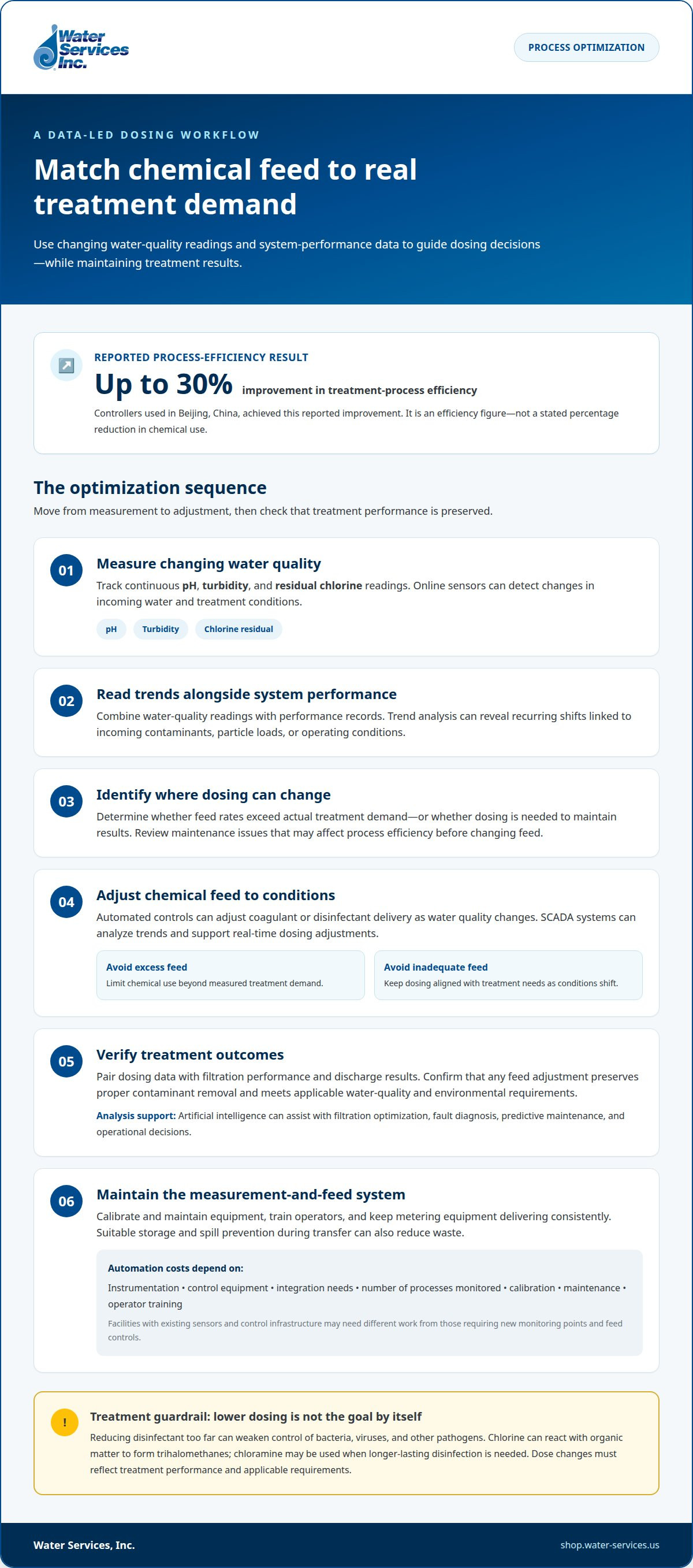
Conventional treatment uses coagulants to help particles clump during coagulation and flocculation, then removes them through sedimentation and filtration. Disinfection follows. Continuous pH, turbidity, and residual-chlorine measurements can help operators adjust feed rates as water quality changes. SCADA systems can analyze trends and support real-time dosing adjustments, helping limit both excess chemical use and inadequate treatment.
Storage and feed-system improvements can reduce waste without compromising treatment. Use suitable chemical storage, prevent spills during transfer, and maintain metering equipment so feed rates reflect demand. A dosing pump that delivers consistently, for example, allows adjustments based on measured pH, turbidity, and chlorine residual instead of a broad manual setting. Facilities must also account for applicable environmental regulations and water-quality requirements when changing a treatment program.
Data analysis and process optimization
Process data helps facilities match chemical feed rates to changing water quality and operating demand. The goal is accurate treatment, not simply lower dosing. To reduce chemical consumption in water treatment, operators need to distinguish excess feed from adjustments needed to maintain treatment results.
Using Data to Optimize Processes
Data analysis combines water-quality readings with system-performance records to reveal where treatment processes can improve. Online sensors can detect quality changes and adjust coagulant or disinfectant feed automatically. Trend analysis also helps operators spot recurring changes linked to incoming contaminants, particle loads, or operating conditions. Controllers used in Beijing, China, have improved treatment-process efficiency by up to 30%. Artificial intelligence can support filtration optimization, fault diagnosis, predictive maintenance, and operational decisions.
Automated Dosing and Monitoring Costs
Installation costs depend on instrumentation, control equipment, integration needs, and the number of processes being monitored. A facility with existing sensors and control infrastructure may need different work from one that requires new monitoring points and feed controls. Ongoing costs also depend on calibration, maintenance, and operator training. A sound assessment weighs these requirements against the value of more consistent dosing and better process visibility.
Approaches to Lower Chemical Consumption
Start by using water-quality and performance data to identify where feed rates exceed actual treatment demand. Automated controls can adjust chemical delivery as conditions change, helping limit both over-dosing and under-dosing. Pair dosing data with filtration performance and discharge results, so reductions preserve proper contaminant removal. Process reviews can also identify maintenance issues that affect efficiency. Facilities can explore water-treatment equipment relevant to their treatment needs.
Data-driven optimization considers the entire treatment process, not one chemical in isolation. Artificial intelligence can support fault detection and filtration decisions, while predictive maintenance can help identify equipment issues before they disrupt operations. Better process visibility lets operators assess whether changes in chemical use align with water quality and treatment performance. Reducing chemical consumption in water treatment is therefore a process-control objective guided by source water, treatment targets, and operating data.
Hard-water, scale, and corrosion management
Hard-water control depends on incoming water quality and the equipment exposed to it. Matching treatment to those conditions can limit scale-related chemical demand without confusing softening with disinfection. In hard-water systems, reducing chemical consumption in water treatment starts with identifying where mineral deposits form and what causes them.
Calcium and magnesium in hard water can form deposits when treatment or operating conditions promote precipitation. Scale on heat-transfer surfaces, pipes, or membrane elements can restrict flow and reduce process efficiency. Before selecting a control method, operators consider water chemistry, operating conditions, and where deposits occur. Addressing the cause of deposition is more useful than increasing chemical feed without a diagnosis.
Ion exchange softening reduces hardness by exchanging dissolved ions on resin. The resin becomes depleted and needs periodic regeneration with a chemical regenerant. In sodium zeolite softening, sodium chloride solution regenerates the resin. Chemical use therefore includes both treatment dosing and resin regeneration. Tracking resin performance and regeneration demand can show whether operating settings suit the water quality.
Antiscalants offer another way to manage scale where hardness minerals could deposit. Their role is scale control, not removal of every dissolved substance or inactivation of bacteria. Dose selection should reflect feed-water chemistry and system operation. More chemical is not automatically more effective: excess dosing can add avoidable use without fixing an underlying process problem.
Corrosion control requires attention to overall water chemistry, since hardness alone does not describe corrosion potential. Changes to softening can alter treated-water composition, so operators assess scale and corrosion together. Ion exchange can suit processes that require hardness removal, while antiscalant control can help prevent deposition. Monitoring treatment performance keeps chemical use aligned with these objectives. Reducing chemical consumption in water treatment means choosing controls suited to the specific water and equipment.
Membrane filtration and chemical cleaning
Membrane filtration separates particles and impurities from the main treatment stream through a semipermeable barrier. Its role depends on pore size, feed-water quality, and the treatment goal.
Different membrane classes target different particles. Microfiltration pore sizes range from 0.1 to 10 μm, while ultrafiltration ranges from 0.001 to .01 μm. Nanofiltration ranges from 0.002 to 0.005 μm, and reverse osmosis membranes have pores measuring 0.0001 μm. These technologies can reduce reliance on some chemical treatment steps, but filtration alone doesn’t automatically provide disinfection. Chlorine or another disinfection method may still be needed to manage pathogens.
Cleaning chemicals help restore membrane performance when accumulated deposits or fouling restrict flow. But cleaning consumes chemicals and creates downtime, so avoid unnecessary cleaning when operating conditions allow. Operators can track filtration performance and clean when indicators show a process need, rather than follow a routine that ignores membrane condition. Feed-water pretreatment and scale control also affect fouling, so cleaning frequency depends in part on incoming water and its contaminants.
Alternative technologies and conventional chemical treatment differ in equipment needs, operating demands, and treatment outcomes. Costs depend on system configuration, energy use, membrane replacement, and cleaning requirements. Effectiveness depends on the contaminants and required output. A membrane may remove particles while disinfection still requires a separate process.
Some membrane applications can also reduce chemical feed elsewhere. Gas transfer membranes can remove carbon dioxide between the first and second pass of a double-pass reverse osmosis system, eliminating the need to inject sodium hydroxide. Whether this approach is suitable depends on system design and water chemistry. In other processes, a filter may reduce particle loading before membranes, supporting filtration performance and helping limit avoidable cleaning.
Review membrane filtration options when assessing equipment for a treatment process.
Water Services, Inc.: Water Treatment Antiscalants and Chemicals
Water Services, Inc. supplies Water Treatment Antiscalants and Chemicals for systems that need scale control. These products are relevant when hard-water minerals threaten membrane or equipment performance. Dosing should align with water chemistry and operating conditions.
For reverse osmosis applications, Water Services, Inc. also offers Hydranautics RO Membranes. Goulds Water Technology Pumps and Viqua UV Water Purification Systems support other parts of water treatment systems. Equipment and chemical choices should suit the process and its requirements.
Contact Water Services, Inc. to discuss antiscalants, chemicals, or related water treatment equipment for your application.
Turn Treatment Data Into Your Next Decision
Make the next improvement a measured one. Use operating data to identify where chemical feed, scale control, or membrane performance needs closer attention. Assess any proposed change against the treatment objective and water-quality requirements, so lower chemical use does not compromise performance. This keeps efforts to reduce chemical consumption in water treatment focused on process needs, not blanket dose reductions.
Water Services, Inc. offers Goulds Water Technology Pumps, Viqua UV Water Purification Systems, and FilmTec Reverse Osmosis Membranes for water treatment applications. The right equipment depends on system requirements and each component’s role in the process. A focused discussion can connect your treatment priorities with relevant equipment and chemical options.
Contact Water Services, Inc. to discuss treatment and identify a useful next step for your operation. A clear, process-led plan gives your team a practical basis for improvement.
Frequently Asked Questions
How can wastewater treatment plants optimize coagulant and flocculant dosing?
Plants can tune coagulant and flocculant feed to influent conditions and check results through settled-water clarity. Compare treatment performance as wastewater conditions change, such as when suspended-particle levels shift, rather than relying on one fixed dose. Jar tests can identify a suitable starting point. Operators can then assess floc formation, settling, and effluent quality during normal operation, adjusting feed when these indicators change.
How do online sensors and automated controls reduce water treatment chemical use?
Online sensors provide readings that automated controls can use to adjust chemical feed as conditions change. For these adjustments to work, facilities need reliable sensor readings and a clear link between each measurement and the feed system it controls. Operators can compare sensor trends with laboratory samples, investigate unusual readings, and review dosing changes alongside treatment results. This helps distinguish genuine water-quality shifts from measurement or equipment problems.
How can jar testing determine optimal coagulant dosage?
Jar testing compares coagulant doses in portions of the same water sample under consistent mixing and settling conditions. Operators add different doses, mix each sample to promote particle contact, then observe floc formation and settling. The clearest sample is a useful candidate, but the test should also account for residual particles and sludge production. Because plant conditions can differ from bench tests, use the result as a starting point for process adjustment.
What chemical savings can water treatment plants achieve through process optimization?
There is no single savings figure that applies to every plant. Reductions depend on baseline dosing, raw-water variability, treatment targets, and how accurately controls respond to process changes. Plants can establish a baseline from chemical feed records, then compare later use with treated-water quality and operating conditions. This helps show whether lower consumption reflects more efficient dosing or a change that affects treatment performance.
0 comments