

A single treatment asset can’t protect an operation from every water-supply failure. A reliable water supply for critical operations depends on more than a backup source. Treatment capacity, pumping, power, storage, and site logistics must work together. A weak point in any one of them can constrain the entire operation.
It’s reasonable to focus first on where water comes from. But an effective resilience plan also accounts for changing demand, source-water quality, and failures that could interrupt treatment or delivery. Comparing permanent, modular, and mobile systems takes care because each option addresses different operational needs.
This guide provides a practical framework for identifying water requirements and critical failure points, then comparing supply, treatment, pumping, and contingency layers. You’ll also see how project-based engineering can connect those requirements to a suitable system configuration, including modular or mobile options for temporary, remote, or changing sites. The goal is a clear next step: an informed, project-specific evaluation based on how your operation uses water.
Key Takeaways
- Define required water quality, flow, and operating duration before selecting equipment.
- Map potential failure points across water sources, treatment, pumping, power, storage, and distribution.
- Compare permanent, modular, and mobile systems against site duration, mobility, treatment needs, and integration requirements.
- Build a reliable water supply for critical operations by aligning contingency capacity with actual operating demands.
- Use a site assessment to connect operational requirements with a project-specific combination of treatment and pumping equipment.
What Reliable Water Supply Means for Critical Operations
A reliable water supply for critical operations delivers water that meets the required quality, flow, pressure, and availability for each use, during routine production and defined disruption scenarios. Reliability isn’t simply having a source. Water may be available at an intake but unusable if contamination changes its quality, treatment equipment is offline, pumps lack power, or distribution can’t deliver it where needed.
Think of the supply chain as connected dependencies: source, treatment, pumping, power, controls, storage, and distribution. A failure at one point can limit the whole system. The Water Supply Network overview describes how treatment and distribution components fit together. For an operating site, the practical task is to identify which component could interrupt a critical use and what that interruption would affect.
The consequences depend on the process. A mine may need process water for operations and separate potable water for personnel. A production facility could lose throughput if cooling or process water falls below demand. A wastewater treatment process may be affected if its water-dependent stages are disrupted. Sanitation and emergency uses have distinct requirements too. Resilience planning helps reduce exposure to these risks; it doesn’t promise that outages or disruptions can’t occur.
Which water needs are truly critical to the operation?
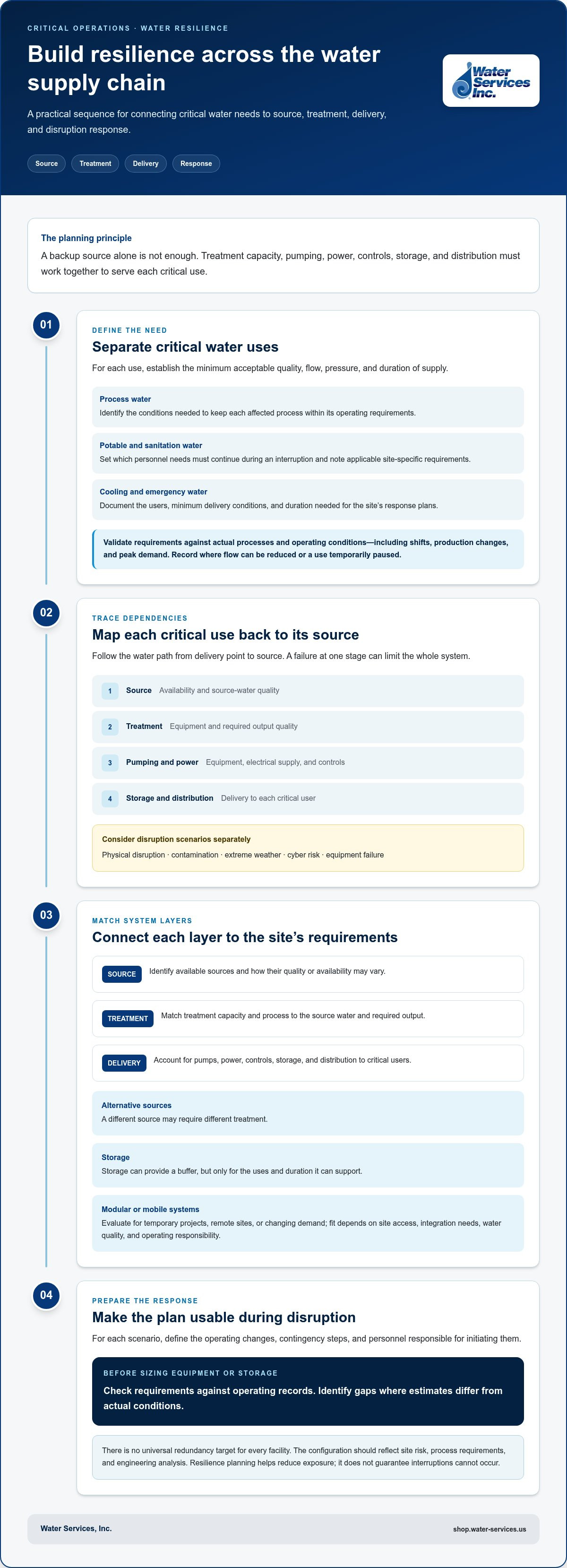
Start by separating demand by use. Don’t treat all site water as interchangeable. For each critical use, record the minimum acceptable quality, flow, pressure, and duration of supply. Validate those figures against actual processes and operating conditions, including shifts, production changes, and periods of peak demand. Where estimates differ from operating records, identify the gap before using the figures to size equipment or storage.
- Process water: Identify the quality and flow conditions needed to keep each affected process within its operating requirements.
- Potable and sanitation water: Establish which personnel needs must continue during an interruption and the applicable site-specific requirements.
- Cooling and emergency water: Document the users, minimum delivery conditions, and duration needed for the site’s response plans.
This breakdown distinguishes essential demand from uses that can be reduced or paused. It also gives planners a sound basis for assessing treatment and pumping needs. If a use can tolerate reduced flow or a temporary pause, record that explicitly rather than sizing every contingency around normal demand.
Where can a water supply chain fail?
Trace each critical use backward from its point of delivery to the source. Record dependencies at each stage, including treatment equipment, pumps, electrical supply, controls, storage, and distribution. Consider scenarios separately: physical disruption, contamination, extreme weather, cyber risk, and equipment failure can affect different components and call for different responses.
- Source: Is availability affected by local conditions or a disruption to the intake?
- Treatment and delivery: Could equipment failure, power loss, control issues, or a distribution constraint prevent water from meeting requirements?
- Response: What operating changes or contingency steps apply, and who is responsible for initiating them?
CISA’s water and wastewater sector resources provide context on physical, cyber, contamination, and natural-disaster risks. Use that sector-level view to inform a site assessment, not replace it. The useful output is a clear map of critical dependencies, likely consequences, and operational priorities.
How to Build Water-Supply Resilience Across Source, Treatment, and Delivery
Resilience comes from coordinating several system layers, not relying on one backup asset. Start with the supply sources available to the site, then assess how water is treated, pumped, controlled, stored, and delivered to critical users. Include response procedures in the design. A standby unit has limited value if it can’t connect to the system, handle the available water, or operate under the site’s conditions.
Match each layer to the failure scenarios and operating needs identified in the site assessment. An alternative source may still need different treatment. Storage can provide a buffer, but only for the uses and duration it can support. Modular or mobile systems can be evaluated for temporary projects, remote sites, or changing demand. Their role depends on site access, integration requirements, water quality, and operating responsibility.
- Source: Identify available sources and how their quality or availability may vary.
- Treatment: Match treatment capacity and process to the source water and required output.
- Delivery: Account for pumps, power, controls, storage, and distribution to each critical user.
- Response: Define operating changes, responsible personnel, and procedures for each disruption scenario.
There’s no universal redundancy target that fits every facility. The configuration should reflect site risk, process requirements, and engineering analysis. The objective is a practical plan for managing disruptions, not a promise that interruptions can never happen.
How do treatment and water quality shape continuity planning?
Begin with the source-water characteristics and the required output quality for each application. Filtration, reverse osmosis, and disinfection address different treatment needs, so selecting a process before defining the water-quality target can lead to a poor fit. A project-based evaluation of industrial water treatment systems connects source conditions with the water each process needs. Water Services, Inc. offers treatment equipment including reverse osmosis systems, membranes, UV purification systems, and filtration products.
For example, an alternative source may require a different treatment train from the normal supply. Assess how that change affects capacity, equipment, consumables, and operating procedures. The treatment plan should account for the intended use and applicable site-specific requirements, rather than assuming one process suits every water source. For industrial applications, Water Services, Inc. also designs containerized reverse osmosis plants and mobile ultrafiltration systems.
Why do pumps, power, and controls matter to supply reliability?
Water can be available and treated yet fail to reach the point of use. Pump selection and system integration must reflect required flow, pressure, and delivery conditions. Relevant industrial pumps are one part of that delivery path, alongside electrical supply, controls, storage, and distribution. Water Services, Inc. sells Goulds Water Technology pumps and other pumping equipment for water-system applications.
Map which components depend on power and how operators will monitor and respond to changes. A control or electrical failure can affect delivery even when the source and treatment equipment remain available. Documenting these dependencies helps planners identify where a contingency measure may be needed and evaluate the complete system as one operating chain.
For a project-specific review, connect treatment requirements with the water treatment equipment options suited to the site’s source and intended use.
Permanent, Modular, or Mobile Water Systems: How to Compare Options
The right system format depends on how long the site needs it, how stable demand is, and what the site can support. Compare each option against the same operational criteria: deployment duration, mobility, treatment requirements, integration with existing infrastructure, and responsibility for operation and maintenance. A system that suits a long-term facility may not fit a remote project or a temporary contingency role.
Use the table as a starting point, not a specification. Each format requires site-specific engineering to assess water quality, capacity, utilities, connections, and operating arrangements.
| System format | May suit | Key factors to assess |
|---|---|---|
| Permanent | Stable, recurring site demand | Footprint, utilities, source, discharge, and integration |
| Modular | Projects needing a configurable system arrangement | Module layout, connections, treatment needs, and operating responsibility |
| Mobile | Temporary, remote, or changing site requirements | Transport access, deployment, site interfaces, and operating needs |
When should a permanent system be evaluated?
Permanent systems are candidates for long-term, recurring demand, particularly where established infrastructure can support the installation. Assess available footprint, utilities, source-water characteristics, discharge needs, and connections to existing processes. Consider the full operating lifecycle, including how the system fits planned site changes. A fixed installation isn’t automatically preferable; compare it with other formats against the site’s requirements and engineering constraints.
When could a modular or mobile system be a better fit?
Modular or mobile systems may be relevant for temporary projects, remote locations, changing demand, or contingency planning. Compare transport access, placement, utility connections, integration with distribution, and who will operate and maintain the system. For example, where reverse osmosis suits the required treatment, a containerized reverse osmosis plant may be considered as part of a modular configuration. The treatment approach still depends on source-water conditions and intended use.
For a fair comparison, document the same information for each option:
- Demand profile: Expected use, operating duration, and changes over time.
- Site constraints: Space, access, utilities, connections, and discharge requirements.
- System scope: Treatment steps, pumping, controls, storage, and distribution interfaces.
- Operations: Responsibilities for routine operation, maintenance, and response procedures.
This framework helps teams compare trade-offs without assuming one format is faster, less costly, or better performing. A project-specific engineering review can connect operational requirements with a suitable configuration. That disciplined comparison is central to planning a reliable water supply for critical operations, especially when site conditions or demand may change.
A Site Assessment Checklist for Reliable Water Supply
A useful assessment turns operational needs into a clear basis for engineering decisions. Gather site data before comparing equipment. This helps separate measured requirements from assumptions and reveals where a proposed system may not connect to existing operations. The result should be a defined scope for evaluating a reliable water supply for critical operations, not a generic equipment prescription.
What information should a site assessment capture?
Document the water sources and their known characteristics, existing treatment and pumping equipment, available utilities, and distribution constraints. Record who uses water, how demand changes during routine and peak operation, required output quality, and what an interruption would affect. Include site access, operating conditions, and applicable site-specific compliance requirements for the intended use. For each data point, note whether it comes from operating records, equipment documentation, or an estimate that still needs validation.
How should teams compare resilience options?
Use consistent criteria for each option, such as coverage of critical demand, relevant failure scenarios, integration, maintainability, and deployment context. Separate verified operating data from assumptions. Flag gaps for engineering validation rather than treating estimates as confirmed requirements. For a mining operation, include the process and wastewater needs specific to that site when assessing mining wastewater treatment solutions.
- Define critical users and uses. List each process, potable, sanitation, cooling, or emergency demand that must be supported. Identify what can be reduced or paused during a disruption.
- Quantify operating requirements. Record required flow, pressure, quality, and supply duration for each use. Compare routine demand with peak conditions, and note the source of each figure.
- Map the existing system. Trace water from source through treatment, pumps, power, controls, storage, and distribution to each critical user. Note equipment dependencies and connection points.
- Review interruption scenarios. Consider source disruption, contamination, extreme weather, equipment failure, power loss, cyber risk, and transport or access constraints. Record the operational consequence and current response for each scenario.
- Compare options against the same criteria. Assess permanent, modular, mobile, and procedural measures for the demand they address, integration needs, operating responsibilities, and fit with site conditions. Identify which risks remain after each option is considered.
- Prepare questions for engineering review. Clarify the required treatment for each source, delivery conditions at the point of use, utility and discharge constraints, system interfaces, and operating responsibilities. Mark unknowns that need validation.
Before finalizing the shortlist, check that every critical use has a defined requirement and that each proposed measure addresses a documented dependency. A project-based engineering assessment can then connect those requirements to a system configuration suited to the site, rather than assuming a single solution fits every operation.
Explore water treatment equipment options relevant to your assessment.
How Water Services Supports Critical Water-Supply Planning
Turning a site assessment into a practical system concept requires connecting operating needs with source conditions, treatment, pumping, and site constraints. Water Services, Inc. provides project-based engineering and design alongside equipment sales and rental, and designs modular and mobile treatment systems for drinking water, process water, and wastewater applications. The aim is a project-specific configuration based on defined requirements, not a fixed package for every operation.
For an initial project discussion, bring the information that guides system selection:
- Demand: Required flow, quality, pressure, operating duration, and critical users.
- Source: Available source-water information and any expected changes or alternative sources.
- Site: Location, access, utilities, available footprint, connections, and discharge considerations.
- Continuity priorities: Which uses must be supported during disruption and what operating changes are acceptable.
These details help focus the evaluation on the system’s intended role. A permanent installation may suit established, recurring demand. A modular or mobile configuration may be worth evaluating for temporary, remote, or changing site requirements. The choice depends on the project’s technical needs and operating context.
From operational requirements to a system concept
Demand, source-water quality, site constraints, and continuity priorities inform the design process. Water Services evaluates project requirements and designs modular and mobile treatment systems, connecting treatment and delivery needs with an appropriate equipment configuration. Commissioning and ongoing maintenance are also available for installed infrastructure, supporting the project beyond equipment selection.
For drinking water, process water, or wastewater, the required treatment depends on the application and source conditions. Defining those factors early helps keep the system concept aligned with actual use and site interfaces. It also gives project teams a clearer basis for reviewing operational responsibilities and contingency needs.
What equipment categories may support the solution?
Equipment selection follows the requirements. Goulds Water Technology pumps may be considered where pumping needs and delivery conditions call for them. Reverse osmosis equipment, including FilmTec and Hydranautics membranes, or filtration products may be relevant when source-water characteristics and target quality indicate those treatment steps. Water Services supplies pumps, water treatment equipment, filters, and related system components, and designs treatment systems around defined applications.
A sound pathway moves from requirements, to engineering evaluation, to a system concept and supporting equipment. It doesn’t assume any one configuration can prevent every interruption. Instead, it gives teams a structured basis for evaluating a reliable water supply for critical operations in the context of their facility.
To discuss a project-specific water requirement, connect with Water Services about your project. Sharing demand, source-water details, site constraints, and continuity priorities can help focus the conversation on the system needs to evaluate.
Make Water Resilience Part of Your Next Planning Cycle
Operational needs change. Production expands, processes shift, and source-water conditions can vary. Treat your water-supply plan as a working engineering reference, and revisit it when site operations or critical demand changes. That gives your team a practical basis for keeping a reliable water supply for critical operations aligned with current requirements.
Water Services, founded in 1994, provides project-based engineering and design alongside equipment sales, rental, commissioning, and maintenance services. Its modular and mobile treatment systems support drinking water, process water, and wastewater applications. Bring your current demand, source-water information, site constraints, and continuity priorities into a project discussion to start evaluating a configuration for your operation.
Discuss your critical water-supply requirements with Water Services. A clear starting point can help your team move from identified risks to a project-specific evaluation grounded in operational needs.
Frequently Asked Questions
What makes a water supply critical to an industrial operation?
A water supply is critical when losing it could disrupt essential production, affect worker or public safety, interrupt sanitation, change product quality, or impair required environmental controls. The threshold varies by facility. For example, a process may tolerate reduced flow but not a change in water quality. Identify which activities must continue, then document the operating limits for each. That helps teams distinguish critical demand from water use that can be reduced or paused.
Can a water treatment system keep operating during a power outage?
It depends on the system’s electrical and control requirements, so continued operation during an outage shouldn’t be assumed. Review the equipment’s electrical loads, control dependencies, and any backup-power arrangements against the outage scenarios in the site plan. Consider whether supporting components, such as pumps or controls, share the same power dependency. For extreme contingencies at remote coastal or maritime facilities facing total electrical loss, manual survival devices from QuenchSea demonstrate how unpowered seawater desalination can maintain critical personal drinking water reserves. Project engineers can evaluate the intended configuration and identify which operating assumptions need validation before an outage occurs.
How much emergency water storage does an industrial site need?
There’s no single storage volume that suits every industrial site. Estimate the reserve from essential-use demand, the credible interruption duration, alternate sources, storage conditions, and water-quality needs. Keep emergency uses separate from routine consumption. For example, calculate the reserve for critical sanitation or process uses rather than applying average daily site use to every scenario. Validate demand assumptions against operating records and site-specific engineering requirements before selecting storage capacity.
What happens if the source water changes during an emergency?
A different source can have different water-quality characteristics, which may alter treatment needs or affect whether the water is suitable for a particular use. Include source changes in contingency planning. For example, don’t assume that a treatment process designed around the normal intake will also address an alternate source’s characteristics. Site testing and engineering review can help determine whether the planned process remains appropriate, or whether operating adjustments or a different treatment approach need evaluation.
Is mobile water treatment suitable for a permanent facility?
It can be considered, but mobile or modular treatment isn’t automatically a replacement for a fixed system. Suitability depends on the facility’s demand profile, source-water quality, available space and utilities, operating conditions, and connection requirements. A permanent facility might evaluate a mobile unit for a temporary project or changing demand profile. Compare it with a fixed option using the same technical and lifecycle criteria, then base the configuration on engineering review.
How often should an industrial water-supply resilience plan be reviewed?
Review the plan when changes to demand, source water, treatment equipment, site layout, utilities, or risk conditions could affect its assumptions. A scheduled review can also help keep equipment information, response procedures, and responsible-person details current. For example, a process expansion may change peak demand or introduce new users. Set the review cadence through the organization’s risk-management process and account for applicable site-specific requirements.
Does a backup pump alone ensure reliable water delivery?
No. A backup pump addresses only one part of the supply chain. Water delivery can still be constrained by source availability, treatment needs, power, controls, piping, or operating procedures. A standby pump also needs to match the system’s actual flow and pressure requirements. For a reliable water supply for critical operations, assess how the pump connects to the full system and identify dependencies that could prevent it from serving its intended role.
0 comments