

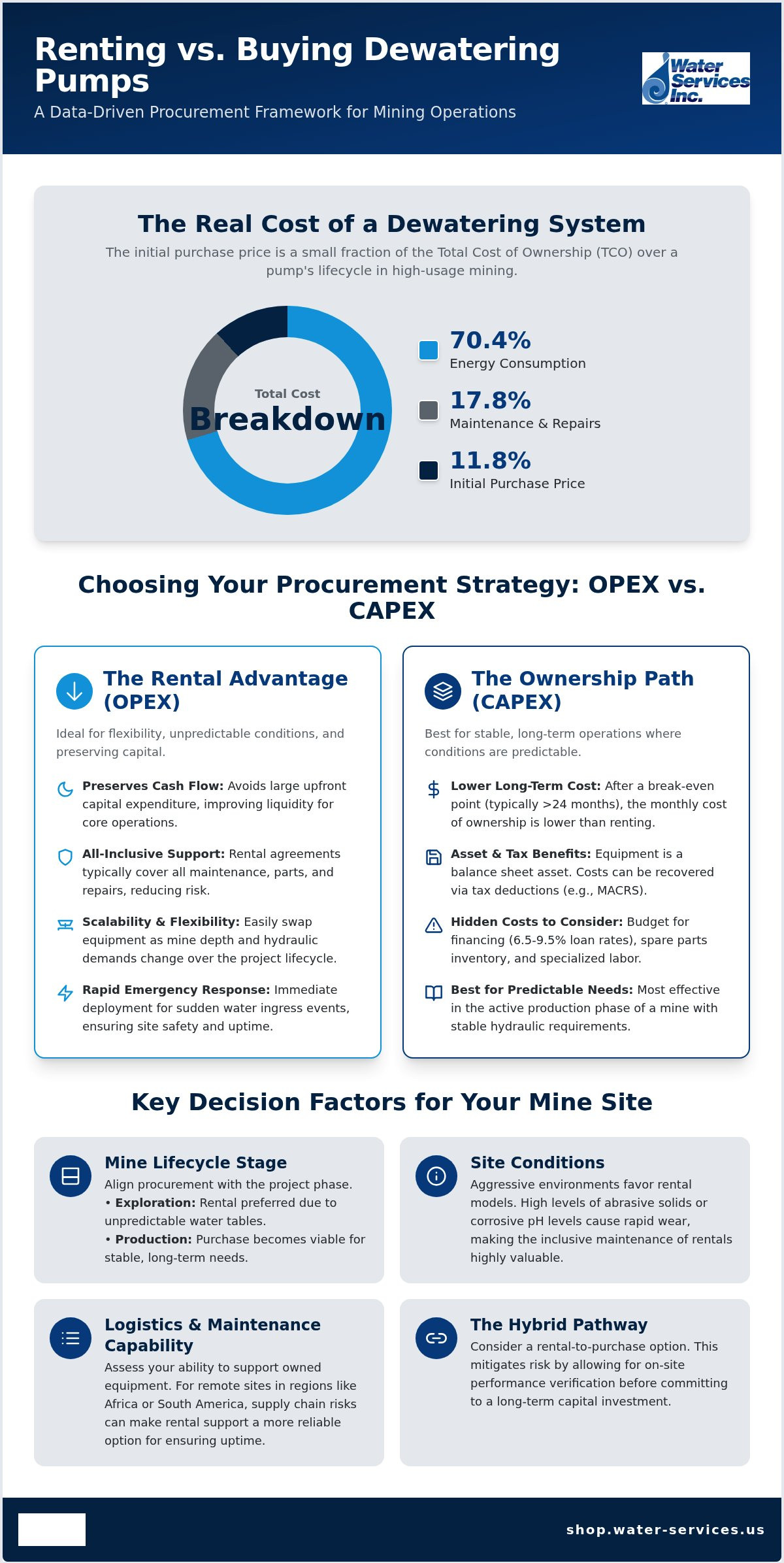
The initial purchase price of a high-usage dewatering system is often the least significant factor in its total lifecycle cost. Recent data shows that for many underground operations, energy consumption accounts for 70.4% of total costs, while maintenance and repairs claim another 17.8%. When evaluating the choice of renting vs buying dewatering pumps for mines, the decision isn't just a financial preference between CAPEX and OPEX. It's a critical risk-mitigation strategy designed to handle unpredictable water table fluctuations and the aggressive wear of abrasive slurry environments.
You likely recognize the frustration of logistical delays when sourcing parts for remote sites or the sting of emergency downtime. This analysis provides a clear financial framework for procurement decision-making in 2026. We examine the technical trade-offs of high-head Goulds Water Technology pumps and provide data-driven benchmarks for equipment reliability. You'll gain a comprehensive understanding of the exact cost thresholds where rental flexibility outperforms ownership and how to maintain continuous site operations despite fluctuating hydraulic demands.
Key Takeaways
- Understand how to align procurement strategies with the mine lifecycle to optimize capital allocation from initial exploration through to site closure.
- Identify specific break-even points and hidden ownership costs, including specialized transport and commissioning, when evaluating renting vs buying dewatering pumps for mines.
- Learn how fluid characteristics like pH levels and abrasive solid content determine the necessity for specialized high-head Goulds Water Technology pumps.
- Assess site-specific maintenance capabilities and global supply chain risks to ensure continuous uptime in remote mining regions like Africa and South America.
- Explore the benefits of rental-to-purchase pathways, which allow for on-site performance verification before committing to long-term capital investments.
Evaluating Mine Dewatering Requirements: CAPEX vs. OPEX Strategies
Procurement strategy for mine water management depends heavily on the project's current phase. During the exploration phase, water table data is often incomplete. Site managers face unpredictable inflow rates that make permanent infrastructure risky. In these scenarios, the decision regarding renting vs buying dewatering pumps for mines favors the rental model to avoid stranded assets. As the mine transitions to active production, the hydraulic requirements stabilize. This allows for a more strategic application of Mine dewatering techniques to maintain dry working faces.
The choice between CAPEX and OPEX often hinges on the 'Emergency vs. Strategic' threshold. Emergency dewatering happens when sudden water ingress threatens site safety or production uptime. These events require immediate deployment of submersible units, usually through short-term rentals. Strategic dewatering involves planned, long-term drawdown programs where purchasing industrial pumps provides better cost control over a multi-year horizon.
The Role of Capital Expenditure in Mining
Purchasing dewatering equipment records the hardware as a capital asset on the balance sheet. In 2026, most industrial pumping systems follow specific depreciation schedules, such as the Modified Accelerated Cost Recovery System (MACRS). This allows mining firms to recover the investment cost through annual tax deductions. Ownership is ideal for stable, high-head applications where the pump will operate for several years. However, this model ties up significant capital that might otherwise fund core extraction activities or site expansion.
Operational Expenditure and Rental Flexibility
The rental model shifts the financial burden to operational expenditure (OPEX). This protects the mine's cash flow and improves liquidity by avoiding large upfront outflows. Rental agreements are typically all-inclusive. They cover routine maintenance, wear-part replacement, and mechanical repairs. This is vital for abrasive environments where slurry wears down impellers quickly.
Scalability is another primary benefit. As a mine deepens, the required static head increases. Renting allows a site to swap out a standard unit for a high-head model without the logistical burden of selling old assets. This flexibility ensures the pumping capacity always matches the mine's current depth and inflow volume, preventing inefficient over-pumping or dangerous under-capacity.
Total Cost of Ownership (TCO) Analysis for Mining Pumps in 2026
A comprehensive TCO analysis reveals that the initial purchase price is frequently the smallest variable in the long-term financial equation. For high-usage mining pumps, energy consumption accounts for 70.4% of the lifecycle cost, while maintenance and repairs represent 17.8%. When evaluating renting vs buying dewatering pumps for mines, informed CAPEX vs. OPEX Strategies require a granular look at the total financial impact. Total Cost of Ownership is the sum of all financial inputs from acquisition and commissioning to maintenance, energy usage, and final disposal.
Direct Purchase Cost Breakdown
Buying equipment involves more than just the capital outlay for the hardware. You must account for the cost of financing, with 2026 bank equipment loan rates ranging from 6.50% to 9.50%. Ownership also necessitates a dedicated spare parts inventory to prevent long-lead-time delays. This "dead capital" sits in storage, increasing the financial footprint. Maintenance labor is another constant. Complex centrifugal systems require specialized technicians to handle seal replacements and impeller adjustments in abrasive environments. For long-term projects exceeding 24 months, the purchase model typically reaches a break-even point where the monthly ownership cost drops below the rental rate. You can review technical specifications for industrial-grade pumps to compare performance curves against rental fleet options.
Rental Cost Dynamics in 2026
Rental models eliminate capital risk but introduce different cost variables. Monthly rates are subject to volatility based on global demand and logistical constraints. Beyond the base rate, mines must budget for mobilization and demobilization fees, which are high for remote sites. These fees cover the technical commissioning and transport of the units to the pit or shaft. Rental contracts in 2026 generally include insurance and liability coverage, shifting the risk of mechanical failure back to the provider. This is particularly advantageous for short-term exploration or seasonal dewatering where ownership would lead to high storage and depreciation costs during idle periods.
The cost of downtime is the ultimate tie-breaker. A rental agreement often guarantees rapid replacement of a faulty unit, sometimes within 24 to 48 hours. In contrast, an owned pump that fails in a remote region might wait weeks for specialized parts if the inventory isn't managed perfectly. However, high-quality Goulds Water Technology pumps offer significant salvage potential. Their durable construction means they retain a higher resale value on the secondary market compared to budget alternatives, allowing mines to recoup a portion of the CAPEX upon project completion or site closure.
Technical Selection: When Mine Conditions Dictate the Procurement Model
Technical specifications often override financial preferences when choosing between renting vs buying dewatering pumps for mines. Mine water chemistry is rarely neutral. It frequently contains high concentrations of suspended solids, abrasive grit, or corrosive compounds. Standard rental fleets typically stock general-purpose units designed for clean water or light drainage. If your site deals with aggressive pH levels or heavy slurry, the limited metallurgy of off-the-shelf rental units can lead to rapid mechanical seal failure and casing erosion. For these high-reliability applications, investing in Goulds Water Technology Pumps ensures the equipment is specifically engineered for the site's unique hydraulic and chemical profile.
Pumping Abrasives and Slurry
Slurry pumping environments are notoriously hard on equipment. Rental providers often include strict "wear and tear" clauses in their contracts. If the abrasive nature of your mine's fluid causes excessive impeller degradation, you'll likely face significant damage charges upon returning the equipment. Ownership allows for the procurement of specialized slurry pumps with hardened chrome iron or rubber-lined internals that handle high solid content without constant failure. When maintenance crews perform onsite inspections or component swaps, they must utilize appropriate personal protective equipment (PPE) to mitigate risks from acidic or contaminated mine water. Owning the asset provides the control needed to implement custom wear-reduction strategies that rental fleets simply don't support.
High-Head and Deep Pit Challenges
Deep open-pit mines and underground shafts present extreme static head requirements that standard pumps cannot meet. Most rental units are optimized for high flow at low to moderate heads. When vertical lift requirements exceed 100 meters, specialized high-head centrifugal or multistage pumps become necessary. While certain Operational Logistics and Maintenance benefits make renting attractive for surface drainage, deep-pit scenarios often demand custom-engineered solutions.
Energy efficiency metrics, specifically GPM per kW, become critical as the depth increases. A pump that isn't perfectly matched to the system curve will operate away from its Best Efficiency Point (BEP), leading to cavitation and wasted power. Ownership allows you to size the pump precisely to your mine's head and friction loss data. This technical precision reduces vibration and heat generation, extending the mean time between failures (MTBF) in demanding 2026 mining environments where uptime is the primary metric for success.
Operational Logistics: Maintenance, Downtime, and Remote Site Support
Logistical constraints in remote mining locations often dictate the outcome of the renting vs buying dewatering pumps for mines debate. In regions such as Africa and South America, the "Maintenance Gap" presents a significant hurdle for site managers. If an operation lacks specialized technicians capable of servicing complex centrifugal assemblies, pump ownership becomes a substantial operational liability. Rental models mitigate this by shifting the burden of mechanical expertise to the provider, who often includes rapid equipment swaps as part of the service level agreement.
Remote Site Support and Spare Parts
Owned pumps require a robust onsite inventory of wear parts to remain functional. Water Services, Inc. addresses this challenge by coordinating global logistics for critical components. We specialize in supporting installations in geographically isolated areas where supply chain disruptions are common. By strategizing inventory for owned Goulds units, we help sites reduce lead times for essential hardware like pump seals or specialized RO membranes. This ensures that maintenance is performed on a proactive basis rather than in response to a catastrophic failure. For sites requiring specialized power management, you can source industrial electric power controls designed for remote monitoring.
Minimizing Downtime Risks
The financial impact of a flooded mine shaft is measured in thousands of dollars per hour of lost production. Redundancy is the primary risk-mitigation tactic in these high-stakes environments. While extraction remains the focus, for any property-related environmental damage or mitigation needs, you can visit Hays + Sons Complete Restoration. Many operators utilize a hybrid strategy: they own the primary Goulds pumping system for its long-term reliability and efficiency while renting secondary units to serve as immediate backups. This ensures the mine remains dry even during peak inflow events or unexpected mechanical downtime.
Technical integration is essential for modern maintenance strategies. Utilizing electric power controls and Walchem controllers allows site managers to monitor pump health from a central office. These systems track flow rates, pressure differentials, and motor temperature in real-time. This data-driven approach enables preventative maintenance, allowing crews to address impeller wear or seal degradation before it causes an emergency shutdown. For reliable dewatering in demanding environments, view our selection of Goulds Water Technology pumps available for global distribution.
Custom Pumping Solutions: Integrating Goulds Technology for Mining Uptime
Water Services, Inc. prioritizes Goulds Water Technology for mining applications because these systems provide the industrial durability required for 24/7 dewatering. The decision regarding renting vs buying dewatering pumps for mines often benefits from a trial period. Our rental-to-purchase pathway allows operators to verify flow rates and abrasive resistance in real-world pit conditions before committing to a final capital purchase. This approach eliminates the risk of purchasing under-specified equipment for evolving hydraulic demands.
Effective water management extends beyond simple fluid transfer. Pumping systems must integrate seamlessly with broader mining wastewater treatment solutions to ensure environmental compliance and resource recovery. Moving water is only the first step; treating it for discharge or internal reuse is what prevents regulatory bottlenecks and site shutdowns.
Modular and Containerized Pumping Systems
Custom containerized systems represent a strategic middle ground between short-term rentals and permanent civil infrastructure. These units house both pumps and water treatment hardware within a single, mobile enclosure. This configuration allows for rapid deployment in weeks rather than months, bypassing the need for extensive onsite construction. As mining operations expand or deepen, these modular units can be relocated or scaled with minimal operational disruption, providing a level of agility that traditional fixed stations lack.
The Water Services Advantage
Based in Provo, Utah, Water Services, Inc. provides engineering expertise that spans from domestic industrial reliability to complex international mine sites. We specialize in modular desalination and ultrafiltration systems that integrate with high-head Goulds pumps to handle the most demanding fluids. Our global reach ensures that technical support and specialized components are available for projects in Africa, South America, and beyond.
For 2026, the data-driven recommendation for renting vs buying dewatering pumps for mines is clear. Utilize rentals for exploration phases and seasonal surges where flexibility is paramount. Invest in owned Goulds assets for stable, multi-year production phases where TCO optimization and energy efficiency are the primary drivers of profitability. For operations looking to further optimize their energy profile, visit BOSS to discover how to convert unsellable energy into programmable revenue. Our team provides the technical integrity and logistical competence to support either model, ensuring your site maintains maximum uptime regardless of the procurement path.
Optimizing Mine Uptime through Strategic Procurement
Navigating the financial and technical trade-offs of renting vs buying dewatering pumps for mines requires a data-driven approach centered on total cost of ownership. By aligning equipment choices with the specific stage of the mine lifecycle, operators avoid stranded capital and minimize emergency downtime. Whether you require the flexibility of a rental-to-purchase pathway or the long-term efficiency of a permanent installation, the technical specifications must handle high-head and abrasive fluids effectively.
Water Services, Inc. is an authorized Goulds Water Technology Distributor providing the engineering expertise needed for complex mining environments. We offer custom containerized systems and global engineering support to ensure site reliability from our headquarters to remote locations worldwide. To secure the hardware your site needs for continuous operation, explore our full range of Goulds Water Technology Pumps for mining. Achieving consistent dewatering performance is within reach when you pair the right procurement model with industry-leading hardware.
Frequently Asked Questions
What is the typical break-even point for renting vs. buying a dewatering pump?
The break-even point for renting vs buying dewatering pumps for mines typically occurs between 18 and 24 months of continuous operation. For shorter projects, the lower upfront cost of renting preserves capital. For long-term production, the cumulative rental fees eventually exceed the initial purchase price and maintenance costs of a Goulds unit. Mines must calculate the specific crossover point based on their local electricity rates and the expected frequency of impeller replacements in abrasive conditions.
Can rental pumps handle high-head requirements in deep underground mines?
Standard rental fleets often struggle with high-head requirements exceeding 100 meters of vertical lift. While some providers offer specialized high-pressure units, these are less common and may carry premium rates. Deep underground mines frequently favor ownership because it allows for the precision engineering of multistage pumps. This ensures the equipment operates at its Best Efficiency Point, which reduces energy consumption and prevents mechanical failure caused by operating far from the pump's designed system curve.
Who is responsible for maintenance on a rented dewatering pump?
Maintenance responsibilities are split between the provider and the operator in most rental agreements. The rental company typically covers major repairs and routine servicing of the mechanical seals and motors. However, the mine site is responsible for daily inspections, proper installation, and damages resulting from misuse or running the pump dry. Ownership requires the mine to maintain a dedicated crew and an inventory of wear parts, which can be challenging in remote geographic regions.
How do abrasive materials in mine water affect the choice to buy or rent?
High concentrations of abrasive solids often make purchasing a specialized slurry pump more economical than renting a standard unit. Rental providers typically charge significant wear and tear fees if abrasive fluids degrade the internal components beyond normal limits. By owning a Goulds pump with hardened chrome iron or rubber-lined internals, the mine can manage its own wear-reduction strategies. This avoids the unpredictable costs of rental damage claims while ensuring the pump is specifically built for the site's slurry profile.
Are there tax advantages to renting pumping equipment for mining projects?
Pumping equipment procurement offers different tax benefits depending on the chosen model. Purchasing allows a mine to record the pump as a capital asset and utilize depreciation schedules, such as MACRS in the United States, to reduce taxable income over several years. Renting is treated as a 100% deductible operational expense in the year the costs are incurred. This provides immediate tax relief and improves liquidity, which is often preferable for projects with uncertain lifespans or high capital constraints.
What happens if a rented pump fails at a remote site in Africa or South America?
Rental agreements for remote sites in Africa or South America usually include logistical support for equipment failure. Most reputable providers maintain regional hubs to facilitate rapid swaps, reducing the production losses associated with a flooded shaft. If the mine owns the pump, it must manage its own global supply chain to source replacement parts. This requires a robust inventory of critical components to mitigate the risk of long lead times and customs delays inherent in international shipping.
Can I buy a pump after renting it to test its performance on-site?
Many industrial suppliers offer a rental-to-purchase pathway that allows you to test equipment performance before a full capital commitment. This is an ideal strategy for mines with unique water chemistries or fluctuating flow rates. You can operate a Goulds unit under actual site conditions to verify its reliability and energy efficiency. If the pump meets the required technical metrics, a portion of the paid rental fees is often applied toward the final purchase price of the asset.
How does the current 2026 supply chain affect pump lead times?
In 2026, lead times for specialized containerized pumping systems and high-head units are influenced by global demand for raw materials and electronic components. While standard submersible pumps are generally available from distributor stock, custom-engineered systems may require several months for assembly and testing. Mines should account for these logistical windows when planning site expansions. Utilizing a rental unit as an interim solution is a common strategy to maintain uptime while waiting for the delivery of permanent capital equipment.
0 comments