

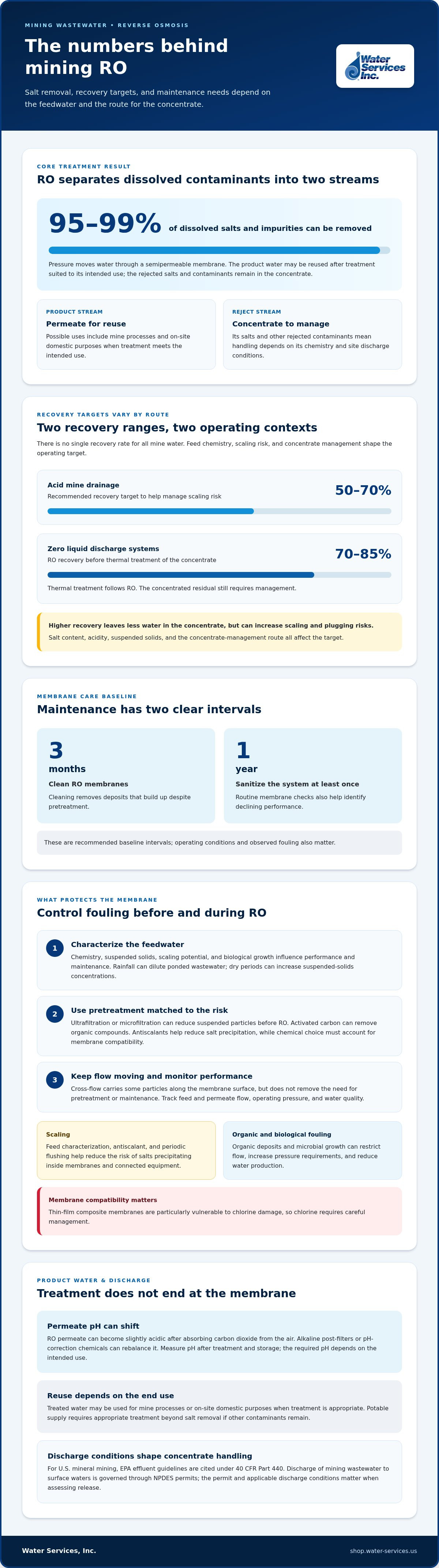
High dissolved-solids loads make mining wastewater a treatment challenge, not just a filtration problem. Reverse osmosis for mining wastewater uses pressure to move water through a semipermeable membrane, separating dissolved salts into a reject stream and producing water for reuse. It can remove up to 95-99% of dissolved salts and impurities, while the concentrate still needs appropriate handling.
That basic separation is only one part of the design. Feedwater chemistry, suspended solids, scaling potential, and biological growth all affect performance and membrane maintenance. This article explains how industrial reverse osmosis treats mining wastewater, which pretreatment steps help control fouling, how dissolved contaminants are separated, and why RO permeate may become slightly acidic after contact with air. It also covers water reuse and how concentrate and discharge requirements shape the process.
Key Takeaways
- RO product water can become slightly acidic after absorbing carbon dioxide from the air; post-treatment can help adjust its pH for the intended use.
- Feedwater pretreatment, cross-flow operation, and routine membrane checks help manage scaling, organic fouling, and biofouling.
- Mining RO system design depends on feedwater chemistry, required water quality, recovery targets, and how the concentrate will be handled.
- RO separates dissolved salts and contaminants into a reject stream, while producing water that may be suitable for reuse after treatment appropriate to its end use.
- Compare pump and membrane requirements with the mine’s operating conditions when assessing Goulds Water Technology Pumps, FilmTec membranes, or Hydranautics RO membranes.
Is the water produced by reverse osmosis process acidic?
Reverse osmosis permeate can become slightly acidic after absorbing carbon dioxide from the air. Alkaline post-filters or pH-correction chemicals can rebalance it. The required product-water pH depends on its intended use, such as process reuse or potable-water treatment. Measure pH after treatment and storage, because contact with air can change the result.
For mine wastewater, reverse osmosis and nanofiltration both separate dissolved contaminants through membranes, but the resulting water quality differs. RO is used to remove dissolved salts, while nanofiltration can suit treatment targets that differ. Ion exchange uses resins to capture selected charged ions; evaporation removes water and leaves a more concentrated residual stream. The feed chemistry and reuse goal guide the choice.
Scaling control starts with feedwater characterization and a suitable antiscalant. Scale inhibitors and periodic flushing can reduce the risk of dissolved salts precipitating inside membranes and connected equipment. Cleaning removes deposits that build up despite pretreatment. Routine membrane checks help identify declining performance. Recommended maintenance is to clean RO membranes once every three months and sanitize the system at least once a year.
There isn’t one recovery rate for all mine water. For acid mine drainage, a recovery target of 50-70% is recommended to manage scaling risk. Salt content, acidity, suspended solids, and the concentrate-management route affect the operating target. Higher recovery leaves less water in the concentrate but can increase scaling and plugging risks.
In the United States, EPA effluent guidelines specific to mineral mining are cited under 40 CFR Part 440. According to the U.S. Environmental Protection Agency, discharge of mining wastewater to surface waters is governed through NPDES permits. The permit and applicable discharge conditions therefore matter when assessing whether treated water can be released.
RO concentrate or brine contains salts and other rejected contaminants, so its handling depends on its chemistry and the site’s discharge conditions. In zero liquid discharge systems, RO typically recovers 70-85% of the water before thermal treatment of the concentrate. That approach reduces the remaining liquid volume, but still requires management of the concentrated residual.
Mining operations can use treated water for internal reuse or on-site domestic purposes, including showers, sinks, and restrooms, when treatment meets the intended use. Potable supply requires appropriate treatment beyond salt removal when other contaminants remain. A water treatment system can combine pretreatment, membrane separation, and product-water conditioning. For suspended particles, ultrafiltration or microfiltration can protect downstream membranes. Feedwater changes also matter: rainfall can dilute ponded wastewater, while dry periods can increase suspended-solids concentrations.
How Mining RO Plant Eliminates Organic Fouling and Biofouling?
Organic fouling develops when natural organic matter and other compounds accumulate on a membrane. Biofouling occurs when microorganisms grow and form deposits on membrane surfaces. In mining wastewater treatment, either type can restrict flow, increase pressure requirements, and reduce water production. Feedwater composition and pretreatment determine which risk needs the closest control.
Cross-flow filtration moves feedwater along the membrane surface rather than directing all of it straight through. This flow can carry some particles away, but it does not eliminate the need for pretreatment or maintenance. Ultrafiltration and microfiltration can reduce suspended particles before reverse osmosis. Their lower-pressure operation can make them useful pretreatment stages, while RO removes dissolved salts.
Organic control also depends on the feed. An activated carbon filter can remove organic compounds in the described water-purification process, helping prevent microbial fouling. Chlorine requires careful management because thin-film composite membranes are particularly vulnerable to chlorine damage. Pretreatment must account for biological risks and membrane compatibility with treatment chemicals.
Scale inhibition addresses a different problem, but it protects the same membrane system. Antiscalant chemicals can help reduce salt precipitation as water concentrates. Periodic flushing helps move accumulated material from the system. For an operation considering water treatment antiscalants and chemicals, the feedwater composition and membrane process should guide chemical selection and use.
Routine checks help operators spot changes before fouling restricts production. Track feed and permeate flow, operating pressure, and water quality as part of membrane maintenance. Clean membranes once every three months, as recommended in the research, and sanitize the RO system at least once a year. These intervals provide a baseline; operating conditions and observed fouling also matter.
Membrane bioreactors can treat biodegradable waste from mining operations or sewage from mine camps. They combine biological treatment with membrane separation to address biodegradable contaminants before further treatment or reuse. They do not replace RO when the target is dissolved-salt removal. Instead, they can fit upstream where wastewater contains biodegradable material that could otherwise contribute to downstream fouling.
Maintenance must also account for changing mine-water conditions. Rainfall can dilute ponded wastewater and affect chemical dosing, while prolonged dry periods can raise suspended-solids concentrations. Operators can use turbidity and silt density index testing to monitor pretreatment performance. If results change, review solids removal and operating conditions before deposits threaten the RO membrane or reduce process-water recovery.
How does Reverse Osmosis (RO) effectively treat mining wastewater?
Reverse osmosis for mining wastewater uses pressure to move water through a semipermeable membrane. Dissolved salts and other rejected substances remain in a concentrated stream. The separated water can support process use, mine-camp supply, or further treatment. Its intended application determines the required product-water quality and the treatment stages around the RO unit.
Begin system design with representative samples from each wastewater source. Salt content, metals, pH, temperature, suspended solids, and turbidity affect membrane selection and pretreatment. A pond receiving rainfall can have different feed conditions from a dry-season source. These variations influence pump duty, chemical dosing, membrane-fouling risk, and the quality of water produced.
Mining wastewater with high salt concentrations creates elevated osmotic pressure. The RO plant must apply enough pressure to drive water across the membrane and overcome that opposing force. High-pressure pumps provide the driving energy, while energy-recovery equipment can reduce energy requirements. Pressure, feed chemistry, and target recovery all shape the operating design.
Small- and medium-volume capacity should match the mine’s actual demand profile. A camp’s domestic water needs differ from those of a process-water circuit that runs continuously. Account for peak demand, operating hours, storage, and planned reuse when sizing the system. A unit sized only for average flow may not meet demand during operating peaks.
System cost depends on more than membrane capacity. Pretreatment equipment, feedwater chemistry, pump duty, controls, installation conditions, and concentrate management all affect project scope. Operational savings can come from water reuse: RO-enabled internal reuse can reduce freshwater consumption by 40-60% compared with once-through operations. The benefit depends on how much treated water the mine can use.
Integration matters at remote sites. Multiple treatment trains and bypass options can help maintain operations during maintenance or equipment interruptions. On-site spare parts and repair tools support continuity. Because changing feed conditions also affect performance, operators can use turbidity and silt density index tests to track solids-removal effectiveness before water reaches the membranes.
Recovery targets must account for scaling and the final discharge or residuals route. In mining zero liquid discharge systems, RO typically recovers 70-85% of water before thermal treatment of the concentrate. That configuration links RO performance to downstream equipment and energy demand. A reuse-focused system may instead prioritize consistent process-water quality and manageable concentrate volumes.
Compare designs using feedwater data, required output quality, flow demand, pretreatment needs, and concentrate handling. These factors connect equipment selection with the mine’s applications and operations. A suitable design integrates the RO stage with upstream solids removal and downstream reuse or discharge treatment, rather than assessing the membrane unit alone.
Dissolved contaminant removal from mining wastewater
Mining wastewater can carry dissolved salts and metals alongside suspended solids. Reverse osmosis uses pressure and a semipermeable membrane to separate dissolved material from water, producing a concentrate stream.
Mining Wastewater Types and Contaminants
Mining wastewater includes ponded tailings water and acid mine drainage, each with distinct treatment challenges. Retention or evaporation ponds can contain salts, heavy metals, and sulfuric acid. These dissolved contaminants behave differently from suspended solids, which can be separated through filtration. Identifying the water source and contaminant types helps determine pretreatment needs and whether RO suits the treatment objective.
Removing Dissolved Salts and Contaminants
RO applies pressure to move water through a membrane while rejecting dissolved salts and impurities into a concentrate. Systems can remove up to 95-99% of dissolved salts and impurities, but the resulting concentrate still requires management. Removal performance depends on feedwater composition and operating conditions. Testing helps establish which dissolved contaminants remain relevant to the intended reuse or discharge quality.
Before selecting a membrane process, identify the water’s complete cation and anion balance and potential contamination. This analysis distinguishes dissolved ions from particles that standard membrane pretreatment can remove. For example, water with high dissolved salts presents a different RO challenge from water carrying suspended tailings. This distinction guides treatment stages and helps avoid relying on RO to remove contaminants outside its role.
Heavy metals require particular attention. Mining wastewater can contain iron, manganese, and other metals that can harm membrane performance. Lime or caustic precipitation can remove high concentrations before water reaches the RO membrane. In acid mine drainage treatment, lime addition and sedimentation can precipitate metals and reduce acidity. This pretreatment also separates material that would otherwise enter downstream equipment.
Suspended solids need a separate control step because they can plug membrane passages. Ultrafiltration, microfiltration, or other solids-removal stages can reduce particles before RO. Bag and cartridge filters can provide a final barrier ahead of membranes, pumps, and energy-recovery devices. Turbidity and silt density index testing helps operators assess incoming water and pretreatment effectiveness.
Membrane choice and pressure must match feedwater salinity and the target product water. High salt concentrations increase osmotic pressure, so the system must overcome that resistance to drive separation. Higher recovery further concentrates rejected salts, increasing scaling and plugging risks. The design therefore links dissolved-contaminant removal with pretreatment, operating pressure, recovery, and concentrate handling.
RO permeate may support process reuse or further treatment, while the concentrate retains rejected contaminants. For discharge, assess treatment performance against the applicable water-quality objective. Clearly distinguishing dissolved contaminants, metals requiring precipitation, and suspended solids gives mining operations a practical basis for designing each treatment stage.
Industrial wastewater reverse osmosis
Industrial RO works best as a treatment train, not an isolated membrane stage. Mining wastewater can vary in acidity, salinity, metals, temperature, and suspended solids. Each change affects pretreatment, operating pressure, recovery, and final water quality. The practical takeaway is to design around measured feedwater conditions and the intended reuse or environmental discharge route.
Acid mine drainage needs specific preparation before membrane treatment. Lime addition and sedimentation can precipitate heavy metals and reduce acidity. The recommended feed pH before RO is 7-8, while suspended-solids removal should reduce the silt density index (SDI) below 3. These targets help limit membrane exposure to acidic feed and particles that can plug flow passages.
Iron and manganese also need attention. Lime or caustic precipitation can remove high concentrations of these metals before they contact membranes. Turbidity and SDI test kits help operators track incoming water and pretreatment performance. Bag and cartridge filters can then capture remaining particles before they reach membranes, pumps, or energy-recovery equipment.
Salt concentration determines the osmotic pressure the RO plant must overcome. High-pressure pumps provide the driving force, while energy recovery systems can reduce energy requirements. Recovery must balance water production against concentration effects: for acid mine drainage, the recommended target is 50-70% to manage scaling risk. Higher recovery can increase solids concentration and plugging risk.
Industrial systems also need to handle changing flow and feed conditions. Rainfall can dilute ponded wastewater and create a risk of chemical overfeeding; prolonged dry periods can increase suspended-solids concentrations. At remote sites, multiple trains and bypass options support operation during maintenance. Keeping spare parts and repair tools on site can help address equipment interruptions.
Set the treatment objective before selecting the process configuration. Internal process-water reuse, drinking-water production for a camp, and environmental discharge have different output requirements. In zero liquid discharge systems, RO typically recovers 70-85% of water before thermal treatment of the concentrate. The downstream residuals process therefore forms part of the RO design, not a separate afterthought.
For discharge planning in the United States, mineral mining effluent guidelines are cited under 40 CFR Part 440. NPDES permits govern discharge of mining wastewater to surface waters, according to the U.S. Environmental Protection Agency. These requirements make consistent feed monitoring and treated-water performance records important parts of industrial operations.
Match pressure, pretreatment, volume, recovery, and residuals handling to the site’s operating profile. For equipment selection, review industrial water treatment equipment suited to the treatment train’s needs.
Water Services, Inc.: Goulds Water Technology Pumps
Water Services, Inc. offers Goulds Water Technology Pumps for water-treatment system pumping requirements. For a mining RO installation, pump selection should reflect feedwater conditions, required pressure, and the treatment train’s flow needs. These factors influence how the RO process operates alongside the selected membrane and pretreatment stages.
Water Services, Inc. also offers FilmTec Reverse Osmosis Membranes and Hydranautics RO Membranes for membrane-treatment applications. Viqua UV Water Purification Systems are another treatment component for processes where ultraviolet purification fits. These offerings provide industrial users with equipment options for water-treatment and purification planning.
Review the Goulds Water Technology Pumps available through Water Services, Inc., or contact Water Services, Inc. to discuss your equipment requirements.
Plan the Next Stage of Your Mining Water Project
The next step is to translate your mine’s water objectives into an equipment specification. Define the feedwater conditions, intended reuse, and operating requirements that should guide equipment selection. This gives your team a practical basis for assessing how reverse osmosis for mining wastewater fits into the wider treatment train.
Water Services, Inc. offers Goulds Water Technology Pumps, FilmTec Reverse Osmosis Membranes, and Viqua UV Water Purification Systems. These equipment options support pumping, membrane separation, and ultraviolet treatment within industrial water systems. The right combination depends on the role each stage needs to perform in your process.
Use your project requirements to guide the next equipment discussion, rather than treating the RO membrane as a standalone decision. Contact Water Services, Inc. to discuss equipment options for your mining water application. A clearly defined treatment objective is a sound starting point for the next phase of project planning.
Frequently Asked Questions
What maintenance is required for a reverse osmosis system?
Maintenance includes scheduled membrane cleaning, system sanitization, and routine checks of flow, pressure, and product-water quality. Clean RO membranes once every three months and sanitize the system at least once a year. Keep operating records so you can compare changes over time. For example, a gradual flow decline alongside changing pressure readings can help distinguish fouling from a change in feedwater.
What are the environmental consequences of discharging untreated mining wastewater?
Untreated mine water can carry acidity, dissolved salts, suspended solids, and metals into receiving waters. These contaminants can alter water chemistry, reduce water quality, and harm aquatic organisms or downstream uses. Effects depend on wastewater composition and the receiving environment. In the United States, the U.S. Environmental Protection Agency says surface-water discharges of mining wastewater are governed through NPDES permits.
What are the primary contaminants found in mining wastewater?
Common contaminants include dissolved salts, heavy metals, suspended solids, and acidic compounds such as sulfuric acid. Iron and manganese may also be present, while wastewater from mine camps may contain biodegradable sewage. The mixture varies among tailings ponds, process-water streams, and acid mine drainage. Identifying each source separately helps distinguish contaminants dissolved in water from particles that require solids removal.
What is the Cost of the RO System for Mining?
There is no single system cost because design requirements vary with flow demand and feedwater quality. Key cost drivers include pretreatment, membrane capacity, high-pressure pumping, controls, energy use, concentrate management, and installation conditions. A remote site may also need multiple treatment trains, bypass arrangements, and on-site spare parts. Comparing options against these project factors is more useful than considering membrane capacity alone.
Why are conventional methods inadequate for treating mining wastewater?
Conventional clarification and precipitation can remove suspended material and precipitated metals, but dissolved salts may remain in the treated water. Evaporation concentrates contaminants rather than separating them into a reusable water stream. These methods can still form part of a treatment train. The limitation matters when the objective includes dissolved-solids removal or water recovery, which requires a suitable membrane process or additional treatment.
How does reverse osmosis treat mining wastewater?
Reverse osmosis for mining wastewater uses applied pressure to move water through a semipermeable membrane. The membrane separates much of the dissolved material into a concentrate stream, leaving permeate for further treatment or reuse. Pretreatment protects the membrane from solids and scale-forming substances. System configuration depends on feed chemistry, required product-water quality, and concentrate handling.
What contaminants in mine wastewater can reverse osmosis remove?
Reverse osmosis can reject dissolved salts and many dissolved impurities, including some dissolved metals. Reported removal can reach 95-99% of dissolved salts and impurities, depending on feedwater and operating conditions. It does not make every contaminant-management step unnecessary: suspended particles and high metal concentrations may need pretreatment, while the rejected contaminants remain in the concentrate for appropriate handling.
What pretreatment is needed before reverse osmosis for mining wastewater?
Pretreatment should match measured feedwater chemistry. It can include solids removal, filtration, and precipitation of metals such as iron or manganese before membrane contact. For acid mine drainage, lime addition and sedimentation can reduce acidity and precipitate metals. Antiscalants can help control mineral precipitation. Testing pH, turbidity, suspended solids, and ionic composition helps determine which stages are needed and whether pretreatment is working.
0 comments