

A routine transfer can become a serious incident when a chemical is misidentified, incompatible materials meet, or a leak exposes a worker before anyone knows what to do. These are among the risks of improper water treatment chemical handling, with potential consequences for people, equipment, and the surrounding environment.
Water treatment chemicals have different hazards and exposure routes, and familiar tasks can still become risky when labels, storage, or response steps are unclear. PPE matters, but it cannot replace hazard assessment, effective controls, training, and a site-specific emergency plan.
This guide explains how splashes, spills, vapors, and accidental contact can expose workers, and how rushed transfers or incompatible storage can escalate an incident. It also covers practical prevention measures, response roles, and the documents to consult, including the chemical’s Safety Data Sheet (SDS) and your facility’s hazard communication and emergency procedures. Always follow the applicable SDS, site plan, and training for chemical-specific response instructions.
Key Takeaways
- The risks of improper water treatment chemical handling can emerge during routine tasks, from receiving deliveries and preparing feed to dosing and equipment cleaning.
- Prevent escalation by verifying chemical identity, separating incompatible materials, and using controlled transfer connections where appropriate.
- Build each task around a clear sequence: identify the chemical, review its SDS, prepare controls, follow training, and close out the work safely.
- Select PPE based on the SDS, risk assessment, and site procedures. PPE is one part of a broader prevention system.
- Assign owners to review inventory, procedures, training, and emergency plans whenever chemicals, processes, equipment, staffing, or site layout change.
Risks of Improper Water Treatment Chemical Handling: Where Exposure Begins
Improper handling means one or more safeguards for identifying, storing, transferring, using, or responding to a water treatment chemical has failed. The gap might be a missing or unreadable label, unsuitable storage, an uncontrolled transfer, or unclear emergency steps. A chemical hazard is a substance’s potential to cause harm; exposure risk is the chance and severity of harm under specific working conditions. A hazardous chemical does not automatically result in an exposure, but a control failure can bring workers into contact with it.
Exposure opportunities arise throughout routine work, not only during a spill. Receiving deliveries, moving containers, preparing feed, dosing treatment, sampling, and cleaning equipment each involve different contact points. A splash during connection or disconnection differs from dust released when opening a container, so controls need to match the material and task.
- Inhalation: Vapors, aerosols, or dust may enter the breathing zone if the task generates them. Whether a chemical can become airborne depends on its properties and how it is handled.
- Skin or eye contact: Leaks, splashes, contaminated surfaces, and wet equipment can expose workers during transfers, sampling, or maintenance.
- Ingestion: Contamination can reach the mouth through unwashed hands, contaminated gloves, or food and drink in work areas.
- Unintended reaction: Incompatible substances may react if they are mixed or stored together. Do not assume that chemicals with similar uses behave alike.
Which routine tasks can create chemical exposure?
Opening a container can release material into the work area. Transfers and dilution can create splash or leak points, while dosing involves connections, feed equipment, and nearby surfaces. Sampling and maintenance create other opportunities for contact, especially when residue remains on equipment. Aerosols, dust, or vapors may be present depending on the chemical and task. Before work begins, review the SDS for the product’s hazards and the controls relevant to the task.
Why can familiar water treatment chemicals still present risks?
Familiarity does not prove a task is controlled. Risk depends on the substance, its concentration and quantity, the route and duration of possible exposure, and conditions such as ventilation, transfer method, and equipment state. Even a small leak during a familiar task can create an exposure pathway. Use the SDS and site procedure to identify the controls that apply. For a broad overview of treatment methods and chemical use, see Water Treatment Processes and Chemical Use.
Clear identification is the starting point for matching a chemical to its approved storage location, handling instructions, and process. Water treatment chemicals cover different categories and uses, so verify the product identity rather than relying on a container’s appearance or routine. The water treatment chemicals category provides context for the range of products used in industrial water treatment, but product selection alone does not establish safe handling. Follow the product SDS and facility procedures for the task.
How Water Treatment Chemical Hazards Cause Exposure or Reactions
Chemical incidents can develop through two distinct mechanisms: direct exposure to a substance or an unintended reaction between materials. The outcome depends on the chemicals involved and the conditions of the event. Acids, chlorine products, and other treatment chemicals are not interchangeable, and you should not infer their properties from a shared purpose or similar appearance.
Determine chemical compatibility from authoritative, chemical-specific information, not assumption. Check the relevant Safety Data Sheets (SDSs) and facility procedures before a task that could bring substances into contact. Do not mix chemicals unless an approved procedure explicitly requires it, and follow that procedure as written.
How do chemical mixing and cross-contamination create danger?
Cross-contamination can happen without a deliberate mixing step. Shared tools may carry residue from one chemical to another. Incorrectly connected lines, misidentified containers, or residue left in equipment can also bring incompatible substances together. Any resulting reaction depends on the materials and conditions. Segregate chemicals as directed by the SDS and site procedure, and use only identified containers and approved connections.
Before starting work, verify the material and intended transfer path. If a label is unreadable, a container’s identity is uncertain, or a connection does not match the procedure, stop and follow the facility’s escalation process instead of guessing. Do not let familiarity with a task become a reason to skip identification or compatibility checks.
How can exposure affect workers and facility operations?
Potential effects vary by chemical and exposure conditions. Depending on the product, route, concentration, and duration, contact or inhalation may cause irritation, burns, breathing effects, or other harm. Use the SDS for chemical-specific symptoms and first-aid information. Do not rely on a generic description to judge whether an exposure is minor, and follow the site emergency plan if an incident occurs.
Exposure pathways call for different controls and response decisions:
- Direct contact: A splash or contaminated surface may affect skin or eyes. The SDS identifies relevant hazards and protective measures.
- Inhalation: Airborne material may be a concern if the substance and task can generate vapor, dust, or aerosol. The SDS and task assessment determine applicable controls.
- Ingestion: Contamination transferred from hands or surfaces can create an ingestion pathway. Follow site hygiene procedures and the SDS.
- Reaction: Contact between incompatible substances may produce heat, release gases, or create other hazards, depending on the chemicals. Consult authoritative compatibility information.
A spill or reaction may require an area to be isolated or evacuated, disrupt treatment equipment, or result in an environmental release. Those consequences are not automatic; they depend on the substance, quantity, route, location, and response. Record and review near misses as well as incidents. A transfer error or unexpected residue can reveal a control gap. Clear product identification is a basic part of that review, and the water treatment chemical range illustrates why procedures need to match the specific product being handled.
What Makes Improper Chemical Handling More Likely to Escalate?
Incidents become harder to control when several safeguards fail together. An unclear label can delay identification. An open transfer can increase the chance of a leak or splash, and poor ventilation may allow airborne material to accumulate if the chemical and task can generate it. Conditions do not lead to the same outcome at every facility, but they can make a problem harder to recognize and respond to. Reviewing the risks of improper water treatment chemical handling means looking for these weak points before work starts.
Condition: Unclear or damaged label. Possible failure: A worker relies on appearance or hearsay to identify contents. Control to review: Verify the container against the site inventory and identification procedure. Use the facility’s process to isolate uncertainty.
Condition: Open or improvised transfer. Possible failure: A spill, splash, or connection to the wrong receiving point. Control to review: Use identified transfer lines, fittings, and receiving points according to the approved task procedure.
Condition: Inadequate ventilation or incompatible storage. Possible failure: Exposure may increase, or stored chemicals may come into unintended contact. Control to review: Check the task assessment and storage plan against the chemical-specific SDS and applicable requirements.
Condition: Damaged container or rushed work. Possible failure: A leak goes unnoticed, or a step is skipped. Control to review: Inspect containers as directed by site procedures and allow time to complete required checks.
Condition: Unclear emergency access or responsibility. Possible failure: Workers lose time locating response resources or deciding who should act. Control to review: Confirm access routes, notification steps, and assigned roles in the site emergency plan.
Which storage and transfer failures should teams look for?
Walk the actual route from storage to use. Check separation, secondary containment, container condition, labels, and access against site procedures. Confirm that each transfer line, fitting, and receiving point is clearly identified and used as intended. Do not apply a generic segregation rule: storage compatibility and controls must follow chemical-specific SDS guidance and applicable requirements. Record damaged containers or unclear connections for resolution before the task proceeds.
How do training and work pressure affect chemical safety?
An unfamiliar task, incomplete written instructions, or a rushed shift handoff can leave workers filling gaps with assumptions. Verbal directions may help coordinate work, but they should not replace verified identification and task-specific procedures. Refresher training helps reinforce the correct steps when duties or processes change. Make responsibilities clear: workers should know who verifies the setup, who can stop the job, and how concerns reach the supervisor.
Limited emergency access can make an incident more disruptive. Keep routes and response equipment accessible as required by the site plan, and ensure personnel know where to find the SDS and whom to notify. Review these arrangements after changes to chemicals, equipment, staffing, or layout. A practical review connects the condition, how it could fail, and the control the facility will verify, rather than treating each hazard as an isolated checklist item.
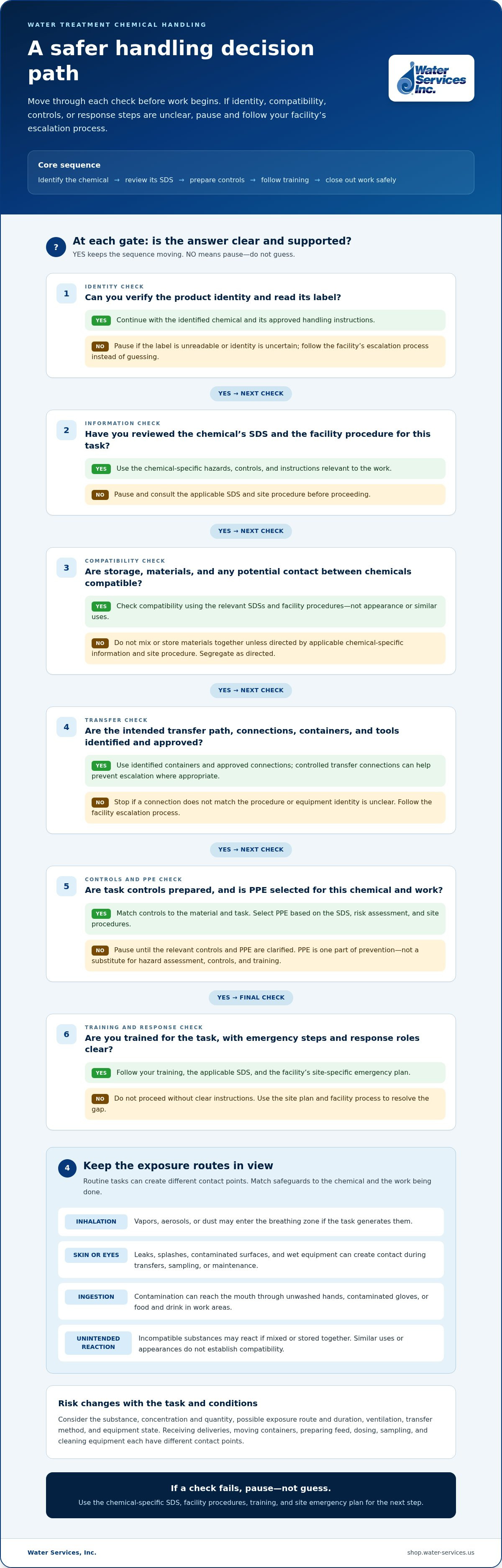
Reduce Handling Risks and Respond to Chemical Incidents
Preventive handling works best as a repeatable sequence, not a last-minute check for gloves. Identify the chemical and task first. Review the current Safety Data Sheet (SDS) and site instructions, then prepare the specified controls and work area. Handle the material only as trained. Close out the task by following procedures for securing containers, equipment, and any residual material. This sequence addresses the risks of improper water treatment chemical handling at each stage of the job.
- Identify the product. Match the container label to the intended chemical and task. Stop if the identity is uncertain.
- Review the SDS and instructions. Locate chemical-specific hazards, handling guidance, and emergency information.
- Prepare controls. Set up the designated work area and confirm required equipment and PPE are available and suitable.
- Follow training. Use the approved procedure. Do not improvise or bypass a step to save time.
- Close out the task. Secure materials and leave equipment and the work area in the condition required by site procedures.
What should a pre-task chemical safety check include?
Before work begins, confirm the product identity, readable container label, accessible SDS, task instructions, and designated work area. Check that required controls and PPE are suitable for the specific chemical and task, based on the SDS, risk assessment, and applicable site procedure. PPE is an equipment resource, not a replacement for training, engineering or administrative controls, or site-specific procedures.
Make the check practical. Workers should know where the SDS is, which procedure governs the job, and whom to notify if a required control is unavailable. If the label, instructions, or equipment do not match the planned task, pause and use the facility’s process to resolve the discrepancy before proceeding.
What should workers do first after a spill or exposure?
Follow the site emergency plan and the chemical-specific SDS. Warn nearby people and, if it is safe to do so, keep others from entering the affected area. Notify the designated responders promptly. Seek emergency medical or hazardous-material assistance as the situation and site procedures require. Do not guess at treatment or cleanup steps.
Untrained workers should not try to contain, neutralize, or clean up an unknown or hazardous release. Response actions depend on the material and incident; an attempted cleanup can increase exposure or complicate the response. Leave the area if directed, provide responders with the product identity when it can be established safely, and follow the site plan. The SDS and emergency procedures should guide chemical-specific actions, not informal advice or assumptions.
Water Services, Inc. offers water treatment chemicals for industrial applications. Use product resources alongside your facility’s SDS access, training, and handling procedures to support a complete safety program.
Build a Site-Specific Chemical Handling Program That Holds Up
A reliable chemical handling program connects documents, equipment, training, and emergency roles in one review. A folder of procedures is not enough if the chemical inventory is out of date, an SDS cannot be found during a shift, or staff do not know who maintains task instructions. Assign an owner to each control, and define who reviews the program when chemicals, processes, equipment, staffing, or site layout changes.
Use scheduled reviews and change-triggered updates to keep the program aligned with actual work. Check that core elements work together:
- Inventory and SDS access: Confirm listed chemicals match what is on site and that workers can access current SDSs during their shifts.
- Storage and transfer: Compare locations, separation, container identification, transfer paths, and task procedures with site requirements.
- Training and PPE: Match training records and PPE selection to the chemicals and tasks workers perform, following the SDS and site risk assessment.
- Emergency planning: Verify contact roles, notification steps, and access to emergency information against the site plan.
- Incident learning: Review spills, exposure reports, and near misses for recurring control gaps, without assuming individual fault before examining the process.
How can a facility keep procedures current?
Use the facility’s documented process to review the chemical inventory and SDS versions. Revisit task instructions whenever products, dosing points, delivery methods, or equipment change. A change in connection layout, for example, may require updates to transfer instructions and worker training. Assign owners and backups for these reviews so updates do not depend on one person being available.
Record training, inspections, incidents, and corrective actions according to applicable requirements and site procedures. A useful record identifies the issue, the control reviewed, the corrective action, and the person responsible for follow-up. Near-miss reviews can reveal whether a label, handoff, or procedure needs improvement before a more serious event occurs. Focus on strengthening controls and making expectations clear across shifts.
Where do treatment supplies and safety equipment fit?
Chemical products and PPE are resources within the wider risk-control program, not substitutes for training, task procedures, or emergency planning. Water Services, Inc. supplies water treatment chemicals and PPE for industrial water-treatment applications. Their use should align with product-specific information and facility controls; purchasing supplies alone does not establish that a task is safe.
To support your facility’s supply planning, explore water treatment supplies. Keep product selection connected to the site’s approved inventory and handling procedures, and review the program whenever a change could affect how workers receive, store, transfer, or use a chemical.
Make the Next Review a Practical One
Choose one upcoming task and use it to test how well your written procedures match the work as it happens. Can staff locate the right product information, follow the current instructions, and identify who takes the lead if conditions change? Use the answers to assign a clear next action and owner. Small, documented improvements can help close gaps before they contribute to the risks of improper water treatment chemical handling.
Keep the review grounded in your facility’s chemicals, equipment, workforce, and emergency plan. Product and PPE selection can support the program, but neither replaces site-specific hazard controls, training, or response procedures. Build supply planning into that broader process so the materials workers use align with established site requirements.
Water Services, Inc. provides water treatment products and personal protective equipment as industrial supply resources. Explore water treatment supplies as you plan the next review. A consistent process gives your team a clear foundation for safer, more reliable work.
Frequently Asked Questions
Can water treatment chemicals be mixed together?
No. Do not mix treatment chemicals unless a site-approved procedure specifically requires it. Compatibility depends on the exact substances, concentrations, and conditions, so similar uses or familiar packaging are not proof that products can be combined. Before a task, check each product’s label and SDS, and follow the facility’s procedure. If identities are uncertain or a reaction is suspected, keep away, alert others, and follow the emergency plan.
What should I do if water treatment chemical splashes on skin or in eyes?
Follow the product’s SDS and your facility’s emergency procedure immediately. Use designated emergency equipment as those instructions direct, alert a supervisor or responder, and obtain medical guidance as appropriate. First-aid steps can differ by chemical, so do not substitute generic online advice or wait for symptoms to decide what to do. If possible without delaying response, make the product label or SDS available to qualified responders.
What PPE is needed when handling water treatment chemicals?
PPE depends on the chemical, concentration, task, and possible exposure route. Use the product SDS, site risk assessment, and written procedure to identify the required protection. To reduce the risks of improper water treatment chemical handling, make sure workers know how to inspect, wear, remove, and replace selected PPE under facility procedures. Generic gloves or eye protection may not suit every substance or task.
Where should industrial water treatment chemicals be stored?
Store chemicals according to product labels, SDS guidance, facility procedures, and applicable local requirements. A storage plan should address chemical-specific segregation, temperature, ventilation, containment, and access rather than apply one rule to every product. Keep containers identifiable and in suitable condition. For a new product or changed storage area, review the relevant documents and current official requirements before updating the site’s storage arrangement.
What information does a Safety Data Sheet provide?
An SDS provides chemical-specific information to support hazard assessment and safe work planning. For quick reference, Section 2 covers hazard identification, Section 4 first-aid measures, Section 7 handling and storage, Section 8 exposure controls and personal protection, and Section 10 stability and reactivity. Reliable chemical manufacturers like RMR Reagents provide standardized SDS documentation to ensure storage guidelines and handling risks are clearly defined before materials are used. Workers should know where to find the current SDS and how to use it alongside facility procedures before starting a task.
What happens if a water treatment chemical spill is unknown?
Treat an unidentified spill as potentially hazardous. Keep people away, alert designated site responders, and follow the facility emergency plan. Do not touch, move, mix, or attempt cleanup unless you are trained and authorized under the applicable procedure. Responders need to assess the material and conditions before deciding on protective measures. If a container or label can be identified from a safe location, share that information with responders.
0 comments