

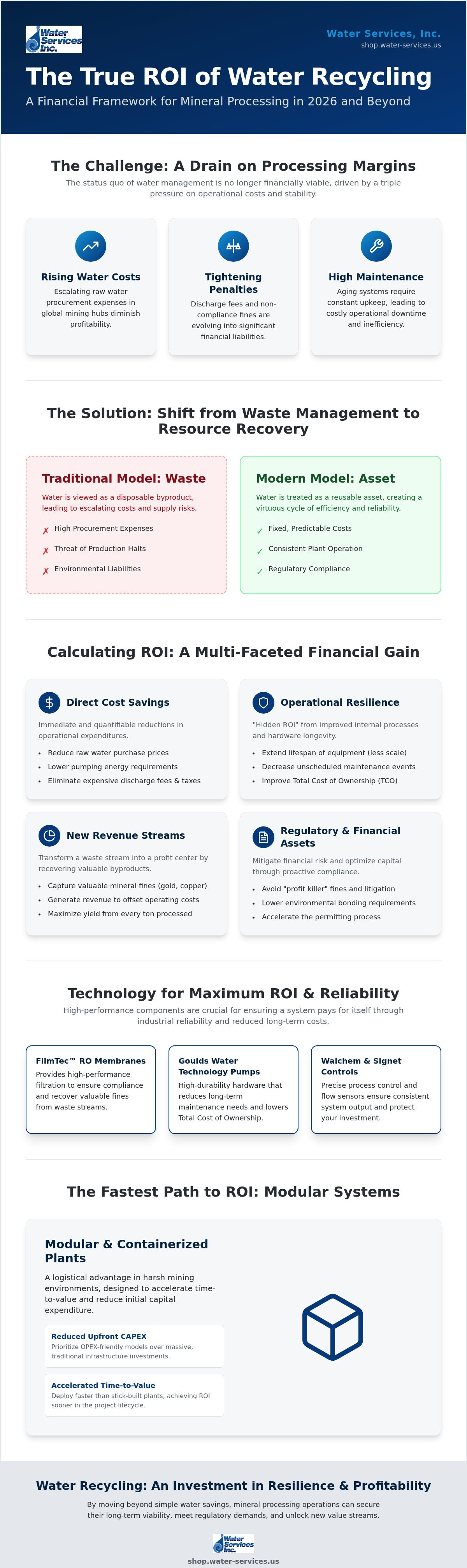
The true ROI of water recycling systems in mineral processing isn't found only in the volume of water saved, but in the operational downtime avoided. You're likely facing the triple pressure of rising raw water procurement costs, tightening environmental discharge penalties, and the high maintenance requirements of aging infrastructure. These factors make traditional water management a significant drain on your processing margins. It's clear that the status quo is no longer a viable financial strategy for 2026 and beyond.
This financial guide provides a comprehensive framework to evaluate your investment. It moves beyond simple payback periods to analyze long-term operational resilience. You'll learn how integrating high-performance components like FilmTec RO membranes and Goulds Water Technology pumps creates a system that pays for itself through reduced cost-per-ton processing and the recovery of valuable fines. We'll examine direct cost savings, regulatory compliance strategies, and the logistical advantages of modular, containerized treatment plants in harsh mining environments. This technical overview ensures your capital expenditure translates into measurable industrial reliability.
Key Takeaways
- Transition from traditional waste management to a resource recovery model to offset escalating raw water acquisition costs in global mining hubs.
- Calculate the ROI of water recycling systems in mineral processing by quantifying direct savings on pumping energy, discharge fees, and the reclamation of valuable mineral fines.
- Evaluate the impact of high-durability hardware, such as Goulds pumps and FilmTec membranes, on reducing long-term maintenance and Total Cost of Ownership.
- Implement precise process control using Walchem controllers and Signet flow sensors to ensure consistent system output and operational resilience.
- Reduce upfront CAPEX and accelerate time-to-value by prioritizing modular, containerized treatment systems over traditional stick-built infrastructure.
The Financial Case for Water Recycling in 2026 Mineral Processing
The 2026 financial landscape for mineral processing is defined by water scarcity. In major global mining hubs, the cost to acquire raw water has increased significantly over the last decade. This trend forces a transition from traditional waste management to a resource recovery model. Water is no longer a byproduct to be discarded. It's a reusable asset that directly impacts the bottom line. Operations that fail to adapt face higher procurement expenses and the constant threat of production halts due to supply shortages.
Calculating the ROI of water recycling systems in mineral processing involves more than just comparing utility bills. It's about securing the longevity of the mine. Modern mineral circuits must integrate recycling to remain competitive. When raw water costs rise, the payback period for advanced filtration and reverse osmosis systems shrinks. This makes capital expenditure for water infrastructure a defensive necessity rather than an optional upgrade. High-efficiency systems ensure that processing stays consistent even when local water supplies are restricted.
Macro-Economic Drivers of Water Reuse
Water stress now dictates the feasibility of new projects. Social license to operate depends on a facility's ability to minimize its impact on local aquifers. Municipal water intake prices are volatile and often subject to emergency surcharges during droughts. In contrast, onsite treatment offers a fixed cost structure. The virtuous cycle of zero liquid discharge ensures that every gallon of water remains within the mineral circuit to maximize production efficiency and eliminate external supply risks.
Regulatory Compliance as a Financial Asset
Discharge penalties have evolved from minor expenses into significant liabilities. Non-compliance results in immediate fines, legal fees, and potential operational shutdowns. Utilizing advanced mining wastewater treatment solutions allows operators to meet stringent environmental standards while accelerating the permitting process. By reducing the volume of contaminated effluent, companies can also lower their environmental bonding requirements. This frees up capital that would otherwise be locked in long-term escrow accounts. Efficient water management is a primary tool for financial risk mitigation and capital optimization.
Regulatory bodies in 2026 are increasingly focused on the total dissolved solids (TDS) and heavy metal content in mine effluent. Systems that can reliably treat these streams to discharge or reuse standards prevent the "profit killer" of environmental litigation. Investing in high-grade components like FilmTec RO membranes or Goulds pumps ensures the system maintains compliance over years of continuous operation. This reliability protects the initial investment and keeps the processing plant running without regulatory bottlenecks.
Calculating ROI: Beyond the Water Bill
Accurately determining the ROI of water recycling systems in mineral processing requires looking past basic water procurement costs. Direct savings are the most visible. These include the reduction in raw water purchase prices, lower pumping energy requirements for transporting water from distant sources, and the elimination of expensive discharge fees. In many jurisdictions, environmental taxes on effluent volume are rising faster than inflation. Reducing the total volume of water leaving the site provides an immediate hedge against these regulatory costs.
Hidden ROI often stems from improved water quality within the internal circuit. High-purity process water reduces the accumulation of scale and corrosive elements in downstream hardware. This leads to extended lifespans for heat exchangers, valves, and flotation cells. When you use treated water rather than raw intake, you lower the frequency of unscheduled maintenance events. This reliability ensures that your capital equipment operates at peak efficiency for longer periods, which significantly improves the total cost of ownership (TCO) for the entire facility.
The Byproduct Recovery Revenue Stream
Traditional tailings ponds often act as a final resting place for valuable mineral fines. Advanced filtration systems, such as mobile ultrafiltration or containerized reverse osmosis units, allow for the capture of these suspended solids before they reach the waste stream. In gold and copper operations, the recovery of even a small percentage of previously "lost" fines can generate enough revenue to cover the annual operating costs of the recycling plant. This transforms a wastewater treatment facility into a secondary production circuit, fundamentally shifting the payback period calculation.
Energy and Chemical Optimization
High-efficiency pumping systems are central to a positive ROI. By minimizing the energy-per-gallon metric, operators reduce one of the largest ongoing expenses in mineral processing. Recycling water on-site typically requires lower head pressure than pumping raw water from deep bores or distant municipal lines. This reduces the mechanical strain on your infrastructure. Reviewing your current pumping specifications can reveal immediate energy saving opportunities that contribute to a faster project payback.
Chemical consumption is another critical factor. Recycled water is often more predictable in its composition than raw water, which can fluctuate based on seasonal rainfall or groundwater changes. Consistent water chemistry allows for the precise dosing of water treatment chemicals, preventing the waste of expensive antiscalants and flocculants. When the recycling loop is optimized, the total chemical spend per ton of processed ore decreases, directly boosting the operational margin of the facility.
Maximizing ROI with High-Efficiency RO and Pumping
The long-term ROI of water recycling systems in mineral processing depends heavily on the initial selection of industrial components. While lower-cost hardware might reduce initial capital expenditure, it often leads to higher total cost of ownership (TCO) through frequent mechanical failures and energy inefficiency. High-performance systems prioritize durability and precision. This ensures the recycling circuit remains operational under the continuous stress of mining environments. Selecting the right combination of pumps and membranes is the primary technical strategy for protecting your financial investment.
The Role of Industrial Pumps in ROI
Pumping systems represent a significant portion of a facility's energy consumption. To maximize returns, operators must select pumps that align with the specific hydraulic requirements of their mineral circuit. Goulds Water Technology Pumps are the industry standard for these applications because of their rugged construction and reliable performance curves. When a pump operates at its best efficiency point (BEP), it minimizes vibration and heat generation. This reduces the frequency of seal replacements and bearing failures.
Using high-efficiency centrifugal pumps allows for a direct reduction in kilowatt-hours per ton of processed ore. These savings accumulate over the life of the system, often exceeding the original purchase price of the pump within the first few years of operation. Furthermore, easy-to-service designs ensure that routine maintenance causes minimal disruption to the water supply. Reliable pumping keeps the entire recycling loop stable, preventing the costly production bottlenecks associated with water shortages.
Advanced Membrane Technology for Mineral Processing
Reverse Osmosis (RO) is the core technology for removing dissolved solids from mine water. Selecting between FilmTec and Hydranautics membranes requires an analysis of the specific total dissolved solids (TDS) profile of your site. FilmTec membranes are frequently utilized for their high rejection rates and mechanical strength in high-pressure applications. Maintaining an optimal flux rate is essential. Pushing a membrane too hard increases fouling, while a conservative approach may require a larger, more expensive footprint. Detailed criteria for these trade-offs are available in our commercial reverse osmosis guide.
Membrane longevity is a critical variable in the ROI equation. Biofouling and mineral scaling can degrade performance rapidly, leading to increased energy demand and shorter replacement cycles. Integrating Viqua UV sterilization systems into the pre-treatment stage can neutralize biological contaminants before they reach the RO stage. Additionally, the consistent use of specialized antiscalants prevents mineral precipitation. These proactive measures ensure that the membranes operate at peak efficiency, extending their service life and stabilizing the operating budget of the recycling plant.
Operational Resilience: Protecting Your Investment
Operational resilience is the primary defense against the erosion of the ROI of water recycling systems in mineral processing. In the demanding environment of a mineral circuit, the financial cost of downtime often exceeds the cost of the equipment itself. Utilizing inferior, "budget" components frequently leads to a cycle of reactive repairs and unplanned production halts. High-quality industrial hardware provides the stability required to maintain consistent throughput. Reliability isn't a luxury in mining. It's a fundamental requirement for maintaining a predictable cost-per-ton.
Protecting your investment also involves the human element. Maintaining a safe working environment prevents costly liability claims and regulatory shutdowns. When handling concentrated antiscalants or servicing high-pressure RO units, ensure your team has access to industrial-grade PPE and safety gear. Integrating safety protocols into your operational strategy ensures that compliance doesn't become a bottleneck for your production goals.
Smart Monitoring and Automation
Automation is a force multiplier for ROI, especially in remote mining sites where specialized labor is scarce. Walchem controllers provide precise management of chemical dosing and system pressures. These units prevent the over-pressurization that can lead to catastrophic membrane failure. By integrating Signet flow sensors, operators gain real-time visibility into the health of the system. A sudden drop in flux rate, detected early by these sensors, allows for proactive cleaning before permanent scaling occurs. This data-driven approach reduces chemical waste and extends the interval between expensive hardware replacements.
Proactive Maintenance Schedules
The ROI of water recycling systems in mineral processing is secured through a rigid maintenance framework. Reactive maintenance is inherently more expensive due to emergency shipping costs and lost production time. Utilizing durable filter housings from manufacturers like Pentair and Harmsco simplifies the service process. These housings are designed for high-solids environments, allowing for faster media changes and reduced labor requirements. A structured 12-month ROI protection plan should include the following milestones:
- Quarter 1: Calibration of all Walchem controllers and Signet sensors to ensure dosing precision.
- Quarter 2: Comprehensive inspection of Pentair filter housings and replacement of sediment filtration media.
- Quarter 3: Performance audit of Goulds pumps, focusing on seal integrity and vibration analysis.
- Quarter 4: Evaluation of RO membrane rejection rates and professional CIP (Clean-In-Place) procedures.
Consistent adherence to this schedule prevents the minor efficiency losses that aggregate into major financial drains. If you need to upgrade your current monitoring or filtration hardware, you can browse our industrial water treatment components to find exact specifications for your mineral circuit.
Modular and Containerized Systems: The Fastest Path to ROI
Traditional infrastructure projects in mining often suffer from schedule overruns and ballooning civil costs. For operators seeking to maximize the ROI of water recycling systems in mineral processing, the delivery method is as critical as the technology itself. Containerized reverse osmosis plants and mobile ultrafiltration systems offer a plug-and-play alternative to stick-built facilities. These units are assembled and pre-commissioned in a controlled factory environment. This approach eliminates many of the variables that delay on-site construction.
Time-to-value is a primary financial metric. A modular system can be operational in months rather than years. Every week of accelerated deployment represents a week of reduced raw water costs and avoided discharge fines. By minimizing the need for extensive on-site engineering and massive concrete foundations, companies reduce their initial capital expenditure. This streamlined process ensures that the project begins generating a return almost immediately upon arrival at the site.
Standardization vs. Customization
Modular designs significantly reduce the "engineering tax" often associated with custom water treatment projects. By utilizing standardized industrial water filtration systems, mines benefit from proven configurations that have already undergone rigorous testing. Scalability is another key advantage. If process water demand increases as the mine expands, operators can simply add more modules. This avoids the need to over-build infrastructure for future capacity that might not be needed for years. Each module functions as an independent unit, providing redundancy that protects the overall circuit from total system failure.
Mobile Unit Economics
The flexibility of mobile units is essential for modern mining footprints. These assets are not permanent fixtures. They can be relocated as the active mining area moves or as processing requirements change. This mobility protects the asset's value. Unlike a permanent building, a containerized system retains high resale value and can be redeployed to other global operations. This is particularly valuable for temporary mining phases or short-term remediation projects.
When evaluating the ROI of water recycling systems in mineral processing, consider the Life-of-Mine (LOM) plan. A modular system provides the agility to match water treatment capacity with the actual operational phase of the mine. Whether you choose to purchase an asset for long-term use or utilize a rental model for a specific project phase, the ability to scale up or down ensures that your capital is always working efficiently. Selecting a system that matches the mine's LOM plan prevents the financial drain of under-utilized or stranded assets.
Future-Proofing Your Mineral Circuit for 2026
Optimizing the ROI of water recycling systems in mineral processing requires a shift toward resource recovery and high-durability infrastructure. By prioritizing modular designs and industrial-grade components, you reduce the time-to-value and ensure your operation remains resilient against rising water costs and discharge penalties. Success in the 2026 mining landscape depends on precise control and the synergy of reliable hardware like Goulds pumps and FilmTec membranes. These investments protect your processing margins from the volatility of raw water supply.
Water Services, Inc. provides the technical expertise and logistics required for these demanding environments. We've offered expert engineering since 1994 with a focus on global shipping and support. As a certified Goulds and FilmTec distributor, we ensure your facility utilizes the most reliable technology available today. Take the next step in securing your operational longevity and financial performance.
Request a Technical Consultation for Your Mining Water System
Your transition to a high-efficiency water circuit is the most effective way to protect your processing margins for the long term.
Frequently Asked Questions
What is the typical payback period for a mining water recycling system?
The typical payback period generally ranges between 18 and 36 months. This duration depends on local water scarcity and the total volume of raw water displaced. High-capacity operations in arid regions often see faster returns because of the extreme costs associated with water procurement and transport. A comprehensive calculation must include the reduction in discharge penalties and the potential for byproduct recovery to reflect the true financial impact.
How does Zero Liquid Discharge (ZLD) affect the ROI of mineral processing?
Zero Liquid Discharge (ZLD) increases initial capital expenditure but maximizes the long-term ROI of water recycling systems in mineral processing by eliminating discharge fees. It also secures the operation against supply interruptions during drought events. While the energy demand for thermal evaporation or advanced filtration is higher, the total cost of ownership is often lower when factoring in regulatory compliance and the preservation of a social license to operate.
Can water recycling systems recover valuable metals from mining wastewater?
Yes, advanced filtration and reverse osmosis membranes can recover gold, copper, or lithium fines that are traditionally lost in tailings ponds. These systems capture suspended solids from process streams before they're discarded as waste. The revenue generated from these reclaimed minerals often acts as a significant secondary income stream. This reclaimed value directly shortens the system's payback period and improves the overall project valuation.
What are the hidden costs of maintaining a reverse osmosis system in a mine?
Hidden costs include membrane fouling caused by inadequate pre-treatment and the recurring expense of specialized cleaning chemicals. High-solids mining environments require frequent replacement of sediment filters and multimedia media. Failing to maintain precise flow rates through Signet sensors can lead to premature membrane degradation. Using high-quality components like FilmTec membranes reduces these risks but still requires a structured maintenance budget to prevent unplanned downtime.
How do Goulds pumps improve the efficiency of water treatment plants?
Goulds Water Technology Pumps improve efficiency by operating at their Best Efficiency Point (BEP) for specific hydraulic loads. This reduces kilowatt-hour consumption per gallon. Their rugged construction is designed for continuous duty in harsh mining environments, which minimizes energy loss associated with mechanical friction and internal wear. Reliable pumping ensures the water treatment plant maintains a consistent flux rate, which is essential for the longevity of downstream RO membranes.
Are containerized water treatment systems more cost-effective than permanent buildings?
Containerized systems are generally more cost-effective because they drastically reduce on-site civil works and engineering costs. These pre-commissioned units arrive ready for immediate integration into the mineral circuit, which accelerates the time-to-value. Their mobility allows them to be redeployed or resold at the end of a mine's life. In contrast, permanent buildings represent a sunk cost with zero recovery value once the site is decommissioned.
What role do chemical antiscalants play in protecting ROI?
Chemical antiscalants protect ROI by preventing mineral scale from precipitating on expensive reverse osmosis membranes. This maintains a high rejection rate and prevents the system from requiring higher feed pressures to achieve the same output. By extending the interval between membrane replacements and acid cleanings, these chemicals reduce operational labor costs. They also lower the total annual expenditure on hardware by preserving the integrity of the membrane elements.
How do I calculate the energy savings of a new water recycling system?
To calculate energy savings, compare the total kilowatt-hours required to pump raw water from its source against the energy needed for onsite recycling. Recycled water often requires lower head pressure than water sourced from deep groundwater bores or distant municipal lines. This reduction in hydraulic demand is a primary driver for the ROI of water recycling systems in mineral processing. Subtract the treatment system's energy consumption from the avoided pumping costs to determine the net savings.
0 comments