

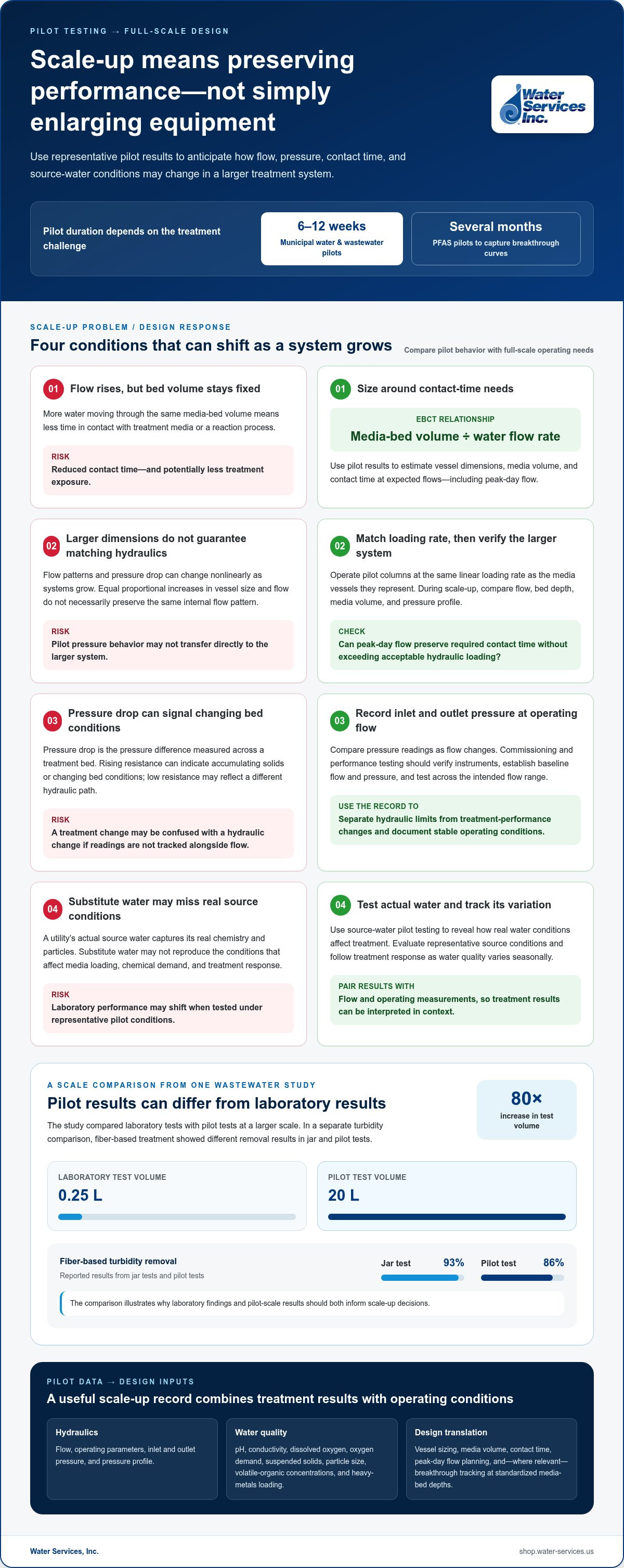
A pilot is not simply a smaller copy of a full-scale treatment plant. Scaling up from a pilot water treatment system means using representative test results to size and configure a larger process, while accounting for changes in flow, pressure drop, contact time, and source-water quality. Most municipal water and wastewater treatment pilots run 6-12 weeks, while PFAS pilots may continue for several months to capture breakthrough curves.
A successful pilot is a useful starting point for full-scale design, but performance can shift as system size and operating conditions change. Pilot testing helps reveal these differences before they affect a permanent treatment system.
This article explains what pilot-scale testing measures and how its results guide scale-up decisions. You’ll see how flow rate, pressure drop, contact time, and source-water conditions affect treatment performance, and why these factors matter when developing a water treatment system.
Key Takeaways
- Use pilot results to guide vessel sizing, media volume, contact-time requirements, and peak-flow planning before finalizing a treatment design.
- Assess hydraulic loading and pressure drop together, since scale changes can alter flow behavior and treatment performance.
- Test with the utility’s actual source water to reveal how its characteristics affect media performance and treatment outcomes.
- Account for changes in mixing, reaction kinetics, and heat transfer as equipment grows; match pumps, membranes, and treatment chemicals to the process needs.
What Is Pilot-Scale Testing?
Pilot-scale testing runs a treatment process at smaller scale to measure performance under representative conditions. Municipal water and wastewater pilots commonly run 6-12 weeks, while PFAS pilots may continue for several months to capture breakthrough curves.
Sizing and Contact-Time Requirements
Design sizing uses pilot results to estimate vessel dimensions, media volume, contact time, and peak-day flow needs. Contact time is how long water remains in contact with treatment media or a reaction process. These measures matter because the design must provide sufficient treatment exposure at expected operating flows. Pilot columns should use the same linear loading rate as the media vessels they represent, so engineers can evaluate media performance under comparable hydraulic conditions.
Process Simulation and Modular Design
Process simulation represents treatment operations and supports module design before full-scale fabrication. Modular designs divide treatment stages into units that can be arranged to match process needs and site constraints. Scale-up planning can include simulation, module design, fabrication, logistics, installation, startup, and commissioning. Each stage connects pilot findings to equipment layout and operating conditions. A water treatment equipment range can also help illustrate how filtration, membranes, and disinfection fit into treatment trains.
Data for Full-Scale System Design
Pilot data translates observed performance into full-scale design inputs, including vessel sizing, media volume, contact time, and peak-day flow planning. For PFAS systems, sampling ports at standardized media-bed depths can track breakthrough and help estimate media lifespan.
In the United States, requirements for a full-scale plant depend on its purpose, discharge route, and location. According to the U.S. Environmental Protection Agency, the Safe Drinking Water Act is the federal law underlying its responsibility to protect drinking water.
Pilot Data Collection for Scale-Up
Collect operating and water-quality measurements that explain both treatment results and the conditions that produce them. Bench-scale tests can measure pH, conductivity, dissolved oxygen, and oxygen demand. Pilot sample analysis can include suspended-solids loading, particle-size analysis, volatile-organic concentrations, and heavy-metals loading. Record flow and operating parameters alongside these results. Together, these data help engineers distinguish treatment limits from changes in source water or hydraulic conditions.
Flow rate, pressure drop, and empty bed contact time
Flow, pressure drop, and empty bed contact time describe how water moves through a media column and how long it contacts the treatment bed. Together, these measures show whether pilot hydraulics can guide the design of a larger operating system.
Empty bed contact time (EBCT) is the media-bed volume divided by the water flow rate. If flow rises while bed volume stays fixed, EBCT falls, reducing treatment exposure. Scale-up must therefore match contact-time needs to design flow, including peak conditions. Pilot column results help determine hydraulic loading rate, media fill volume, and treatment technology order.
Pressure drop is the difference in pressure measured across a treatment bed. Track it alongside flow: rising resistance can indicate accumulating solids or changing bed conditions, while low resistance may reflect a different hydraulic path. Record inlet and outlet pressure at operating flow, then compare readings as flow changes. This record helps distinguish hydraulic limits from changes in treatment performance.
Column operation should reproduce the intended full-scale linear loading rate, rather than simply enlarging vessel dimensions. Changes between laminar and turbulent flow are difficult to predict because fluid dynamics change nonlinearly as systems grow. Equal proportional increases in vessel size and flow therefore do not necessarily preserve the same internal flow pattern or pressure drop. Pilot data informs the design, but engineers must still evaluate the larger system’s hydraulic behavior.
Commissioning and performance testing should verify instruments, establish baseline flow and pressure readings, and test operation across the intended flow range. Operators can then compare treatment results and pressure drop with design targets, documenting adjustments and stable operating conditions.
During scale-up, compare pilot and full-scale flow, bed depth, media volume, and pressure profile. If the larger system must handle peak-day flow, assess whether it can preserve required contact time without exceeding acceptable hydraulic loading. These comparisons help identify where the design needs additional bed volume, revised flow control, or a different treatment-stage arrangement.
Pilot-scale testing with a utility’s actual source water
Testing with a utility’s source water reveals how real water conditions affect treatment. Laboratory performance can change at pilot scale, so both stages inform scale-up decisions.
Testing with Actual Source Water
A source-water pilot treats water drawn from the utility’s supply, capturing its actual chemistry and particles. This matters because substitute water may not reproduce conditions that affect media loading, chemical demand, and treatment response. One wastewater study compared laboratory tests using 0.25 L with pilot tests using 20 L, an 80-fold scale increase. Account for seasonal changes by evaluating representative source conditions and tracking treatment response as water quality varies.
Turbidity Removal During Scale-Up
Turbidity removal measures how well treatment reduces suspended particles, but results can shift between laboratory and pilot scales. In one comparison, fiber-based treatment removed 93% of turbidity in jar tests and 86% in pilot tests. Conventional treatment without fibers achieved 84% in jar tests and 49% in pilot tests. These results show why laboratory outcomes alone may not predict pilot performance. Compare removal under each scale and relate differences to source-water characteristics and process operation.
Non-Linear Scale-Up Effects
Non-linear scale-up means treatment performance does not change in direct proportion to equipment size or input quantities. Fluid mechanics, reaction kinetics, and mixing conditions shift as the system grows. For example, multiplying reactant amounts by 500 in a tank 500 times larger does not necessarily produce 500 times the product or heat. This matters because chemicals and process conditions must be evaluated together, rather than scaled by volume alone.
Validating a Pilot Before Construction
Pilot validation compares measured results with design objectives and tests whether performance holds under representative operating conditions. Analyze samples for suspended-solids loading, particle-size distribution, volatile-organic concentrations, and heavy-metals loading. Use semi-empirical modeling to identify technology limitations, then compare predicted performance with pilot observations. This evidence helps refine process design before full-scale construction and reveals assumptions that need adjustment. Include source-water variation and treatment response in the validation record.
Water treatment technology development
Since the early 20th century, water treatment has advanced beyond basic filtration and chlorination. Pilot testing helps municipalities evaluate newer processes under operating conditions before committing to full-scale design. That matters when a treatment system must meet defined output goals: a poorly performing installation can put millions in project spending at risk. Pilot evidence connects new technology’s efficacy with practical engineering decisions.
Scale changes affect more than vessel dimensions. Reaction kinetics, fluid mechanics, and thermodynamics can shift as process volumes grow. A beaker system enlarged into a tank 500 times larger, with reactants multiplied by 500, won’t necessarily produce 500 times the product or heat. Engineers therefore assess mixing, heat gain and loss, and reaction time rather than relying on proportional arithmetic alone.
Reynolds number informs mixing efficiency and thermal transfer, so pilot plant design should account for it. Agitation also matters because turbulence influences reaction kinetics. Angled agitators and baffles can increase turbulence, while changes in the surface-area-to-mass relationship affect heat exchange. Materials matter too: surfaces exposed to reactions can influence process behavior, erode, or add to system cost. These factors guide equipment selection and system longevity.
A practical development plan links front-end engineering to process simulation, module design, fabrication, logistics, installation, startup, and commissioning. At each stage, designers can compare pilot results with intended full-scale operating conditions and identify constraints before fabrication. Material availability and operator involvement also affect whether the design can be operated and maintained as intended. The key lesson is that scale-up develops a process around measured limits, not simply larger equipment.
Explore water treatment equipment options relevant to process design and system development.
Water Services: Goulds Water Technology Pumps
Water Services, Inc. offers Goulds Water Technology Pumps for treatment applications where pump selection must align with process flow and pressure requirements. This is a practical next step when pilot findings are guiding equipment choices for a larger system. Water Services, Inc. also offers Viqua UV Water Purification Systems, Hydranautics RO Membranes, and Water Treatment Antiscalants and Chemicals for treatment trains that use those processes.
Use the pilot’s operating data to define process requirements, then consider which equipment categories fit the planned treatment stages. For pump needs, review the Goulds Water Technology Pumps offering. Contact Water Services, Inc. to discuss equipment options for your water treatment application.
Move from pilot data to a practical equipment plan
Scaling up from a pilot water treatment system means turning measured process needs into clear equipment decisions. Define the operating conditions the full-scale system must handle, then match each treatment stage to the required flow, pressure, and water-quality objectives. This keeps procurement aligned with engineering priorities.
Water Services, Inc. offers Goulds Water Technology Pumps, Viqua UV Water Purification Systems, and FilmTec Reverse Osmosis Membranes for treatment applications that use these equipment categories. The right selection depends on each component’s role in the planned process. Aligning equipment choices with pilot findings gives the design team a focused basis for the next project decisions.
Discuss equipment options and your treatment application with Water Services, Inc. Contact Water Services to take the next step toward a well-matched system.
Frequently Asked Questions
How do you scale water treatment process capacity from pilot to full scale?
In practice, scaling up from a pilot water treatment system means translating measured results into a full-scale process configuration, then checking that each treatment stage can meet required throughput. Start with the output target and source-water conditions. Identify the process stage that limits production, then assess whether parallel treatment trains or larger equipment suit the design. Compare predicted performance with pilot observations and refine the layout before equipment procurement.
What design criteria and calculations are needed to size full-scale water treatment equipment?
Size equipment based on required flow, treatment targets, source-water characteristics, and the operating range the plant must handle. For a media vessel, calculate bed volume by multiplying flow by the required empty bed contact time; cross-sectional area relates flow to hydraulic loading. Engineers also assess pressure limits, pretreatment needs, chemical dosing, and maintenance access. Keep units consistent throughout each calculation to avoid design errors.
How do pilot results change at full scale due to hydraulics, mixing, and mass transfer?
Hydraulic and mixing effects complicate scaling up from a pilot water treatment system because larger equipment changes flow distribution and contact between water and treatment media. Poor distribution may create bypass paths, while weaker mixing can slow chemical contact with contaminants. Pilot removal rates therefore cannot be multiplied directly by vessel size. Examine flow paths and mixing conditions, then validate performance during commissioning.
What are typical capital and operating costs for scaling up a water treatment system?
Project costs depend on the equipment, site work, installation, and controls required for the selected process. Operating expenses include energy, replacement media, treatment chemicals, labor, maintenance, and residuals handling. Separate one-time capital items from recurring requirements, then assess how operating conditions affect each category. For example, a process with frequent media replacement has a different operating profile from one dominated by pumping energy.
What are the main technical and operational risks when scaling up a water treatment pilot?
Key risks include altered hydraulics, unexpected fouling, changes in chemical reactions, and materials that erode or affect process performance. Operational gaps can arise if instrumentation, alarms, or routine sampling do not support full-scale operation. Define operating limits, maintenance tasks, and response procedures in the design package. Involving operators during pilot operation builds familiarity with process controls and supports a clearer transition to routine plant operation.
What permits and regulatory requirements apply to a full-scale water treatment plant in the United States?
Requirements depend on the plant’s purpose, discharge route, and location. The Safe Drinking Water Act is the federal law underlying the EPA’s responsibility to protect drinking water.
0 comments