

A malfunctioning pressure gauge is rarely just a faulty component; it's often the final warning sign of a systemic process failure. When your Ashcroft instrumentation begins to drift or freeze, the immediate instinct is to swap it out and move on. However, ignoring the underlying cause of gauge error risks more than just a replacement cost. It threatens the integrity of your Goulds pumps and the safety of your entire pressurized system.
We understand that industrial maintenance teams face constant pressure to minimize downtime while managing tight repair budgets. This guide provides the technical framework for troubleshooting Ashcroft pressure gauges with precision. You'll learn how to master the diagnostic steps required to identify gauge failure, mitigate process stressors like pulsation, and determine when a unit is safe to remain in service. We will examine root cause analysis, safety protocols for over-pressurization, and the implementation of preventative measures. By utilizing hardware like the new 502 all-welded flanged diaphragm seals or snubbers, you can protect your instrumentation from future damage and ensure long-term reliability in demanding environments.
Key Takeaways
- Learn to differentiate between internal mechanical defects and external process stressors by interpreting symptoms like pointer flutter and "dead gauge" readings.
- Master the use of block and bleed valves to safely isolate instrumentation for atmospheric "zero checks" when troubleshooting Ashcroft pressure gauges.
- Identify how high-frequency vibration and hydraulic pulsation degrade internal gears and learn to mitigate these forces using snubbers or diaphragm seals.
- Evaluate the technical and financial trade-offs between field repairs and full replacement to maintain safety compliance and Goulds pump performance.
- Implement standardized Ashcroft instrumentation across your facility to ensure data consistency and seamless integration with automated monitoring controllers.
Identifying Common Ashcroft Pressure Gauge Failure Symptoms
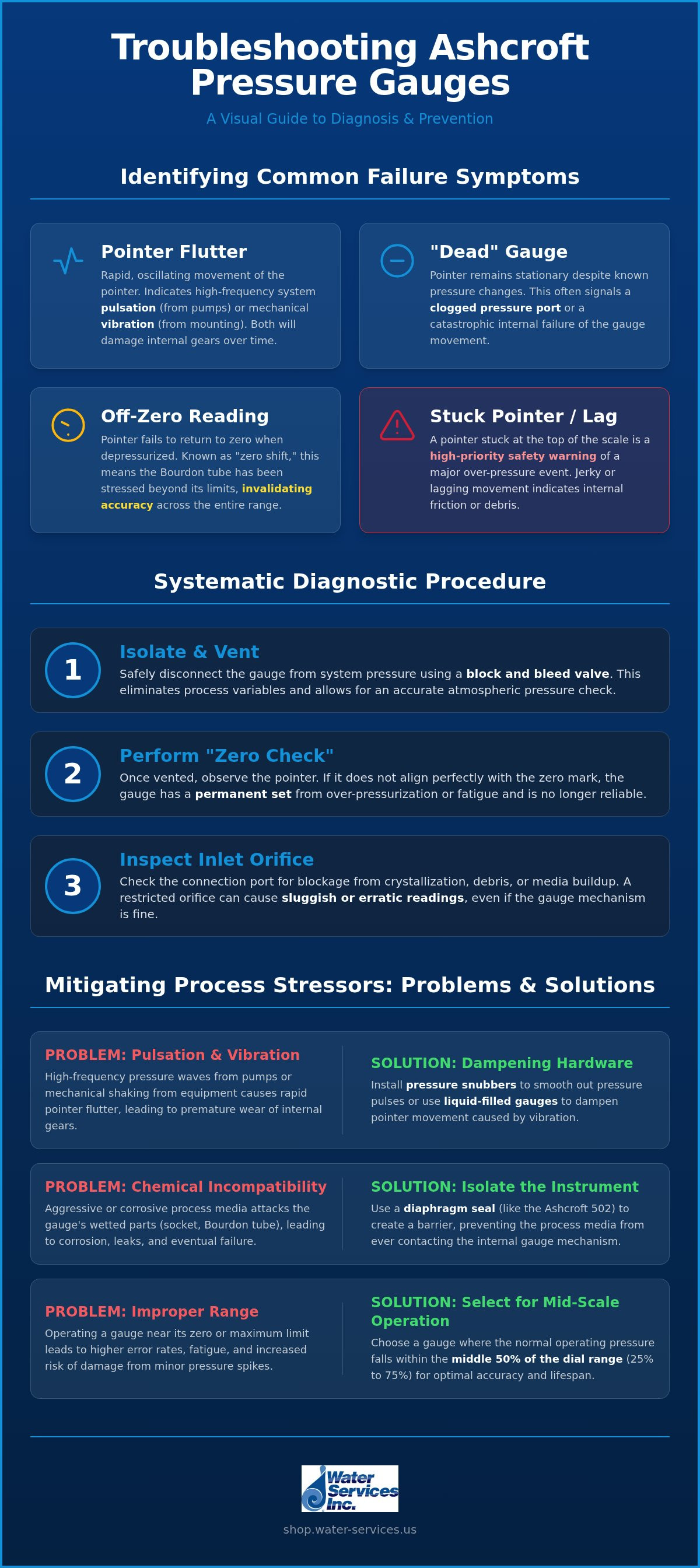
Visual inspection is the primary step in troubleshooting Ashcroft pressure gauges. A "dead gauge" describes a state where the pointer remains stationary despite known pressure fluctuations in the line. This usually points to a clogged pressure port or a catastrophic internal failure of the movement. In contrast, pointer flutter involves rapid, oscillating movement. Technicians must identify if this is caused by system pulsation or mechanical vibration. Pulsation is often the rhythmic hammering from positive displacement pumps, while vibration originates from the equipment mounting itself. Both forces will eventually destroy the internal gears if left unaddressed.
Off-zero readings occur when the pointer fails to return to the zero pin upon depressurization. This phenomenon, known as "zero shift," indicates that the Bourdon tube has been stressed beyond its design limits. Gaining a deeper understanding of pressure measurement principles reveals that a zero shift typically invalidates the accuracy of the gauge across its entire range. If the pointer sits significantly above zero, the instrument is no longer a reliable source of data for your Goulds pump or RO system. It's a clear signal that the internal calibration has been compromised by an over-pressure event.
The Significance of Pointer Position
A pointer stuck at the top of the scale is a high-priority safety warning. It signals a major over-pressure event that likely exceeded the gauge's maximum capacity. In these scenarios, the internal mechanism is often permanently deformed. You might also observe "lag," where the pointer moves in jerky increments rather than a smooth sweep. This is generally caused by mechanical friction within the movement gears or the accumulation of debris inside the case. Such friction prevents the gauge from providing the real-time precision required for industrial water treatment. When troubleshooting Ashcroft pressure gauges, any non-linear movement should be treated as a sign of mechanical wear.
External Indicators of Internal Stress
The physical condition of the gauge case provides vital clues. Cloudy or yellowed fill fluid suggests chemical ingress or UV degradation of the glycerin or silicone. If you're using liquid-filled gauges, verify that the fill plug has been clipped. An unvented plug creates internal pressure as the fluid expands with temperature, which creates a false reading on the dial. Finally, examine the connection socket for signs of corrosion or pitting. This usually indicates that the wetted parts are incompatible with the process media. In such instances, installing a diaphragm seal is necessary to protect the instrumentation from aggressive chemicals and prevent total system leakage.
Systematic Diagnostic Procedures for Inaccurate Readings
Effective troubleshooting Ashcroft pressure gauges requires a controlled environment to eliminate process variables. Begin by isolating the instrument from the system using a block and bleed valve assembly. This allows you to vent internal pressure safely and perform a "Zero Check" under atmospheric conditions. If the pointer doesn't align with the zero mark once vented, the gauge has likely suffered a permanent set in the Bourdon tube or movement gears. Before proceeding to mechanical adjustments, inspect the inlet orifice for media buildup. Crystallization or debris in the socket can restrict flow, leading to sluggish response times or erratic readings in high-pressure RO systems. If the orifice is clear and the zero is off, the internal mechanism is likely compromised.
Step 1: The External Audit
Before removing the gauge for testing, conduct a field audit of its installation parameters. Accuracy is often compromised by simple environmental factors rather than internal failure. It's vital to verify these settings first to avoid unnecessary replacements. Check the following:
- Pressure Range: Ensure the operating pressure falls within the middle 50% of the dial range. Gauges used at the extreme top or bottom of their scale are prone to higher error rates and faster fatigue.
- Installation Orientation: Confirm the gauge is mounted according to its design specifications. A gauge calibrated for vertical mounting may show a slight offset if installed horizontally due to the weight of the internal components.
- Line Integrity: In liquid-filled lines, check for trapped air pockets or loose fittings that might cause pressure dampening or leaks. These small leaks can cause the pointer to drift over time.
Step 2: The Master Gauge Comparison
Validation requires a high-accuracy Ashcroft test gauge, typically with a 0.25% or 0.5% full-scale accuracy. Pressure gauge calibration in the field involves comparing your process gauge against this master unit at specific intervals. Record the readings at 25%, 50%, and 75% of the total span. This systematic approach helps distinguish between a simple span error, which is a consistent deviation across the range, and a non-linearity error, where the inaccuracy varies at different pressure levels. Simple span errors can sometimes be adjusted via the internal recalibration screw, but non-linearity often signals a worn linkage that requires professional repair. If the deviation exceeds the manufacturer's stated tolerance at any point, the unit must be recalibrated or replaced to maintain the efficiency of your Goulds water technology pumps. Consistent data is essential for identifying membrane fouling or pump cavitation before they lead to system downtime. Don't overlook these small deviations, as they are often the first signs of pump seal failure or clogged filters.
Mitigating Process Stressors: Pulsation, Vibration, and Temperature
When troubleshooting Ashcroft pressure gauges, identifying the environmental stressor is as critical as identifying the failure itself. Industrial environments, specifically mining and high-pressure reverse osmosis (RO) plants, subject instrumentation to harsh conditions that degrade accuracy over time. Most gauge failures are caused by vibration, pulsation, or temperature extremes rather than manufacturing defects. Understanding these stressors allows maintenance teams to implement targeted protective measures that extend the service life of their monitoring equipment.
Vibration vs. Pulsation: Choosing the Right Accessory
Vibration originates from mechanical sources like rotating pump assemblies or unsecured piping. It causes rapid, high-frequency pointer movement that accelerates wear on the internal movement gears. Conversely, pulsation is a fluid-dynamic event. It's the rhythmic hammering caused by positive displacement pumps, such as Pulsafeeder metering pumps. While vibration destroys the linkage through friction, pulsation can fatigue the Bourdon tube until it cracks. To mitigate these effects, consider the following hardware solutions:
- Liquid-Filled Cases: Filling the gauge with glycerin or silicone oil provides viscous dampening to stabilize the pointer and lubricate internal parts.
- Pressure Snubbers: These accessories restrict the flow of the process media to the gauge, smoothing out pressure spikes before they reach the Bourdon tube.
- Ashcroft PLUS! Performance: This proprietary dampening mechanism provides the benefits of a liquid-filled gauge in a dry case, eliminating the risk of leakage or fluid discoloration in sensitive water treatment areas.
Protecting Gauges in Mining and RO Applications
Temperature extremes alter the elasticity of the Bourdon tube. High temperatures make the metal more pliable, causing the gauge to read higher than actual pressure. In steam applications, a siphon or "pigtail" must be installed. This creates a condensate trap that prevents live steam from entering the gauge and causing thermal shock. Chemical compatibility is equally vital. Corrosive antiscalants or abrasive mining slurries will quickly pit 316 stainless steel components. In these scenarios, a diaphragm seal acts as a barrier, transferring pressure through a flexible membrane to the gauge movement without direct contact with the media. For extreme environments, selecting Monel wetted parts ensures long-term resistance to chemical attack. These protective layers ensure your instrumentation remains the reliable "eyes" of your system, providing the precision data needed to monitor RO membrane health and pump efficiency.
The Repair vs. Replacement Decision Framework for 2026
Industrial maintenance managers must weigh technical integrity against budgetary constraints during every service interval. When troubleshooting Ashcroft pressure gauges, the decision to overhaul a unit or discard it hinges on the "50% Rule." If the aggregate cost of labor, replacement parts, shipping, and NIST-traceable recalibration exceeds half the price of a new instrument, replacement is the more economical path. Beyond direct costs, safety and liability are paramount. Field-repaired gauges that haven't been certified by an authorized laboratory often fail compliance audits in the mining and military water treatment sectors. This lack of certification can compromise the documented safety of your entire pressurized system.
Recalibration requirements are a significant factor in this calculation. NIST-traceable certification is non-negotiable for instruments used to monitor RO membrane pressure or Goulds pump discharge. A gauge that appears to function correctly but hasn't been verified against a known standard can provide false data. This unreliable information leads to premature membrane fouling or undetected pump cavitation. If you can't guarantee the accuracy of a repaired gauge through formal testing, the risk to your high-value equipment outweighs the savings of a repair.
When is Repair Viable?
Repairing an instrument makes sense for high-value components. Large-diameter 6-inch process gauges or high-accuracy test gauges often justify the investment in professional service. If the failure is purely cosmetic, such as a cracked lens or a degraded case seal, these can be replaced without disturbing the internal Bourdon tube or movement gears. Additionally, legacy systems featuring custom dials or non-standard scales may require repair because direct replacements aren't immediately available due to current 2026 lead times. In these specific cases, the specialized nature of the dial makes the labor cost of troubleshooting Ashcroft pressure gauges a secondary concern to system uptime.
The Case for Immediate Replacement
Certain failure modes mandate immediate disposal for safety reasons. Any gauge that has been subjected to a "burst pressure" or "proof pressure" event must be replaced. The internal metal has likely suffered fatigue or permanent deformation that no amount of recalibration can fix. Standard 2.5-inch commercial gauges are also prime candidates for replacement. The labor hours required for a technician to disassemble and fix a small-diameter gauge usually exceed the cost of a new unit. For critical safety loops or high-pressure RO plants, using a brand-new, factory-certified gauge is the only way to ensure system protection. If your diagnostic audit reveals a compromised unit, you can find factory-new Ashcroft pressure gauges and accessories to restore your system's accuracy.
Optimizing System Performance with Quality Ashcroft Instrumentation
Standardizing on a single brand like Ashcroft ensures that maintenance teams across global sites use the same diagnostic language. It simplifies training and reduces the inventory of spare parts required for various process lines. Beyond mechanical readouts, integrating these gauges with Walchem Controllers allows for automated system monitoring. These controllers can process signals from pressure transmitters to trigger alarms or shut down Goulds pumps if pressures exceed safe thresholds. When troubleshooting Ashcroft pressure gauges in high-pressure environments, safety is the first priority. Always utilize appropriate PPE, including face shields and heavy-duty gloves, before approaching a line that shows signs of over-pressurization or mechanical vibration.
Proper Installation for Longer Service Life
Precision instrumentation requires precise installation. A common error during troubleshooting Ashcroft pressure gauges is applying torque to the gauge case rather than the socket flats. This stresses the internal movement and can cause immediate calibration drift. Use a wrench on the square socket flats only. For high-purity RO applications, select a thread sealant that won't leach contaminants into the permeate stream. In mining wastewater sites, implement a monthly inspection program. Check for buildup on the dial face and verify that the case venting plug remains functional. Regular cleaning prevents the accumulation of corrosive dust that can seize external moving parts or obscure the lens.
Scaling Solutions with Water Services, Inc.
Our engineering team specializes in integrating Ashcroft instrumentation into modular, containerized RO plants and mobile ultrafiltration systems. We understand that precision monitoring is the only way to protect expensive RO membranes from fouling. By utilizing the Water Services Online Shop, facility managers can source replacement gauges, snubbers, and diaphragm seals with minimal lead times. We support remote mining and military operations through a global distribution network that prioritizes technical integrity and logistical speed. Whether you need a single replacement unit or a complete instrumentation overhaul for a new facility, we provide the hardware and expertise required for demanding industrial environments. Browse our full selection of Ashcroft Pressure Gauges to secure your system's performance today.
Securing Long-Term Instrumentation Reliability
Precision monitoring is the cornerstone of system health in high-pressure RO and mining applications. By mastering the systematic steps for troubleshooting Ashcroft pressure gauges, you'll differentiate between simple calibration drift and catastrophic mechanical failure. Identifying stressors like hydraulic pulsation or thermal shock early allows you to implement protective accessories that prevent costly downtime. It's about maintaining the technical integrity of your entire pressurized environment.
As an Authorized Ashcroft Distributor, Water Services, Inc. has supported global mining and military infrastructure since 1994. We provide expert engineering support for industrial water systems to ensure your instrumentation remains accurate under the most demanding conditions. If your current audit reveals a failed unit, our online store offers a streamlined path to procurement. You can find everything from standard process gauges to specialized diaphragm seals in our inventory.
Shop Ashcroft Pressure Gauges & Accessories
Consistent maintenance and proper equipment selection are the best defenses against process failure. We're here to help you keep your systems running safely and efficiently.
Frequently Asked Questions
Can I recalibrate an Ashcroft pressure gauge in the field?
Field recalibration is possible for specific Ashcroft models, such as the 1379 Duragauge, which feature an adjustable micrometer pointer. You can adjust the span or zero point using the internal screw mechanisms. However, field adjustments don't provide the NIST-traceable certification required for high-stakes military or mining applications. If the gauge shows non-linear errors, it usually requires professional laboratory service rather than a simple field tweak.
Why is my liquid-filled gauge leaking fluid from the top?
Fluid leakage from the top of the case usually indicates a compromised fill plug or a failure to vent the gauge properly. If the fill plug wasn't clipped after installation, internal pressure builds as the glycerin or silicone expands with heat, forcing the fluid past the seal. Ensure the plug is seated correctly and the vent nipple is open. If leakage persists, the case gasket may be damaged.
What is the difference between proof pressure and burst pressure for Ashcroft gauges?
Proof pressure is the maximum pressure an instrument can withstand without suffering permanent mechanical deformation or a loss of accuracy. Conversely, burst pressure is the threshold where the Bourdon tube or case will catastrophically fail, resulting in a system leak. While troubleshooting Ashcroft pressure gauges, always verify that your system peaks never exceed the proof pressure rating to avoid permanent zero shift or internal gear damage.
How do I know if my gauge needs a diaphragm seal?
A diaphragm seal is necessary if your process media is corrosive, highly viscous, or contains suspended solids like mining slurry. It acts as a physical barrier that prevents aggressive chemicals from contacting the internal 316 stainless steel or Monel Bourdon tube. If you're managing RO antiscalants or abrasive wastewater, a seal prevents clogging and chemical attack, ensuring the gauge remains an accurate monitoring tool for your system.
Why is the pointer on my pressure gauge not returning to zero?
When a pointer fails to return to zero after depressurization, it's a symptom of "zero shift" caused by an over-pressure event. The Bourdon tube has likely been stretched beyond its elastic limit, resulting in permanent deformation. This is a critical step in troubleshooting Ashcroft pressure gauges, as it confirms the unit is no longer reliable. A gauge with a significant zero shift must be replaced to ensure system safety.
How often should industrial pressure gauges be inspected or replaced?
Industrial instrumentation should undergo a visual inspection monthly and a full calibration check annually. In demanding environments like high-pressure RO plants or remote mining sites, semi-annual inspections are recommended. Factors such as extreme vibration or frequent pressure spikes accelerate mechanical wear. If a gauge operates in a critical safety loop, more frequent verification ensures compliance with industrial safety standards and maintains pump performance.
What does 3-2-3% accuracy mean on an Ashcroft commercial gauge?
The 3-2-3% designation refers to ASME B40.100 Grade B accuracy. This means the gauge is accurate to within ±3% of the full scale in the first and last quarters of the dial, and within ±2% in the middle half. For applications requiring higher precision, such as monitoring RO membrane performance, maintenance teams should standardize on Grade 2A or Grade 3A instruments which offer much tighter tolerances across the entire span.
Can I use a standard gauge for steam or high-temperature liquids?
Standard pressure gauges shouldn't be used directly on steam lines because high temperatures will destroy the internal movement and Bourdon tube. You must install a siphon or "pigtail" between the process and the gauge. This accessory creates a condensate trap that prevents live steam from entering the instrument. For high-temperature liquids, consider using a capillary line or a diaphragm seal with a high-temperature fill fluid to isolate the gauge.
0 comments