

A low UV dose alarm is rarely just a signal of a failed lamp; it’s a critical diagnostic window into the health of your entire pre-filtration and water chemistry chain. When these alerts trigger, the immediate instinct is often to replace expensive components prematurely, yet this rarely addresses the underlying technical issue. You understand that bypassed alarms lead to regulatory non-compliance and the risk of bacterial breakthrough in your process water. Effectively troubleshooting low UV dose alarms requires a methodical approach that looks beyond the controller display to the actual hydraulic and chemical conditions of the system.
Identify the root cause of your UV system alarms and restore disinfection performance with this expert-led industrial troubleshooting guide. We analyze how water transmittance (UVT), quartz sleeve fouling, and sensor calibration impact your dose readings. You’ll learn to clear the alarm state, ensure water safety compliance, and optimize the maintenance schedule for your UV components. This technical overview provides the exact steps needed to maintain system integrity without incurring unnecessary operational costs.
Key Takeaways
- Learn the technical distinction between a simple lamp failure and a low UV dose alarm to prioritize critical disinfection risks.
- Discover how to perform a precise physical inspection of quartz sleeves and sensors to identify solarization or fouling.
- Identify how invisible water chemistry factors like iron, manganese, and tannins act as UV absorbers that trigger system alerts.
- Follow a systematic approach for troubleshooting low UV dose alarms to verify ballast output and electrical stability in industrial environments.
- Understand the importance of utilizing genuine Viqua replacement components to ensure sensor calibration accuracy and regulatory compliance.
Understanding the "Low UV Dose" Alarm: Safety and Compliance Risks
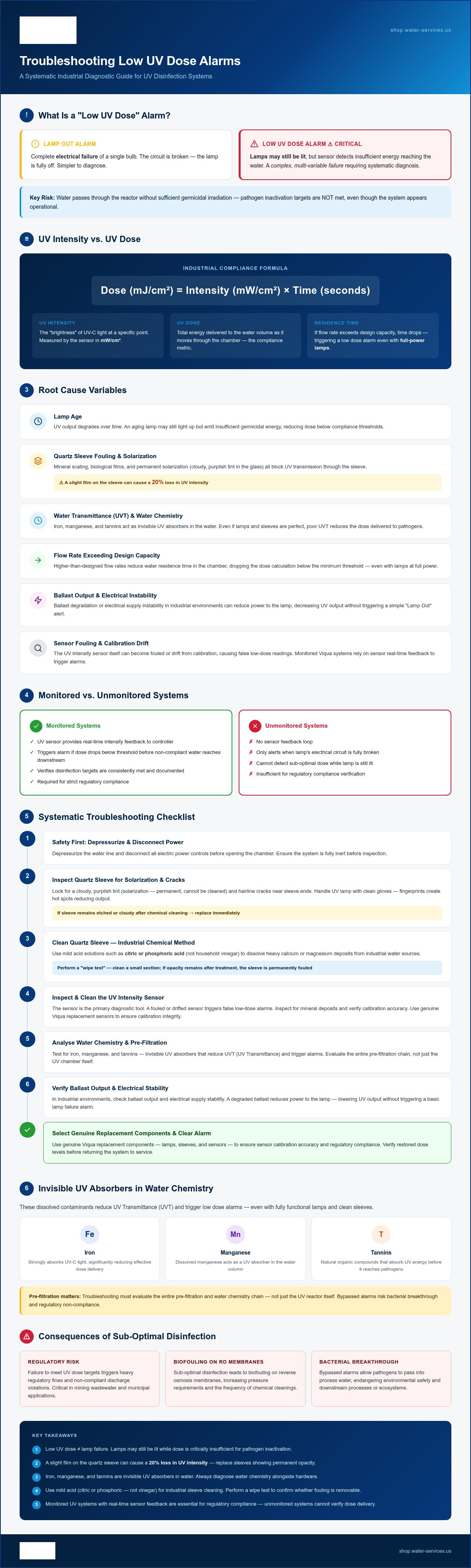
A "Low UV Dose" alarm is a critical system notification that indicates the disinfection process is no longer meeting the minimum energy requirements for pathogen inactivation. Unlike a simple "Lamp Out" signal, which indicates a complete electrical failure of a single bulb, a low dose alarm suggests the water is passing through the reactor without receiving sufficient ultraviolet germicidal irradiation. This is a more complex failure state because the lamps may still be lit, but the system sensors detect that the energy reaching the water is insufficient. Effectively troubleshooting low UV dose alarms requires understanding that this state is a product of several variables, including lamp age, quartz sleeve clarity, and water transmittance.
In industrial environments, the distinction between monitored and unmonitored systems is vital for operational integrity. Monitored Viqua systems utilize a UV sensor to provide real-time feedback to the controller. If the sensor detects a drop in UV intensity, it triggers the alarm to prevent untreated water from reaching downstream processes. Unmonitored systems lack this feedback loop and only alert operators when a lamp's electrical circuit is broken. For facilities requiring strict regulatory compliance, relying on a monitored system is the only way to verify that disinfection targets are consistently met and documented.
UV Intensity vs. UV Dose: What’s the Difference?
UV intensity refers to the "brightness" of the UV-C light at a specific point, usually measured by the sensor in mW/cm². UV dose represents the total energy delivered to the water volume as it moves through the chamber. Dose is calculated by multiplying the intensity by the exposure time, also known as residence time. For industrial compliance, the formula is expressed as: Dose (mJ/cm²) = Intensity (mW/cm²) × Time (seconds). If flow rates increase beyond the system's design capacity, the residence time drops, potentially triggering a low dose alarm even if the lamps are operating at full power.
The Operational Impact of Sub-Optimal Disinfection
Failure to maintain the required UV dose poses immediate risks to downstream equipment and environmental safety. In high-stakes applications like mining wastewater treatment solutions, UV systems are essential for meeting discharge permits and protecting local ecosystems from microbial contamination. Sub-optimal disinfection also leads to biofouling on reverse osmosis membranes, which increases pressure requirements and necessitates more frequent chemical cleanings. When troubleshooting low UV dose alarms, operators must evaluate the entire system chain to identify where the energy loss occurs and prevent the heavy regulatory fines associated with non-compliant water discharge.
Step-by-Step Physical Inspection: Cleaning the Quartz Sleeve and Sensor
Before beginning any maintenance, strict safety protocols must be followed to protect personnel and equipment. Depressurize the water line and disconnect all electric power controls to ensure the system is inert. Once the chamber is open, perform a visual inspection of the quartz sleeve. Look for "solarization," which appears as a cloudy, purplish tint within the glass that cannot be cleaned. This indicates the quartz has reached its service limit. Check for hairline cracks near the ends of the sleeve. When handling the UV lamp, wear clean gloves to prevent skin oil contamination. Fingerprints create hot spots on the bulb surface, which reduces output and leads to premature failure.
Industrial Cleaning Procedures for Quartz Sleeves
Industrial water sources, particularly in mining or municipal applications, often contain high mineral loads that cause rapid scaling. Use mild acid solutions, such as citric or phosphoric acid, rather than household vinegar to dissolve heavy calcium or magnesium deposits. Perform a "wipe test" by cleaning a small section of the sleeve; if the quartz remains etched or cloudy after chemical treatment, it is permanently fouled. Maintaining CDC water treatment and disinfection standards requires optimal transmittance. Replacing a sleeve that shows permanent opacity is necessary, as even a slight film can cause a 20% loss in UV intensity.
Inspecting and Cleaning the UV Intensity Sensor
The sensor is the primary tool for troubleshooting low UV dose alarms. Carefully remove the sensor from the reactor chamber, ensuring you don't damage the delicate lens. Clean the sensor face using a lint-free swab soaked in isopropyl alcohol to remove any film. Inspect the sensor cable for signs of corrosion or moisture ingress at the connection point. In industrial settings, electrical interference from nearby motors can disrupt sensor signals, so verify the cable shielding is intact. This methodical inspection is the first stage in troubleshooting low UV dose alarms before moving to water chemistry analysis.
Re-assembly requires precision to ensure a watertight seal. Always inspect the O-rings for nicks or compression sets before re-inserting the sleeve. A compromised seal will lead to leaks that can damage the lamp or ballast. If you find the sleeve is beyond recovery, sourcing genuine Viqua quartz sleeves ensures the system maintains its original engineering specifications and sensor calibration. Use the following checklist during re-assembly:
- Verify the quartz sleeve is free of internal "solarization" purple tinting.
- Confirm the sensor lens is clear of mineral scale and fingerprints.
- Ensure O-rings are lubricated with silicone grease and seated correctly to prevent leaks.
Diagnostic Analysis of Water Quality and Pre-Filtration
If physical cleaning of the quartz sleeve and sensor doesn't resolve the issue, the focus must shift to the influent water chemistry. Many industrial operators assume that visually "clear" water is suitable for UV disinfection, but this is a technical misconception. Dissolved solutes and microscopic particles can drastically reduce the efficacy of the system without changing the water's appearance. When troubleshooting low UV dose alarms, you must evaluate the concentration of UV absorbers such as tannins, iron, and manganese. Iron levels exceeding 0.3 ppm or manganese levels above 0.05 ppm will absorb UV-C energy and cause rapid mineral scaling on the quartz sleeve, effectively "blinding" the sensor and triggering an alarm state.
Turbidity also plays a critical role in system performance. Measured in Nephelometric Turbidity Units (NTU), high turbidity causes a phenomenon known as "shadowing." Suspended solids in the water column act as physical shields for pathogens, allowing bacteria to pass through the reactor without receiving the required energy dose. Industrial systems generally require an NTU value of less than 1.0 for reliable operation. If your source water quality fluctuates, implementing robust industrial water filtration systems upstream is the only way to maintain consistent disinfection and prevent nuisance alarms.
How UV Transmittance (UVT) Affects Your Dose
UV Transmittance (UVT) is the percentage of UV-C light that successfully passes through a 1 cm path of water. Most industrial UV reactors are engineered for a specific minimum UVT, typically 85% to 95%. A drop in UVT from 95% to 85% might seem minor, but it represents a significant reduction in the energy reaching the sensor. If the UVT falls below the system's design threshold, the controller will trigger a low dose alarm because the water is too "opaque" to the UV-C spectrum. If alarms persist after lamp replacement, a laboratory UVT analysis is required to determine if the water chemistry has changed.
The Role of Pre-Filtration in Preventing Alarm Triggers
Effective pre-filtration is the primary defense against UV system failure. A 5-micron sediment filter is the industry standard for removing the particles that cause shadowing and sensor interference. Operators should monitor the pressure differential across these filters using Ashcroft pressure gauges. A significant pressure drop indicates a clogged filter that may be restricting hydraulic throughput or allowing bypass flow. Proper pre-treatment ensures that the water entering the UV chamber meets the technical specifications required for full pathogen inactivation, reducing the frequency of troubleshooting low UV dose alarms and extending the life of your consumables.
Troubleshooting Electrical and Hardware Failures
Distinguishing between a "Lamp Failure" and a "Low Intensity" alarm is the first step in electrical diagnosis. A lamp failure indicates a complete break in the electrical circuit. Conversely, troubleshooting low UV dose alarms often reveals that the lamp is receiving power, but the sensor detects insufficient UVC output to maintain disinfection standards. Industrial facilities frequently experience power surges or "dirty" power that can damage sensitive smart controllers or degrade sensor accuracy over time. Monitoring the input voltage at the controller is necessary to ensure the system operates within its engineered tolerances.
Electromagnetic interference (EMI) is a frequent cause of "false" alarms in complex mechanical environments. When UV controllers are mounted in close proximity to large industrial pumps, the magnetic fields generated by the motors can induce signal noise in the sensor cables. This noise mimics a fluctuating UV dose, causing the controller to trigger intermittent alarms despite stable water quality and healthy lamps. Properly shielding sensor cables and ensuring the UV chamber is grounded to a dedicated industrial earth ground can eliminate these phantom errors and restore system stability.
UV Lamp End-of-Life (EOL) Indicators
Standard industrial UV lamps are rated for approximately 9,000 hours of continuous operation. After this period, the internal mercury and filaments degrade, leading to a 20% to 40% loss in UVC intensity. Operators must be wary of "ghosting," where a lamp continues to emit a visible blue glow but fails to produce the germicidal wavelengths required for pathogen inactivation. Viqua controllers feature a countdown timer to track these service hours; resetting this timer without replacing the lamp compromises the safety of the entire water system and leads to recurring alarm states.
Ballast and Controller Signal Errors
The ballast serves as the engine of the UV system, regulating the voltage and current delivered to the lamps. A failing ballast often manifests through flickering lamps or erratic alarm states that don't correspond to physical water conditions. For systems integrated into a facility-wide SCADA network, verify the 4-20mA signal output from the controller. If the SCADA readings don't match the local controller display, the issue likely resides in the signal wire or the analog output card. Troubleshooting low UV dose alarms in these cases requires a multimeter to verify that the ballast is providing the correct output voltage to the lamp pins.
Maintaining electrical stability is essential for preventing system downtime and ensuring regulatory compliance. If your diagnostic process reveals a hardware failure, you can source authorized Viqua replacement ballasts and controllers to restore your system to its original factory specifications. Consistent voltage monitoring and the use of high-quality surge protection will extend the lifespan of these critical electrical components and prevent future alarm triggers.
Selecting Replacement Components for Industrial UV Systems
The final stage in troubleshooting low UV dose alarms often involves a critical decision between component repair and total hardware replacement. In demanding industrial environments, the technical integrity of the disinfection system depends on utilizing components that meet exact engineering specifications. Selecting the correct hardware ensures that your UV reactor remains fully compatible with larger commercial water purification systems. For remote operations in the mining or oil and gas sectors, maintaining a strategic on-site inventory of genuine lamps, quartz sleeves, and ballasts is the only reliable method to prevent extended operational downtime and regulatory non-compliance.
When troubleshooting low UV dose alarms, operators should follow a clear component status matrix. If the quartz sleeve shows permanent solarization or etching after a chemical wash, it must be replaced to restore transmittance. If the ballast fails to provide stable voltage to the lamp pins, a new industrial-grade controller is required. Most importantly, if a lamp has reached its 9,000-hour service threshold, it must be replaced regardless of its visible blue glow. This proactive approach prevents the system from entering a permanent alarm state that would require bypassing safety protocols.
Genuine Viqua Replacement Lamps vs. Generic Alternatives
Genuine Viqua lamps are engineered with a specialized internal coating that maintains a stable UVC output throughout their entire operational lifespan. Generic lamps often lack this coating, resulting in a rapid decay of germicidal energy. Because monitored industrial controllers are calibrated to the specific output curves of genuine lamps, installing a generic bulb frequently triggers a "Low Dose" alarm immediately. The sensor detects that the UVC intensity is lower than the programmed safety threshold. Utilizing non-genuine parts also voids equipment warranties and can jeopardize your facility's environmental discharge permits.
Upgrading to High-Flow Industrial UV Sterilizers
If your facility's GPM requirements have scaled beyond the original system design, a single-lamp reactor may no longer provide the residence time necessary for pathogen inactivation. Upgrading to multi-lamp industrial chambers provides critical redundancy; if one lamp circuit fails, the remaining lamps often provide sufficient dose to maintain safety until maintenance can be performed. Integrating these high-output units with commercial reverse osmosis water filtration systems creates a robust multi-barrier treatment chain. This configuration is particularly effective for high-purity process water where bacterial breakthrough would result in significant financial loss.
Industrial operators have three primary lamp technologies to consider during a system upgrade:
- Standard Output Lamps: Best for low-flow, consistent temperature applications.
- High Output (HO) Lamps: Provide higher UVC density in a compact footprint for increased flow rates.
- Amalgam Lamps: The industrial standard for high-flow systems, offering stable UVC output across a wide range of water temperatures and longer service intervals.
Optimizing Industrial UV System Performance and Compliance
Maintaining continuous disinfection in demanding environments requires a methodical approach to system health. Effectively troubleshooting low UV dose alarms ensures that your facility avoids the high costs of bacterial breakthrough and regulatory non-compliance. By prioritizing quartz sleeve clarity, monitoring UV transmittance, and utilizing genuine electrical components, you establish a reliable barrier against waterborne pathogens. It's essential to look beyond the controller display to the hydraulic and chemical factors that influence UVC delivery.
Water Services, Inc. provides the technical foundation for these critical operations. As an authorized Viqua distributor, we combine Provo-based engineering expertise since 1994 with global shipping capabilities for industrial spares. Our team delivers in-house engineering support to help you optimize maintenance schedules and restore system performance. You can rely on our logistical competence to keep your treatment plants running without interruption. We don't just supply parts; we provide the industrial reliability your site demands.
Browse Genuine Viqua Replacement Parts & UV Systems to secure the components your industrial site requires. Proper maintenance today prevents the operational failures of tomorrow.
Frequently Asked Questions
What is the most common cause of a low UV dose alarm?
Mineral fouling on the quartz sleeve is the most frequent trigger for system alerts. Calcium and magnesium deposits create a physical barrier that prevents UVC light from reaching the sensor. Even a thin, invisible layer of scale can reduce intensity significantly. In industrial settings, fluctuations in influent water quality or a failure in the pre-filtration stage often lead to this condition, necessitating a mechanical or chemical cleaning to restore proper dose readings and ensure compliance.
Can I bypass a low UV dose alarm in an emergency?
Bypassing a low UV dose alarm is not recommended because it allows potentially contaminated water to enter your process stream. While some controllers allow for temporary alarm silencing, doing so creates a significant risk of pathogen breakthrough and regulatory non-compliance. Instead of bypassing, operators should verify the sensor's accuracy and inspect the quartz sleeve for fouling. For critical sites, a redundant UV reactor or a temporary shut-off valve provides a safer management strategy than ignoring the alarm.
How often should I clean the UV quartz sleeve in an industrial system?
Cleaning frequency depends on your specific water chemistry and pre-treatment efficiency. In high-mineral environments like mining or remote municipal sites, sleeves may require inspection every 30 to 90 days. Systems with automatic wipers reduce this interval, but manual verification is still necessary. Monitoring pressure drops across pre-filters and tracking sensor intensity trends will help you establish a site-specific maintenance schedule that prevents unexpected system downtime and keeps the reactor operating at peak germicidal efficiency.
Why does my new UV lamp still trigger a low intensity alarm?
A new lamp may still trigger an alarm if the quartz sleeve is fouled or if the water transmittance (UVT) has dropped. Troubleshooting low UV dose alarms often reveals that the problem isn't the light source, but the environment around it. If the sensor lens is dirty or the water contains high levels of UV absorbers like iron or tannins, the system will report low intensity despite the presence of a brand-new, high-output lamp.
Does water temperature affect the UV dose and trigger alarms?
Water temperature significantly impacts the UVC output of standard and high-output lamps. UV lamps are engineered to operate at peak efficiency within specific temperature ranges, typically around 40°C (104°F) for the lamp wall. If water flow stops and the chamber overheats, or if the water is excessively cold, the mercury vapor pressure inside the lamp changes. This results in a lower UV output and can trigger a dose alarm even if the components are clean and functional.
What is the difference between a UV lamp and a UV sensor?
The UV lamp is the component that generates germicidal light, while the UV sensor is the diagnostic tool that measures that light's intensity. The lamp provides the energy needed for disinfection, whereas the sensor provides real-time feedback to the controller. Troubleshooting low UV dose alarms requires checking both components; a healthy lamp cannot compensate for a fouled sensor, and a clean sensor will accurately report the failure of a degraded lamp. Both must be maintained for system integrity.
How do I test my water for UV Transmittance (UVT)?
Testing for UV Transmittance (UVT) requires a spectrophotometer calibrated to the 254 nm wavelength. You can perform this test using a portable field meter or by sending a water sample to a certified laboratory. UVT measures the percentage of light that passes through a 1 cm water sample. Since industrial water quality can shift due to seasonal changes or upstream process variations, regular UVT testing is vital for maintaining system compliance and preventing unexpected low dose alarms.
Can mineral scaling on the sensor itself cause a false alarm?
Mineral scaling on the sensor lens is a frequent cause of false low-intensity readings. The sensor "sees" the light through a small quartz window; if this window becomes clouded with iron or calcium, the sensor reports a lower dose than what is actually present in the water. Cleaning the sensor face with an alcohol-soaked swab or a mild acid solution often resolves the alarm without requiring expensive component replacements or system recalibration. This step is a core part of professional maintenance.
0 comments