

What if a pump with more stages still fails to meet your system’s pressure and flow requirements? Choosing vertical multistage centrifugal pumps by stage count or motor power alone can lead to a poor fit. The operating duty matters: required flow and head, suction conditions, fluid properties, available installation space, and control needs all affect selection.
Each impeller adds head as water moves through the pump, but stage count alone doesn’t show whether the pump will perform at your system’s actual duty point. Compare the manufacturer’s pump curve with your system requirements to assess the fit.
This 2026 buying guide explains how vertical multistage pumps develop pressure and what operating data to gather before selecting one. You’ll learn how to assess flow, total head, suction conditions, fluid compatibility, motor and control requirements, and installation constraints. It also covers how to read pump curves and compare options against the complete system duty before purchasing.
Key Takeaways
- Vertical multistage centrifugal pumps add pressure through impellers arranged in series, but stage count alone doesn’t determine system fit.
- Define the required flow and total head at the operating condition before comparing pump options.
- Use pump and system curves together to identify the operating point and assess performance against actual system resistance.
- Document fluid properties, suction and inlet conditions, operating schedule, and site constraints before narrowing the selection.
- Keep fire-protection system components distinct from pump selection; each has a different function in the system.
Vertical Multistage Pumps in High-Pressure Systems
Vertical multistage centrifugal pumps use multiple impellers arranged in series within one pump assembly. Each impeller and its surrounding diffuser or flow passage forms a stage. As water moves through successive stages, the pump adds energy to the flow, increasing the total head it can provide. The stages share a vertical shaft, which can create a compact footprint compared with some horizontal configurations.
Flow and head describe different parts of the pump duty. Flow rate is the volume of liquid delivered over time. Total head describes the energy the pump must add to move that liquid through the system. It accounts for elevation change and resistance from piping, valves, filters, and other equipment. Adding stages primarily increases the head available; it does not increase flow by the same amount with each stage. Delivered flow depends on the selected pump, its operating speed, and system resistance.
How impellers and stages build pressure
At each stage, a rotating impeller transfers energy to the liquid. A stationary passage then guides the flow to the next impeller. This process repeats, allowing head developed by successive stages to accumulate. For the same liquid, greater head corresponds to a greater pressure difference, but the actual performance must be checked against the manufacturer’s data.
Flow path: Inlet → first impeller → next stage(s) → discharge. Each stage adds head as the liquid continues through the pump.
A single-stage centrifugal pump has one impeller and may suit duties requiring less head or a different operating range. A multistage design may suit a system that requires greater head at its required flow. Neither configuration is automatically better. Compare the expected duty point with the applicable manufacturer performance curve.
Where vertical multistage pumps are commonly considered
Pressure boosting and process-water supply are examples of duties where this configuration may be considered. It can also be evaluated in water-treatment systems, including reverse osmosis applications that require feed pressure. These examples don’t guarantee suitability. Confirm the required flow and head against the pump curve, then account for the liquid’s chemistry, temperature, suction and inlet conditions, and operating profile.
Installation constraints matter too. A vertical arrangement may suit a site with limited floor space, but the complete assembly, connections, access, and maintenance clearance still need to fit. Don’t assume a standard vertical multistage pump is suitable for fire-protection service, which has distinct system requirements.
Water Services, Inc. supplies Goulds Water Technology Pumps for industrial water systems. Explore the pumps category for pumping equipment, and assess any selection against the complete system duty and manufacturer performance data.
How to Read Flow, Head, and Pump Curves Before Comparing Models
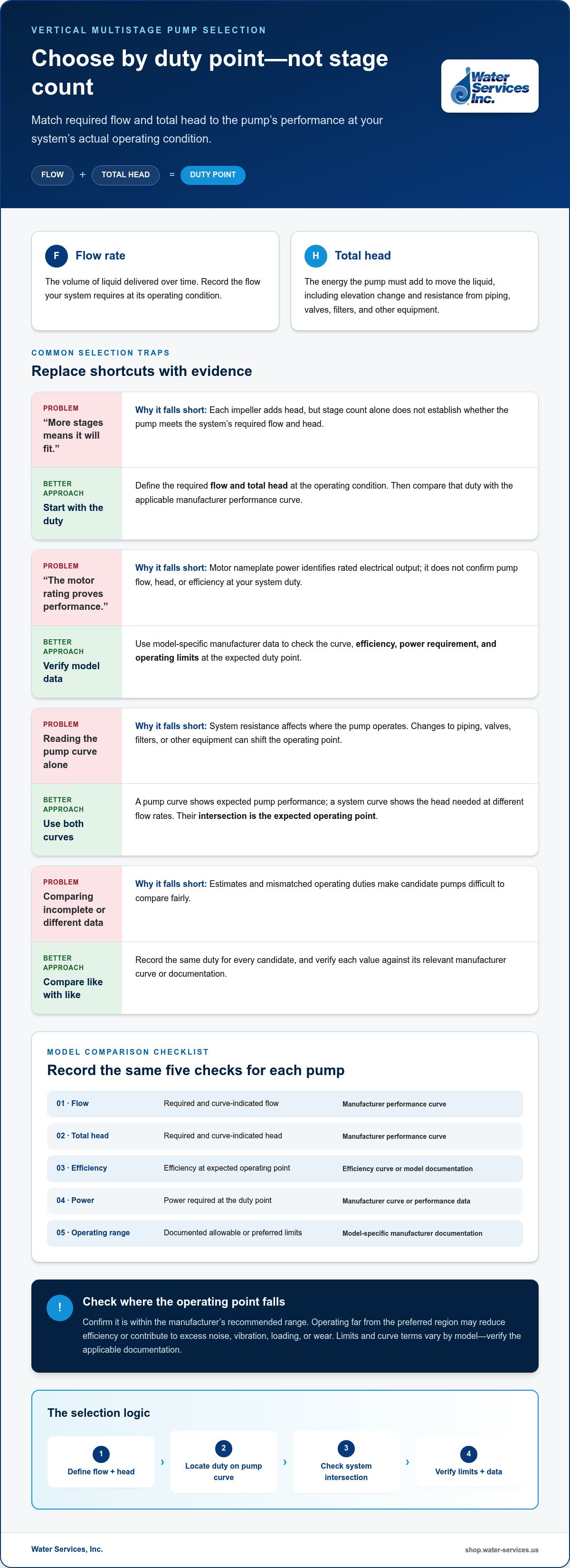
A pump duty point is the required flow rate and total head at a defined operating condition. Use those requirements to compare options, rather than relying on stage count or motor size. Total head includes the energy needed to overcome elevation and system resistance, while flow describes the volume delivered over time.
A manufacturer’s pump curve shows how a specific pump is expected to perform. Flow is commonly plotted on the horizontal axis and head on the vertical axis. Mark the system’s required flow and head, then locate that point on the curve. A system curve represents the head needed at different flow rates. Where the pump curve and system curve intersect is the expected operating point. Changes to piping, valves, filters, or other equipment can change system resistance and shift that intersection.
What pump curves reveal about operating performance
Check whether the expected operating point falls within the manufacturer’s recommended range for that model. Operating far from the preferred region may reduce efficiency or contribute to excess noise, vibration, loading, or wear. Curve terms and limits vary by manufacturer and model, so verify labels, assumptions, and operating limits in the applicable documentation.
For a fair comparison, record the same duty for each candidate and source figures from the relevant manufacturer curve or documentation. Don’t fill gaps with estimates.
| Comparison item | What to record | Source to verify |
|---|---|---|
| Flow | Required and curve-indicated flow | Manufacturer performance curve |
| Total head | Required and curve-indicated head | Manufacturer performance curve |
| Efficiency | Efficiency at the expected operating point | Efficiency curve or model documentation |
| Power | Power required at the duty point | Manufacturer curve or performance data |
| Operating range | Documented allowable or preferred limits | Model-specific manufacturer documentation |
Why stage count or motor power cannot select a pump alone
Stage count describes the pump’s configuration, but it doesn’t establish a complete match for flow and head. Motor nameplate power identifies the motor’s rated electrical output, not the pump’s performance at your system duty. The motor rating alone can’t confirm that the pump will deliver the required flow and head efficiently.
Use model-specific documentation to confirm the curve, efficiency, power requirement, and operating limits. The Multi-Stage Centrifugal Pumps Market Analysis offers broader industry context, but market information isn’t a substitute for pump performance data.
Keep fire-protection equipment selection separate from pump-curve comparisons. For related system components, view fire-protection equipment. These components have distinct functions and aren’t substitutes for vertical multistage centrifugal pumps.
Compare Vertical Multistage Pumps by Fluid, Materials, and Operating Conditions
A pump curve may match the required duty, yet the pump can still be a poor fit if its wetted materials, inlet conditions, or installation requirements don’t suit the application. Compare these factors alongside performance data. A material description by itself isn’t enough to establish fluid compatibility.
Match pump materials and seals to the fluid
Document the fluid’s composition and temperature, whether it contains suspended solids, and how clean or treated it is during normal operation and process upsets. Include any treatment chemicals that may contact the pump. These details can affect wetted components and seals, as well as corrosion and wear risks.
Check the manufacturer’s compatibility guidance for the complete fluid and operating conditions. Don’t assume a material is suitable based only on a general label such as “stainless steel.” Alloy grade, concentration, temperature, exposure time, and other fluid constituents can affect compatibility. If fluid composition varies, document the range rather than selecting against a single typical condition.
Account for suction, controls, and the installation footprint
Record suction pressure and inlet conditions, including any variation during operation. Pump performance depends on conditions at the inlet, so assess the source, piping arrangement, and restrictions as part of the system. Compare these details with the manufacturer’s model-specific operating limits. A matching discharge duty alone doesn’t guarantee a suitable installation.
Measure the space available for the pump assembly, piping connections, motor access, and routine inspection or maintenance. A compact vertical footprint may help, but the complete installed arrangement still needs adequate clearance and a practical access route.
Describe how the system will operate. Note expected operating hours, whether demand is steady or variable, and how flow or pressure requirements change over time. Use documented motor and pump specifications to assess the control approach; don’t assume one configuration suits every duty. Related electric power and controls should be considered as part of the overall system, not in isolation from the pump.
- Fluid: Composition, temperature, solids, cleanliness, and treatment chemicals.
- Inlet: Suction pressure and operating variations.
- Site: Space, connections, access, and maintenance clearance.
- Operation: Run schedule, demand variation, and control requirements.
Keep verified data separate from assumptions. Manufacturer documentation should support material compatibility, operating limits, and control requirements for the selected model. If a process condition is unknown, record it as an open design input rather than treating an unverified assumption as a specification.
A Practical Selection Checklist for Vertical Multistage Centrifugal Pumps
A reliable selection starts with a complete duty specification, then checks that specification against the installation and manufacturer data. Use this sequence to organize the information before comparing vertical multistage centrifugal pumps. If an input is unknown, flag it for engineering review rather than filling the gap with a generic assumption.
Build a complete pump-duty specification
Record the system’s required flow and total head, including normal conditions and minimum or maximum demand where available. Add fluid and site information that affects pump fit. Keep units and operating conditions consistent across the data you compare.
- 1. Define the duty. Document required flow and total head at normal operation, plus minimum and maximum flow requirements where known. Note the conditions associated with each duty point.
- 2. Document the fluid. Record composition, temperature, cleanliness, suspended solids, and treatment chemicals. Use manufacturer guidance to assess wetted-material and seal compatibility.
- 3. Map system and site constraints. Gather suction and inlet data, available space, connection requirements, access for inspection, and installation limitations. Include expected operating hours and how demand varies.
- 4. Compare manufacturer curves. Check each candidate against the same flow and head requirements. Review documented efficiency, power demand, preferred operating range, and model-specific limits.
- 5. Validate the fit. Reconcile the selected pump data with the full system requirements, fluid conditions, operating schedule, motor and control needs, and installation layout before final equipment selection.
Selection checklist: Match the required flow and total head to the fluid properties, suction conditions, operating schedule, control needs, and site limitations. Then validate the fit against model-specific manufacturer documentation.
Avoid common sizing and purchasing mistakes
Motor horsepower, connection size, and number of stages are useful specifications, but none proves that a pump will meet the system duty. Don’t compare performance figures taken at different flow or head conditions as though they describe equivalent service. Check the applicable curve and documentation for the exact model, and make sure system assumptions are clear before deciding.
For broader pump options, browse the pumps equipment category. Fire-protection components perform separate functions and aren’t pump substitutes. For that equipment, view the fire-protection equipment collection.
Connect Pump Selection to Fire-Protection System Equipment and Next Steps
Pump selection and fire-protection equipment selection address different functions within a project. A vertical multistage pump moves liquid and must be selected against the required system duty and its manufacturer performance data. Sprinklers, risers, and valves are components within a fire-sprinkler system. They aren’t substitutes for a pump, and their specifications don’t establish pump performance.
Distinguish pump equipment from sprinkler-system components
Examples of fire-protection components include the Viking EasyPac Commercial Riser, a pre-assembled riser with an integrated TESTanDRAIN valve, and the Viking VK202 pendent sprinkler, a sprinkler component. The Reliable FX Dry Pipe Valve is a dry-pipe system component. Each has a distinct function in a fire-protection system; none should be treated as a vertical multistage pump or used to determine its flow and head capability.
For fire-protection projects, assess the pump and associated system components against their separate functions and project requirements. Keep the pump’s duty point and applicable manufacturer curve distinct from documentation for sprinkler-system equipment.
Move from selection criteria to a documented project decision
Before finalizing a pump selection, bring the design inputs together in one record: required flow and total head, fluid composition and temperature, suction and inlet conditions, operating schedule, demand variation, control needs, and installation constraints. Compare these inputs with the selected pump’s model-specific curve and documentation. Resolve missing or uncertain data through engineering review rather than assumptions.
This documented comparison helps evaluate whether the pump suits the complete water system, not just one isolated specification. It also keeps the selection traceable if operating conditions or project requirements change. For broader pumping equipment options, explore the industrial pumps category.
If your project also requires related fire-system equipment, browse fire-protection equipment. These products serve fire-protection system functions and remain separate from pump selection.
Make Your Pump Selection a Documented System Decision
The right pump choice starts with the operating duty, not a headline specification. For vertical multistage centrifugal pumps, match required flow and total head to the manufacturer’s curve, then account for fluid properties, suction conditions, controls, operating schedule, and installation limits. Comparing candidates at the same duty point keeps the decision grounded in your system’s actual requirements.
Water Services, Inc. supplies Goulds Water Technology Pumps for industrial water systems. Its equipment supports pumping needs within a broader range of water-treatment and industrial water solutions.
Fire-protection components perform different functions from pumps, so assess them as separate parts of the project. If you’re sourcing related equipment for a fire-protection system, browse fire-protection equipment.
With clear operating data and verified manufacturer documentation, you can evaluate the fit between equipment and system. Explore Water Services, Inc.’s pumps for industrial pumping equipment.
Frequently Asked Questions
What is a vertical multistage centrifugal pump?
A vertical multistage centrifugal pump is a centrifugal pump with multiple impellers arranged in series in a vertical assembly. Each stage adds energy to the liquid, allowing the pump to develop more total head than a comparable single-stage arrangement may provide. Required flow and head, fluid conditions, and installation constraints determine whether a particular model is suitable. Check its manufacturer documentation for model-specific performance and operating limits.
How does a multistage centrifugal pump increase pressure?
As liquid passes through the pump, each rotating impeller transfers energy to it. Flow passages guide the liquid from one impeller to the next, so the head produced by successive stages accumulates. This increases the energy available to overcome system resistance and elevation. More stages don’t automatically mean a higher flow rate; flow depends on the pump’s performance curve and system operating conditions.
How do I size a vertical multistage pump?
Size vertical multistage centrifugal pumps by matching the system’s required flow and total head at the operating condition to a manufacturer’s performance curve. Account for system resistance, suction and inlet conditions, fluid properties, operating schedule, and demand variation. Compare the expected operating point with the model’s documented range and power requirements. Don’t select by motor rating or stage count alone, and flag missing design inputs for engineering review.
Can vertical multistage pumps handle water with solids?
Some models may tolerate limited solids, while others are intended for clean liquids. Suitability depends on the solids’ size, concentration, hardness, and nature, as well as the pump’s passages, materials, and seals. Don’t assume a pump can handle solids based on its general type or material description. Compare actual water conditions with the specific manufacturer’s limits and guidance before selecting or operating a pump.
What is the difference between a vertical multistage pump and a single-stage pump?
A vertical multistage pump has several impellers arranged in series, while a single-stage pump has one impeller. The multistage arrangement can build greater total head as liquid moves through the stages. That doesn’t make it universally superior or establish its flow performance. Choose between configurations by comparing the required flow and head with each candidate’s performance data, then consider fluid and site conditions.
Does a vertical multistage pump work for fire-protection systems?
Not automatically. A general vertical multistage pump shouldn’t be assumed suitable for fire-protection service. Fire pumps must be specifically listed and installed to applicable project requirements, including the fire-pump standard adopted by the relevant jurisdiction. Sprinklers, risers, and valves are separate system components, not pump substitutes. Confirm that the pump’s documented design and approval match the intended fire-protection application and system requirements.
What information should I have before comparing vertical multistage pumps?
Gather required flow and total head, including normal and variable demand where known. Document fluid composition, temperature, cleanliness, and solids; suction and inlet conditions; operating hours; control needs; and installation space and access. Use these inputs to compare manufacturer curves at the same duty point, then review model-specific limits, efficiency, and power data. Identify unknowns rather than replacing them with generic assumptions.
0 comments