

What if the most significant cost of your pumping system isn't the hardware, but the method used to start it? In industrial water treatment, the choice between a VFD vs soft starter for industrial pumps determines whether your facility operates with hydraulic precision or electrical inefficiency. You likely understand that mechanical shock and peak demand surcharges directly impact your bottom line. Uncontrolled pressure spikes do more than stress pipe joints; they compromise the structural integrity of expensive FilmTec and Hydranautics RO membranes.
Selecting the correct control architecture is critical as the U.S. Department of Energy shifts toward IE4 efficiency standards for industrial motors. This guide provides the technical framework needed to master the differences between these systems to optimize pump longevity and mitigate water hammer. We will evaluate technical mechanisms, environmental constraints, and total cost of ownership to ensure your Goulds Water Technology pumps maintain stable pressure for sensitive filtration processes. By the end of this guide, you will be equipped to choose between electrical simplicity and continuous speed modulation to protect your site’s mission-critical assets.
Key Takeaways
- Understand the fundamental difference between voltage-ramping SCRs in soft starters and the frequency-modulating IGBTs used in VFDs for precise motor control.
- Determine the optimal choice of VFD vs soft starter for industrial pumps by analyzing if your application requires continuous variable flow or simply a reduction in mechanical startup stress.
- Implement hydraulic protection strategies like 'Soft Stop' to prevent water hammer and safeguard high-value components, including Goulds pumps and sensitive RO membranes.
- Assess the total cost of ownership by comparing the lower initial investment of soft starters against the significant energy savings and regulatory compliance offered by VFD technology.
- Identify the best controller for harsh environments by evaluating technical factors such as heat dissipation needs and the compact footprint required for mobile or containerized systems.
The Challenge of Industrial Pump Starting: Inrush and Torque
Across-the-line (DOL) starting remains the default for many legacy industrial systems despite its inherent risks. It connects the motor directly to the full supply voltage, creating an immediate application of maximum torque. For a 3-phase industrial motor, this transition from standstill to full speed occurs in milliseconds. While simple, this method ignores the physics of inertia. The primary objective of modern control systems is protecting the electrical grid and the pump hardware from the violence of these starts. Evaluating the VFD vs soft starter for industrial pumps decision begins with understanding the baseline stressors of uncontrolled acceleration.
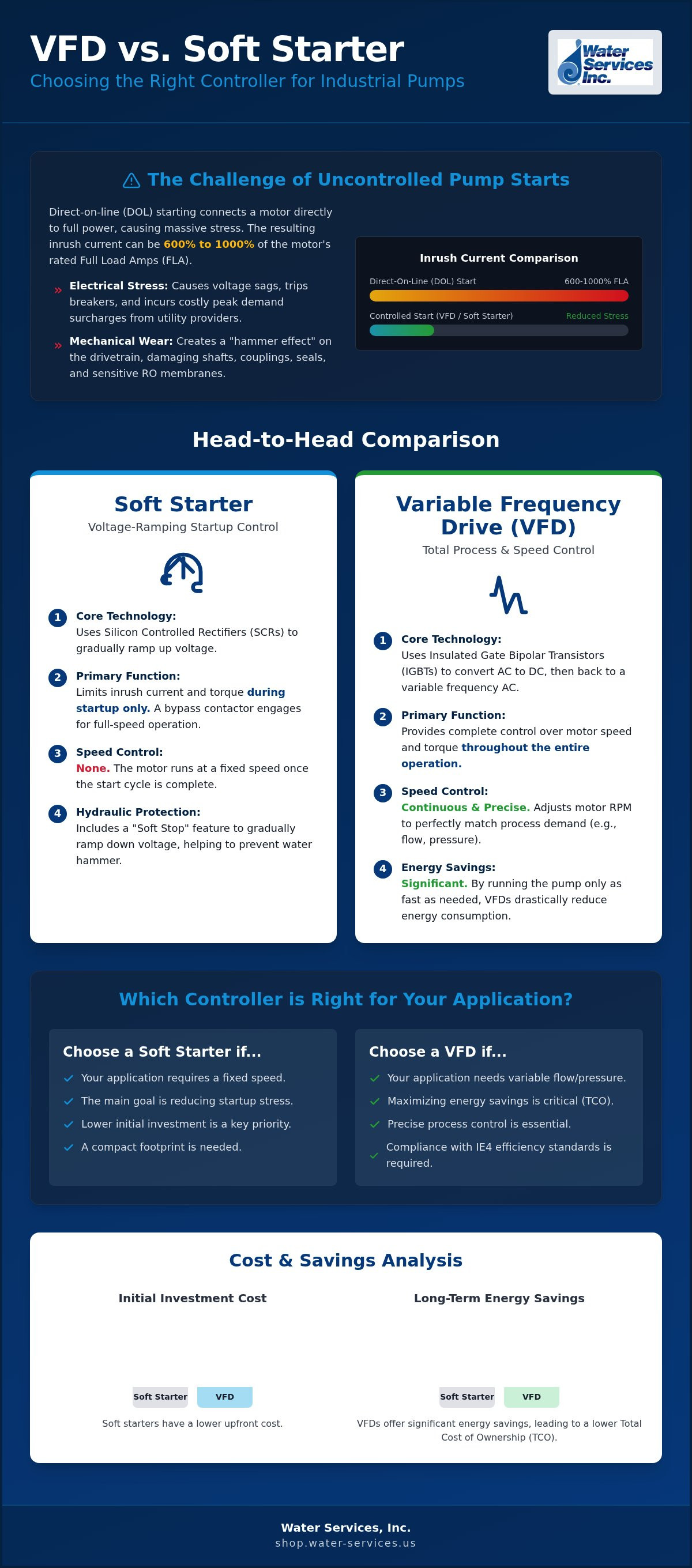
The "Inrush Current" phenomenon is the most immediate consequence of DOL starting. When a motor starts, it draws a massive surge of current to establish the magnetic field and overcome rotor inertia. This surge typically reaches 600% to 1000% of the motor’s rated Full Load Amps (FLA). These spikes often trip circuit breakers and cause significant voltage sags across the local network. Using a Motor soft starter or a VFD mitigates these issues by managing power delivery during the critical first seconds of operation.
Electrical Stress and Peak Demand Charges
Industrial utility providers penalize facilities for massive current spikes through peak demand charges. These surcharges are based on the highest level of electricity drawn during a specific window. In remote mining operations, peak demand charges represent a significant portion of the energy bill because of the high cost of maintaining stable voltage on isolated grids. High inrush current can destabilize the entire site's power quality. This instability risks damaging other sensitive electronic equipment and drives up operational overhead. For facilities seeking to protect these assets, Hatch Power provides specialized electrical engineering and power quality solutions. Correctly identifying the right VFD vs soft starter for industrial pumps solution is a fiscal necessity for remote industrial sites.
Mechanical Wear on Impellers and Couplings
Mechanical failure is frequently a result of "hard" starts. The instant torque of a DOL start creates a hammer effect on the drivetrain. This sudden acceleration can shear pump shafts, shatter couplings, or cause premature wear on centrifugal pump seals. Goulds Water Technology Pumps are engineered for durability, but no hardware is immune to the repetitive stress of uncontrolled acceleration. Constant speed motors in high-pressure RO systems are particularly vulnerable. Without a controlled ramp-up, hydraulic shock can dislodge sediment or damage delicate membrane structures. Protecting these assets requires a transition from sudden impact to a controlled, linear torque curve.
Variable Frequency Drives (VFD) vs. Soft Starters: Technical Mechanisms
The engineering distinction between a VFD vs soft starter for industrial pumps lies in how they manipulate electrical power. While both protect against the mechanical and electrical shocks discussed in the previous section, their internal architectures serve different operational goals. A soft starter is a solid-state device designed for the transition from standstill to full speed. In contrast, a VFD is a power converter that manages the motor throughout its entire operating cycle. Choosing the right technology requires an understanding of how Silicon Controlled Rectifiers (SCRs) differ from Insulated Gate Bipolar Transistors (IGBTs).
How a Soft Starter Manages the Start Cycle
A soft starter utilizes SCRs to restrict the voltage delivered to the motor during the initial power-on phase. By pulsing these semiconductors, the device creates a gradual voltage ramp, which effectively limits both current inrush and torque. Once the motor reaches its nominal operating speed, most units engage a mechanical bypass contactor to shunt the SCRs. This reduces heat generation and improves efficiency during steady-state operation. It's a reliable, cost-effective method for fixed-speed applications. However, because the device only modulates voltage and not frequency, it cannot change the motor’s RPM once the start cycle is complete.
How a VFD Provides Total Process Control
Variable Frequency Drives (VFDs) offer a deeper level of integration by using IGBTs. These components allow the drive to convert incoming AC power into DC, then reconstruct a simulated AC sine wave through Pulse Width Modulation (PWM). This process enables the simultaneous adjustment of both voltage and frequency. By controlling the frequency (Hz), the VFD dictates the exact rotational speed of the pump impeller. VFDs eliminate the need for mechanical throttling valves by allowing the motor to run at the specific speed required for the process. When evaluating a VFD vs soft starter for industrial pumps, the VFD’s ability to provide continuous speed control is the primary differentiator for variable-load systems.
The Hydraulic Institute emphasizes that optimizing pump systems often involves leveraging the Affinity Laws. These laws dictate that power consumption is proportional to the cube of the shaft speed. For example, reducing the motor speed by 20% can result in nearly 50% energy savings. This makes VFD technology the superior choice for variable-load applications where flow demand fluctuates throughout the day. For facilities requiring this level of precise modulation, our electric power controls provide the necessary hardware to implement these energy-saving strategies while protecting expensive pump assets.
Preventing Water Hammer and Protecting Sensitive Filtration
Water hammer, or hydraulic shock, is a pressure surge caused by the sudden stop or change in direction of fluid in motion. This phenomenon represents a significant threat to industrial piping, especially in systems with long pipe runs or high-head requirements. When a pump stops abruptly, the kinetic energy of the moving column of water must dissipate, creating a high-pressure wave that travels through the system. This wave can exceed the design limits of pipes and fittings, leading to catastrophic failure. Understanding the role of VFD vs soft starter for industrial pumps is essential for engineers tasked with mitigating these hydraulic risks.
Both VFDs and soft starters provide a "Soft Stop" function to manage this energy. Instead of an immediate power cut, these controllers gradually reduce motor speed over a programmed duration. This controlled deceleration prevents check valves from slamming shut, which is the primary trigger for water hammer in vertical lift applications. While both technologies offer this protection, their impact on the overall process stability differs significantly.
Hydraulic Shock and Pipe Integrity
The physics of kinetic energy in moving water dictates that the danger of sudden stops increases with flow velocity and pipe length. Modern control systems utilize ramp-down functionality to extend the operational life of PVC and steel piping by managing energy dissipation linearly. In mining wastewater lines, uncontrolled stops frequently lead to joint fatigue and pipe bursts. Implementing a controlled stop cycle ensures that pressure transients remain within the safe operating parameters of the infrastructure, reducing emergency maintenance costs and downtime.
Stable Pressure for RO and Chemical Dosing
Sensitive filtration assets like FilmTec Reverse Osmosis Membranes require stable, non-turbulent flow to maintain their structural integrity. Pressure spikes can cause physical damage to membrane leaves or lead to premature fouling. While a soft starter protects the system during the start and stop cycles, a VFD is superior for maintaining constant pressure during the entire production run. VFDs respond to changing filter resistance or transmembrane pressure automatically, adjusting the pump speed to maintain a consistent flux rate.
Precision chemical delivery via Pulsafeeder Metering Pumps also depends on a stable hydraulic environment. Fluctuations in line pressure can compromise dosing accuracy, leading to improper water chemistry. Professionals often integrate Signet Flow Sensors with VFDs to establish closed-loop control. This integration ensures that the system maintains exact flow rates regardless of downstream resistance changes, providing a level of process precision that a soft starter cannot achieve.
Selection Framework: Choosing the Right Controller for Your Site
Selecting between a VFD vs soft starter for industrial pumps requires a rigorous analysis of the application's hydraulic profile and the site's electrical infrastructure. It isn't merely a comparison of price points. Engineers must account for environmental stressors, power quality, and the long term total cost of ownership (TCO). This framework ensures you balance initial capital expenditure with long term operational efficiency.
When to Choose a Soft Starter
Applications with a constant load, such as simple tank-to-tank transfers or fixed-head wastewater discharge, don't benefit from speed modulation. In these scenarios, the electrical simplicity of a soft starter is a distinct advantage. These units are significantly more compact than VFDs and generate negligible heat once the bypass contactor is engaged. This makes them ideal for space-constrained enclosures where active cooling is impossible. If your project is budget-conscious and speed control provides no process benefit, the soft starter remains the most reliable and cost-effective solution.
When a VFD is the Mandatory Choice
VFDs are essential for processes with fluctuating demand, such as reverse osmosis systems or municipal booster stations. While a VFD for a mid-range motor can cost up to three times more than a soft starter, the energy savings often provide a return on investment within 18 to 36 months. They're mandatory when maintaining a constant pressure setpoint is critical for downstream equipment or when you need to comply with tightening 2026 energy regulations. Use this checklist to identify variable torque loads in your water treatment facility:
- Centrifugal pumps with varying daily discharge requirements.
- Systems utilizing pressure transducers or flow sensors for closed-loop feedback.
- Facilities subject to high peak-demand utility surcharges.
- Processes where mechanical throttling via valves is currently used to manage flow.
Environmental constraints also dictate the choice. VFDs require significant heat dissipation and often need air-conditioned control rooms, especially in high-ambient mining environments. Furthermore, VFDs generate harmonics that can interfere with sensitive electronics unless you install specialized filtering. For remote sites with limited technical support, the electrical simplicity of a soft starter reduces the risk of complex drive failures. However, if your goal is maximizing the lifecycle of Goulds pumps through precise speed control, the VFD is the superior investment.
You can source high-performance electric power controls directly from our online store to ensure your site meets the latest industrial efficiency standards.
Industrial Power Controls from Water Services, Inc.
Water Services, Inc. provides the specialized hardware required to implement the control strategies discussed throughout this 2026 guide. The decision between a VFD vs soft starter for industrial pumps is a critical engineering step, but successful execution relies on high-quality components and precise integration. Our Electric Power Controls collection includes everything from basic soft starters to advanced variable frequency drives designed for the most demanding water treatment environments. We prioritize technical integrity, ensuring that each controller is matched to the specific electrical and hydraulic requirements of your Goulds Pump models.
We specialize in the custom engineering of containerized reverse osmosis plants where VFDs are typically the standard for managing fluctuating feed water conditions. This integration protects sensitive FilmTec or Hydranautics membranes from the pressure transients that often occur during startup. Our logistical capabilities are built for global reach. We maintain established distribution channels to deliver heavy industrial controls to remote sites in Africa, the Middle East, and beyond. This ensures that even the most isolated mining or military operations have access to reliable power control technology.
Modular and Containerized System Integration
Our team pre-configures VFDs and soft starters for mobile ultrafiltration and RO units to facilitate rapid site deployment. For harsh environments, we provide NEMA 4X rated enclosures that protect internal electronics from dust, moisture, and corrosive chemicals. These "Plug-and-Play" electrical solutions are essential for remote sites where local technical support is limited. By delivering fully integrated and tested control panels, we reduce the risk of wiring errors and ensure your system meets operational specs immediately upon arrival.
Expert Technical Support and Sourcing
Sourcing your pump and controller from a single expert provider eliminates the compatibility issues that often plague industrial projects. We provide detailed technical specifications for Walchem Controllers and integrated Signet flow sensors to ensure your closed-loop system operates at peak efficiency. This unified approach to sourcing your VFD vs soft starter for industrial pumps hardware ensures that the electrical ramp-up matches the pump’s specific torque requirements. Our technical experts are available to help you navigate the complexities of 2026 energy regulations and NEMA compliance.
Contact Water Services, Inc. for a custom control panel quote today.
Optimizing Pump System Reliability and Efficiency
Navigating the technical requirements of VFD vs soft starter for industrial pumps is a prerequisite for maintaining operational integrity in 2026. You've seen how VFDs leverage the Affinity Laws to reduce energy consumption by nearly 50% while providing the constant pressure required for sensitive RO membranes. Conversely, soft starters remain the standard for fixed-speed applications where mitigating inrush current is the primary objective. Both technologies are essential tools for eliminating water hammer and extending the lifecycle of your Goulds Water Technology pumps.
As an authorized distributor with global engineering support for the mining and oil sectors, Water Services, Inc. provides the specialized expertise needed for these complex integrations. We specialize in containerized treatment systems designed for harsh environments; we ensure your controls are as durable as your hardware. Matching the correct motor control to your specific hydraulic profile is the most effective way to avoid utility demand charges and mechanical failure. Precise control ensures your infrastructure remains compliant with the latest efficiency standards.
Shop Industrial Pump Controls and VFDs at Water Services, Inc. to secure the high-performance hardware your facility requires. We look forward to supporting your next industrial project with technical precision and reliable logistical delivery.
Frequently Asked Questions
Can a soft starter save as much energy as a VFD for industrial pumps?
No; a soft starter cannot match the energy savings of a VFD for variable-load industrial pumps. Soft starters only reduce energy consumption during the startup ramp by limiting inrush current. Once the motor reaches full speed; the bypass contactor engages; and the motor runs at its rated frequency. VFDs provide continuous savings by adjusting motor speed to match actual system demand throughout the entire operating cycle.
Do VFDs cause more electrical noise (harmonics) than soft starters?
Yes; VFDs generate significantly more electrical noise and harmonic distortion than soft starters. This occurs because VFDs use high-frequency switching of IGBTs to modulate the output wave. Soft starters only generate harmonics during the brief starting and stopping sequences. When implementing a VFD vs soft starter for industrial pumps; you must evaluate the need for harmonic filters or line reactors to protect sensitive site electronics.
Is it possible to use a soft starter for a submersible pump in a deep well?
What is the typical lifespan of a VFD compared to a soft starter in harsh environments?
Soft starters typically have a longer operational lifespan in harsh environments because they are electrically simpler than VFDs. A soft starter contains fewer heat-sensitive power electronics and usually operates via a bypass contactor during the majority of its run time. VFDs require active cooling and are more susceptible to failure from ambient heat; dust; and vibration. In remote mining sites; the durability of a soft starter often outweighs the technical depth of a VFD.
How do I know if my pump motor is 'Inverter Duty' rated for a VFD?
You can identify an "Inverter Duty" rated motor by checking the nameplate for compliance with NEMA MG-1 Part 31 standards. These motors feature enhanced insulation systems designed to withstand the high-voltage spikes and increased heat generated by VFD switching. Standard motors lack this insulation and may suffer from winding failure or bearing damage if operated on a VFD for extended periods. Always verify this rating before upgrading your pump controls.
Can I retrofit a soft starter with a VFD later if my flow requirements change?
You can retrofit a soft starter with a VFD if your flow requirements change; but this process involves more than just a component swap. VFDs are physically larger and generate more heat; which often requires a new enclosure or significant upgrades to the existing cabinet's ventilation. You must also verify that your existing motor is inverter-duty rated and that your power distribution system can handle the increased harmonic load.
Does a VFD eliminate the need for a separate motor protection relay?
A modern VFD typically eliminates the need for a separate motor protection relay because it includes integrated thermal overload; short circuit; and phase loss protection. These drives monitor motor current and temperature in real-time to prevent damage. When comparing a VFD vs soft starter for industrial pumps; note that while high-end soft starters also include these features; basic models may still require external protection hardware to meet safety standards.
What are the heat dissipation requirements for an industrial VFD enclosure?
Industrial VFD enclosures require substantial heat dissipation; often calculated at 2% to 3% of the drive's rated power. For a large drive; this results in significant thermal energy that must be removed via high-volume fans or air conditioning units. Soft starters generate much less heat because they utilize a bypass contactor once the motor is up to speed; which significantly reduces the thermal load on the enclosure during steady-state operation.
0 comments