

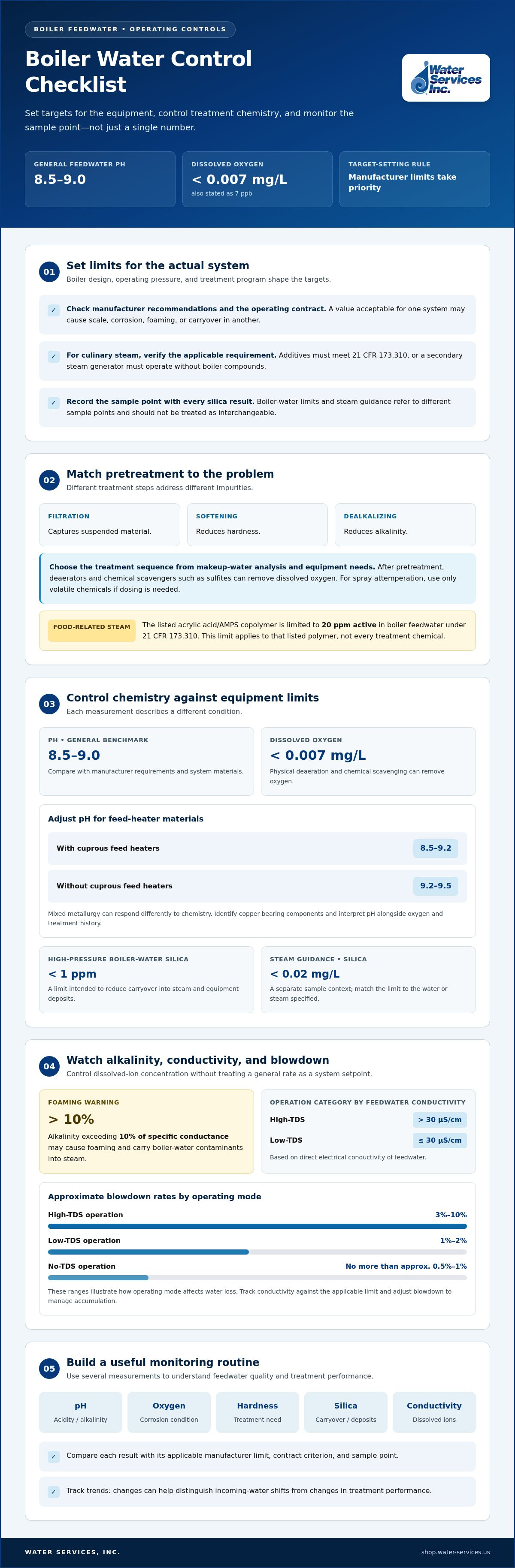
There isn’t one limit that fits every boiler: boiler feed water quality requirements vary with boiler type, operating pressure, and the treatment program. A general feedwater benchmark is pH 8.5-9.0 and dissolved oxygen below 0.007 mg/L, but the boiler manufacturer’s limits take priority.
It’s natural to look for a single set of numbers. In practice, water acceptable for one system may cause scale, corrosion, foaming, or carryover in another. Appropriate targets depend on the equipment and its operating conditions.
This guide explains how pressure and boiler design affect example quality limits, why pretreatment and chemical conditioning matter, and which parameters to monitor. It covers alkalinity, including how excess alkalinity can promote foaming, and shows how regular sampling helps operators spot changes before they affect boiler performance.
Key Takeaways
- Use boiler design, operating pressure, and manufacturer limits to set water-quality targets; one set of values does not fit every system.
- Understand how pretreatment and chemical conditioning affect dissolved oxygen, hardness, pH, and impurities entering the boiler.
- Compare example limits for low-pressure steam, high-pressure steam, and hot-water boilers to identify which parameters matter for your equipment.
- Build routine sampling and testing into operations, with attention to sample cooling and sample-point location.
- Track alkalinity alongside conductivity and pH, and consider water-treatment equipment and chemicals where feedwater quality needs control.
Manufacturer instructions and contractual requirements
In the United States, boiler limits generally follow the manufacturer’s recommendations and operating contract; boiler design and pressure shape the targets. For culinary steam, additives must meet 21 CFR 173.310, or a secondary steam generator must operate without boiler compounds, according to the Agricultural Marketing Service, U.S. Department of Agriculture.
Silica Control in High-Pressure Boilers
Silica control means limiting dissolved silica in boiler water to reduce carryover into steam and deposits on equipment. High-pressure boilers typically require silica below 1 ppm, while steam guidance sets a silica limit below 0.02 mg/l. These values address different sample points, so match each limit to the water or steam named in the specification. Turbine service makes carryover control important because silica deposits can impair turbine performance. Record the sample point with each result.
Alkalinity and Conductance Control
Alkalinity and conductance control means keeping dissolved ions and alkaline chemicals within the boiler’s operating limits. Alkalinity exceeding 10% of specific conductance may cause foaming, which can carry boiler-water contaminants into steam. High-TDS operation is defined as feed water with direct electrical conductivity above 30 μS/cm; low-TDS operation is at or below 30 μS/cm. Use the manufacturer’s limits and contract criteria to set control points, then compare test results against those limits rather than treating one target as universal.
TDS Control and Blowdown
Total dissolved solids (TDS) control manages the concentration of dissolved material in boiler water; blowdown removes some of that concentrated water. Approximate blowdown rates are 3% to 10% for high-TDS operation, 1% to 2% for low-TDS operation, and no more than approximately 0.5% to 1% for no-TDS operation. These ranges illustrate how operating mode affects water loss. Track conductivity against the applicable limit and adjust blowdown to control accumulation without treating a general rate as a boiler-specific setpoint.
Corrosion Control
Corrosion control means limiting conditions that attack boiler metal, particularly oxygen exposure and unsuitable pH. A general feedwater benchmark is pH 8.5-9.0, with dissolved oxygen below 0.007 mg/L (7 ppb). For feed water with cuprous feed heaters, the recommended pH range is 8.5 to 9.2; without them, it is 9.2 to 9.5. Compare chemistry results with the manufacturer’s requirements, since heater materials affect the target. Stable measurement and adjustment help operators detect changes before corrosion affects equipment.
Boiler feedwater purity and chemical conditioning
Boiler feed water quality requirements depend on source-water quality, boiler design, and the treatment sequence. Conditioning controls dissolved gases and impurities before they become concentrated in the boiler.
Pretreatment and Chemical Treatment
Pretreatment removes or reduces contaminants before water enters the boiler; chemical treatment manages the remaining chemistry. The distinction matters because filtration, softening, and dealkalizing address different problems. Filtration captures suspended material, softening reduces hardness, and dealkalizing reduces alkalinity. Choose a sequence based on makeup-water analysis and equipment needs.
After pretreatment, deaerators and chemical scavengers such as sulfites can remove dissolved oxygen, which can contribute to corrosion in feedwater and boiler equipment. Treatment also needs to account for where chemicals enter the system and how their concentration changes during operation. For spray attemperation, use only volatile chemicals if dosing is needed.
Food-related steam has a separate chemical constraint: under 21 CFR 173.310, the listed acrylic acid/AMPS copolymer is limited to 20 parts per million (active) in boiler feedwater, according to the Office of the Federal Register. This limit applies to that listed polymer, not to every treatment chemical. Keep steam use and chemical identity aligned with the applicable requirement.
Boiler Feedwater Chemistry Parameters
Feedwater chemistry parameters are measurements of purity and treatment performance. Common checks include pH, dissolved oxygen, hardness, silica, and conductivity. Each measures a different condition, so no single result represents overall feedwater quality. Interpret results using the boiler feed water quality requirements for each parameter and sample point.
For example, a general feedwater pH recommendation is 8.5-9.0, and a dissolved oxygen benchmark is below 0.007 mg/L (7 ppb). Dissolved oxygen can be removed through physical deaeration and chemical scavenging. Hardness and silica indicate other treatment needs. Monitoring trends helps distinguish a change in incoming water from a change in treatment performance.
PH and Mixed Metallurgy
Mixed metallurgy means a feedwater system contains different metals, such as steel and copper alloys, that can respond differently to chemistry. The pH target matters because treatment suitable for one material may affect another. Feed water with cuprous feed heaters has a recommended pH range of 8.5 to 9.2; without cuprous feed heaters, the recommended range is 9.2 to 9.5.
Interpret targets in the context of the actual equipment. Identify whether copper-bearing components are present, then evaluate pH alongside dissolved oxygen and treatment history. Boiler feed water quality requirements should reflect material-specific criteria, not just a general pH range. This supports a consistent chemistry program across feedwater components and boiler operation.
Example quality limits by boiler type and pressure
Boiler limits vary with pressure, boiler design, and whether the system produces steam or hot water. The values below are example guidelines, not universal operating targets.
Steam Boiler Feedwater and Boiler Water Limits
Feedwater limits apply to water entering the boiler; boiler-water limits apply to the concentrated water inside it. This distinction matters because evaporation concentrates dissolved solids in the boiler, while feedwater measurements describe incoming water chemistry.
Boiler-water limits for low-pressure steam boilers can vary with the boiler and its treatment conditions. Example high-pressure steam boilers operating above 300 psi use pH 9.0-9.6 and TDS below 1000 ppm. Their listed oxygen limit is below 0.005 ppm. Check the specified sample point before comparing results.
Hardness Limits and Softening
Hardness limits restrict scale-forming minerals, and softening reduces hardness before water enters the boiler. Hardness that reaches the boiler can deposit on heat-transfer surfaces.
Example limits set high-pressure steam boiler hardness below 0.1 ppm and hot-water boiler hardness below 0.3 ppm. A general post-softening feedwater benchmark is below 1 ppm. These figures refer to different system conditions, so use the value matching the boiler type and measurement point.
Feedwater, Makeup Water, and Boiler Water
Makeup water replaces system losses, feedwater is supplied to the boiler, and boiler water remains inside the operating boiler. Feedwater can contain makeup water and returned condensate. As steam forms, dissolved material concentrates and boiler-water chemistry changes.
This difference helps explain why a makeup-water result cannot stand in for a boiler-water result. For instance, example hot-water boiler limits include pH 8.5-9.5, TDS below 500 ppm, and alkalinity 50-150 ppm as CaCO3. Measure and interpret each sample according to its location.
Allowable Limits for Key Water Parameters
Example limits for high-pressure steam boilers operating above 300 psi include dissolved oxygen below 0.005 ppm, silica below 10 ppm, iron below 0.05 ppm, and hardness below 0.1 ppm. Listed alkalinity, expressed as CaCO₃, is 300-500 ppm. Copper has no single value in these example guidelines; metallurgy and the applicable boiler specification determine its control target.
High heat flux can require tighter limits than pressure alone suggests. For industrial watertube boilers with local heat flux above 1.5 × 10^5 Btu/hr/ft2 (473.2 kW/m2), guidance recommends using limits for at least the next higher pressure range. Apply that adjustment when reviewing water chemistry levels for affected equipment.
Routine testing and water-quality monitoring
A reliable monitoring program combines routine field checks, representative samples, and laboratory analysis. Sampling frequency and handling matter because poor collection can distort results.
Online Monitoring and Quality Assurance
Online monitoring tracks selected water-quality measurements during boiler operation, while quality assurance checks whether readings represent the system. Trending conductivity can reveal accumulating dissolved material or shifting treatment conditions. Compare instrument readings with collected samples and applicable operating limits.
Many boiler systems use daily on-site checks and weekly laboratory analysis. Taken together, daily checks help identify operational changes, while laboratory analysis provides a broader chemistry review. ASTM and ASME publish detailed methods for chemical analysis of boiler-water grab samples. Consistent sampling locations and documented results make comparisons across operating shifts more useful.
Sample handling is part of measurement quality. Cool boiler-water samples quickly to 100 F (38 C) to avoid losing the species being measured. Place sample points at least 10 diameters downstream of the last bend or flow disturbance, where flow is more representative. Boiler-water sample lines should maintain a minimum water velocity of 6 ft/s (1.8 m/s). These practices reduce variation caused by sampling conditions.
Online instruments and laboratory results have different roles. An online reading can reveal a developing trend, while a grab sample supports chemical analysis. If readings diverge, compare the instrument location, sample point, and collection timing before changing water treatment. Record operating conditions with each result, including whether the boiler is starting, running steadily, or changing load.
Iron and Copper Monitoring
Monitoring iron and copper tracks corrosion products and metal transport through the boiler system. Measured levels help operators assess whether water chemistry or operating conditions may be affecting metal surfaces. Include these metals in laboratory reviews when relevant to the treatment program or equipment materials.
Interpret iron and copper results alongside pH, dissolved oxygen, and conductivity. A single result cannot identify the source of a change, so compare repeat samples and review the sample location. For example, a change in iron alongside a change in dissolved oxygen calls for a broader chemistry review, not an isolated adjustment based on iron alone.
Use a defined process for out-of-range results: confirm the sample identity, compare the result with applicable boiler limits, and review recent treatment changes. Keep the laboratory report with the online trend. This creates a traceable record for evaluating foaming, deposits, or corrosion concerns without mistaking a sampling error for a change in the boiler system.
Alkalinity and caustic embrittlement
Alkalinity measures water’s capacity to neutralize acids. Caustic embrittlement is cracking associated with concentrated alkaline conditions and stressed metal. In industrial boilers, interpret alkalinity alongside pH, conductivity, pressure, and metallurgy, rather than in isolation.
Recommended alkalinity targets vary by boiler type and operating conditions. Boiler type changes the useful operating range: hot-water boilers list 50-150 ppm, low-pressure steam boilers list 700-900 ppm, and high-pressure steam boilers list 300-500 ppm. These examples show why operators should match alkalinity limits to their equipment and operating conditions rather than apply one target across every boiler system.
Conductivity helps show how dissolved ions accumulate, while alkalinity describes a specific part of that chemistry. Alkalinity values exceeding 10% of specific conductance may cause foaming. Foam can carry boiler-water droplets into steam, affecting steam purity and downstream equipment. Compare alkalinity and conductance results together, and assess both against the limits used for the specific boiler and treatment program.
Caustic embrittlement involves localized concentration of caustic material around stressed areas of metal. Boiler-water chemistry, deposits, and operating conditions influence whether this concentration develops. Review alkalinity alongside pH and relevant chemistry trends; an acceptable average reading does not prove conditions are uniform throughout the system. This distinction matters in industrial systems where local metal stress and water chemistry interact.
For boilers below 900 psig (6.21 MPa), minimum hydroxide alkalinity concentrations must be specified individually by a qualified water treatment consultant. This makes equipment-specific limits essential for interpreting test results. Keep the hydroxide target, total alkalinity result, and operating pressure together in operating records. A change in makeup-water source or treatment can alter alkalinity, so review the measured concentration against the system’s established criteria after such changes.
Follow a consistent review process: record the sample location and operating conditions, compare total and hydroxide alkalinity with applicable limits, then assess conductivity and pH for related changes. If values shift together, investigate treatment performance and incoming-water conditions before adjusting chemical feed. This helps distinguish routine fluctuation from chemistry that could contribute to foaming or localized caustic concentration.
For water-treatment chemicals relevant to alkalinity control, explore water treatment products as part of your boiler chemistry review.
Water Services, Inc.: Goulds Water Technology Pumps
Water Services, Inc. offers Goulds Water Technology Pumps for moving water within treatment and industrial systems. For boiler operators reviewing boiler feed water quality requirements, the next step is to match treatment equipment and chemistry products to the water-quality challenge. FilmTec and Hydranautics reverse osmosis membranes support dissolved-solids reduction, while Water Treatment Antiscalants and Chemicals address needs such as scale control. The right combination depends on source-water characteristics, boiler requirements, and the treatment process already in use.
Turn to Water Services, Inc. when assessing equipment or treatment products for a feedwater program. Explore the available product categories or contact Water Services, Inc. to discuss your requirements.
Turn Water-Quality Targets Into a Practical Plan
Connect your boiler’s operating limits with a water-treatment plan your team can measure and maintain. Use the manufacturer’s specifications, current water analysis, and operating records to identify the parameters that need closer attention. This provides a clear basis for reviewing treatment choices and tracking changes over time.
Water Services, Inc. offers Goulds Water Technology Pumps, Viqua UV Water Purification Systems, and FilmTec Reverse Osmosis Membranes. These products support water movement, purification, and dissolved-solids reduction in water systems. Select equipment according to its role in your process and the applicable boiler feed water quality requirements.
For a practical next step, Contact Water Services, Inc. to discuss water-system equipment and treatment products. A clear plan helps your team apply its quality targets consistently and make informed operating decisions.
Frequently Asked Questions
What water quality limits are recommended for boiler feedwater by boiler pressure and type?
Limits depend on boiler design, pressure, and the sample point, so use equipment-specific criteria rather than one universal table. As examples, hot-water boiler guidance lists pH 8.5-9.5 and total dissolved solids below 500 ppm. High-pressure steam examples include dissolved oxygen below 0.005 ppm and hardness below 0.1 ppm. Feedwater and boiler-water limits describe different samples, so don’t compare them as though they were interchangeable.
How do feedwater requirements differ for low-pressure, high-pressure, and utility boilers?
Higher-pressure boilers generally need purer feedwater, and high-pressure systems require demineralized water that is free of oxygen and essentially free of hardness and suspended solids. Low-pressure examples allow higher boiler-water solids and alkalinity than high-pressure examples. Utility boilers may also have turbine steam-purity targets; turbine manufacturers can specify total dissolved solids in steam below 0.030 ppm. Design, pressure, and steam use determine the applicable targets.
What tests should be performed to monitor boiler feedwater quality, and how often?
Monitor pH, dissolved oxygen, conductivity, hardness, silica, iron, and copper where relevant to the system’s materials and treatment program. Most boiler systems benefit from daily on-site checks and weekly laboratory analysis. For example, operators can compare daily conductivity trends with laboratory chemistry results to investigate a shift. Sample handling matters: cooling samples quickly to 100 F (38 C) helps avoid losing the species being measured.
What water treatment methods are used to meet boiler feedwater requirements?
Common pretreatment methods include filtration, softening, and dealkalizing, selected according to incoming-water chemistry. Reverse osmosis or demineralization can further reduce dissolved material when system requirements call for higher purity. Deaerators and chemical scavengers such as sulfites can remove dissolved oxygen. Treatment works in stages: pretreatment addresses source-water contaminants, while conditioning manages remaining chemistry before and during boiler operation.
What problems can poor boiler feedwater quality cause, such as scale, corrosion, and carryover?
Excess hardness can deposit on heat-transfer surfaces, reducing effective heat transfer and complicating operation. Dissolved oxygen can contribute to corrosion, while unsuitable alkalinity and conductivity can promote foaming. Foam and entrained water droplets can carry boiler-water impurities into steam and affect downstream equipment. Silica carryover is a particular concern for turbines because deposits can impair performance. Risk depends on the contaminant and where it becomes concentrated.
How do feedwater quality requirements differ for fire-tube and water-tube boilers?
Boiler construction affects heat transfer, water circulation, and the consequences of deposits, so apply limits for the actual boiler design and operating conditions. European standards distinguish water-tube boilers under EN 12952-12 and shell boilers under EN 12953-10. For industrial watertube boilers with local heat flux above 1.5 × 10^5 Btu/hr/ft2 (473.2 kW/m2), guidance recommends using limits for at least the next higher pressure range.
0 comments