

The efficiency of your water treatment plant depends less on the RO unit itself and more on the engineering of the pre-treatment and pressure-delivery ecosystem. When source water presents high TDS levels, standard configurations often lead to frequent membrane fouling and excessive downtime. Most operators struggle with the escalating costs of membrane replacement and the pressure of meeting the EPA's Preliminary Effluent Guidelines Program Plan 16. Deploying high-capacity industrial reverse osmosis systems requires a precise balance of chemical antiscalants, multimedia filtration, and high-pressure Goulds Water Technology pumps to ensure operational stability.
You've likely found that high TDS source water makes consistent output nearly impossible without constant intervention. This case study demonstrates how custom-engineered solutions solve complex purity challenges in mining, military, and manufacturing environments. We'll show you how to configure a system that delivers predictable water quality while lowering your total cost of ownership. This analysis previews the integration of DuPont FilmTec BW30 series membranes, Signet flow sensors, and Walchem controllers to achieve scalable, modular performance in demanding industrial settings.
Key Takeaways
- Understand the impact of 2026 EPA wastewater regulations on high-TDS water treatment strategies for industrial compliance.
- Identify the technical specifications of industrial reverse osmosis systems that utilize Goulds Water Technology Pumps to ensure consistent system flux and reliability.
- Evaluate the logistical efficiency of containerized reverse osmosis plants for rapid deployment in demanding environments like mining and military sites.
- Compare performance benchmarks of FilmTec and Hydranautics membranes to select the optimal solution for specific brackish or seawater challenges.
- Implement maintenance protocols using specialized antiscalants and multimedia filter tanks to lower the total cost of ownership and extend membrane life.
The Challenge of High-TDS Source Water in Industrial Environments
High-capacity industrial reverse osmosis systems are defined by their ability to maintain permeate quality while processing feed water with Total Dissolved Solids (TDS) levels often exceeding 5,000 mg/L. In 2026, the technical threshold for these systems has shifted. They're no longer just filtration units; they're critical components of regulatory compliance and resource recovery. The fundamental principle of reverse osmosis (RO) dictates that as TDS increases, the required osmotic pressure rises proportionally. This physical reality makes source water chemistry the primary driver of system design. High TDS levels in mining and oil/gas process water, frequently containing high concentrations of sulfates, chlorides, and heavy metals, demand specialized engineering. Standard commercial units fail in these environments. They lack the structural integrity and pump capacity to overcome extreme osmotic pressures, leading to catastrophic membrane failure and system downtime.
Source Water Analysis: The First Step in Engineering
A comprehensive water chemistry profile is mandatory before any hardware selection occurs. This analysis identifies specific scaling ions like calcium, magnesium, and silica that threaten membrane integrity. Organic foulants and biological matter also require precise identification to prevent rapid flux decline. Establishing baseline flux rates ensures that the system provides a predictable permeate output over its service life. This data drives the selection of specific water treatment antiscalants and multimedia filtration media. Without this baseline, predicting the total cost of ownership becomes impossible. Engineering must account for the seasonal variability of source water to maintain stable operation in rugged field conditions.
Regulatory Compliance and Environmental Stewardship
Meeting the EPA's Preliminary Effluent Guidelines Program Plan 16 requires rigorous control over industrial wastewater discharge. Facilities must now manage emerging contaminants like PFAS, often necessitating industrial reverse osmosis systems as a primary treatment step. These systems are central to Zero Liquid Discharge (ZLD) strategies, where the objective is to recover all process water for reuse. Efficiency in these high-pressure environments depends on the hardware. Utilizing high-efficiency Goulds Water Technology Pumps allows operators to meet discharge limits while optimizing energy consumption. Precise monitoring through Walchem controllers and Signet flow sensors ensures the system stays within its designed performance envelope. This technical oversight prevents regulatory non-compliance and protects the surrounding environment from untreated industrial discharge.
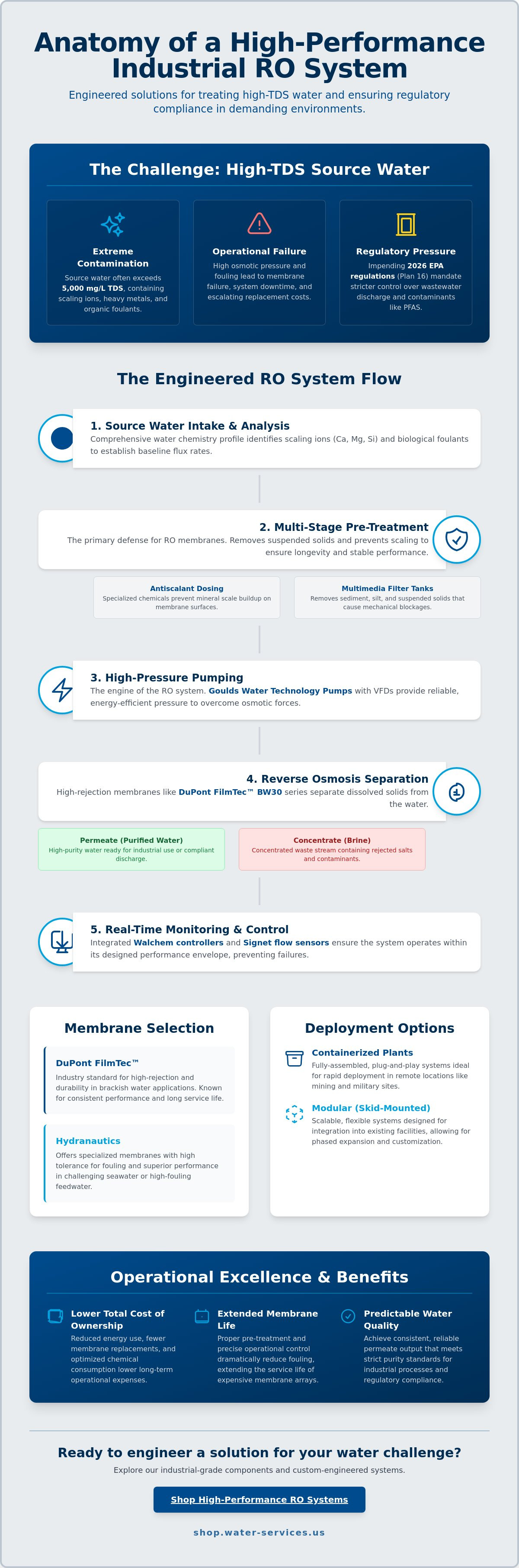
Anatomy of a High-Performance Industrial RO System
Industrial reverse osmosis systems function as integrated machines where every component must support the high-pressure membrane flux. The synergy between the high-pressure pump and the membrane array determines the system's recovery rate and longevity. High-capacity operations cannot rely on generic hardware. They require specific engineering specifications to overcome the osmotic pressure barriers found in complex source water. A failure in any single component, from a sensor to a seal, can lead to immediate system downtime and costly membrane fouling.
Pumping Systems: The Engine of Reverse Osmosis
Centrifugal pump curves are critical for maintaining stable permeate production. Feed water temperature fluctuations alter viscosity and pressure requirements, meaning a pump must operate efficiently across a wide performance range. Goulds Water Technology Pumps provide the mechanical reliability needed for continuous industrial duty cycles. Integrating Variable Frequency Drives (VFDs) allows the motor to adjust to these changing variables in real time. This optimization reduces energy consumption and minimizes mechanical stress on the system. For high-salinity or corrosive environments, selecting 316 stainless steel or duplex materials for pump internals is a technical necessity to prevent premature hardware failure.
Pre-treatment arrays serve as the primary defense for the RO membranes. Multimedia filter tanks remove suspended solids and sediment that would otherwise cause mechanical blockages. Pentair filter housings and Harmsco filtration products provide the secondary barrier, ensuring that only pre-filtered water enters the high-pressure stage. Precise chemical dosing is also mandatory. Pulsafeeder metering pumps inject specific antiscalants to inhibit mineral precipitation on the membrane surface. This multi-stage approach ensures the membranes operate within their designed parameters, extending their service life and maintaining water quality.
Instrumentation and Process Control
Real-time data is the only way to maintain system integrity in 2026. Signet flow sensors provide accurate GPM readings for both permeate and concentrate streams. This data allows Walchem controllers to calculate recovery rates and salt rejection percentages instantly. Automated flush cycles are programmed into the controller logic to prevent silica and calcium scaling during standby periods. For remote sites or modular installations, integrating electric power controls ensures system autonomy and protects sensitive electronics against power surges. Ashcroft pressure gauges provide the final physical verification of the pressure differential across the membrane bank, allowing operators to schedule maintenance before a critical failure occurs.
Professionals seeking to optimize their infrastructure can explore industrial pump specifications to find the correct match for their specific system flux requirements.
Case Study: Modular vs. Containerized RO Deployment
Traditional stick-built water treatment facilities often require 12 to 18 months for engineering, site preparation, and construction. For modern industrial operations, this timeline is frequently unacceptable. Containerized reverse osmosis plants offer a functional alternative, providing a pre-commissioned solution that arrives ready for immediate site integration. These units house the entire treatment train within a reinforced ISO shipping container, significantly reducing the requirement for on-site civil engineering and specialized labor. This deployment model is particularly effective for emergency response scenarios where high-capacity water production is needed to maintain operational continuity after a primary system failure.
A recent deployment for a remote mining operation in Africa illustrates the utility of this approach. The site required a reliable source of drinking water from a high-TDS brackish aquifer. By utilizing industrial reverse osmosis systems housed in climate-controlled 40-foot containers, the facility achieved full production capacity within 30 days of arrival. The system integrated the high-pressure Goulds pumps and Walchem controllers discussed previously, ensuring that the remote team had access to predictable water quality despite the rugged environment. This logistical advantage eliminates the complexities of local construction while ensuring that the equipment remains protected from external environmental factors.
Modular System Design for Scalability
Modular industrial reverse osmosis systems allow facilities to scale their water production in alignment with operational growth. Instead of over-specifying a single large plant, engineers can deploy smaller, interconnected modules that function as a single unit. Plug-and-play interfaces facilitate rapid expansion, allowing new modules to be brought online with minimal disruption to existing flows. This design philosophy reduces initial capital expenditure and ensures that the system doesn't operate at inefficient low-load conditions during the early stages of a project's lifecycle.
Containerized Solutions for Harsh Climates
Operations in extreme temperatures or high-dust environments require specialized protection for sensitive water treatment components. Containerized units feature integrated HVAC systems and insulation to maintain optimal operating temperatures for membranes and electronics. This enclosure protects Ashcroft pressure gauges and Signet flow sensors from vibration and abrasive particulate matter. Beyond protection, containerization maintains the long-term asset resale value. Since the system is not a permanent fixture of the site's real estate, it can be decommissioned and transported to a different location or sold once the project concludes. This portability makes it a lower-risk investment for temporary or high-variability industrial applications.
Membrane Selection: FilmTec vs. Hydranautics
The selection of a membrane element defines the operational energy profile and permeate quality of industrial reverse osmosis systems. While both DuPont FilmTec and Hydranautics provide industry-leading technology, their performance characteristics suit different feed water profiles and recovery requirements. High-capacity systems require membranes that maintain structural integrity under high osmotic pressure while resisting the physical and chemical stresses of frequent cleaning cycles. Technical professionals must evaluate membrane flux, salt rejection rates, and fouling resistance to ensure the selected element aligns with the facility's specific water chemistry.
Membrane fouling remains the primary cause of flux decline and increased energy consumption. Scaling from calcium carbonate or silica and bio-fouling from organic matter require precise Clean-In-Place (CIP) protocols. Maximizing membrane lifespan depends on the accuracy of pre-treatment and chemical dosing. Utilizing Pulsafeeder metering pumps to deliver high-quality water treatment antiscalants prevents mineral precipitation before it reaches the membrane surface. This proactive management extends the interval between CIP cycles and protects the thin-film composite structure from irreversible damage.
FilmTec Membranes: Industry Standards for Reliability
FilmTec elements, such as the BW30 series for brackish water and the SW30 series for seawater, are recognized for their high-rejection characteristics. These membranes consistently achieve salt rejection rates exceeding 99%, making them ideal for manufacturing and process water applications where purity is non-negotiable. Their robust construction allows for stable performance in environments with fluctuating feed water quality. FilmTec is often preferred for stable feed water due to its consistent rejection rates and high mechanical tolerance.
Hydranautics: Innovation in Low-Energy Desalination
Hydranautics specializes in membranes designed for specific energy and fouling challenges. The ESPA (Energy Saving Polyamide) series is engineered to operate at lower feed pressures, significantly reducing the electrical load on high-pressure pumps. This makes them a preferred choice for wastewater reclamation and large-scale desalination where energy costs dominate the total cost of ownership. The CPA (Composite Polyamide) series provides a balance of high rejection and energy efficiency for brackish water applications. Interpreting membrane data sheets requires a focus on the specific project ROI, weighing the initial membrane cost against long-term energy savings and cleaning frequency. For facilities processing high-fouling feed water, the Hydranautics LFC (Low Fouling Composite) series offers a neutral surface charge that reduces the adhesion of organic contaminants.
Technical teams can browse our inventory of FilmTec and Hydranautics membranes to find the exact specifications required for their high-capacity treatment plants.
Operational Excellence: Maintenance and TCO
Calculating the Total Cost of Ownership (TCO) for industrial reverse osmosis systems requires a shift from initial capital expenditure to long-term operational costs. Over a ten-year lifecycle, energy consumption, chemical consumables, and membrane replacements represent the majority of the financial burden. Systems engineered with high-efficiency components, such as Goulds pumps and FilmTec membranes, provide a lower TCO by reducing the frequency of unscheduled interventions. Operational excellence is achieved when site personnel treat the system as a precise chemical process rather than a static piece of hardware. Maintaining 99% uptime depends on the synergy between high-quality filtration media and rigorous maintenance protocols.
The role of anti-scalants and multimedia filtration media is fundamental to system longevity. These components prevent the irreversible scaling and fouling discussed in earlier sections, ensuring that the RO unit operates at its designed flux. Multimedia filter tanks must be backwashed according to a strict schedule to prevent pressure drop increases. Training site personnel for daily operational monitoring ensures that subtle changes in GPM flow or salt rejection are identified before they escalate into system failures. Leveraging technical support and specialized maintenance contracts provides an additional layer of reliability for high-capacity facilities.
Preventative Maintenance Schedules
Daily operational checklists are the first line of defense against system degradation. Operators must record feed water TDS, permeate conductivity, and pressure differentials across Pentair or Harmsco filter housings every shift. A significant increase in the "delta P" across these housings indicates that the sediment or carbon filters require immediate replacement. Weekly inspections should focus on the mechanical integrity of high-pressure fittings and the calibration of Signet flow sensors. During chemical handling or membrane cleaning, operators must utilize appropriate personal protective equipment (PPE) to ensure compliance with industrial safety standards. Monthly reviews of Walchem controller logs help identify long-term performance trends that may necessitate a CIP cycle.
Optimizing Chemical Dosing
Precision in chemical delivery is essential for minimizing OPEX. Pulsafeeder metering pumps provide the exact volumetric flow required for anti-scalant injection, preventing both under-dosing scaling and over-dosing waste. Integrating these pumps with automated sensor feedback via Walchem controllers allows the system to adjust dosing rates based on real-time feed water variability. This automation reduces chemical waste and protects the membrane bank from mineral precipitation. For a deeper analysis of the deployment phase, review our guide on how to implement a reverse osmosis water purification system. Consistent adherence to these maintenance standards ensures that industrial reverse osmosis systems deliver the predictable water quality required for 2026 regulatory compliance.
Strategic Engineering for 2026 Water Treatment Standards
Optimizing industrial reverse osmosis systems requires a technical focus on component synergy and pre-treatment precision. This analysis has detailed how selecting the correct high-pressure pump curves and membrane rejection characteristics ensures long-term operational stability. As regulatory standards for wastewater discharge become more rigorous in 2026, the transition to modular and containerized plants provides the scalability that doesn't sacrifice performance for speed. These systems reduce the total cost of ownership by minimizing on-site civil engineering and facilitating rapid deployment in rugged locations.
Founded in 1994, our organization brings over 30 years of global expertise to every water treatment project. We serve as an authorized distributor for industry leaders including Goulds Water Technology, FilmTec, and Viqua. This status ensures that your facility operates with verified hardware and specialized technical support. Our experience with containerized solutions for remote mining and military sites provides a dependable path to compliance and resource recovery. Request a Custom Engineering Consultation for Your Industrial RO Needs to secure your facility's operational future. Achieving high-capacity purity is a predictable and manageable engineering outcome with the right technical partner.
Frequently Asked Questions
What is the typical lifespan of an industrial reverse osmosis membrane?
Industrial reverse osmosis membranes typically last between three and five years when supported by proper pre-treatment and regular cleaning cycles. Factors such as feed water quality, operating temperature, and the consistency of antiscalant dosing determine the exact replacement interval. Operators should monitor salt rejection and permeate flux to identify when an element has reached its technical end-of-life.
Can industrial RO systems handle high levels of iron or manganese?
Industrial RO systems cannot process high levels of iron or manganese without specialized pre-treatment stages. These metals oxidize and cause rapid, irreversible fouling on the membrane surfaces. Systems must integrate oxidation filters or green sand media before the RO stage to remove these contaminants. Failure to do so leads to immediate pressure increases and catastrophic flux decline.
How much pre-treatment is required before water enters the RO membranes?
Standard pre-treatment requires multimedia filter tanks, sediment filters, and precise chemical antiscalant dosing. Depending on the source water analysis, carbon filters or ultrafiltration may also be necessary to remove organics and chlorine. This multi-stage approach protects the high-pressure membranes from mechanical blockages and chemical degradation, ensuring the stability of high-capacity industrial reverse osmosis systems.
What is the difference between brackish water and seawater RO systems?
The primary difference lies in the operating pressure and the specific membrane chemistry utilized. Brackish water systems operate at lower pressures, typically using FilmTec BW30 or Hydranautics CPA elements. Seawater systems require much higher pressures to overcome extreme osmotic barriers and utilize specialized elements like the SW30 series to maintain high salt rejection in high-salinity environments.
How do I calculate the recovery rate for my industrial RO system?
You calculate the recovery rate by dividing the permeate flow rate by the total feed flow rate and multiplying by 100. For example, if a system produces 75 GPM of permeate from a 100 GPM feed, the recovery rate is 75%. Most industrial reverse osmosis systems are engineered to operate between 50% and 75% recovery to prevent over-concentration of salts in the reject stream.
What are the power requirements for a 100 GPM industrial RO unit?
Power requirements for a 100 GPM unit depend on the feed water TDS and the resulting pump pressure. High-TDS applications require more horsepower to overcome osmotic pressure. Most systems utilize high-pressure Goulds Water Technology pumps paired with VFDs to optimize energy consumption. Operators should consult the specific pump curve for the motor's electrical load under full-load conditions.
Is it better to lease or purchase a mobile RO treatment plant?
Choosing between leasing and purchasing depends on the project's duration and capital allocation strategy. Purchasing is often more cost-effective for permanent installations or long-term mining projects where the asset provides multi-year value. Leasing provides a utilitarian solution for emergency response or short-term remediation where immediate deployment and lower initial capital expenditure are the primary requirements.
0 comments