

A single hour of communication lag in a remote mining operation often costs more in equipment damage and lost productivity than a decade of telemetry subscriptions. When evaluating cellular vs satellite pump monitoring in 2026, the decision isn't merely about signal bars. It's about matching specific signal physics to your site's topography and technical requirements. Many operators realize too late that a standard cellular signal fails exactly when critical pressure spikes or motor overloads occur. This technical gap leads to expensive manual site visits and reactive maintenance that erodes your operational margins.
You've likely dealt with difficult terrain blocking signals or high data costs for the high-frequency monitoring required to protect heavy-duty Goulds pumps. It's a common pain point in industrial water management. This 2026 industrial connectivity guide provides the data you need to ensure 100% uptime for your remote pumping operations. We'll analyze the performance of 5G RedCap, the emergence of LEO satellite constellations, and how to integrate Walchem controllers with Signet flow sensors. This overview ensures you select a reliable fail-safe system that delivers a clear ROI on your telemetry hardware and maintains system integrity.
Key Takeaways
- Identify the optimal telemetry backbone by analyzing the signal physics and cost structures of cellular vs satellite pump monitoring for industrial sites.
- Leverage NB-IoT and 5G RedCap technologies to achieve deep-penetration monitoring in industrial zones with minimal power consumption.
- Assess the latency differences between LEO and GEO satellite systems to ensure reliable real-time edge control for remote mining and military water assets.
- Optimize hardware footprints by matching antenna requirements and data throughput needs to your specific site topography.
- Implement a high-reliability integrated solution using Goulds Water Technology Pumps, Walchem controllers, and Signet flow sensors for automated remote management.
The Critical Role of Remote Pump Monitoring in 2026
Remote pump monitoring acts as the digital nervous system for critical industrial water assets. By 2026, the technical landscape for cellular vs satellite pump monitoring has evolved from basic data logging to sophisticated real-time edge control. This transition enables operators to execute remote commands, such as adjusting VFD parameters or isolating valves, directly from a centralized dashboard. Modern telemetry is no longer a luxury for remote sites. It is a fundamental requirement for operational safety and equipment longevity.
For mining wastewater management and military process water applications, 100% uptime is a baseline requirement. Operating without visibility leads to "blind" operations where pump cavitation and dry running go unnoticed until the hardware fails. These failures result in expensive emergency site visits and potential environmental leaks. Automated telemetry provides the necessary fail-safe to maintain system integrity in isolated regions where manual inspection is logistically impossible.
Why Terrestrial Radio is Losing Ground
Traditional terrestrial radio systems rely on Line-of-Sight (LoS) transmission. In mountainous or heavily forested terrain, signal degradation is common. Maintaining a network of repeater stations in remote areas creates a heavy logistical burden. Each station requires independent power and physical security. Modern industrial sites are moving toward IP-based protocols. Utilizing cellular networks or satellite links allows for much higher data density. It simplifies the infrastructure required for global deployments while reducing the total cost of ownership for the communication backbone.
Key Metrics for Pump Telemetry
Precision monitoring depends on the integration of high-quality instrumentation. Data is only as useful as the sensors providing it. Key metrics include:
- Flow rate: Using Signet Flow Sensors allows for real-time verification of hydraulic efficiency and pump output.
- System Pressure: Ashcroft industrial gauges provide the data needed for leak detection and filter health monitoring across the distribution network.
- Vibration and Temperature: These metrics serve as early warning signs of mechanical fatigue. They allow for predictive maintenance before a total pump failure occurs, protecting high-value assets like Goulds Water Technology Pumps from preventable damage.
By capturing these data points through a reliable telemetry link, operators can transition from reactive repairs to a proactive asset management strategy. This shift is essential for maintaining the rigorous demands of industrial water processing in 2026.
Cellular Pump Monitoring: Speed, Cost, and 5G/NB-IoT
In urbanized industrial zones and developed regions, 4G LTE and 5G NR (New Radio) remain the dominant protocols for high-speed data transmission. By 2026, NB-IoT (Narrowband IoT) has established itself as the gold standard for low-power, deep-penetration monitoring. This technology allows signals to reach into subterranean pump rooms or reinforced concrete structures where standard signals often fail. When evaluating cellular vs satellite pump monitoring, cellular provides the lowest latency. This speed is critical for managing electric power controls that require near-instantaneous response times to prevent motor burnouts or system overflows.
Data plans for cellular telemetry are significantly more affordable than satellite alternatives. Standard industrial IoT plans in 2026 typically range from $1 to $5 per device per month. However, cellular has distinct limitations. Signal shadows and "dead zones" are common in remote mining pits or deep valleys where geography blocks the line-of-sight to carrier towers. If your site has reliable tower access, you can find compatible monitoring hardware at shop.water-services.us to begin your integration.
The Rise of Private LTE Networks in Mining
Large-scale mining operations are increasingly deploying private LTE networks to bypass public carrier limitations. These proprietary infrastructures provide dedicated bandwidth for critical water assets, ensuring that telemetry traffic is never throttled by consumer demand. By integrating cellular telemetry with existing site-wide Wi-Fi mesh systems, operators ensure seamless data handover for mobile pumping units. Private bands also offer superior security, shielding critical water infrastructure from the vulnerabilities inherent in public cellular networks.
When Cellular is the Right Choice
Cellular connectivity is the optimal choice for sites located within 10 miles of a carrier tower with relatively flat topography. It's particularly effective for applications requiring high-frequency data, such as 1-second intervals for surge detection or chemical dosing adjustments. Budget-conscious projects benefit from lower hardware costs and simplified installation. While the EPA provides extensive research on satellite remote sensing for broad water resource management, terrestrial cellular remains the most cost-effective path for localized, high-speed pump telemetry in 2026. Use this option when site accessibility allows for reliable terrestrial signal propagation.
Satellite Pump Monitoring: LEO vs. GEO for Global Reach
Satellite telemetry provides the only viable solution for remote mining and military sites situated beyond the reach of terrestrial towers. When comparing cellular vs satellite pump monitoring, the primary advantage of orbital connectivity is total global coverage. These systems remain immune to terrestrial obstructions like mountain ranges or dense vertical rock faces that create "dead zones" for cellular signals. By 2026, the satellite data services market has expanded to a projected $6.29 billion, driven largely by the proliferation of Low Earth Orbit (LEO) constellations that bridge the gap between remote assets and centralized control centers.
LEO Satellites: Changing the Latency Game
The 2026 reality of high-speed satellite telemetry is defined by Starlink and OneWeb. These LEO constellations allow for real-time SCADA control, enabling operators to adjust pump speeds or valve positions with minimal delay. For off-grid solar-powered sites, technical planning must prioritize power management. Satellite modems typically require 15 to 30 watts during transmission, which is significantly higher than the milliwatt requirements of NB-IoT cellular modules. LEO satellites operate with a latency of 100 to 200 milliseconds, significantly outperforming the 600 millisecond delay inherent in traditional GEO systems. This speed allows for the integration of high-frequency sensors that were previously limited to local wired networks.
GEO Satellites for Fixed Infrastructure
Geosynchronous (GEO) satellites remain a reliable choice for permanent river intake stations where connection stability outweighs the need for low latency. For ultra-reliable alarm callouts, Iridium SBD (Short Burst Data) serves as a robust standard for low-bandwidth messaging, ensuring that critical alerts reach the supervisor even during severe network congestion. Operators must actively mitigate weather-related signal attenuation, or rain fade, by using larger reflector dishes and implementing aggressive forward error correction. By 2026, industry forecasts indicate that satellite data costs for IoT applications have dropped to between $0.50 and $2.00 per megabyte. This makes it a viable path for the continuous monitoring of Goulds Water Technology Pumps and integrated Walchem controllers in environments where terrestrial infrastructure is non-existent.
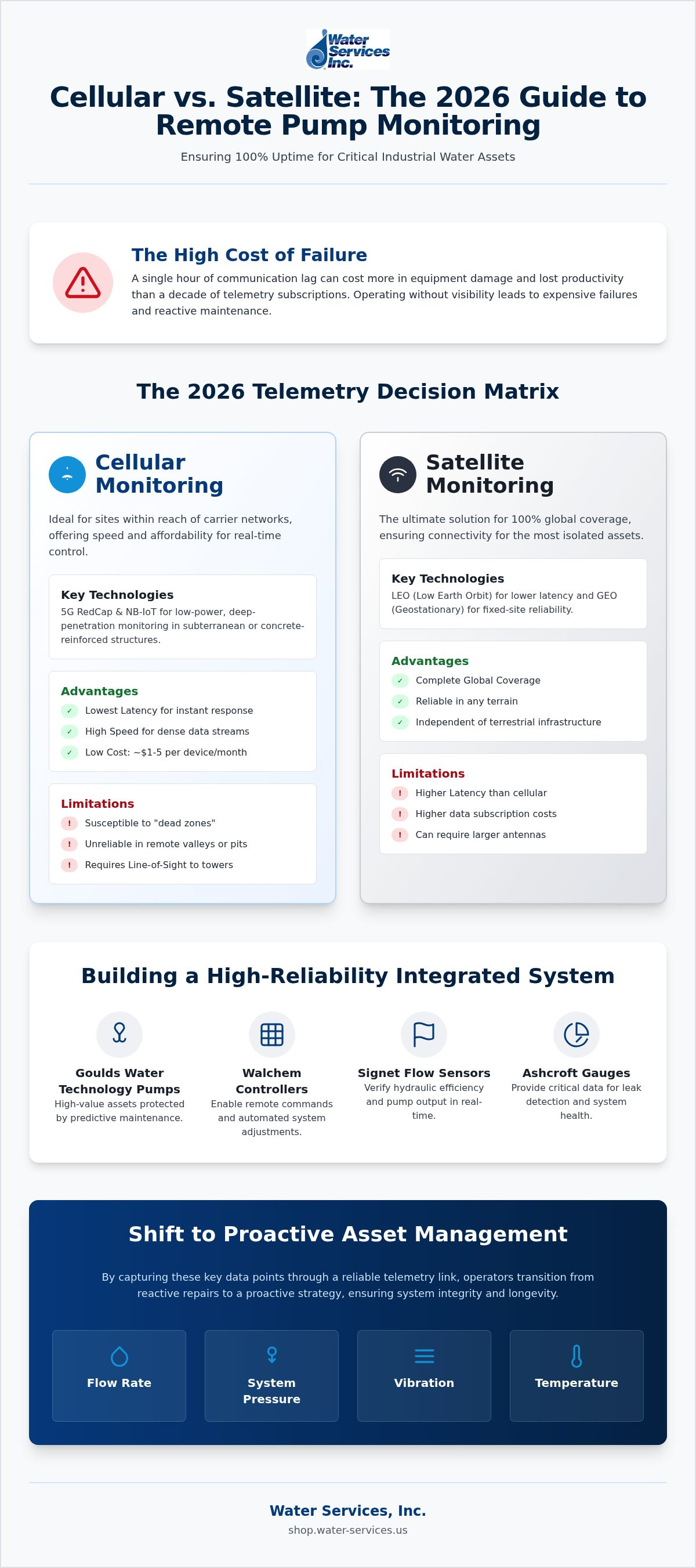
Cellular vs. Satellite: The 2026 Decision Matrix
Selecting between cellular vs satellite pump monitoring requires a technical evaluation of latency requirements and hardware footprints. Cellular networks provide the most responsive connection with latency typically under 50ms. This speed is necessary for high-frequency control loops and immediate emergency shutdowns. Low Earth Orbit (LEO) satellites offer a competitive middle ground at 100-200ms, while Geosynchronous (GEO) systems often exceed 600ms. Hardware footprints also vary significantly. Cellular systems utilize small, omni-directional antennas that are easy to conceal or protect. Satellite systems require oriented dishes or phased array terminals that have a larger physical profile and higher wind load requirements.
By 2026, the industry standard for high-stakes mining and military applications has shifted toward hybrid "Dual-Path" monitoring. This configuration utilizes cellular as the primary data carrier for low-latency performance and uses satellite as an automated fail-safe. This redundancy ensures that a terrestrial tower outage or localized signal interference doesn't result in a total loss of visibility. Using a dual-path approach protects your investment in Goulds Water Technology Pumps by maintaining constant oversight of motor health and flow metrics.
Total Cost of Ownership (TCO) Breakdown
Initial hardware investment for cellular modems remains lower than the cost of satellite terminals. However, Operating Expenditure (OPEX) is heavily influenced by polling frequency. While satellite data costs have decreased to between $0.50 and $2.00 per megabyte in 2026, high-frequency polling can still lead to substantial monthly invoices. Maintenance logistics also differ. Satellite dishes may require manual realignment following extreme weather events or site vibrations. Cellular modules generally support remote firmware updates and configuration changes, reducing the need for expensive technician deployments to remote locations.
Environmental and Topographic Factors
Topography often dictates which technology is viable. Deep canyons or steep mountainous terrain can block satellite lines-of-sight while allowing cellular signals to reflect and reach the equipment. Conversely, open plains with limited tower density make satellite the only reliable option. Durability in these environments is non-negotiable. Integrating telemetry gear within NEMA-rated enclosures and using Ashcroft pressure gauges ensures the system withstands extreme thermal cycling and moisture. For comprehensive system-wide integration details, see our Industrial Water Treatment Systems guide. To source industrial-grade telemetry components for your next project, browse our inventory at shop.water-services.us.
Implementing Integrated Monitoring with Water Services, Inc.
The successful deployment of a remote system depends on the seamless integration of telemetry with industrial hardware. Water Services, Inc. serves as the technical bridge between site-specific connectivity needs and high-performance equipment. When deciding on cellular vs satellite pump monitoring, the choice must align with the specific requirements of your Goulds Water Technology Pumps. Our engineering team ensures that every pump station is pre-configured for bidirectional communication, allowing for both data acquisition and remote edge control. This integration is vital for maintaining hydraulic efficiency and preventing the mechanical failures discussed in previous sections.
Our custom containerized reverse osmosis plants are engineered with redundant communication backbones. These modular units often include pre-wired cellular primary links with automated satellite failover. This configuration is essential for maintaining compliance in mining wastewater treatment, where automated reporting and 100% uptime are regulatory mandates. By centralizing data from Walchem controllers and Signet sensors, operators can manage complex chemical dosing and filtration parameters without physical site presence.
Hardware Integration: From Pump to Cloud
Selecting the correct Variable Frequency Drive (VFD) is the first step in achieving remote speed control. The VFD must support industrial IP protocols to communicate effectively with the telemetry gateway. Walchem controllers play a critical role in this ecosystem by managing water treatment processes based on live sensor feedback. During the installation and maintenance of these telemetry components, on-site technicians must utilize appropriate Personal Protective Equipment (PPE) to ensure safety in demanding industrial environments. Proper hardware selection ensures that the data path from the pump to the cloud remains secure and uninterrupted.
The Water Services, Inc. Advantage: Global Engineering
Water Services, Inc. provides global engineering expertise from our headquarters in Provo, Utah. We have extensive experience deploying monitored systems in challenging environments across Africa and the Middle East. This global reach allows us to support remote mining and military operations with specialized technical logistics. Beyond initial integration, we provide direct access to replacement FilmTec and Hydranautics RO membranes. These components are essential for maintaining the high-purity standards required in monitored systems. Our approach combines domestic industrial reliability with the logistical competence required for international distribution and support.
Optimizing Industrial Reliability through Advanced Telemetry
Selecting the correct communication protocol is essential for maintaining the operational integrity of high-value water assets. Evaluating cellular vs satellite pump monitoring requires a precise understanding of site topography and required data frequency. While 5G and NB-IoT provide cost-effective solutions for sites with terrestrial access, LEO satellite constellations offer the low-latency control necessary for the most isolated environments. Implementing a hybrid failover system ensures that your remote mining or military operations maintain 100% uptime regardless of local signal fluctuations.
Water Services, Inc. is an authorized Goulds Water Technology distributor with global deployment experience in more than 40 countries. We specialize in custom engineered containerized systems that bridge the gap between industrial pump hardware and modern telemetry software. Our technical expertise ensures that your monitoring solution provides a clear ROI through reduced site visits and predictive maintenance. We invite you to Request a Technical Consultation for Your Remote Monitoring Project to secure your infrastructure. Achieving total system visibility is the most effective way to protect your long-term equipment investment.
Frequently Asked Questions
What is the typical latency for satellite pump monitoring in 2026?
Typical latency for satellite pump monitoring in 2026 depends on the orbital altitude of the constellation. Low Earth Orbit (LEO) systems, such as Starlink or OneWeb, achieve 100 to 200 milliseconds. Traditional Geosynchronous (GEO) systems usually exceed 600 milliseconds. This technical difference makes LEO the preferred choice for real-time edge control where rapid response is required for motor adjustments or emergency shutdowns.
Can cellular pump monitoring work in deep mining pits?
Cellular pump monitoring can work in deep mining pits provided there is clear line-of-sight to a tower or a private LTE network is in place. Standard public signals often suffer from "signal shadows" in steep excavations. Using NB-IoT improves deep-penetration capabilities through dense terrain. However, many large-scale operations install dedicated site-wide cellular infrastructure to ensure consistent coverage across all pit levels and subterranean pump rooms.
Is it possible to switch from cellular to satellite without changing my pump hardware?
You can switch from cellular to satellite without changing your pump hardware by replacing only the telemetry gateway or modem. The core pump components, such as the Goulds motor and wet end, remain identical. The integration happens at the controller level, such as a Walchem unit. You simply disconnect the cellular module and install a satellite-compatible terminal to route data through orbital networks instead of terrestrial towers.
How much data does a standard industrial pump monitoring system use per month?
A standard industrial pump monitoring system typically uses between 1MB and 5MB of data per month for basic status updates and alarm callouts. High-frequency monitoring with 1-second polling intervals can increase this usage to 1GB or more. When comparing cellular vs satellite pump monitoring costs, it's important to match your polling frequency to your budget. Satellite data remains more expensive per megabyte than cellular IoT plans.
Do I need a special antenna for satellite monitoring in heavy rain?
You don't necessarily need a special antenna, but you should use a larger reflector dish or a high-gain phased array terminal to mitigate rain fade. Heavy precipitation causes signal attenuation, particularly in the Ka and Ku bands used by many satellites. Properly oriented hardware and aggressive forward error correction help maintain a stable link. Ensuring your equipment is mounted on a rigid, vibration-resistant structure also prevents signal loss during storms.
What happens to my pump monitoring if the cellular network goes down?
Your monitoring system will stop transmitting real-time data if the cellular network goes down unless you have a hybrid failover system. Most modern industrial gateways include local data logging to store metrics until the connection is restored. However, for critical mining or military sites, a "Dual-Path" configuration is the standard. This setup automatically switches to satellite connectivity to ensure 100% uptime and continuous visibility during terrestrial outages.
Can I control my Goulds pump remotely using a satellite connection?
You can control your Goulds pump remotely using a satellite connection if you utilize a Low Earth Orbit (LEO) constellation. These systems provide the low latency required for bidirectional SCADA commands, such as adjusting VFD speeds or starting and stopping the motor. Traditional GEO satellites are often too slow for precise remote control. Integrating the satellite link with a Walchem controller allows for automated adjustments based on real-time sensor data.
Is NB-IoT or 5G better for water treatment facility monitoring?
NB-IoT is generally better for water treatment facility monitoring because it offers superior signal penetration through concrete and metal structures. It also consumes significantly less power than full 5G NR. If your facility requires high-definition video surveillance or massive data throughput, 5G is the appropriate choice. For most sensor-based telemetry, such as flow and pressure monitoring, the reliability and cost-efficiency of NB-IoT make it the industrial preference.
0 comments