

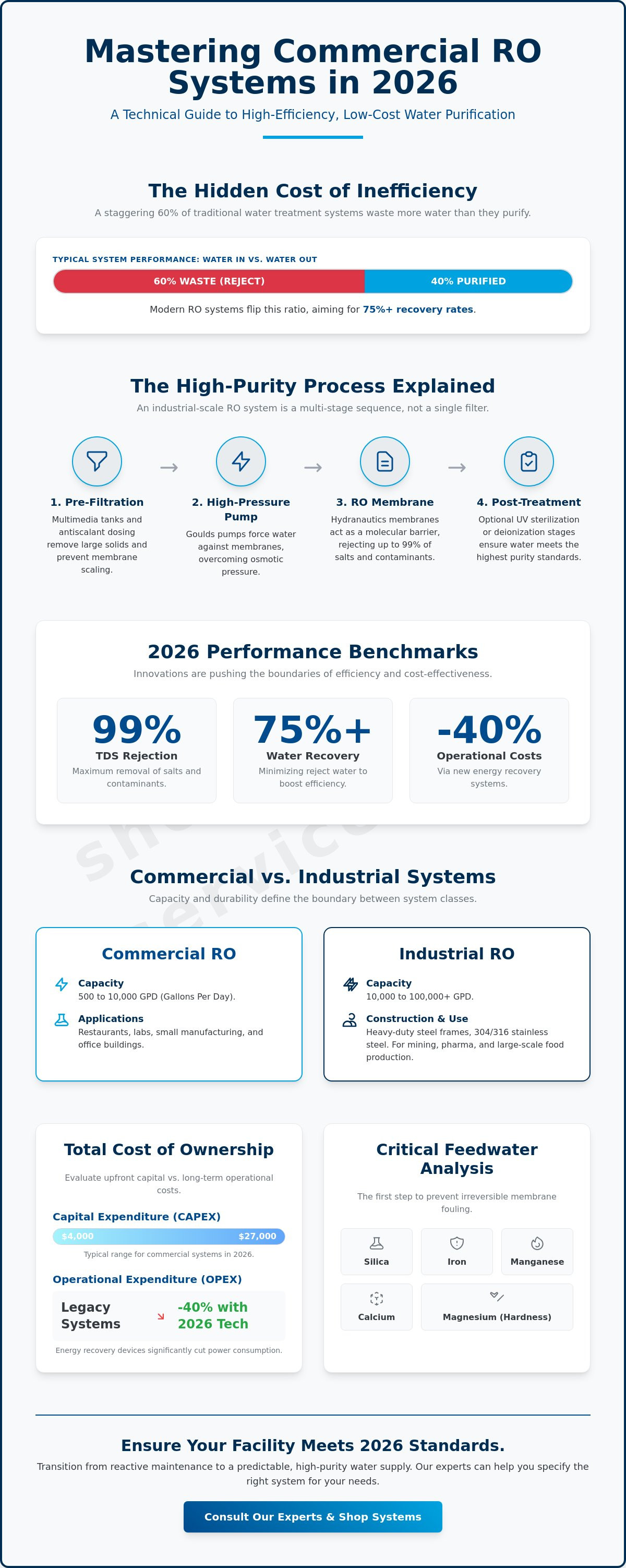
Why are 60% of traditional water treatment systems wasting more water than they actually purify? Selecting a commercial reverse osmosis water filtration system in 2026 requires looking beyond simple GPD ratings to the synergy between membrane rejection chemistry and high-efficiency pumping. You likely understand that inconsistent TDS levels and frequent membrane replacements aren't just maintenance headaches; they're direct drains on your facility's bottom line and operational stability.
This guide provides the technical framework to master the variables of industrial RO, ensuring you meet NSF/ANSI 58 standards while lowering your total cost of ownership. We examine the current capital expenditure range of $4,000 to $27,000 and explain how 2026 innovations in energy recovery systems are cutting operational expenses by 40%. You'll learn how to configure high-efficiency Goulds pumps and Hydranautics membranes to maintain compliance and prevent system downtime in remote locations. By analyzing the January 2026 EPA regulatory updates alongside real-time TDS monitoring trends, you can transition from reactive maintenance to a predictable, high-purity water supply.
Key Takeaways
- Understand the engineering transition from standard filtration to high-pressure membrane processes for effective Total Dissolved Solids (TDS) removal.
- Master the calculation of peak demand versus average daily flow requirements using precise feedwater analysis of pH, hardness, and contaminant levels.
- Identify how specific hardware selection, including Goulds pumps and Hydranautics membranes, dictates the long-term reliability of your commercial reverse osmosis water filtration system.
- Evaluate the total cost of ownership by comparing upfront capital expenditure against operational costs and mobile plant rental options.
- Discover the logistical advantages of containerized and modular RO systems for rapid scaling in demanding industrial sectors like mining and oil.
The Engineering Behind a Commercial Reverse Osmosis Water Filtration System
A commercial reverse osmosis water filtration system is a precision-engineered assembly designed to remove up to 99% of Total Dissolved Solids (TDS) from raw feed water. Unlike standard mechanical filtration that traps suspended solids within a media bed, reverse osmosis (RO) uses high-pressure pumps to force water through semi-permeable membranes. The Engineering Behind a Commercial Reverse Osmosis Water Filtration System relies on the fundamental physics of overcoming osmotic pressure to achieve high-purity permeate. In 2026, industrial standards have shifted toward maximizing recovery rates to 75% or higher while integrating energy recovery devices that reduce operational costs by 40% compared to previous decade benchmarks.
Core industries including mining, pharmaceuticals, and food and beverage production rely on this technology for operational stability. Mining sites utilize RO for remote potable water and process chemistry, while pharmaceutical facilities require it to meet stringent USP water standards. Food and beverage manufacturers use these systems to ensure ingredient water consistency across global production lines. As the global water treatment market grows to $48.83 billion in 2026, the focus has intensified on systems that minimize reject water and energy consumption.
Just as high-performance RO systems are essential for water quality, businesses looking to maintain a premium environment can rely on the advanced scenting solutions from ISCENT to enhance their commercial spaces.
How Reverse Osmosis Works at Scale
Industrial-scale RO isn't a single filter; it's a multi-stage sequence. The process begins with pre-filtration, often utilizing multimedia tanks and antiscalant dosing to prevent membrane scaling. High-pressure Goulds centrifugal pumps then drive the water against FilmTec or Hydranautics membranes. These membranes act as a molecular barrier, allowing water molecules through while rejecting salts and contaminants. Rejection rate is the primary performance indicator, defining the percentage of contaminants successfully removed from the feed water. Post-treatment stages may include Viqua UV sterilization or deionization to reach specific high-purity benchmarks.
Commercial vs. Industrial RO: Key Differences
Capacity and durability define the boundary between commercial and industrial configurations. Standard commercial systems typically handle 500 to 10,000 GPD (gallons per day). Industrial systems exceed these volumes, often reaching 100,000 GPD or more in containerized plants. Industrial builds prioritize technical integrity with 304 or 316 stainless steel housings and powder-coated heavy-duty steel frames to withstand harsh environments. For a deeper technical analysis of the chemistry involved, consult our guide on What is RO Water?. This distinction ensures that a commercial reverse osmosis water filtration system is correctly specified for its intended hydraulic load and source water chemistry.
Sizing and Specifying: How to Calculate Your Business RO Requirements
Specifying a commercial reverse osmosis water filtration system requires more than selecting a Gallons Per Day (GPD) rating. You must align the system's hydraulic capacity with the raw water's chemical profile. A detailed feedwater analysis serves as the baseline for every engineering decision. It prevents premature fouling and ensures the equipment operates within its design parameters. Neglecting this step often leads to TDS spikes and increased maintenance costs that erode the system's value over time.
Feedwater Analysis: The Critical First Step
Feedwater chemistry determines membrane selection and pre-treatment needs. Five primary contaminants frequently cause irreversible membrane fouling: silica, iron, manganese, calcium, and magnesium. High concentrations of these elements require specific interventions. For example, brackish water sources with TDS levels exceeding 2,000 ppm necessitate different membrane specifications and higher pump pressures than standard municipal water. Following EPA WaterSense RO Standards helps maintain high efficiency while minimizing reject water. If your analysis reveals high hardness or iron, pre-treatment using water treatment antiscalants or multimedia filters is non-negotiable to protect the RO membranes.
Sizing for Flow and Pressure
Calculating Gallons Per Minute (GPM) is vital for operational success. You must distinguish between your average daily flow and your peak demand periods. Over-sizing a system leads to frequent short-cycling and reduced pump life. Conversely, under-sizing results in pressure drops that halt production. Many facilities utilize atmospheric storage tanks to buffer peak demand, allowing a smaller, more efficient unit to run continuously. This approach balances capital expenditure with long-term energy efficiency.
Temperature also dictates performance. For every degree the water temperature drops below 77°F (25°C), permeate production can decrease by approximately 3%. In 2026, modern controllers account for these fluctuations, but the physical sizing must accommodate the lowest expected seasonal temperature. Maximizing your recovery rate is the final step. Aim for a 75% recovery to reduce wastewater discharge and environmental impact. Properly sized Goulds high-pressure pumps ensure the commercial reverse osmosis water filtration system maintains the necessary flux across all seasonal variables.
Critical Components: Comparing Membranes, Pumps, and Control Systems
Component specification determines the operational lifespan and reliability of a commercial reverse osmosis water filtration system. While many providers focus on simple GPD ratings, the technical integrity of the individual hardware determines the system's rejection efficiency and energy profile. In industrial environments, the synergy between the high-pressure pump and the membrane elements dictates the total cost of ownership. Selecting sub-standard components leads to frequent downtime and inconsistent water quality that can compromise production standards.
Membrane Selection: FilmTec vs. Hydranautics
High-rejection membranes like FilmTec or Hydranautics are essential for industrial applications where feedwater TDS levels fluctuate. The FDA Technical Guide to Reverse Osmosis highlights that membrane configuration must align with specific chemical rejection requirements, particularly in pharmaceutical and food processing. FilmTec membranes are often preferred for their high-rejection capabilities in high-salinity environments. Hydranautics offers specialized low-fouling membranes that perform exceptionally well in wastewater reuse applications. It's vital to use genuine replacement consumables to prevent bypass and maintain system certification.
High-Efficiency Pumping Solutions
The pump serves as the heart of the RO system. Goulds Water Technology Pumps are the industrial standard because they provide the consistent high pressure required to overcome osmotic resistance. Multi-stage centrifugal pumps are preferred for their durability and steady flow rates under heavy-duty cycles. Integrating Variable Frequency Drives (VFDs) allows the pump to adjust its speed based on real-time demand. This optimization can reduce energy consumption by up to 30% in systems with fluctuating permeate needs, preventing the pump from running at full load when demand is low.
Automation and Control Systems
Modern industrial systems require more than manual valves. Walchem controllers provide real-time TDS monitoring and automated chemical dosing for antiscalants. For a commercial reverse osmosis water filtration system deployed at isolated mining sites, remote telemetry allows technicians to monitor performance from a central hub. Integrating electric power controls ensures system safety by providing automatic shut-off during high-pressure or low-flow events. Ashcroft pressure gauges remain critical for preventative maintenance. By monitoring the pressure differential across the membrane bank, operators can identify fouling before it causes permanent damage, ensuring long-term operational stability.
Total Cost of Ownership: Evaluating Purchase, Rental, and Maintenance Logistics
Purchasing a commercial reverse osmosis water filtration system involves balancing initial capital expenditure (CAPEX) with long-term operational expenses (OPEX). In 2026, the upfront cost for these systems ranges from $4,000 to $27,000, depending on the complexity and GPD requirements. However, the energy consumption and consumable costs over a 5-10 year lifecycle often exceed the initial purchase price. Systems with low-quality pumps or inferior membranes may appear cost-effective during procurement but frequently result in TDS spikes and excessive downtime. High-efficiency systems can reduce these operational costs by up to 40% through advanced membrane technology and integrated energy recovery systems.
The Buy vs. Rent Framework
Industrial facilities must determine if ownership or a mobile water treatment plant rental aligns better with their logistical requirements. Rental models are often superior for temporary mining operations, military deployments, or emergency scenarios where local water quality is compromised. Leasing equipment preserves capital for other critical infrastructure while ensuring the facility utilizes current technology. Most rental agreements include comprehensive maintenance, which eliminates the burden of sourcing replacement parts and managing technical labor in remote locations. This flexibility allows businesses to scale their water production without the long-term liability of maintaining aging hardware in harsh environments.
Maintenance and Consumable Logistics
Proactive maintenance is the only way to secure a reliable 10-year equipment lifecycle. Operators should establish a strict schedule for membrane cleaning and replacement based on pressure differential readings from Ashcroft gauges. The use of water treatment antiscalants is a critical variable in ROI; these chemicals prevent mineral scaling that would otherwise necessitate premature membrane replacement. Staff safety during these procedures is paramount. Always provide technicians with the necessary personal protective equipment when they're handling cleaning chemicals or performing high-pressure system checks. Consistent logistics management ensures that sediment and carbon filters are replaced before they impact the high-pressure pump's performance or the membrane's integrity.
Effective water management requires both precise hardware and disciplined financial planning. If you're ready to specify a system for your facility, browse our full catalog of commercial water equipment to find the right configuration for your specific water chemistry.
Modular and Containerized RO: Scaling High-Purity Water for Industrial Sites
Containerized RO plants represent the pinnacle of logistical efficiency for field operations. These units arrive as plug-and-play solutions housed in reinforced 20-foot or 40-foot shipping containers. They're weather-proof and portable. This modularity allows for rapid scaling in the mining and oil sectors. When a site expands, adding a second containerized commercial reverse osmosis water filtration system is significantly more efficient than rebuilding a stationary facility. We view Industrial Water Treatment Systems as the baseline for these custom engineering projects. These plants include internal lighting, insulation, and pre-wired electrical panels for immediate commissioning upon arrival.
Deploying RO in Harsh or Remote Environments
Remote industrial sites often operate in extreme climates that would degrade standard indoor equipment. Containerized units feature climate-controlled enclosures to maintain membrane flux in temperatures ranging from -30°C to 50°C. Shipping these modular units to regions like sub-Saharan Africa or the Middle East requires logistical precision and heavy-duty framing. These systems play a vital role in mining wastewater treatment. They provide on-site resource recovery and ensure compliance with the 2026 EPA water quality certification updates. Integrating Viqua UV sterilization provides a final biological barrier. This ensures the permeate meets potable or high-purity process standards regardless of the feedwater source. The use of stainless steel high-pressure piping and ruggedized mounting prevents vibration damage during transport.
Custom Engineering and Design
Site-specific integration is the difference between a functional system and an optimized one. Standard RO units serve many purposes, but custom containerized plants address specific feedwater chemistries and spatial constraints. Engineers analyze the hydraulic load and electrical requirements to ensure the system integrates with existing facility infrastructure. This process involves moving from a standalone commercial reverse osmosis water filtration system to a fully integrated, automated plant. Every custom build includes Walchem controllers and Signet flow sensors for precise data logging. If your facility requires a specialized solution for high-volume or remote water purification, contact Water Services, Inc. for a custom RO system quote. We provide the technical integrity and logistical competence needed for global industrial deployments. Our Provo, Utah headquarters manages the engineering and global shipping logistics to ensure your equipment arrives ready for service.
Securing Your Industrial Water Supply for 2026 and Beyond
Selecting a commercial reverse osmosis water filtration system requires a shift from reactive purchasing to precise engineering. You've learned that system longevity depends on the synergy between Goulds high-pressure pumps and high-rejection FilmTec or Hydranautics membranes. Technical integrity ensures you meet the strict 2026 EPA water quality standards while maintaining a 75% recovery rate. By evaluating the total cost of ownership and the flexibility of modular containers, you can stabilize your facility's budget and purity benchmarks.
Water Services, Inc. provides the logistical competence to support your facility's growth. We are an authorized distributor for Goulds, FilmTec, and Viqua; we offer custom engineering for containerized plants and mobile ultrafiltration units. Our global deployment experience spans from South America to Africa, ensuring reliable hardware reaches the most isolated industrial sites. Whether you need a permanent installation or a mobile plant rental, our equipment is built for stability and precision. We prioritize the technical integrity of every component to keep your operations running without interruption.
Ready to optimize your facility's water treatment infrastructure? Browse Industrial-Grade Reverse Osmosis Systems at Water Services to secure a high-purity supply you can trust. Your path to long-term operational stability starts with the right equipment.
Frequently Asked Questions
How much water does a commercial reverse osmosis system waste?
A standard commercial reverse osmosis water filtration system typically rejects between 25% and 50% of the input water. High-efficiency configurations in 2026 reach recovery rates of 75% or higher. Traditional systems may waste up to 60% of feed water according to EPA data. Using energy recovery devices and optimized Goulds pump pressures helps minimize this discharge while maintaining high-purity permeate production for your facility.
What is the average lifespan of a commercial RO membrane?
Industrial RO membranes generally last between 3 and 5 years in most commercial environments. This lifespan depends heavily on the quality of pre-treatment and the consistency of the chemical cleaning schedule. Using antiscalants and sediment filtration prevents premature fouling from minerals and organics. If TDS levels spike or pressure differentials increase by 15%, the membrane elements may require immediate inspection or replacement to maintain water quality.
Can a commercial RO system remove bacteria and viruses?
Reverse osmosis membranes effectively remove 99% of bacteria and viruses due to their extremely small pore size. However, RO is not a dedicated sterilization stage for biological safety. We recommend integrating Viqua UV water purification systems as a final barrier. This ensures complete disinfection and prevents biofilm growth within the storage tanks or distribution piping that could compromise your facility's industry water standards.
What is the difference between brackish water RO and seawater RO?
The primary difference lies in the Total Dissolved Solids (TDS) concentration and the required operating pressure for the membranes. Brackish water systems handle TDS levels between 1,000 and 10,000 ppm. Seawater systems must process 35,000 ppm or more. Seawater RO requires specialized high-pressure pumps and corrosion-resistant materials like 316 stainless steel to handle the extreme osmotic pressure and high salinity levels encountered in marine environments.
How often should I clean the membranes in my industrial RO system?
You should clean membranes when the normalized permeate flow drops by 10% or the pressure differential increases by 15%. For most industrial sites, this maintenance occurs every 3 to 12 months. Monitoring Ashcroft pressure gauges and Signet flow sensors provides the technical data needed to schedule these cleanings. Delaying this process can lead to irreversible membrane scaling and a permanent loss of system flux and efficiency.
Does a commercial RO system require a booster pump?
Yes, a high-pressure booster pump is a mandatory component of any commercial reverse osmosis water filtration system. The pump must generate enough pressure to overcome the natural osmotic pressure of the source water. We utilize Goulds multi-stage centrifugal pumps to provide the consistent GPM and head pressure required for efficient performance. Without a booster pump, the system cannot force water through the membrane molecular barrier.
What are the power requirements for a 10,000 GPD RO system?
A 10,000 GPD system typically requires a 3-horsepower to 5-horsepower motor to drive the high-pressure pump. Electrical specifications usually demand 230V or 460V three-phase power to ensure industrial operational stability. Using Variable Frequency Drives (VFDs) and Walchem controllers can optimize this power consumption based on real-time demand. Precise requirements depend on the feed water TDS and the specific pump model selected for the application.
Is pre-treatment always necessary for commercial reverse osmosis?
Pre-treatment is essential for 95% of commercial and industrial applications to protect the sensitive membrane elements from damage. Raw water often contains chlorine, hardness, or sediment that will destroy membranes within a few weeks of operation. Multimedia filter tanks and carbon blocks remove these contaminants before they reach the RO stage. Implementing a proper pre-treatment sequence is the most effective way to reduce total cost of ownership.
0 comments