

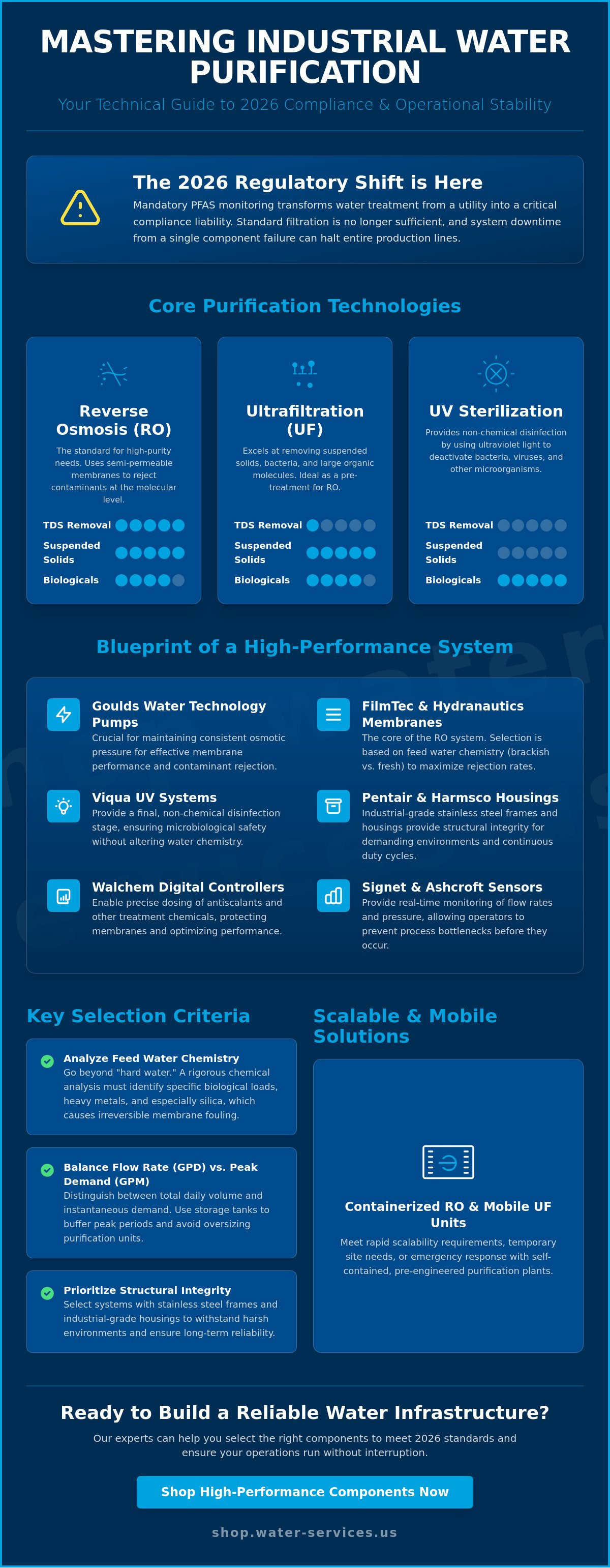
The 2026 implementation of mandatory PFAS monitoring means that a standard filtration setup is no longer just inefficient; it's a compliance liability. A single GPM bottleneck or a failed pre-filtration stage can halt an entire production line. Selecting high-performance commercial water purification systems requires a precise alignment of pump performance, membrane chemistry, and sensor accuracy. You likely recognize that system downtime in harsh environments is often the direct result of poor initial technical scoping.
This guide ensures you master the specific engineering requirements and hardware specifications necessary to maintain a high-purity water supply that scales with your production needs. We will analyze the critical roles of industrial components like Goulds pumps, Viqua UV systems, and FilmTec membranes in achieving operational stability. From managing industrial discharge standards to optimizing real-time flow with Signet sensors, this technical overview provides the roadmap for a reliable and future-proof water infrastructure.
Key Takeaways
- Evaluate the 2026 regulatory shift from simple filtration to multi-stage commercial water purification systems to ensure long-term industrial process compliance.
- Compare Reverse Osmosis and Ultrafiltration technologies with Viqua UV sterilization to achieve precise TDS removal and non-chemical disinfection.
- Select hardware based on structural integrity, prioritizing stainless steel frames and industrial-grade housings from Pentair or Harmsco for demanding environments.
- Maintain consistent system pressure and dosing accuracy by integrating Goulds Water Technology pumps and Walchem digital controllers.
- Deploy containerized RO plants or mobile ultrafiltration units to meet rapid scalability requirements and temporary site operational needs.
Defining Commercial Water Purification Requirements for 2026
Industrial operations in 2026 face unprecedented scrutiny regarding water quality and environmental impact. Simple sediment filtration is insufficient for modern process requirements. High-performance commercial water purification systems utilize a multi-stage approach, integrating pre-filtration, reverse osmosis, and often UV sterilization. These systems are essential for compliance with the EPA’s 2026 PFAS monitoring mandates and the stricter industrial discharge limits affecting steam electric power plants. Effective industrial water treatment requires a precise understanding of feed water chemistry and the specific rejection rates of your membrane array.
Off-the-shelf solutions frequently fail in demanding environments because they lack the robust engineering required for continuous duty cycles. High Total Dissolved Solids (TDS) levels or excessive conductivity can rapidly degrade standard components not rated for industrial use. Industrial-grade systems rely on precision hardware like Goulds Water Technology pumps to maintain the specific osmotic pressure needed for effective contaminant rejection. Using high-accuracy Ashcroft pressure gauges and Signet flow sensors ensures that operators can monitor these metrics in real-time, preventing process bottlenecks before they occur.
Assessing Your Site-Specific Water Quality
Equipment selection begins with a rigorous chemical analysis of the feed water. It's not enough to know the water is "hard." You must identify specific biological loads, heavy metals, and silica concentrations. These factors dictate the choice between FilmTec or Hydranautics membranes. Silica is particularly hazardous; if it's not managed with appropriate water treatment antiscalants, it causes irreversible membrane fouling. Determining the required purity level—whether it's for boiler feed water or pharmaceutical-grade processing—dictates the entire system architecture and pre-treatment stages.
Flow Rate vs. Peak Demand Capacity
Sizing a system requires a clear distinction between daily volume and instantaneous demand. A system rated for 10,000 Gallons Per Day (GPD) may fail if the process requires a 20 Gallon Per Minute (GPM) burst that exceeds the pump's capacity. Incorporating storage tank capacity is a practical way to buffer peak demand periods without over-investing in oversized purification units. If your peak demand is 50 GPM but your average use is low, a combination of a steady-state RO system and a pressurized storage array is often the most cost-effective solution. Estimating future growth needs now ensures your commercial water purification systems remain scalable as production increases.
Core Technologies: Reverse Osmosis, Ultrafiltration, and UV Sterilization
Selecting the right technology requires balancing contaminant rejection with energy consumption. Ultrafiltration (UF) excels at removing suspended solids and large organic molecules but doesn't address Total Dissolved Solids (TDS). For high-purity requirements, industrial reverse osmosis (RO) is the standard. It uses semi-permeable membranes to reject up to 99% of dissolved salts. Advanced water filtration technologies originally developed for extreme environments now drive efficiency in these commercial water purification systems. Integrating multimedia filter tanks as a primary stage protects sensitive membranes from heavy sediment loads and reduces the frequency of backwashing cycles.
Industrial Reverse Osmosis (RO) Systems
Membrane selection depends on feed water salinity. FilmTec and Hydranautics offer specialized membranes for both brackish and fresh water applications. Brackish water membranes require higher operating pressures; this often necessitates high-head Goulds Water Technology pumps to overcome osmotic resistance. Energy efficiency is a primary metric. Selecting the correct pump curve reduces long-term operational costs. To prevent mineral scaling and extend membrane life, precise dosing of water treatment antiscalants via Pulsafeeder metering pumps is required. This chemical pre-treatment ensures commercial water purification systems maintain their rated GPM without premature fouling or membrane degradation.
UV Sterilization and Biological Control
Biological control is critical in food, beverage, and pharmaceutical processes. Viqua UV systems provide non-chemical disinfection by disrupting the DNA of pathogens. This method adds no chemicals or residual flavors to the effluent. Sizing these units requires calculating the UV dosage, measured in mJ/cm², against the peak flow rate. For example, a Viqua Pro 10 is rated for 10 GPM at specific clarity levels, while the VP600 handles up to 24 GPM. Effective sterilization depends on water transmittance. High turbidity can shield microbes from the light, making sediment pre-filtration essential. Regular maintenance of quartz sleeves and annual lamp replacement are non-negotiable protocols to ensure continuous safety.
If your process requires specific ion removal, such as softening without sodium exchange, nanofiltration is the technical middle ground between UF and RO. It's particularly effective for removing divalent ions like calcium and magnesium while allowing some monovalent ions to pass. For sites dealing with heavy iron or manganese loads, multimedia filter tanks using varied media layers are the first line of defense. These tanks prevent the rapid clogging of downstream cartridge filters. You can find high-performance replacement filters and membranes to keep your system at peak efficiency.
Key Selection Criteria for High-Volume Water Systems
High-volume commercial water purification systems require structural integrity that matches their operational demand. Frame material is a primary consideration. 304 or 316 stainless steel frames provide superior corrosion resistance in chemical-heavy environments compared to powder-coated aluminum. Aluminum frames are lighter and often sufficient for climate-controlled indoor sites, but they lack the rigidity needed for heavy vibrating equipment. This choice directly impacts the system's lifespan and structural stability during high-pressure pump cycles. Beyond the frame, the selection of industrial water treatment technologies must account for the physical footprint and ease of maintenance.
Feed water temperature significantly affects purification efficiency. Most RO membranes are rated at a standard 77°F. As water temperature drops, viscosity increases. This requires higher operating pressure from the feed pump to maintain the same permeate flow. If your facility uses cold groundwater, you must size your pumps and membranes to handle this increased resistance. Factoring in these seasonal fluctuations is vital for calculating Total Cost of Ownership (TCO). A true TCO analysis includes initial capital, recurring costs for energy, replacement sediment filters, and the labor required for membrane clean-in-place (CIP) procedures. Energy consumption from high-pressure pumps typically represents the largest portion of long-term operational expense.
Membrane and Filter Housing Durability
Pentair filter housings are the industrial standard for harsh sites due to their high-pressure ratings and chemical compatibility. For high-flow pre-treatment, engineers must choose between bag filters and cartridge filters. Bag filters are ideal for high sediment loads and rapid change-outs. Cartridge filters offer finer sub-micron ratings for sensitive downstream components. Using robust housings from Harmsco or Pentair ensures that the system can handle the hydraulic shock typical in industrial cycles. These pressure vessels must be rated for the maximum output of your Goulds pumps to prevent catastrophic failure. For a deeper look at hardware options, see our Industrial Water Filtration Systems: A Comprehensive 2026 Roundup.
Scaling Systems for Industrial Volume
Modular design allows for scalability and redundancy. Parallel configurations ensure that if one unit requires maintenance, the others continue to meet production demand. In contrast, series configurations are used to achieve higher recovery rates or ultra-pure water quality. When integrating commercial reverse osmosis systems for 24/7 operations, balancing flux rates is critical. Flux, measured in Gallons per Square Foot per Day, must be kept within manufacturer specifications to prevent premature membrane fouling. Over-driving a system to meet short-term demand often leads to irreversible scaling and increased downtime. Systems should be designed with at least 15% to 20% excess capacity to account for future production growth. Engineers seeking reliable components can source industrial-grade hardware directly from Water Services, Inc. to ensure system longevity.
Operational Integration: Pumps, Controls, and Maintenance Logistics
Operational reliability in commercial water purification systems depends on the seamless integration of mechanical force and digital oversight. The pump acts as the heart of the system, while the controller serves as the brain. High-purity water production is impossible without consistent hydraulic pressure and precise chemical balance. Industrial environments demand hardware that can withstand 24/7 duty cycles without performance degradation. Integrating high-accuracy sensors ensures that every gallon meets the specified purity standards before entering the production line.
High-Performance Pumping and Pressure Management
Industrial systems require specific head pressure to overcome membrane resistance and facilitate permeate flow. We utilize Goulds Water Technology Pumps for their proven reliability in high-cycle environments. It's vital to analyze the pump curve to ensure the selected model provides the necessary GPM at the system’s design pressure. Inadequate pressure leads to poor permeate quality and increased salt passage. Protecting these assets from cavitation or dry-run scenarios is essential. Low-pressure shut-off switches prevent air from entering the pump head, which avoids catastrophic impeller damage and unplanned downtime.
Precision Monitoring and Automation
Precision monitoring eliminates the guesswork in water treatment. Integrating electric power controls allows for automated system shut-off during fault conditions. Walchem controllers provide real-time data on pH, ORP, and conductivity, ensuring that chemical dosing remains within specification. These systems work in tandem with Signet flow sensors and Ashcroft pressure gauges to provide a comprehensive view of hydraulic health. For remote or unmanned installations, these controllers can transmit alerts to off-site operators, allowing for proactive intervention before a process bottleneck occurs.
Developing a preventative maintenance schedule is critical for remote industrial sites where technician access is limited. This schedule must include monthly calibration of sensors and quarterly inspection of pump seals. Replacing sediment and carbon filters on a fixed schedule, rather than waiting for significant pressure drops, prevents bacteria growth and fouling. Logging data from Ashcroft gauges helps identify gradual performance declines, indicating when a membrane clean-in-place (CIP) cycle is necessary. Maintaining a log of these metrics is often a requirement for compliance with industrial discharge or process standards.
Maintain your system’s peak performance by sourcing industrial-grade pumps and controllers directly from our technical catalog.
Custom and Containerized Solutions by Water Services, Inc.
Remote industrial sites in sectors like mining, oil, and gas require commercial water purification systems that function independently of local infrastructure. Containerized reverse osmosis plants provide a self-contained, climate-controlled environment for sensitive equipment. These units are engineered within standard shipping containers, allowing for rapid deployment to sites in Africa or South America. By housing the entire treatment train within a single enclosure, operators protect critical components like FilmTec membranes and high-pressure pumps from extreme external temperatures and dust. This design also simplifies the logistics of site relocation once a project phase is complete.
Modular and Mobile Treatment Advantages
Modular systems offer a significant reduction in on-site engineering labor. They arrive as plug-and-play installations, requiring only feed water and power connections to begin operation. Mobile ultrafiltration units are particularly effective for emergency response or temporary installations. These systems provide a high-flux solution for removing suspended solids and pathogens without the need for permanent concrete foundations. For specific applications in the extractive industries, see our detailed guide on Mining Wastewater Treatment Solutions. These units often feature integrated Signet flow sensors and Ashcroft gauges for immediate performance verification upon startup.
Expert Consultation and Global Support
Water Services, Inc. specializes in custom water treatment engineering tailored to the unique chemistry of your site. Our technical team, based at our Provo, Utah headquarters, designs systems that meet stringent military and industrial specifications. We manage the complex logistics of international shipping and provide commissioning support to ensure system performance upon arrival. This includes coordinating the delivery of specialized chemicals and replacement parts to remote locations. Long-term maintenance contracts are available to support remote operations, ensuring that replacement sediment filters and antiscalants are delivered on a predictable schedule. This logistical competence ensures that high-purity water remains available even in the most challenging global environments. We prioritize technical integrity, ensuring every custom build is a stable and dependable partner for your production needs.
Optimizing Industrial Water Infrastructure for 2026
Selecting commercial water purification systems requires strict adherence to technical specifications and site-specific chemistry. As regulatory requirements for PFAS and industrial discharge tighten throughout 2026, the margin for error in system design has vanished. Reliable performance depends on the synergy between high-head Goulds pumps, FilmTec membranes, and Walchem automation. Whether you're deploying a fixed plant or a containerized RO unit, technical integrity is the only safeguard against process bottlenecks and unplanned downtime.
Water Services, Inc. has provided industrial water solutions since 1994. With over 30 years of expertise and project experience spanning four continents, we understand the rigors of harsh environments. As an authorized distributor for Goulds, Viqua, and FilmTec, we provide the hardware and engineering support needed to maintain high-purity standards. Our logistical capabilities ensure that your system remains operational regardless of your geographic location. We prioritize durability and precision in every build to ensure your facility meets its production goals.
Consult with our Engineers for a Custom Water Purification Quote to secure a dependable water supply for your facility. We're ready to help you engineer a solution that scales with your growth.
Frequently Asked Questions
What is the difference between commercial and industrial water purification?
Commercial systems are typically designed for light-duty applications such as offices, restaurants, or small laboratories with intermittent demand. Industrial systems are engineered for 24/7 duty cycles and higher Gallons Per Minute (GPM) requirements. These industrial-grade commercial water purification systems often feature stainless steel frames, modular redundancy, and advanced Walchem controllers to handle the rigors of process-critical environments.
How often should RO membranes be replaced in a commercial system?
RO membranes generally require replacement every two to five years depending on feed water quality and the efficacy of pre-treatment stages. Utilizing high-quality water treatment antiscalants and maintaining a strict sediment filter replacement schedule can significantly extend membrane life. Operators should monitor permeate conductivity and pressure differentials across the vessel to determine the optimal replacement point.
Can a commercial water purification system remove PFAS and other emerging contaminants?
Yes, commercial water purification systems utilizing reverse osmosis or ultrafiltration are highly effective at rejecting PFAS and other forever chemicals. Starting in 2026, US public water systems are mandated to monitor for these substances under new EPA regulations. Industrial facilities can achieve compliance by integrating FilmTec or Hydranautics membranes specifically rated for high rejection of emerging organic contaminants.
Beyond meeting industrial standards for purity, many professionals are also exploring the health benefits of specialized water chemistry; to see how the PureONE generator uses molecular hydrogen for wellness, learn more.
What are the power requirements for a 10,000 GPD reverse osmosis system?
A 10,000 GPD system usually requires a 220V or 460V three-phase power supply to drive the high-pressure Goulds centrifugal pump. The specific amperage draw depends on the motor horsepower and the osmotic pressure required for the feed water's TDS level. Engineers must verify site electrical capacity to ensure stable voltage during high-torque startup periods.
How does feed water temperature affect the performance of a purification plant?
Feed water temperature has a direct impact on membrane flux and permeate production rates. Most systems are rated at a standard 77°F. For every degree the temperature drops below this baseline, permeate output decreases by approximately 3%. This requires the feed pump to work harder to maintain flow, which increases energy consumption and operational costs.
Is a UV sterilizer necessary if I already have a reverse osmosis system?
A UV sterilizer serves as a critical final safety barrier against biological growth in downstream storage tanks and distribution piping. While RO membranes reject most pathogens, they aren't absolute biological barriers. Integrating a Viqua UV system ensures non-chemical disinfection and prevents bacterial colonization without adding residual flavors or odors to the purified water.
What is the typical ROI for an industrial water recycling system?
Most industrial facilities achieve a full ROI on water recycling systems within 18 to 36 months through reduced freshwater procurement and lower wastewater discharge fees. These systems enable closed-loop operations that reduce environmental impact and ensure resource stability. The exact payback period depends on local utility rates and the volume of process water successfully recovered for reuse.
Do you offer rental or leasing options for mobile water treatment units?
Prospective users should contact our Provo, Utah headquarters to discuss current availability for mobile ultrafiltration or containerized RO plants. Rental and leasing options are frequently utilized for emergency response, temporary mining sites, or pilot testing of new industrial processes. Our engineering team provides site-specific consultations to determine the most cost-effective procurement path for your project.
0 comments