

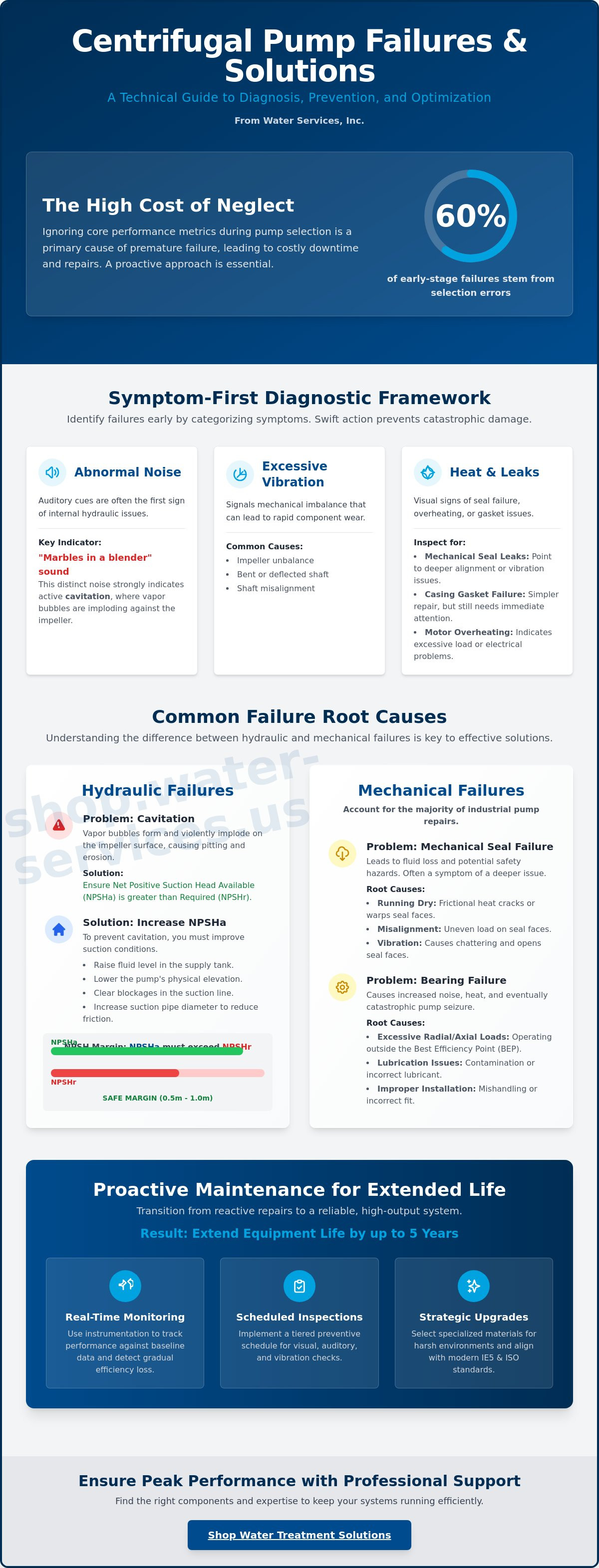
Over 60% of early-stage pump failures result from ignoring core performance metrics like flow rate and head during the initial selection process. Addressing common centrifugal pump failures and solutions is critical for any operator facing the high costs of unexpected downtime. You likely understand that even a minor vibration or a slight drop in pressure can signal a systemic hydraulic misalignment that leads to premature equipment wear.
This guide provides the technical framework to identify and resolve these issues before they escalate. We'll analyze the root causes behind cavitation, mechanical seal leaks, and motor overheating while providing the exact diagnostic steps needed to restore peak performance. This process ensures your hardware remains durable in harsh industrial environments.
By aligning your troubleshooting with the latest IE5 energy efficiency regulations and ISO 15783:2026 standards, you can extend equipment life by up to five years. This overview provides a structured approach to move from reactive repairs to a reliable, high-output fluid transfer system that respects your facility's time and budget.
Key Takeaways
- Implement a symptom-first diagnostic framework to categorize failures by vibration, heat, and noise, allowing for rapid identification of performance deviations.
- Analyze common centrifugal pump failures and solutions involving hydraulic instability, focusing on Net Positive Suction Head (NPSH) to prevent internal impeller erosion.
- Reduce maintenance frequency by addressing the root causes of mechanical seal and bearing failure, which account for the majority of industrial pump repairs.
- Optimize equipment durability in harsh environments through specialized material selection and protective configurations for abrasive or chemically aggressive fluids.
- Establish a tiered preventive maintenance schedule integrated with automated power controls to minimize operational downtime and extend service life.
Diagnostic Framework: Identifying Centrifugal Pump Failure Symptoms
Effective troubleshooting begins with a technical definition of failure. Centrifugal pumps are engineered to operate along a specific performance curve where head, flow, and power consumption remain in balance. Any measurable deviation from this curve constitutes a failure. Operators must adopt a symptom-first diagnostic framework to categorize issues before they result in a total system shutdown. Waiting for a complete seizure often leads to catastrophic shaft deflection or motor winding failure. Early detection relies on comparing real-time metrics against baseline performance data established during initial commissioning.
Categorizing symptoms by noise, heat, vibration, and flow allows for a structured response. This hierarchy ensures technicians address the root cause rather than just the visible effect. Understanding common centrifugal pump failures and solutions requires distinguishing between hydraulic issues and mechanical wear. Immediate intervention is non-negotiable. A pump operating outside its preferred operating range (POR) generates excessive heat and radial loads that degrade components rapidly. It's a risk that seasoned experts don't take lightly.
Visual and Auditory Warning Signs
Auditory cues provide the first line of defense in a busy industrial environment. A distinct sound resembling "marbles in a blender" typically indicates cavitation. This happens when vapor bubbles implode against the impeller surface. Visual inspections should focus on specific leak points. Differentiating between a mechanical seal leak and a casing gasket failure is essential for determining the repair scope. While a gasket leak might require a simple replacement, a seal leak often points to deeper shaft alignment or vibration issues. Abnormal vibration patterns frequently signal an impeller unbalance or a bent shaft. Identifying these common centrifugal pump failures and solutions early prevents secondary damage to the motor and housing.
Performance-Based Indicators
Data-driven diagnostics utilize instrumentation to identify internal wear that visual inspections miss. Monitoring a water flow meter gpm reading helps detect gradual efficiency loss. If the flow rate drops while the motor speed remains constant, internal clearances have likely widened due to erosion. Technicians should interpret pressure gauge fluctuations on both the suction and discharge sides. A drop in discharge pressure coupled with an increase in energy consumption usually points to internal friction or a bypass within the volute. Consistent tracking of these metrics prevents unexpected downtime and maintains the high level of industrial reliability required for specialized global operations.
Hydraulic Failures: Cavitation, NPSH, and Flow Instability
Hydraulic failures represent the most destructive class of common centrifugal pump failures and solutions. These issues stem from the fundamental physics of fluid movement and system design. Cavitation occurs when the absolute pressure of the liquid at the impeller inlet drops below its vapor pressure. This drop causes vapor bubbles to form. As these bubbles move to areas of higher pressure, they implode with enough force to pit and erode the metal. It effectively destroys the impeller from the inside out and creates the "marbles in a blender" noise identified in the diagnostic framework.
Preventing this erosion requires a precise understanding of Net Positive Suction Head (NPSH). You must ensure that NPSH Available (NPSHa) exceeds NPSH Required (NPSHr) by a safe margin, typically at least 0.5 to 1.0 meters. If the suction pressure is too low, the pump cannot maintain a continuous liquid column. This leads to flow instability and eventual mechanical damage. Running dry is the fastest way to destroy mechanical seals and bushings. Without the process fluid to act as a coolant and lubricant, frictional heat rises instantly. This heat causes seal faces to crack or warp, necessitating immediate hardware replacement.
Resolving Suction-Side Issues
Techniques for increasing NPSHa in existing installations focus on reducing friction and increasing static head. Operators can raise the fluid level in the supply tank or lower the pump's elevation to improve suction pressure. Clearing blockages and optimizing suction piping geometry by removing unnecessary elbows will minimize friction losses. It's also vital to check for air leaks in the suction line and priming systems. Air entrainment and vortexing introduce compressible gas into the pump, which leads to erratic discharge, increased vibration, and a significant drop in hydraulic efficiency.
Managing Discharge and System Head
Discharge management is critical for preventing internal temperature spikes. "Dead-heading" occurs when a pump runs against a closed discharge valve. The energy from the motor is converted entirely into heat, causing the liquid inside the casing to boil. Conversely, operating too far to the right of the Best Efficiency Point (BEP) creates high-velocity turbulence and excessive radial thrust on the shaft. Adjusting control valves to match system demand ensures the pump stays within its design parameters. For facilities requiring precise flow management, selecting the right industrial pump configurations is the most reliable way to maintain long-term hydraulic stability. Addressing these common centrifugal pump failures and solutions through proper discharge control prevents premature wear on both the motor and the internal hydraulics.
Mechanical Failures: Seals, Bearings, and Alignment
Mechanical components represent the primary failure points in high-demand industrial systems. Mechanical seal failure accounts for nearly 70% of pump maintenance events. This high frequency is rarely a defect of the seal itself. Instead, it's usually a symptom of shaft deflection or excessive vibration. When a shaft deviates from its center, the seal faces can't maintain the required film of lubricant. This leads to friction, heat, and leakage. Understanding the link between these physical stresses is vital for identifying common centrifugal pump failures and solutions before they lead to a total system seizure.
Bearing longevity is tied directly to lubrication management and alignment precision. Over-lubrication is just as dangerous as under-lubrication. Excess grease increases internal friction and prevents heat dissipation, which leads to bearing overheating. Conversely, under-lubrication causes metal-to-metal contact and rapid race degradation. Coupling misalignment remains the silent killer of industrial pump drivetrains. It introduces parasitic loads that destroy bearings and seals simultaneously. These mechanical stresses are often the physical manifestation of the hydraulic instabilities discussed in previous sections.
Seal and Gasket Troubleshooting
Seal face heat checking occurs when thermal stress creates microscopic cracks on the surface. This is a frequent issue in sectors where industrial contaminants interfere with the cooling fluid. For Goulds Water Technology Pumps, using the correct O-ring material and face combination is critical for operational durability. Technicians should consider upgrading from traditional packing to mechanical seals for chemical applications. This transition eliminates process fluid loss and significantly reduces shaft wear, providing a more reliable solution for harsh environments.
Shaft and Bearing Integrity
Detecting "soft foot" during installation is a mandatory step for preventing frame stress. Soft foot happens when the pump frame isn't level with the baseplate. Tightening bolts on an uneven frame creates internal stress that warps the casing and misaligns the internal components. Precision laser alignment is necessary for high-RPM operations to ensure the motor and pump shafts share a single rotational axis. Using vibration analysis allows operators to pinpoint specific bearing race defects before they cause a catastrophic failure. This proactive approach is essential for managing common centrifugal pump failures and solutions in complex industrial layouts.
Industry-Specific Challenges: Mining and Harsh Environments
Mining operations present environmental stressors that standard industrial troubleshooting guides often overlook. Erosion and abrasion represent the most aggressive threats to equipment integrity in these sectors. Mine tailings and heavy sediment act as liquid sandpaper, rapidly thinning pump casings and destroying impeller vanes. These common centrifugal pump failures and solutions require a shift from standard maintenance to specialized material engineering. Chemical compatibility is also a central requirement for mining wastewater treatment solutions, as acidic or alkaline process water can cause rapid metallurgical failure if the pump housing is not properly specified.
Remote mining sites also face electrical challenges. Significant power fluctuations in isolated grids can degrade motor insulation and lead to premature winding failure. Additionally, managing "slurry settling" is critical during idle periods. If solids drop out of suspension while the pump is stationary, the resulting "plug" can seize the impeller upon restart. This often leads to broken shafts or burnt-out motors. Operators must implement automated flushing cycles to clear the casing before every shutdown to maintain operational reliability.
Abrasive Wear and Solids Handling
High-grit environments require hardened impellers and replaceable wear rings to sacrifice components rather than the main housing. Proper flush water pressure is mandatory for seal longevity. If the flush pressure doesn't exceed the internal stuffing box pressure, abrasive particles will enter the seal faces and cause immediate scoring. Implementing commercial water filtration systems protects downstream pumps by removing large-diameter solids before they reach the intake. This reduces the frequency of common centrifugal pump failures and solutions related to internal clogging and abrasive wear.
Corrosion and Material Selection
Corrosion management involves differentiating between general surface oxidation and localized pitting. In reverse osmosis and wastewater systems, chloride-induced pitting can penetrate even stainless steel casings. The role of pH monitoring and the application of water treatment chemicals is vital for preventing casing rot. Engineers should specify 316SS or CD4MCu materials for acidic process water to ensure durability. For facilities managing remote installations, integrating robust electric power controls is essential for protecting motor windings from voltage instability and ensuring the system remains responsive to fluctuating hydraulic demands.
Preventive Maintenance and Professional Support
Effective management of common centrifugal pump failures and solutions requires a transition from reactive repairs to a structured preventive maintenance strategy. Industrial facilities that implement a tiered maintenance schedule achieve a 45% lower failure rate than those without scheduled inspections. This approach prioritizes reliability by identifying wear before it causes a system-wide shutdown. Integrating automated electric power controls allows for real-time monitoring of motor loads and efficiency. These systems provide an early warning for the hydraulic and mechanical issues discussed in previous sections.
Deciding whether to repair or replace a unit depends on a Total Cost of Ownership (TCO) analysis. If the cost of a major overhaul exceeds 50% of the price of a new pump, or if permanent internal erosion has reduced efficiency by more than 10%, replacement is the more economical path. Modern hardware often incorporates superior metallurgy and IE5-compliant motor standards that reduce long-term energy costs. During these major overhauls, leveraging rental units ensures that industrial output remains steady without forcing a full facility stoppage. It's a pragmatic approach to maintaining uptime.
Developing a Robust Maintenance Plan
A robust plan requires on-site availability of critical spares, including mechanical seals, bearings, and gaskets. Technicians should log thermal imaging data monthly to track heat trends in motor windings and bearing housings. This data helps pinpoint friction or electrical resistance before it leads to failure. Additionally, training personnel on proper start-up and shut-down sequences is vital. Incorrect procedures often cause the water hammer or dead-heading events that lead to the common centrifugal pump failures and solutions identified in this guide. Consistent logging of baseline data ensures deviations are caught early.
Strategic Equipment Selection
Selecting hardware with a proven track record for durability is the foundation of industrial reliability. Goulds Water Technology Pumps are frequently preferred for high-reliability applications due to their robust hydraulic designs and ease of maintenance. For complex or specialized requirements, consulting with Water Services, Inc. provides access to custom-engineered modular systems tailored to specific flow and pressure demands. If an emergency failure occurs, mobile water treatment plant rentals bridge the operational gap. These containerized solutions provide immediate fluid transfer and treatment capabilities while permanent hardware is being serviced or replaced.
Optimizing Industrial Fluid Transfer Performance
Operational longevity in demanding environments depends on a precise diagnostic hierarchy and alignment with modern efficiency standards. By implementing the symptom-first approach and maintaining strict NPSH requirements, you can prevent the hydraulic instability that leads to internal erosion. Transitioning from reactive repairs to a structured, tiered maintenance plan reduces the frequency of common centrifugal pump failures and solutions, ensuring your facility remains productive and compliant with the latest IE5 regulations.
Water Services, Inc. serves as a dependable partner for specialized global markets. We are an authorized Goulds Water Technology distributor with decades of experience in containerized water treatment systems and global engineering support for the mining and industrial sectors. Our technical expertise ensures you receive exact hardware solutions for your most rigorous fluid transfer challenges.
Browse our industrial Goulds Water Technology Pumps and replacement parts to secure the components needed for your next maintenance cycle. Establishing a culture of technical precision today ensures your facility maintains peak hydraulic efficiency and equipment durability for years to come.
Frequently Asked Questions
What are the most common signs that a centrifugal pump is failing?
The most frequent indicators include excessive vibration, abnormal noise levels, and a measurable drop in discharge pressure. These symptoms often signal that the equipment is operating outside its preferred range. If you notice a "marbles in a blender" sound, the pump is likely cavitating. Consistent monitoring of baseline performance data is the best way to catch these common centrifugal pump failures and solutions before they lead to a total motor seizure.
How can I stop my centrifugal pump from vibrating so much?
Reducing vibration requires a systematic check of alignment and mounting. Start by verifying the precision laser alignment of the coupling and checking for "soft foot" on the baseplate. Vibration also occurs due to hydraulic imbalances like cavitation or air entrainment. If the mechanical setup is sound, inspect the impeller for debris or physical wear that could cause rotational unbalance. Proper mounting and alignment are essential for bearing longevity.
What causes cavitation in a centrifugal pump and how do I fix it?
Cavitation occurs when the absolute pressure at the suction inlet drops below the liquid's vapor pressure. This causes bubbles to form and implode against the impeller. To fix this, you must increase the Net Positive Suction Head Available (NPSHa). Solutions include raising the fluid level in the supply tank, lowering the pump's elevation, or clearing suction line blockages to reduce friction. Matching NPSHa to the pump's requirements is critical for hydraulic stability.
How often should I replace the mechanical seals on an industrial pump?
Mechanical seals don't have a fixed replacement date; instead, replace them when they show signs of leakage or during a scheduled overhaul. Since seal issues account for nearly 70% of maintenance events, proactive monitoring is vital. If a seal fails prematurely, check for shaft deflection or vibration. Upgrading to a mechanical seal from packing can improve durability in chemical applications and reduce the frequency of hardware replacement.
Why is my pump motor drawing excessive current or tripping the breaker?
Excessive current draw usually points to a pump operating too far to the right of its Best Efficiency Point (BEP). This creates a higher load on the motor than it was designed to handle. Other causes include internal friction from widened clearances or a mechanical seizure in the bearings. Check your electric power controls for voltage fluctuations that might be stressing the motor windings and leading to a breaker trip.
Can a centrifugal pump run backwards, and what happens if it does?
A centrifugal pump can run backwards if the motor is wired incorrectly. While it will still move fluid, it will do so with significantly reduced flow and head. Running in reverse can cause the impeller to unscrew from the shaft, leading to catastrophic internal damage. Always verify the rotation arrow on the casing during commissioning to ensure the drivetrain is rotating in the intended direction for maximum hydraulic efficiency.
What is the difference between a mechanical failure and a hydraulic failure?
Mechanical failures involve physical components like seals, bearings, and shafts; hydraulic failures relate to the fluid's behavior within the system. A mechanical failure might be a seized bearing due to over-lubrication. A hydraulic failure is something like cavitation or flow instability caused by incorrect suction piping. Understanding the distinction between these common centrifugal pump failures and solutions is vital for accurate troubleshooting because hydraulic turbulence often causes secondary mechanical wear.
When should I choose a repair over a complete pump replacement?
Choose a complete replacement when the repair cost exceeds 50% of the price of a new unit. You should also consider replacement if internal wear has caused a permanent efficiency drop of 10% or more. New Goulds Water Technology Pumps often provide better energy efficiency through IE5 motor standards. A Total Cost of Ownership (TCO) perspective helps determine if the energy savings of a new pump outweigh the short-term cost of a repair.
0 comments