

Hot wastewater can turn routine sump duty into a demanding equipment-selection decision. High-temperature sump pumps are designed for hot water, condensate, and wastewater in settings such as boiler rooms and commercial kitchens. For high temperature sump pump applications, select equipment to match both the liquid conditions and the solids load.
Temperature alone does not define the duty. Material compatibility, solids-handling capacity, flow and head requirements, and operating water level all affect whether a pump suits the installation. A pump that handles hot liquid but cannot pass the solids in the stream may not meet the actual sump or sewage requirement.
This guide covers the materials and solids-handling features to assess, how to interpret operating limits, and safety considerations when hot water enters a sump pit. Use it to distinguish hot-water duty from sewage duty and match equipment to conditions at the installation.
Key Takeaways
- Start pump selection with the solids’ size and composition, then match the pump’s passage capacity to the wastewater stream.
- Assess corrosion resistance against both the liquid’s temperature and its chemical composition.
- Compare submersible and vertical configurations by considering sump layout, access, and maintenance needs.
- Include water movement and stagnation in the safety assessment when hot water enters a sump pit.
Solids-handling capability
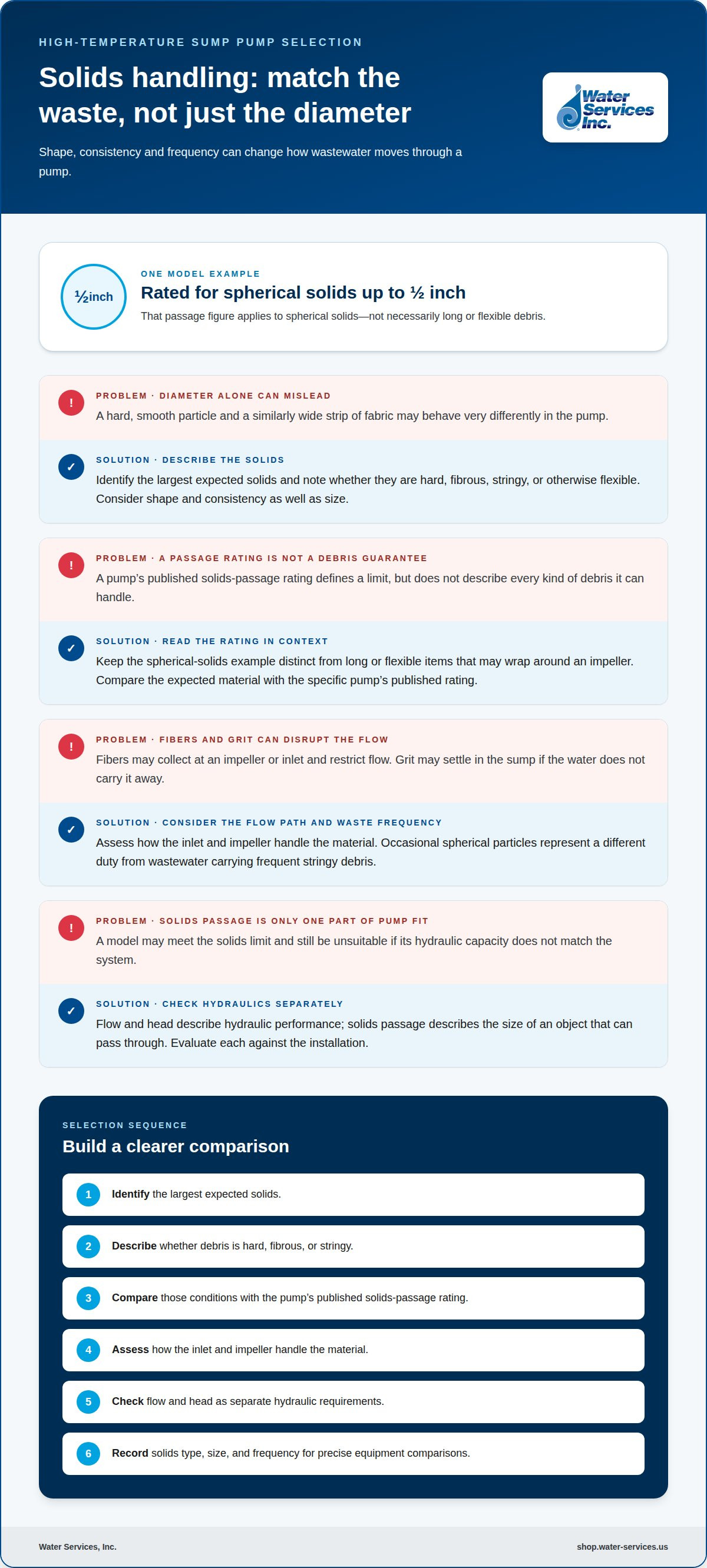
For sewage duty, assess the solids before choosing a pump. Small, hard particles behave differently from fibrous material, wipes, or stringy debris. Consider the shape and consistency of the waste as well as its size. A clear solids-passage rating helps define a pump’s limits, but it does not describe every type of debris the equipment can handle.
One high-temperature sump pump model handles spherical solids up to 1/2 inch in diameter. That figure applies to spherical solids, not necessarily long or flexible items that can wrap around an impeller. Keep the distinction clear when interpreting a specification. A pump’s flow and head ratings describe hydraulic performance, while its solids passage describes the size of an object that can pass through.
Consider the wastewater’s likely contents and the pump’s flow path. A smooth, hard particle may pass through where a similarly wide strip of fabric could snag. Fibers can collect at an impeller or inlet and restrict flow. Grit can also settle in a sump if the water does not carry it away. These examples show why diameter alone is not a complete measure of solids-handling capability.
Use a practical selection sequence: identify the largest expected solids, note whether debris is hard or fibrous, then compare those conditions with the pump’s published passage rating. Next, consider how the inlet and impeller handle the material. Occasional spherical particles create a different duty from sewage carrying frequent stringy waste. Then check flow and head separately. A model that meets the solids limit may still be unsuitable if its hydraulic capacity does not match the system. Record the solids’ type, size, and frequency to make equipment comparisons more precise.
High-temperature sewage and sump pump applications
High-temperature sump pumps handle hot water, condensate, and wastewater in settings such as boiler rooms and commercial kitchens. Heat, wastewater composition, and solids distinguish these duties from ordinary drainage. A boiler-room condensate pit may receive hot liquid intermittently, while a commercial kitchen sump may collect wastewater with changing debris. Match the pump to the actual liquid and operating cycle, not just the sump’s dimensions.
For U.S. installations, plumbing, electrical, and workplace requirements depend on the jurisdiction and site conditions. Applicable rules vary, so no single set of requirements covers every installation. The pump’s electrical supply, installation environment, and service access all affect which requirements apply.
Plan the installation around the pump’s operating limits and the sump’s conditions. Confirm the liquid temperature, expected flow, discharge route, and solids load before selecting equipment. Position the pump to remain submerged as designed. High-temperature liquid pumps should not run below their continuous running water level. Low water can compromise operation, so the control arrangement and sump level matter.
Focus maintenance on parts exposed to heat and wastewater. Inspect the intake for accumulated debris, check accessible components for wear or corrosion, and confirm that the pump starts and stops at the intended water levels. Keep the discharge path clear, since obstructions can affect flow. For properties relying on on-site wastewater management, such as those seeking septic tank pumping Portland OR, routine maintenance of both the pump and holding tank is essential to prevent backups. Record changes in noise, vibration, or pumping behavior to help identify developing mechanical issues before they disrupt service.
For example, a boiler-room sump may need a different operating assessment from a kitchen sump receiving mixed wastewater. Treat each as a distinct duty. Document liquid conditions, operating levels, discharge configuration, and maintenance findings. These details make pump selection and future troubleshooting more precise. For equipment planning, explore pump options alongside the installation requirements.
How do submersible and vertical high-temperature sump pumps compare?
A submersible pump operates with its pump and motor assembly below the liquid surface. This compact arrangement can suit a sump with limited floor space or direct installation in a pit. For hot wastewater, the decisive factors are the pump’s rated liquid temperature and duty conditions. Submersible construction alone does not establish suitability for a particular temperature or sewage stream.
A vertical sump pump places its motor above the liquid, with a shaft and pump components extending into the pit. This arrangement keeps the motor out of the collected liquid and can make the drive assembly easier to access. The shaft, column, bearings, and wetted components still need to suit the fluid and operating conditions. A raised motor also requires adequate clearance above the sump.
Compare pump arrangements against the installation, not the name alone. A confined boiler-room pit may favor the smaller footprint of a submersible unit. A process area with accessible overhead space may accommodate a vertical design. In either case, heat exposure, solids passage, discharge routing, and service access affect selection. Confirm that the specific model is designed for the liquid temperature and expected wastewater duty.
- Submersible layout: assess pit dimensions, access for lifting, and the motor’s temperature rating.
- Vertical layout: assess overhead clearance, shaft arrangement, and access to above-pit components.
- Both designs: compare solids-handling limits, hydraulic requirements, and materials exposed to the liquid.
A deep pit with clear overhead access may accommodate a vertical assembly, while a cramped installation may favor a submersible footprint. Neither arrangement is universally better. Evaluate the pump’s rated temperature, solids capability, flow and head requirements, and maintenance access together. Compare specific models under the same operating conditions. For high-temperature sump pump applications, configuration is only one factor; the full pump specification must match the duty.
What safety risks come with pumping hot water into a sump pit?
Hot water in a sump pit creates operating and exposure concerns. Stagnant hot water can enter the Legionella growth range of 77°-113°F (25°-42°C), according to the Centers for Disease Control and Prevention. A pit that retains water between pump cycles deserves attention because low movement can allow stagnant conditions. Pump operation, liquid temperature, and sump turnover all affect the site’s conditions.
Heat makes it important to match the pump and connected equipment to the liquid. A model operated beyond its temperature rating may not perform as intended. The same applies to seals, cables, discharge piping, and other components exposed to hot wastewater. For example, do not assume a pump selected for cooler drainage is suitable for boiler condensate.
- Stagnation: review how water enters and leaves the pit, including periods between pump cycles.
- Temperature compatibility: compare the liquid’s operating conditions with the pump and component ratings.
- Access: keep inspection and maintenance procedures clear of hot liquid and moving equipment.
- Electrical work: use qualified personnel for work on pump wiring and controls in wet areas.
During operation, observe whether the pump cycles as intended and whether water remains in the pit. A blocked discharge or failed control can alter normal pumping behavior. If the sump serves a kitchen, boiler room, or another process area, record the source and pattern of incoming water. This helps distinguish a routine cycle from a change that needs attention. Tailor maintenance procedures to the installation, pump, and wastewater conditions.
For work around a sump pit, use task-appropriate protective equipment and follow site procedures for hot liquids and electrical systems. Review protective equipment options for maintenance tasks around pump installations.
Water Services
Water Services, Inc. offers Goulds Water Technology Pumps for demanding water applications. After defining the liquid temperature, solids load, flow needs, and installation layout, match those operating conditions to suitable pump options. These details provide a practical starting point for an equipment discussion.
Water Services, Inc. also offers Viqua UV Water Purification Systems, Hydranautics RO Membranes, and water-treatment antiscalants and chemicals for other treatment needs. For sump or sewage duty, focus on the pump and operating environment. Water-treatment products do not replace the need to address solids handling and temperature limits.
Contact Water Services, Inc. to discuss your pumping requirements.
Turn Operating Conditions Into a Clear Next Step
Use operating observations to define the equipment requirement. Record the incoming liquid’s source, temperature profile, solids characteristics, and pit cycling. Include discharge conditions and available installation space. These details provide a practical basis for discussing the system.
In high temperature sump pump applications, selection should reflect the full duty, not a label or configuration alone. Water Services, Inc. offers Goulds Water Technology Pumps for pumping needs, along with Viqua UV Water Purification Systems and FilmTec Reverse Osmosis Membranes for water-treatment requirements. Each product category serves a distinct process role.
A clear operating brief can help focus the next discussion on your actual system. Note which conditions change during normal operation and what the pump must handle. This keeps the decision grounded in the installation rather than a single feature. Contact Water Services, Inc. about pump options to discuss your requirements and move forward with a focused equipment conversation.
Frequently Asked Questions
What temperatures can standard sump pumps safely handle?
There is no single safe temperature limit for all standard sump pumps; the maximum rating varies by model. Use the pump’s specified liquid-temperature limit, not its general-purpose label, to assess suitability. A unit designed for cool groundwater, for example, should not be assumed suitable for hot process discharge. Temperature ratings for the pump, seals, motor, and cable all matter in the installed system.
What types of sump pumps are designed for high-temperature water?
Use a pump specifically rated by its manufacturer for the liquid temperature and duty. Submersible and vertical configurations may both be available for elevated-temperature service, but construction type alone does not establish suitability. A submersible design needs compatible immersed components, while a vertical design still needs suitable wetted and shaft components. Compare each model’s temperature limit and operating conditions.
What are common high-temperature sump pump applications?
Common duties include collecting hot condensate from boiler equipment and wastewater from commercial food-preparation areas. A condensate collection pit handles a different process stream from a kitchen drain sump receiving cleaning wastewater. Industrial process drainage can also involve elevated liquid temperatures. Classify the incoming liquid by source and composition, then match pump construction and capacity to that specific duty.
How do pump materials and seals affect high-temperature performance?
Materials and seals determine how the pump’s wetted components tolerate heat and liquid chemistry. Corrosion-resistant metal may suit a chemically aggressive stream, while seal materials must be compatible with the operating temperature and fluid. A mismatch can accelerate wear or cause leakage. Condensate containing treatment chemicals, for example, presents different material considerations from wastewater with food residues. Assess component compatibility across the system, not just the casing.
How does hot-water temperature affect sump pump capacity and service life?
What specifications should I check when selecting a high-temperature sump pump?
Check the maximum liquid-temperature rating, flow rate, total dynamic head, solids passage, motor duty, voltage, and outlet connection. Confirm that wetted materials and seals suit the liquid’s chemistry. A sewage sump requires attention to solids passage, while a condensate pit may place greater emphasis on temperature compatibility and flow. Compare specifications with the complete installation, including discharge piping and controls.
0 comments