

A water-system proposal needs more than an equipment recommendation. To build a business case for a new water system, define the operational need, compare viable options, including doing nothing, and assess each option’s costs, benefits, risks, and resource requirements. Connect the preferred solution to measurable business objectives.
Decision-makers will want to know how the investment could improve operations and what implementation and ongoing maintenance will require. A clear case answers both questions with evidence, realistic assumptions, and a direct comparison of alternatives.
This guide explains how to frame the problem, evaluate system options, assess project risks, and plan the staffing, skills, and milestones required. It also shows how to present financial and operational outcomes in terms that support a practical funding decision.
Key Takeaways
- Build a risk register that pairs each project exposure with a practical mitigation and a responsible owner.
- Compare investment options with optimized existing resources and the cost of inaction, not just new equipment alternatives.
- Connect the proposal’s costs, benefits, and performance measures to clear operational and business objectives.
- Estimate system demand from actual operating needs, then map the required skills, staffing, and milestones to implementation.
Assessing project risks and mitigation strategies
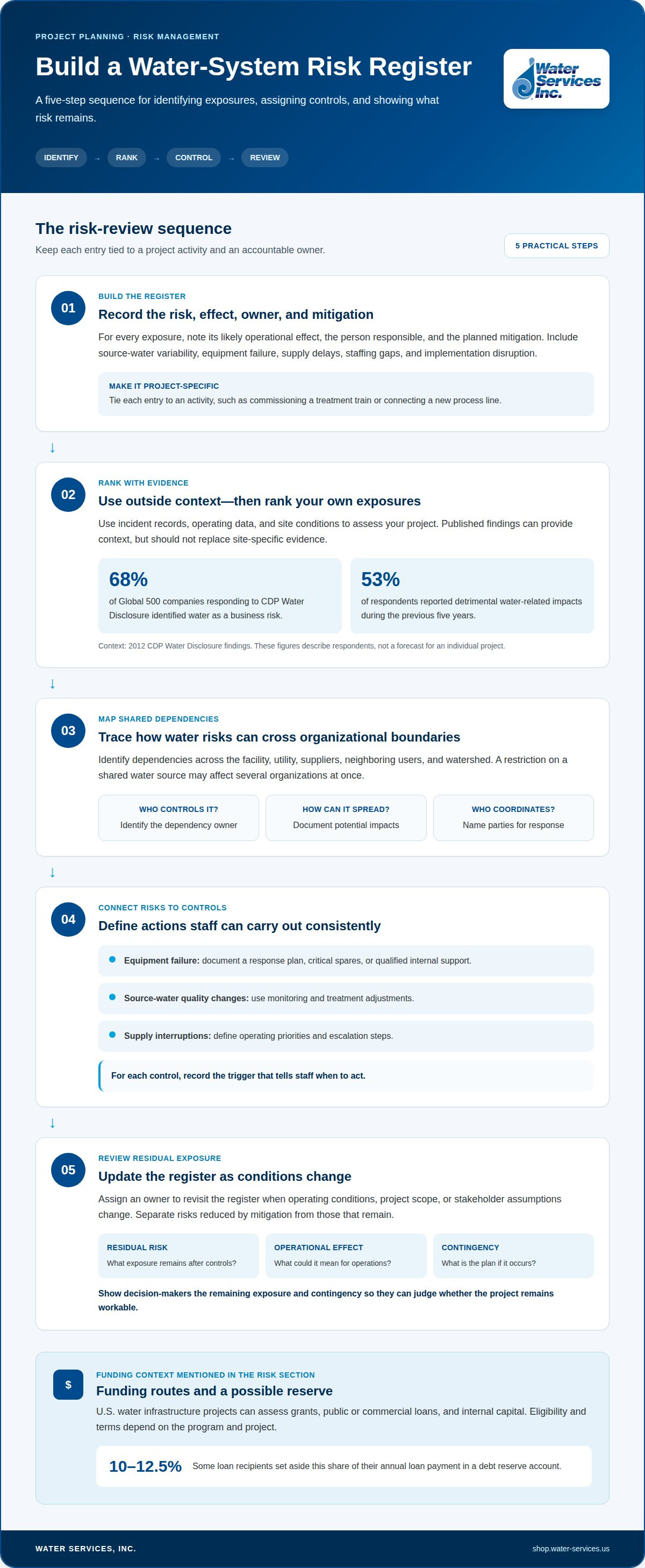
U.S. water infrastructure projects can assess grants, public or commercial loans, and internal capital as funding routes. Eligibility and terms depend on the program and project. Some loan recipients set aside 10-12.5% of their annual loan payment in a debt reserve account.
- Build a project risk register. Record each risk, its likely operational effect, an owner, and a mitigation strategy. Include source-water variability, equipment failure, supply delays, staffing gaps, and implementation disruption. Tie each entry to a specific project activity, such as commissioning a treatment train or connecting a new process line.
- Use evidence to rank risks. In 2012, 68% of Global 500 companies responding to CDP Water Disclosure identified water as a business risk. The same disclosure reported detrimental water-related impacts during the previous five years for 53% of respondents. Use these findings as context, then rank your own exposures using incident records, operating data, and site conditions.
- Map shared water risks among stakeholders. Identify dependencies across the facility, utility, suppliers, neighboring users, and watershed. For example, restrictions on a shared water source may affect several organizations at once. Document who controls each dependency, how impacts could spread, and which parties need coordinated response strategies.
- Connect each risk to a practical control. Address equipment failure with a documented response plan, critical spares, or qualified internal support. Manage changes in source-water quality through monitoring and treatment adjustments. For supply interruptions, define operating priorities and escalation steps. Record the trigger for each action so staff can respond consistently.
- Review trends and residual exposure. Assign an owner to update the register when operating conditions, project scope, or stakeholder assumptions change. Distinguish risks reduced by mitigation from those that remain. Show decision-makers the residual exposure, its operational consequences, and the contingency plan so they can judge whether the project remains workable.
Comparing alternative solutions, including doing nothing
Compare the existing system, targeted upgrades, a new system, and the do-nothing baseline. Apply the same demand assumptions and evaluation period to every option.
-
Compare Alternatives With Doing Nothing
List each option, including process changes that could improve existing assets without a new installation. For the do-nothing case, describe the material consequences of continuing current operations, such as recurring quality problems, production interruptions, or lost efficiency. Keep examples from unrelated projects, such as flood control, separate from water-system cost estimates.
Compare options against the same requirements. For example, assess a pump-based upgrade against current performance and a complete replacement, rather than evaluating it in isolation.
-
Estimate Capital and Operating Costs
Separate one-time capital costs from recurring operating costs. Capital estimates may include equipment, site preparation, installation, controls, commissioning, and integration with existing assets. Operating estimates should account for energy, treatment inputs, labor, routine maintenance, replacement parts, and planned component changes—such as recurring needs for industrial tubing and specialist hoses from Abbey Extrusions.
Use project-specific quantities and operating assumptions for each alternative. Record when costs occur and who owns each estimate. Comparing one option’s installed cost with another’s equipment-only cost obscures the full investment needed to put the system into service.
-
Calculate Returns and Lifecycle Costs
Calculate return on investment by dividing net benefits over the selected period by the initial investment, then multiplying by 100. Estimate simple payback by dividing initial investment by annual net savings. Define net benefits consistently, including measurable savings or revenue improvements and subtracting added operating expenses.
For lifecycle cost, add capital costs to operating, maintenance, and replacement costs across the same evaluation period. Apply consistent assumptions to every option, and show the inputs separately so decision-makers can see what drives the result. To assess a pump-based alternative, compare its relevant water system pump options within that same cost framework.
Water industry and business knowledge
Permit requirements depend on the project’s location, water source, and planned system changes. Identify applicable federal, state, and local approvals for source use, treatment, discharge, construction, and land use. Tie permit assumptions to the proposed site and system scope.
Present the case to executives, boards, or public officials as a decision document. State the approval requested, explain the business impact, and show how results will be measured. To understand how to build a business case for a new water system, connect each technical requirement to the decision-maker’s priorities.
- Align objectives with organizational priorities. Connect the proposed system to outcomes such as operational efficiency, cost reduction, water quality, sustainability targets, or environmental compliance. For example, explain how consistent process water supports production instead of relying on a broad claim of improvement.
- Translate technical results into business effects. Pair each technical measure with its operational consequence. Explain how reduced downtime, lower treatment demand, or improved process consistency could contribute to savings. Distinguish measured results from projected benefits, and show the assumptions behind each projection.
- Build a decision-ready financial view. Present expected revenue, operating expenses, reserves, and capital improvements together. The Tallulah Falls water-system business plan recommends an in-depth budget covering these categories over five years. Use a comparable view to show how the proposal fits into financial planning.
- Make the evidence easy to review. Use clear language, concise tables, and defined performance metrics. Show the preferred option beside alternatives, including the do-nothing case. Identify the evidence supporting each claim so reviewers can trace requested resources to project outcomes.
- Write the executive summary last. Once the analysis is complete, summarize the decision requested, preferred solution, benefits, material risks, and funding needs. For teams learning how to build a business case for a new water system, the summary should make the decision and its rationale clear.
Approvals depend on the project’s location, water source, and planned system changes. Identify federal, state, and local requirements for source use, treatment, discharge, construction, and land use.
How do you estimate demand and size a new water system?
- Set the system boundary. Define the processes, buildings, or production lines the system will serve. Distinguish water used as an ingredient, process input, cleaning supply, or utility. For example, a production line and washdown area may have different schedules and quality requirements. Include only demand within the proposed system boundary.
- Build a demand profile from operating records. Gather meter readings, production schedules, shift patterns, and maintenance logs. Convert usage into consistent units, such as gallons per day and gallons per minute. Pair each reading with its time period and operating context. Daily totals can conceal short, high-flow events that affect equipment selection.
- Calculate average and peak demand separately. Estimate average use over representative operating periods, then identify the highest concurrent demand across connected processes. Show the inputs, including flow rate and operating duration. For example, multiply a process flow rate by its runtime to estimate its volume, then add other simultaneous uses.
- Account for operating changes. Model planned production shifts, new equipment, seasonal schedules, and expected changes in product mix. Keep the baseline separate from each forecast scenario. This shows whether a proposed system fits current use, planned growth, or both, without hiding assumptions in a single demand figure.
- Translate demand into treatment and delivery requirements. Specify required water quality at each point of use, source-water conditions, and the required treated-water flow. Account for water consumed or rejected during treatment when estimating feed demand. Use these inputs to compare water treatment options against the defined operating requirements.
- Document the sizing basis. Present the demand profile, peak-flow calculation, quality targets, and forecast assumptions together. Identify the operating condition that determines required capacity, such as simultaneous process use or a scheduled cleaning cycle. This gives reviewers a traceable basis for evaluating system configurations and comparing them with actual operating data later.
Water Services
Water Services, Inc. can support a business case that identifies treatment or equipment needs. Its offerings include Goulds Water Technology Pumps, Viqua UV Water Purification Systems, Hydranautics RO Membranes, and Water Treatment Antiscalants and Chemicals.
Use the demand profile, water-quality requirements, and alternatives comparison to define which components belong in the proposed system. These products can support projects involving pumping, UV purification, reverse osmosis, or treatment chemicals. The right configuration depends on the operating conditions and system objectives established in the business case.
Turn the Business Case Into a Defined Next Step
A well-supported proposal provides a basis for moving from evaluation to project planning. Next, align the selected system components with operating requirements and the decision-makers’ approved scope. This keeps procurement discussions tied to documented needs rather than assumptions.
As you refine how to build a business case for a new water system, match each equipment category to its intended function. Water Services offers Goulds Water Technology Pumps, Viqua UV Water Purification Systems, and FilmTec Reverse Osmosis Membranes. These products can support projects requiring pumping, UV purification, or reverse osmosis.
Use the defined demand, treatment objectives, and operating constraints to guide the next discussion. This creates a clearer link between the required equipment and the business need it addresses.
Contact Water Services, Inc. to discuss equipment options for your project. A clear next step can help move a sound case toward implementation.
Frequently Asked Questions
How do I Write Winning Water Treatment Business Case?
A strong water-treatment business case makes the decision and its consequences clear. Start with the operational problem and show how it affects production, quality, or service. Then present a preferred option, credible alternatives, and the evidence supporting the choice. For example, connect a recurring process interruption to documented downtime records, then explain which measurable outcome would demonstrate improvement. Keep assumptions visible so reviewers can assess them.
What should a business case for a new water system include?
Include the decision requested, project objectives, current operating conditions, system requirements, alternatives, cost and benefit analysis, risks, and implementation resources. Add an evidence trail by identifying the source and owner for each important assumption, such as a meter record, maintenance log, or production forecast. This makes the case easier to update if demand changes or decision-makers revise the project scope.
How do you compare centralized, decentralized, and on-site water system options?
Compare where treatment occurs, how water moves, and who operates each configuration. A centralized option may serve multiple users through shared infrastructure, while decentralized or on-site treatment places equipment closer to specific demand points. Assess distribution requirements, operating responsibilities, source conditions, and the effects of an outage. For example, a remote facility may weigh transport and local operating capacity differently from a connected industrial campus.
What water quality, reliability, and public health risks should a business case address?
Address source-water variability, treatment performance, equipment failure, monitoring gaps, and potential contamination pathways. Identify each risk’s operational consequence, such as a process interruption or water that fails to meet its intended use. Explain how monitoring results trigger investigation, corrective action, or escalation. For public-facing systems, describe how responsible staff communicate incidents and coordinate with relevant authorities.
What alternatives should be assessed before proposing a new water system?
Assess whether existing equipment can be optimized, a targeted upgrade can address the problem, or process changes can reduce demand. Compare these options with a new system and the do-nothing baseline. For example, a facility with inconsistent output might assess maintenance or control adjustments before replacing treatment equipment. Apply the same operating requirements and evaluation assumptions across all options to make the trade-offs clear.
What permits and regulations apply to building a new water system in my state and locality?
Requirements depend on the project’s location, water source, and planned system changes. Identify applicable federal, state, and local approvals for source use, treatment, discharge, construction, and land use.
0 comments