

A chemical supplier should be judged by more than its product list. Knowing how to choose a water treatment chemical supplier means assessing whether its products, technical guidance, documentation, and delivery support fit your treatment process and operating requirements.
It’s reasonable to start by finding a chemical suited to the water problem. But product selection also affects how chemicals interact with membranes, filtration equipment, and other treatment stages. A supplier with relevant treatment expertise can help connect these decisions instead of treating each chemical as a separate purchase.
This guide explains how to assess supplier support, regulatory and environmental considerations, safety data sheets, product specifications, and application knowledge. You’ll also learn what to consider when chemicals need to work alongside reverse osmosis or filtration systems, helping you evaluate the overall fit for your operation.
Key Takeaways
- Assess delivery, ordering, and supply continuity alongside product fit to judge whether supplier support matches your operation.
- Consider how chemical selection and dosing affect regulatory requirements, treatment performance, and environmental impacts.
- Use product specifications, Safety Data Sheets, and relevant quality documentation to understand chemical characteristics and safe handling.
- Look for treatment expertise that accounts for how chemicals interact with processes such as reverse osmosis and filtration.
Assessing distributor and OEM support
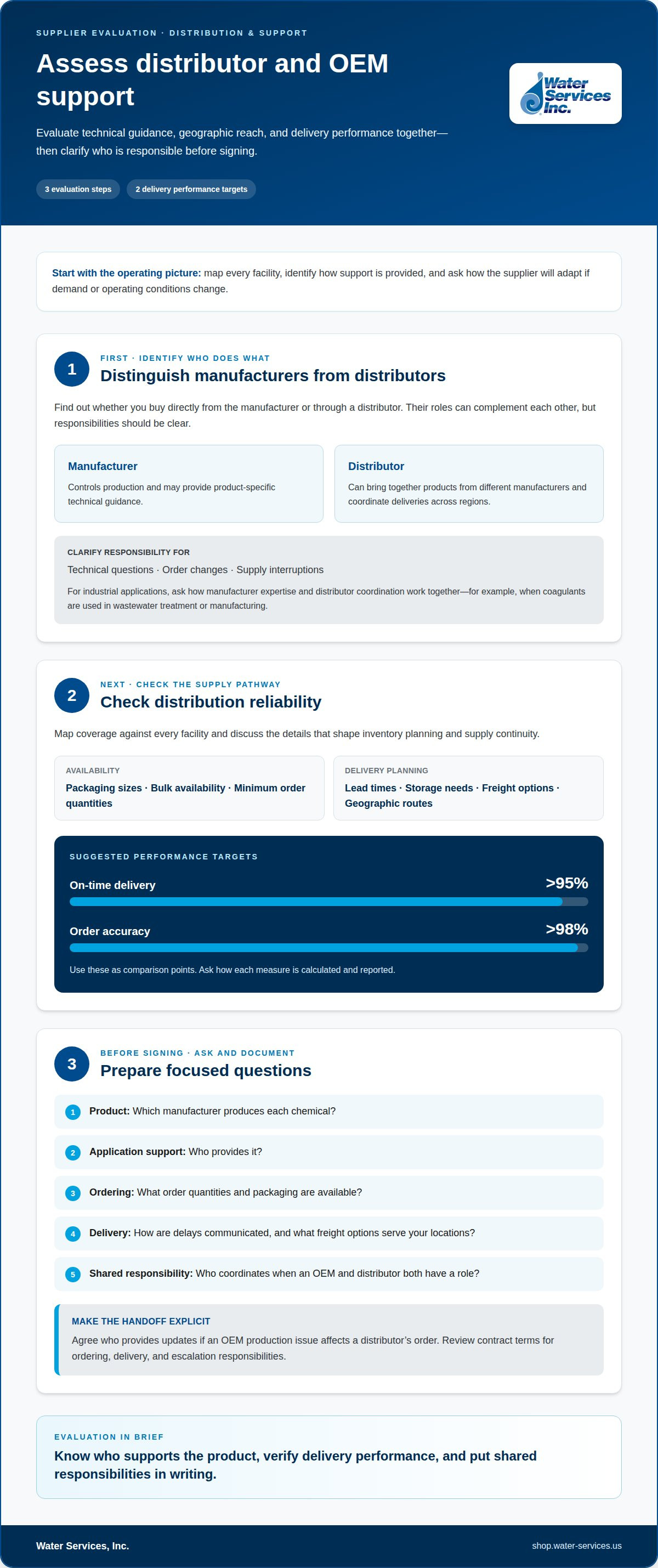
To decide how to choose a water treatment chemical supplier, assess technical support, geographic reach, and delivery performance together. Ask how support will adapt if demand or operating conditions change.
1. Distinguish manufacturers from distributors
Find out whether you’re buying directly from a manufacturer or through a distributor. Manufacturers control production and may offer product-specific technical guidance. Distributors can bring together products from different manufacturers and coordinate deliveries across regions. Ask who handles technical questions, order changes, and supply interruptions. For industrial applications, clarify how manufacturer expertise and distributor coordination work together, especially when coagulants are used in wastewater treatment or manufacturing.
2. Check distribution reliability
Map distribution coverage against every facility location. Ask about packaging sizes, bulk availability, minimum order quantities, lead times, storage needs, and freight options. These details influence inventory planning and continuity. Discuss geographic routes and how the supplier handles deliveries to each site. For facilities sourcing chemicals or treatment components internationally, working with an experienced trade compliance provider like Global4PL can ensure seamless cross-border freight and customs clearance. Use the suggested performance targets as comparison points: on-time delivery above 95% and order accuracy above 98%. Ask how the supplier calculates and reports these measures.
3. Prepare questions before signing
A practical way to understand how to choose a water treatment chemical supplier is to ask focused questions before signing. Which manufacturer produces each chemical? Who provides application support? What order quantities and packaging are available? How are delays communicated, and what freight options serve your locations? Clarify who coordinates when an OEM and distributor share responsibility. For example, agree on who provides updates if an OEM production issue affects a distributor’s order. Review contract terms for ordering, delivery, and escalation responsibilities. Compare water treatment chemical options with your procurement needs.
Chemical regulation and environmental impacts
Assess each chemical for its application, discharge conditions, and handling requirements. These vary between drinking water, cooling systems, and wastewater treatment.
- Map the applicable requirements for each treatment application. Identify whether water is used for drinking, cooling, or industrial wastewater treatment. The U.S. Environmental Protection Agency proposed allowing qualifying systems to request an additional two years, extending the requested compliance date to 2031 for federal PFOA and PFOS limits. Treat that proposal as specific to those contaminants and qualifying systems, not as a general chemical approval. Ask how the supplier identifies products for your intended use.
- Match the chemical to the water and treatment objective. Identify the contaminants the process must remove and the discharge conditions it must meet. The right choice depends on source-water chemistry, system configuration, and existing treatment stages. In cooling applications, consider potential effects on equipment and downstream water management. Don’t choose a product based on its general category alone.
- Review safety documentation before approving a purchase. Obtain the product-specific Safety Data Sheet, handling instructions, storage recommendations, and relevant certification records. Make sure the documents identify the product being supplied and support its intended application. For example, operators handling an aluminum-based treatment chemical need clear product and handling information for their procedures. Keep applicable documents accessible to purchasing, operations, and safety personnel.
- Clarify the supplier’s regulatory support. Ask how it communicates changes that affect product documentation, intended applications, or conditions of use. Find out who provides current safety information and answers questions about product suitability. For wastewater treatment, connect chemical selection to pollutant levels, pH, and discharge requirements. Record responsibilities so procurement and plant teams work from consistent information.
Safety data sheets and product specifications
In the United States, chemical and supplier-service costs depend on the product, application, order quantity, packaging, freight, and technical support. Compare itemized quotes based on identical requirements. Product documentation and controlled testing also help establish whether a chemical suits your process.
-
1. Review product specifications and documentation
Match each specification to the treatment process and intended water use. Review concentration, physical form, storage recommendations, and handling instructions alongside the Safety Data Sheet. Request quality-control information, traceability details, and an applicable Certificate of Analysis for the supplied product. For drinking water or industrial water applications, confirm that product documentation addresses the intended use. Keep current records accessible to purchasing, operations, and safety teams at each facility.
-
2. Evaluate compatibility and treatment performance
Assess compatibility using your water chemistry, existing treatment stages, and equipment materials. Consider wastewater composition, pollutant concentrations, pH, and discharge requirements. Ask how the chemical may interact with other process inputs. For example, coagulants and flocculants aggregate suspended solids, supporting subsequent filtration. Test a sample under representative operating conditions before placing a bulk order. Record the treatment results and any observed effects on downstream filtration or process equipment.
- Compare supplier products and services with the needs of your facilities. A supplier may offer chemicals for distinct applications, while technical support can vary by product and process. Identify which products address your treatment objective and what documentation or application guidance comes with them. For example, a wastewater operation may need chemical options that work with its existing clarification and filtration stages. Compare specifications and support scope, not just catalog breadth.
Supplier expertise and integrated treatment solutions
Assess whether technical guidance connects chemical selection to your complete treatment process. Ask for relevant references and practical examples, not general claims.
-
1. Assess supplier expertise
Describe your water quality, process goals, and existing treatment stages. Ask how the supplier evaluates interactions between chemicals, membranes, and filtration equipment. For example, pretreatment chemicals can help limit membrane fouling in reverse osmosis systems. Discuss how dosing decisions may change with source-water conditions. The supplier should explain the reasoning behind a proposed treatment program and identify where disinfectants fit. For municipal, industrial, or process-water applications, prioritize guidance tailored to the operating context.
-
2. Check references and track record
Request references from customers with comparable applications, such as industrial wastewater or municipal treatment. Ask which process the supplier supported, what treatment challenges arose, and how its technical role was defined. To assess experience, look for documented examples involving similar systems rather than broad assurances. Ask how the supplier monitors water-quality changes and adjusts recommendations. References are most useful when they reflect comparable treatment goals and equipment. For technical specialists traveling internationally to evaluate reference facilities or inspect operations firsthand, Atlas eSIM provides reliable mobile data to stay seamlessly connected abroad.
- Evaluate how the supplier considers the whole system. A chemical can affect downstream filtration, membrane performance, and process stability. Ask how recommendations account for existing equipment and treatment stages. For example, discuss whether chemical pretreatment fits the filtration steps already installed. This helps show whether the supplier understands integrated treatment instead of viewing each product in isolation.
- Connect recommendations to an operating plan. Ask who interprets process data, communicates changes, and supports dosing adjustments as water quality shifts. Clarify what information the supplier needs to assess the system, such as source-water characteristics and treatment objectives. Use the discussion to determine whether its technical approach fits your facility’s operation. You can review water treatment chemical options alongside your process requirements.
Water Services, Inc.: Water Treatment Antiscalants and Chemicals
Water Services, Inc. offers water treatment antiscalants and chemicals for treatment programs where mineral scale can threaten reverse-osmosis membrane performance. Antiscalants help prevent mineral buildup, making them relevant when membrane scaling is a concern. Water Services, Inc. also offers Hydranautics RO membranes, Goulds Water Technology pumps, and Viqua UV water purification systems for related treatment requirements.
Use your process conditions, water chemistry, and existing equipment to determine whether antiscalant products fit your application. For product options, explore water treatment chemicals. If you’re evaluating chemical supply for a reverse-osmosis or broader water-treatment system, contact Water Services, Inc. to discuss your requirements.
Turn your requirements into a clear next step
Before deciding what to buy, bring your process priorities together in a concise specification. Record the treatment objective, system constraints, and equipment the chemical program must support. This gives your team a practical basis for discussing product fit and related equipment, rather than assessing a chemical in isolation. A structured brief also makes it easier to compare proposals with your operational needs.
Deciding how to choose a water treatment chemical supplier means finding a fit between the product and the wider system. Water Services offers Goulds Water Technology pumps, Viqua UV water purification systems, and FilmTec reverse osmosis membranes alongside water treatment chemicals. These products may suit projects that also require pumping, UV treatment, or reverse osmosis.
Discuss supplier support with Water Services and take the next step with a clear view of your treatment requirements.
Frequently Asked Questions
What water treatment chemicals does a supplier offer for different applications?
Product ranges vary by treatment objective and water source. Municipal clarification and industrial wastewater treatment may use coagulants and flocculants to aggregate suspended material. Reverse osmosis systems may use antiscalants to help limit mineral buildup, while other processes use disinfectants or pH adjusters. Match the chemical category to the process stage and intended outcome rather than relying on a broad product label.
How do you verify a water treatment chemical supplier’s certifications and regulatory compliance in the US?
Match each certification to the product and intended application, then review its scope and issuing organization. For drinking water chemicals, NSF/ANSI/CAN 60 sets health-effects requirements. ISO 9001 concerns a quality-management system; according to the International Organization for Standardization, it does not establish that each product suits every application. Treat management-system certification and product-specific suitability as separate checks.
What US regulations apply to purchasing and handling water treatment chemicals?
Applicable requirements depend on the chemical’s intended use, the treatment system, and the site’s discharge conditions. For chemicals used to treat drinking water, NSF/ANSI/CAN 60 addresses health-effects requirements. That standard does not cover every purchasing or handling consideration. Identify the application and operating location first, then determine which federal, state, and local requirements apply to that specific process.
How do you compare water treatment chemical suppliers on product quality and technical support?
A practical way to choose a water treatment chemical supplier is to give each candidate the same process scenario, such as a change in source-water chemistry, and compare its reasoning. Look for relevant quality-control records and batch traceability. Assess whether the technical explanation accounts for your treatment objective and system constraints, rather than relying on a general product description.
How do you assess a supplier’s delivery reliability, inventory, and emergency response?
When choosing a water treatment chemical supplier, assess supply plans against the needs of each facility, not just standard order conditions. Ask how inventory is allocated across sites, how seasonal demand changes are handled, and how delayed shipments are communicated. Define the escalation path for an urgent shortage, including who provides updates and identifies available alternatives.
What safety data sheets, labels, and handling guidance should a chemical supplier provide?
Expect a current, product-specific Safety Data Sheet, clear container identification, and storage and handling recommendations. When receiving a shipment, match the product name and identifier on the container to its accompanying documentation. Keep documents accessible where the chemical is stored and used. If the product or supplier changes, update site records so operators can refer to instructions for the material on hand.
0 comments