

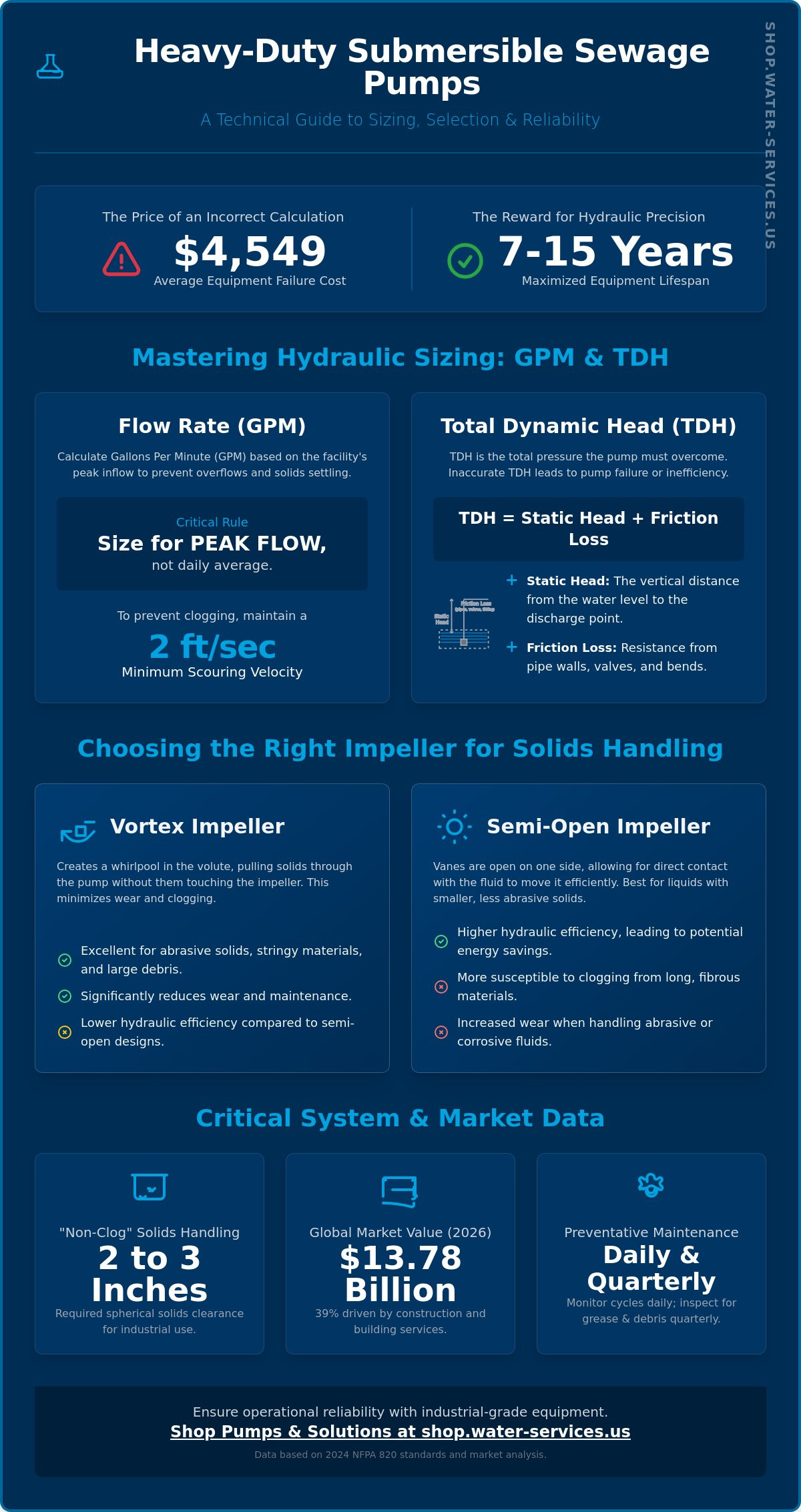
The global market for submersible pumps is valued at $13.78 billion in 2026, with the construction and building services segment accounting for 39% of that demand. Despite this massive scale, the difference between a reliable system and a $4,549 equipment failure often rests on a single hydraulic calculation. You understand that frequent clogging and downtime aren't just inconveniences; they're operational risks that compromise your facility's efficiency. Managing heavy-duty submersible sewage pumps requires a no-nonsense approach to technical precision and industrial reliability.
This guide will help you master the essentials of sizing, installing, and maintaining these critical systems for dependable wastewater management. We'll clarify the confusion between GPM and Head while incorporating the 2024 NFPA 820 standards for fire protection. You'll learn how to select the correct impeller for solids handling and establish a preventative maintenance routine that maximizes the 7 to 15 year lifespan of your equipment. By focusing on hydraulic precision, you can ensure your Goulds Water Technology systems operate without catastrophic failure.
Key Takeaways
- Identify the core mechanics of heavy-duty centrifugal pumps and their hermetically sealed underwater motor designs.
- Calculate Total Dynamic Head (TDH) and Flow Rate (GPM) to prevent system failure due to inaccurate hydraulic sizing.
- Prepare for installation by verifying basin dimensions and electrical supply compatibility for heavy-duty submersible sewage pumps.
- Establish a preventative maintenance routine that includes daily cycle monitoring and quarterly inspections for grease and debris buildup.
- Leverage Goulds Water Technology and modular containerized solutions to maintain equipment reliability in remote or harsh industrial environments.
What are Submersible Sewage Pumps and How Do They Work?
Submersible sewage pumps are specialized centrifugal units engineered to function while fully submerged in the fluid they transport. Unlike standard water pumps, these heavy-duty machines feature a hermetically sealed motor directly coupled to the pump body. This design prevents the ingress of wastewater into the electrical windings, allowing the unit to remain at the bottom of a wet well or basin indefinitely. Using a submersible pump for sewage pumping is standard practice in municipal and industrial lift stations because it eliminates the need for long drive shafts and suction lift issues common in dry-pit configurations. The waterproof casing, typically constructed from heavy-cast iron or stainless steel, acts as a heat sink, using the surrounding liquid to cool the motor during high-demand cycles.
It's vital to distinguish these from other wastewater equipment to avoid site-specific failures. Effluent pumps handle liquid that has already been settled and only contain small solids. Grinder pumps utilize a cutting mechanism to macerate solids into a fine slurry before discharge. In contrast, heavy-duty submersible sewage pumps move raw sewage and large solids through a wide discharge without pre-processing. This capability is essential for industrial basins where influent contains unpredictable debris that would easily stall smaller, less robust units.
The Role of Solids-Handling Engineering
Industrial sewage management requires equipment that can process spherical solids ranging from 2 to 3 inches in diameter. The "non-clog" designation is the most critical feature of these systems. A non-clog pump is defined by its ability to pass a specific diameter of solid material through its internal passages without making contact with the impeller vanes or obstructing the flow. This engineering ensures that fibrous materials, which account for a high percentage of system failures in aging infrastructure, don't wrap around the rotating assembly. Reliable submersible sewage pumps prioritize these wide internal clearances to maintain flow consistency even when the waste stream is heavily loaded with particulates.
Centrifugal Force and Impeller Types
The movement of heavy slurry depends on centrifugal force generated by the impeller. For industrial applications, you must choose between vortex and semi-open impellers based on your specific waste stream. Vortex impellers create a whirlpool effect in the volute that keeps solids away from the impeller itself, which significantly reduces abrasive wear. Semi-open impellers offer higher hydraulic efficiency but are more susceptible to clogging if the waste stream contains long, stringy debris. Material selection also impacts the equipment lifecycle. While cast iron is the standard for general municipal use, stainless steel is necessary for corrosive industrial environments where pH levels fluctuate. Precise engineering prevents cavitation and ensures the discharge port maintains consistent pressure during peak flow periods.
How to Size and Select a Sewage Pump for Your Facility
Selecting industrial submersible sewage pumps is a technical process that dictates the long-term reliability of your wastewater system. Guessing at horsepower or relying on residential-grade logic often leads to catastrophic failure in harsh environments like mining or chemical processing. You must evaluate the specific hydraulic demands of your facility to ensure the equipment operates within its intended design parameters. Precision in the selection phase is the only way to avoid the frequent maintenance cycles that plague poorly planned lift stations.
Calculating GPM and Peak Flow
You must determine the Gallons Per Minute (GPM) based on the peak inflow of your facility rather than the daily average. For an industrial site, this calculation involves measuring the maximum discharge from production processes and staff facilities simultaneously. If you don't size for peak flow, the wet well will overflow during high-production cycles. A critical factor in this calculation is "scouring velocity." To prevent heavy solids from settling and clogging your discharge lines, the pump must move fluid at a minimum rate of 2 feet per second (fps) through the entire pipe run.
Understanding TDH and Pump Curves
Total Dynamic Head (TDH) represents the total pressure the pump must overcome to move fluid from the basin to the discharge point. It consists of the static head, which is the vertical distance the fluid travels, and friction loss caused by the pipe walls, valves, and fittings. You can determine friction loss by consulting industry-standard tables for pipe diameter and material type. After calculating your required TDH and GPM, you must plot these coordinates on the manufacturer's performance curve. The objective is to select a pump where your duty point falls as close as possible to the Best Efficiency Point (BEP). Operating too far to the left or right of the BEP causes premature failure because it subjects the pump shaft and bearings to uneven hydraulic forces and excessive vibration.
Electrical requirements are equally vital for industrial reliability. While 115V or 230V single-phase power is sufficient for light commercial use, heavy industrial sites usually require 460V 3-phase systems. These high-voltage setups provide the necessary torque to handle heavy solids and offer better energy efficiency for continuous-duty applications. If you need to upgrade your current infrastructure, you can view our selection of heavy-duty pumps to find a model that matches your facility's electrical and hydraulic profile.
Step-by-Step: How to Prepare for Pump Installation
Proper preparation for the installation of submersible sewage pumps prevents 90% of early-stage system failures. You must first verify that the basin dimensions provide adequate clearance for both the pump footprint and the full arc of the float switches. In a standard industrial duplex configuration, a 48 inch diameter basin is typically the minimum requirement to prevent mechanical interference between units. You should also inspect the discharge piping for structural integrity. Every installation requires a dedicated check valve and a full-port shut-off valve located outside the wet well to prevent backflow and facilitate future maintenance.
Venting is a critical but often overlooked step in the preparation process. A sewage basin must be vented to the atmosphere to prevent airlock. This condition occurs when air becomes trapped in the pump volute and prevents the impeller from moving liquid. Proper venting also manages the accumulation of hydrogen sulfide gases. These gases are highly corrosive to electrical components and present a significant safety risk to personnel during inspections. Ensure the vent pipe diameter matches the requirements of your local plumbing code, which usually specifies a minimum of 2 inches for industrial basins.
Basics of Basin and Rail Systems
For deep industrial pits, guide rail systems are the standard for efficient maintenance. These systems allow you to raise or lower the pump along stainless steel pipes, automatically engaging the discharge flange at the bottom. This setup eliminates the need for personnel to enter the basin, which is a significant safety advantage in hazardous environments. When preparing a concrete or fiberglass pit for these heavy industrial loads, ensure the floor is level and reinforced to handle the weight of the hardware. You can find the necessary rail system hardware and pump accessories in our curated industrial catalog.
Electrical and Control Panel Setup
Wiring for submersible motors must comply with local codes for hazardous locations. This often requires explosion-proof seals if the basin is classified as Class I, Division 1 under NFPA 70 standards. You must set float switch levels with precision to manage pump cycles effectively. The "Off" float should be positioned to keep the motor housing submerged for cooling. The "Lead" and "Lag" floats trigger the first and second pumps during peak flow, while the "High Alarm" float provides a final warning of potential overflow. Managing these multi-pump lift stations requires robust electric power controls and sensors designed for high-frequency industrial duty cycles. Verify that your control panel's voltage and phase match the pump's technical specifications before final termination.
How to Troubleshoot and Maintain Sewage Pumps
Establishing a rigorous maintenance schedule is the only way to prevent the $4,549 equipment failures common in high-demand industrial environments. Daily monitoring should focus on two primary metrics: pump cycle frequency and motor amp draw. A sudden increase in amp draw often indicates a mechanical bind or an impeller obstruction. Conversely, short-cycling suggests a failing check valve or a misplaced float switch. You should conduct a comprehensive basin inspection every 90 days to remove grease caps and debris that accumulate in stagnant areas. For remote mining or military sites, these inspections are mandatory to ensure submersible sewage pumps remain operational in locations where logistical support is limited.
Early detection of seal failure is critical for protecting the motor windings. Most industrial units feature a dual mechanical seal with a moisture-sensing probe. If the control panel triggers a seal-fail alarm, you must pull the pump immediately to inspect the oil chamber for emulsification. Ignoring this warning leads to a total motor burnout, which is significantly more expensive than a standard seal replacement kit. If you need replacement parts or technical support, shop our full range of industrial sewage pumps and parts to restore your system's integrity.
Common Issues: Clogging and Airlock
Airlock occurs when air becomes trapped in the pump volute, preventing the impeller from creating the necessary pressure to move fluid. The primary symptom is a motor that runs at the correct RPM but produces zero flow. You can solve this by drilling a 1/8 inch to 3/16 inch weep hole in the discharge pipe between the pump and the check valve. This hole allows trapped air to escape when the basin refills. Clogging remains the most frequent cause of downtime, particularly when "flushable" wipes or fibrous industrial waste enter the system. To clear a clog, you must disconnect the power and rotate the impeller backward to dislodge the material. Don't use pry bars on the impeller vanes, as this can bend the motor shaft and cause permanent vibration issues.
Managing Harsh Environments
Mining wastewater often contains high concentrations of abrasive solids that can reduce impeller efficiency by 12% to 15% within the first six months of operation. You must use hardened cast iron or high-chrome impellers in these settings to resist surface erosion. Always wear appropriate personal protective equipment (PPE) when servicing any part of the wastewater stream to protect against biological hazards and corrosive chemicals. Understanding these mechanical challenges is part of a broader strategy for Industrial Water Treatment Systems, where equipment durability dictates the success of the entire facility. Consistent troubleshooting ensures your submersible sewage pumps meet their 15-year lifecycle target even in the most aggressive site conditions.
Industrial-Grade Solutions: The Water Services Advantage
Operational success in industrial wastewater management depends on the integration of high-quality hardware and precise engineering support. Water Services, Inc. operates from its headquarters in Provo, Utah, providing a centralized hub for technical expertise and global logistics. We specialize in the procurement and deployment of submersible sewage pumps that meet the rigorous demands of the mining, oil and gas, and municipal sectors. Our approach focuses on technical integrity and industrial reliability, ensuring that every component in your system contributes to a lower total cost of ownership over its 15-year service life.
For remote sites where infrastructure is limited, we offer modular and containerized wastewater systems. These units are engineered for rapid deployment and come pre-configured with all necessary filtration, pumping, and control hardware. This "plug-and-play" capability is essential for military installations and remote mining camps that require immediate compliance with environmental regulations. By centralizing the engineering process in Utah, we maintain strict quality control over the hydraulic and electrical specifications of every plant we ship worldwide.
Goulds Pumps: Built for 2026 Standards
Goulds Water Technology remains the industry standard for reliable sewage movement in 2026. Industrial buyers prioritize Goulds for critical infrastructure because of their heavy-duty cast iron construction and robust dual mechanical seal designs. These features provide a necessary barrier against the abrasive and corrosive fluids common in industrial waste streams. When you integrate these pumps with our wider range of water treatment equipment, you create a cohesive system where every valve, sensor, and membrane works in hydraulic harmony. This technical synergy reduces the risk of cavitation and premature motor failure.
Global Reach and Technical Support
Our logistical capabilities allow us to support projects in diverse geographic locations, including frequent shipments to Africa and the Middle East. We don't just supply hardware; we provide project-based engineering that adapts to the specific water chemistry of your site. This is particularly vital for Mining Wastewater Treatment Solutions, where resource recovery and regulatory compliance are top priorities. Our team analyzes your influent data to recommend the exact pump metallurgy and impeller design required to handle high-solids content without clogging. This level of specialization ensures that your facility remains operational regardless of its distance from a major metropolitan center.
Optimizing Industrial Wastewater Infrastructure
Mastering the technical requirements for industrial wastewater management ensures your facility avoids the high costs of unplanned downtime. Accurate hydraulic sizing and a rigorous preventative maintenance schedule are not optional for sites handling 2 to 3 inch solids. By matching your duty point to the Best Efficiency Point on a pump curve, you protect the mechanical integrity of your submersible sewage pumps for their full 15-year lifecycle. Correct installation prep prevents the airlock and clogging issues that stall production.
Water Services, Inc. provides the engineering expertise and high-quality hardware required for these demanding environments. As an authorized Goulds Water Technology distributor, we offer equipment built to the highest industrial standards. We provide expert engineering support and facilitate global shipping from our headquarters in Provo, Utah. It's our priority to deliver precise solutions for your most complex wastewater challenges. Shop High-Performance Submersible Sewage Pumps today to secure the operational reliability your facility requires. We look forward to supporting your next project.
Frequently Asked Questions
What is the difference between a sewage pump and a grinder pump?
Sewage pumps move raw waste through large internal clearances, typically handling 2 or 3 inch spherical solids without pre-processing. Grinder pumps use a rotating cutting blade to shred solids into a fine slurry before discharge through a smaller port. You should choose a sewage pump for high-volume flow requirements and unobstructed discharge paths. Grinder pumps are better for high-pressure, low-flow applications where waste must travel through small-diameter pipes over long distances.
How long do submersible sewage pumps typically last in industrial settings?
Industrial submersible sewage pumps typically last between 7 and 15 years. This lifespan depends heavily on the abrasive content of the waste stream and the frequency of preventative maintenance. Pumps in mining environments may require impeller replacements every 24 months due to erosion from grit. Consistent monitoring of motor amp draw and quarterly basin cleaning can extend the total service life toward the 15-year upper limit.
Can a sewage pump handle large solids like rocks or metal debris?
No, sewage pumps aren't designed to process inorganic debris like rocks, gravel, or metal fragments. While they manage organic solids and soft waste, hard objects will chip the impeller vanes or jam the rotating assembly. This leads to a locked rotor condition and potential motor burnout. You must install a bar screen or grit trap upstream of the basin to protect the pump from heavy inorganic materials.
What happens if my submersible pump runs dry?
Running a submersible pump dry causes rapid overheating and catastrophic seal failure. These motors rely on the surrounding liquid to dissipate heat generated during operation. Without this cooling medium, internal temperatures exceed the thermal limits of the motor windings and mechanical seals. Most industrial control panels use float switches or sensors to ensure the pump shuts off before the liquid level drops below the motor housing.
How do I know if I need a 3-phase pump for my facility?
You need a 3-phase pump if your facility operates on 208V, 230V, or 460V industrial power and requires high starting torque. 3-phase motors are more efficient and reliable for continuous-duty applications compared to single-phase models. They don't require start capacitors, which are a common point of failure in wastewater systems. If you're moving heavy slurries or high volumes of influent, 3-phase equipment is the industrial standard.
What is a "check valve" and why is it mandatory for sewage pumps?
A check valve is a mechanical device that allows fluid to flow in only one direction. It's mandatory because it prevents the wastewater in the discharge pipe from draining back into the basin once the pump stops. Without it, the pump would have to move the same volume of liquid repeatedly, leading to short-cycling and premature motor wear. It also protects the system from water hammer during shut-off cycles.
How often should I pull my pump for a full inspection?
You should pull the pump for a full physical inspection at least once every 12 months. In harsh sites with high abrasive or corrosive content, semi-annual inspections are recommended. This process involves checking the oil chamber for moisture, inspecting the impeller for surface wear, and verifying the integrity of the power cable entry. Regular inspections identify minor seal leaks before they result in a total motor failure.
Does Water Services, Inc. ship submersible pumps internationally?
Yes, Water Services, Inc. provides international shipping for all industrial equipment from our headquarters in Provo, Utah. We support global projects across diverse regions, including Africa and the Middle East. Our logistics team handles the technical documentation required for international transit to ensure your submersible sewage pumps arrive on schedule. We also provide engineering support to ensure the selected equipment meets the specific electrical and hydraulic standards of your project location.
0 comments