

The media selected for a contaminant may still be the wrong fit for the water. Selecting the right filter media for water treatment means looking beyond a product category or contaminant name. Influent chemistry, treatment goals, flow conditions, pressure loss, backwash capacity, and vessel compatibility all affect whether a choice will work at a specific site.
It’s understandable to start with the contaminant you need to address. But a poor match can increase operating demands, shorten replacement intervals, or create maintenance issues downstream. A sound decision accounts for both water quality and the system that will contain and operate the media.
This guide compares common media by treatment duty and explains what water-quality and operating data to collect before specifying one. You’ll learn how to build a practical shortlist, assess performance and maintenance requirements, and check compatibility with the filter vessel and wider process. The goal is a selection based on site conditions, not a product label alone.
Key Takeaways
- Start with the treatment duty: particle filtration, adsorption, and iron or manganese removal require different approaches.
- Compare silica sand, anthracite, garnet, and activated carbon by their operating mechanisms and application requirements, not as interchangeable options.
- Use influent chemistry, flow, treated-water targets, vessel design, and backwash capacity to guide selecting the right filter media for water treatment.
- Follow a structured selection workflow, then confirm media specifications and design assumptions with the supplier before specifying the system.
- After choosing the media, check compatibility with the vessel and its internals. Multimedia filter tanks and replacement sediment and carbon filters are equipment categories to consider where appropriate.
Selecting filter media for water treatment starts with the treatment objective
Filter media is the material inside a treatment vessel that retains particles, adsorbs selected compounds, or supports another specified removal process. Media is the treatment material; a filtration system is the complete assembly that contains, distributes, and operates it. That distinction matters: even a suitable material may not deliver the intended result if the vessel, flow path, or operating conditions are a poor match.
Start with the required treated-water quality and the next process step, not a media label. Particle filtration targets suspended material. Adsorption addresses selected compounds through interaction with the media surface. Iron or manganese removal may depend on water chemistry and the treatment process, so don’t assume particle straining alone will do the job. Confirm the mechanism and operating conditions for each treatment duty.
Which water-quality problem must the media address?
Use current influent and treated-water analyses to identify the constituents that need control. Suspended solids and turbidity describe particles in the water; taste-and-odor compounds may require a different treatment mechanism. Dissolved contaminants also need specific consideration because media chosen to capture particles may not remove them. Before shortlisting media, define the target, expected variability, and required effluent quality. Don’t promise a removal outcome without checking the mechanism and conditions against supplier documentation.
How does the treatment train affect media selection?
Map the process from pretreatment through media filtration, disinfection, and downstream treatment, where applicable. Upstream chemistry can affect media performance, while downstream membranes may have feed-water requirements that shape pretreatment choices. A filter that reduces one constituent may not address the next process’s limiting concern. For a broader view of process integration, see this industrial water treatment systems guide.
For example, if filtration protects a downstream membrane, first define the feed-water quality that membrane stage requires. The objective is not simply to make water look clearer; it’s to deliver water suited to the next operation. A media filter may use single, dual, or multiple media layers, but the arrangement alone doesn’t establish suitability. Confirm the media’s function and system requirements for the specific application.
Once the treatment duty and operating requirements are clear, equipment sourcing becomes a system-fit question. Water Services, Inc. offers water treatment equipment, including multimedia filter tanks. Check vessel and process integration alongside the selected media rather than treating the media choice as a standalone decision.
How common water-treatment filter media differ in operation
Media choices serve different functions. Sand, anthracite, and garnet are granular materials used in particle filtration, while activated carbon is selected for adsorption of specific compounds. A layered bed may combine granular media, but its performance depends on media grading, bed configuration, vessel design, and operating conditions. The common water treatment methods described by the University of Georgia Cooperative Extension also distinguish mechanical filtration from activated-carbon and oxidizing-filter approaches.
Media suitability depends on contaminant form and system conditions, not the media name alone.
| Media | Primary mechanism | Potential duty | Operating needs and limitations |
|---|---|---|---|
| Silica sand | Particle straining and depth filtration | Suspended-solids reduction in a granular bed | Requires a compatible bed and backwash design. Performance depends on particle characteristics and operating conditions; it isn’t a general solution for dissolved compounds. |
| Anthracite | Particle capture in a granular bed | Often considered as a layer in dual- or multimedia filtration | Suitability depends on its grade and relationship to other bed layers. Confirm the configuration and hydraulic requirements for the vessel. |
| Garnet | Particle capture within a layered bed | May be combined with other granular media in multimedia filtration | Its role depends on bed grading and design. Don’t assume it can replace another layer or operate effectively in any vessel. |
| Activated carbon | Adsorption onto the media surface | Selected taste-and-odor compounds or other target compounds, subject to verification | Confirm target compounds, water chemistry, and operating conditions. Adsorption is distinct from particle capture, and effectiveness must be supported by application data. |
When are granular and multimedia beds considered?
As water passes through granular media, particles may be retained at the surface or within the bed. Sand, anthracite, and garnet can be combined in a layered arrangement to support particle filtration. The bed is a designed assembly, not a mix-and-match recipe. Before specifying it, verify media grades, layer arrangement, vessel dimensions, distributor design, and backwash criteria.
When might activated carbon or specialty media be considered?
Consider carbon when the treatment objective involves compounds suited to adsorption. Then confirm the target through water testing and supplier data. Evaluate specialty media with the same care: require evidence that its mechanism fits the water chemistry and operating conditions. Confirm media specifications and current availability before purchase.
For a process-level comparison, review industrial water-treatment equipment after defining the duty and system requirements. Matching the media to the vessel and process is part of selecting the right filter media for water treatment.
Compare filter media using water chemistry and operating requirements
A media shortlist is useful only if it fits the water and the plant’s operating range. For selecting the right filter media for water treatment, compare each candidate against representative influent data, required treated-water quality, hydraulic limits, and maintenance capacity. Separate verified specifications from design assumptions: supplier documentation describes the media, while site analyses and testing help show how it may perform under actual conditions.
Which water and process data should buyers collect?
Gather laboratory analyses that represent normal operation, and record known seasonal or process-related changes. Include pH, temperature, target constituents, and suspended-solids or turbidity data where relevant. A single sample may not represent the conditions the filter must handle.
- Operating duty: Record minimum, normal, and peak flow, operating hours, and acceptable pressure loss.
- Water-quality target: Document the required effluent quality and confirm it with the project team responsible for downstream equipment.
- System fit: Check vessel dimensions and distributor design. Confirm that available backwash capacity matches the proposed bed design.
These details expose trade-offs. A media option that appears suitable at normal flow may not fit peak demand or the downstream process’s water-quality requirements. Check assumptions against site data and supplier specifications before treating a proposed performance value as established.
How do maintenance and lifecycle needs change the comparison?
Compare pressure loss and solids loading alongside expected media attrition and replacement triggers. Ask what conditions indicate that the media needs attention, and request support for any stated service-life or performance expectation. Check backwash water supply, drainage capacity, and how much downtime the operation can accommodate. Also evaluate disposal requirements for spent media against the site’s handling procedures.
Chemical conditioning can affect operation, depending on the application. Confirm whether upstream or in-process chemical use changes media requirements, and consult the water-treatment chemicals integration guide for broader process considerations.
For a defensible comparison, label each input as a measured site result, a supplier-confirmed specification, or an assumption that still needs verification. This makes information gaps visible before the media is specified and helps focus follow-up testing on conditions that could change the selection.
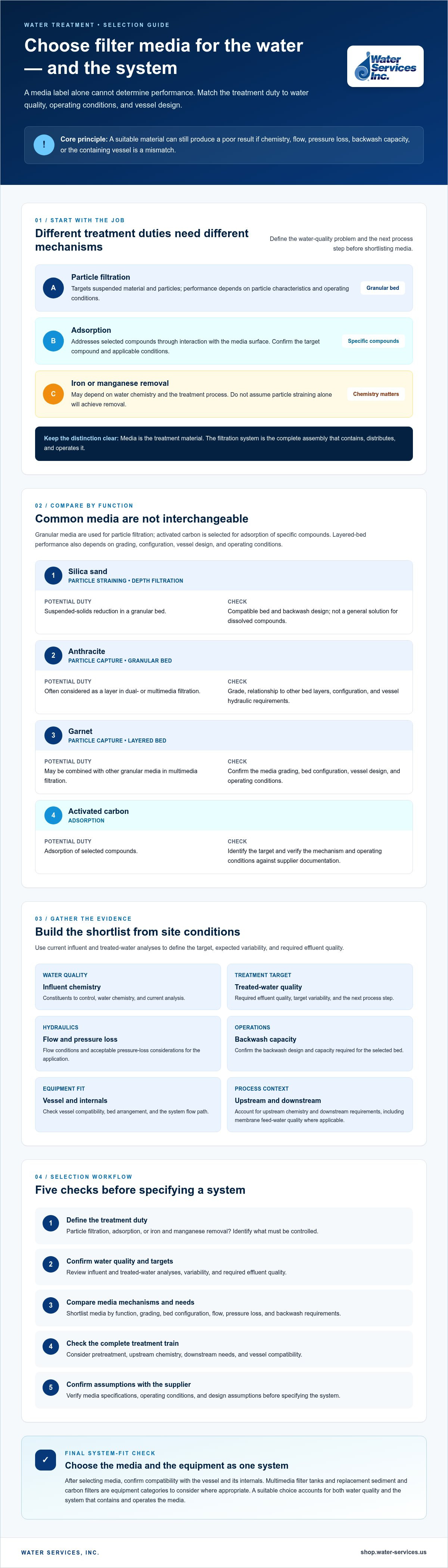
Use this filter-media selection checklist before specifying a system
A documented selection process separates measured facts from assumptions. Use this workflow to move from treatment need to a specification that suppliers and the project team can review. Final sizing and performance expectations require application-specific design validation.
- Define the treatment objective. State the target constituents and required treated-water quality. Identify how the filtered water will be used or what process follows.
- Compile site data. Collect representative water analyses and note seasonal or operational variability. Record flow range, peak demand, operating hours, acceptable pressure loss, and available backwash capacity.
- Shortlist media by duty. Match each candidate’s documented mechanism to the target and operating conditions. Don’t assume a media category alone establishes removal performance.
- Check system compatibility. Review the proposed vessel, dimensions, distributor design, bed configuration, flow range, and backwash conditions as one system.
- Verify assumptions before purchase. Obtain written supplier confirmation of specifications and application fit. Consider pilot testing or engineering review if the water varies materially or a treatment failure would have serious consequences.
- Plan commissioning and monitoring. Define operating procedures, monitoring points, and criteria for adjustment, replacement, or regeneration where applicable. Confirm how actual performance will be assessed against the required treated-water targets.
What should a filter-media specification include?
Document the media type and, when confirmed, grade, effective size, uniformity data, and bed depth. Include vessel details, design flow range, backwash conditions, and treated-water targets. Mark unknown values for supplier or engineer confirmation. Don’t fill gaps with generic defaults: suitable specifications depend on the media, vessel, water, and treatment duty.
How can buyers reduce selection risk before purchase?
Ask the supplier to confirm in writing that the proposed media matches the analyzed water and operating duty, and to identify the assumptions behind the recommendation. Review how operators will monitor performance and what triggers maintenance or replacement. If filtration precedes reverse osmosis, the commercial reverse osmosis selection guide can help frame process compatibility questions.
This record makes selecting the right filter media for water treatment more defensible, but it doesn’t replace application-specific review. After defining the duty, compare industrial water-treatment equipment, including multimedia filter tanks. Confirm current specifications and system compatibility before finalizing the design.
Source compatible water-treatment filtration equipment after selecting the media
Once the treatment duty and operating requirements are documented, evaluate the equipment that will contain and operate the selected media. The media bed, vessel, internal distributors, flow range, and backwash arrangement must work as a compatible system. Suitable media in an unsuitable vessel may not deliver the intended operation, and a tank by itself doesn’t guarantee contaminant removal or treated-water quality.
Water Services, Inc. supplies multimedia filter tanks and replacement sediment and carbon filters. These are equipment and filtration-component categories, not a claim that a particular media type or specification is available. Confirm current product details and compatibility with the application before sourcing.
When should buyers consider a multimedia filter tank?
Consider a tank only after the proposed bed configuration, design flow, and backwash requirements are understood. Check vessel dimensions and internal components against the media supplier’s specifications and the system design. Confirm available configurations directly rather than assuming a tank will suit a particular bed or operating duty. The tank supports the filtration process; performance depends on the complete design and site conditions.
When is broader system engineering relevant?
Engineering input may be useful where media filtration interfaces with reverse osmosis, disinfection, or process reuse. Define the upstream filter’s role in relation to downstream feed-water needs, process controls, and operating constraints. For example, if filtration precedes RO, confirm what the membrane stage requires and how the filtration step fits that duty. Water Services, Inc. designs modular treatment systems for industrial applications, where media selection depends on vessel and process integration.
For a broader view of filtration technologies and their place in a treatment train, review this industrial water filtration overview.
With water data, performance targets, and operating requirements in hand, you can compare compatible equipment more effectively. Review water-treatment equipment and verify specifications and system fit before making a final selection. Selecting the right filter media for water treatment is only part of the decision; the complete assembly must support the intended duty.
Make your media decision a system-ready specification
Effective media selection starts with the treatment objective, then checks whether each candidate suits the water chemistry, operating conditions, and required treated-water quality. Comparing mechanisms prevents treating granular filtration and adsorption as interchangeable. Reviewing flow, pressure loss, backwash capacity, and vessel compatibility helps reveal operating constraints before a specification is finalized.
Selecting the right filter media for water treatment also means verifying assumptions. Use current water data, request supplier confirmation, and seek application-specific design review when water variability or process consequences warrant it. The media, vessel, internals, and backwash arrangement must work together.
Water Services, Inc. offers multimedia filter tanks and replacement sediment and carbon filters, and designs modular water-treatment systems for industrial applications. Once your performance requirements and site data are documented, review industrial water-treatment equipment as a practical next step. Confirm specifications and system compatibility before proceeding. With a clear basis for comparison, you can move forward with greater confidence in your selection.
Frequently Asked Questions
How do I choose the right filter media for water treatment?
Choose media by matching its treatment mechanism to the target constituent, required treated-water quality, and operating limits. Start with current influent analysis, then compare candidates against flow, water chemistry, vessel design, and backwash capacity. For selecting the right filter media for water treatment, distinguish verified supplier specifications from assumptions that need testing or engineering review. Confirm the proposed media and system configuration for your application before finalizing the selection.
What is the difference between sand, anthracite, and activated carbon?
Sand and anthracite are granular media used primarily to capture suspended particles within a filter bed. They may be combined in a layered arrangement, depending on bed design and system requirements. Activated carbon works by adsorption, which differs from particle capture, and may be considered for specific target compounds after suitability is confirmed. These media aren’t interchangeable. Selection depends on the contaminant, water conditions, vessel, and operating design.
Can different filter media be combined in one vessel?
Yes, different granular media can be combined in a layered bed when the design calls for it. A multimedia bed may use materials such as sand, anthracite, and garnet, but the combination and layer arrangement must be designed for the application. Confirm media grades, bed depth, vessel dimensions, distributor design, flow, and backwash conditions with the supplier or engineer. Combining media without checking compatibility can lead to poor operation or performance.
How does water chemistry affect filter media selection?
Water chemistry helps determine whether a media’s treatment mechanism is appropriate and whether the process can operate as intended. Review representative analyses for target constituents and relevant properties such as pH and temperature. Consider seasonal or operational variability, too. Chemistry may affect adsorption or other treatment processes, while downstream equipment may have specific feed-water needs. Use site-specific data and supplier documentation to verify suitability rather than relying on a general media description.
How often does water filter media need to be replaced?
There’s no universal replacement interval. Media service life depends on media type, water quality, operating conditions, maintenance, and the supplier’s application guidance. Ask for documented replacement or regeneration triggers and monitor the system for changes in treated-water quality, pressure loss, or other specified performance indicators. Use those observations alongside supplier recommendations to establish a site-specific maintenance plan. Don’t assume a generic interval applies to your system.
Does filter media remove dissolved contaminants?
Some media may address specific dissolved compounds through adsorption or another mechanism, but ordinary particle filtration doesn’t remove dissolved contaminants simply by straining water through a bed. The right approach depends on the contaminant’s form and the media’s verified capabilities under actual operating conditions. Identify the target through water analysis, then confirm expected reduction with supplier documentation or application testing. Don’t assume a media removes a dissolved constituent based on its general category.
What information should I provide when requesting a filter-media recommendation?
Provide recent influent and treated-water analyses, target constituents, required effluent quality, and known seasonal or process variability. Include normal and peak flow, operating hours, acceptable pressure loss, vessel dimensions, distributor details, and available backwash capacity. Describe downstream equipment and relevant operating or maintenance constraints. This information helps a supplier evaluate fit and identify missing data. Ask for written confirmation of media specifications, compatibility, and the assumptions behind the recommendation.
0 comments