

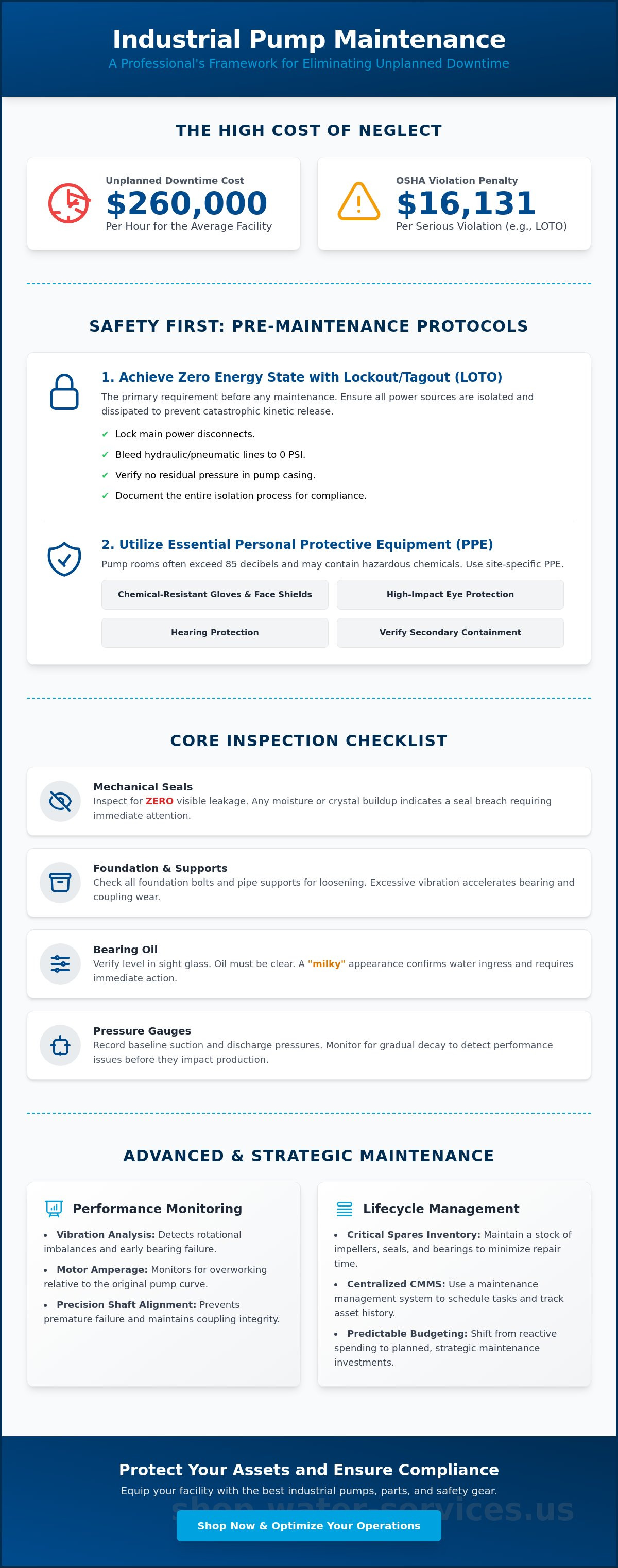
For the average industrial manufacturer in 2026, a single hour of unplanned downtime costs approximately $260,000. You recognize that reactive maintenance is an expensive liability that erodes profit margins and risks OSHA serious violation penalties, which currently stand at $16,131 per occurrence. Maintaining specialized centrifugal pumps or RO systems in remote sites requires a shift from basic visual rounds to data-driven technical oversight. Utilizing a comprehensive pump maintenance checklist for industrial facilities is essential for protecting your mechanical assets and ensuring continuous production flow.
This guide provides a professional-grade framework to eliminate unplanned downtime through systematic inspection and strategic parts management. You'll gain a technical roadmap for monitoring critical performance metrics across equipment like Goulds Water Technology Pumps and FilmTec membranes. We detail specific protocols for bearing vibration analysis, mechanical seal integrity, and the calibration of Ashcroft pressure gauges. Following this structured approach results in extended equipment lifespan, predictable maintenance budgets, and total regulatory compliance within your facility.
Key Takeaways
- Establish rigorous Lockout/Tagout protocols to reach a Zero Energy State across all hydraulic, pneumatic, and electrical power sources before inspection.
- Implement a standardized pump maintenance checklist for industrial facilities to identify abnormal mechanical seal leakage and foundation instability during daily visual rounds.
- Execute precision shaft alignment and component-level inspections to prevent premature bearing failure and maintain coupling integrity.
- Utilize vibration analysis and motor amperage monitoring to detect rotational imbalances or overworking relative to the original equipment pump curve.
- Optimize operational uptime by maintaining a technical inventory of critical spares, including impellers and seals, integrated with a centralized CMMS.
Pre-Maintenance Protocols: Safety and Regulatory Compliance
Establishing a "Zero Energy State" is the primary requirement before executing any item on a pump maintenance checklist for industrial facilities. This state ensures that all energy sources, including electrical, hydraulic, and pneumatic, are completely dissipated. Failure to isolate these systems leads to catastrophic kinetic release. Proper Lockout/Tagout (LOTO) protocols must be strictly enforced. This involves physically locking the main power disconnects and bleeding down pressurized lines to zero PSI. Technicians must verify that no residual pressure remains in the pump casing before loosening any bolts.
Understanding Centrifugal Pump Principles is vital during this phase. The impeller can act as a stored energy source if the fluid column isn't properly drained or if backflow occurs. In 2026, OSHA increased enforcement for LOTO violations, with serious penalties reaching $16,131. Documentation of the isolation process isn't optional. It's a regulatory mandate that protects both the technician and the facility from legal liability. Precise record-keeping is the only way to prove compliance during a surprise inspection.
Essential PPE for Industrial Pump Technicians
Pump maintenance often involves exposure to aggressive chemicals or high-decibel environments. Technicians must utilize personal protective equipment (PPE) that meets site-specific safety standards. For water treatment applications involving antiscalants or chlorine, chemical-resistant gloves and face shields are mandatory. High-impact eye protection and hearing protection are required when working near active centrifugal units. Noise levels in pump rooms often exceed 85 decibels, making consistent ear protection use a critical safety requirement for long-term health.
Environmental and Regulatory Isolation
Environmental containment is critical during pump disassembly to prevent hazardous spills. In mining wastewater treatment scenarios, pumps may handle heavy metals or acidic process water. Technicians must verify secondary containment structures before opening a seal chamber. Draining and flushing the pump casing into an approved recovery system prevents site contamination. A thorough pump maintenance checklist for industrial facilities must include a step for verifying the integrity of these containment basins before work begins.
As of 2026, OSHA's updated Hazard Communication Standard requires current Safety Data Sheets (SDS) for all chemicals used in flushing or maintenance. Compliance ensures safety and avoids the $161,323 maximum penalty for willful violations. Keep your OSHA 300 logs updated between February 1 and April 30, 2026, to reflect any maintenance-related incidents accurately. Proper documentation is as important as the mechanical work itself for maintaining a professional facility.
The Daily and Weekly Visual Inspection Checklist
Daily visual rounds serve as the primary diagnostic tool for identifying mechanical degradation before it causes a system trip. A professional pump maintenance checklist for industrial facilities requires technicians to differentiate between expected operational signatures and indicators of failure. For example, a pump using traditional packing requires a controlled drip rate for lubrication and cooling. Conversely, a mechanical seal should show no visible leakage. Any moisture or crystalline buildup at the seal face indicates a breach in the primary or secondary sealing elements. Identifying these issues early is a core tenet of Preventive Pump Maintenance programs.
Structural stability is equally critical for long-term reliability. Inspect all foundation bolts and pipe supports for signs of loosening caused by rotational vibration. Excessive movement accelerates wear on couplings and bearings, leading to premature failure. Concurrently, verify oil levels through the sight glass on the bearing housing. The oil must be clear. A "milky" appearance confirms water ingress or seal failure, requiring an immediate oil change and investigation. Recording baseline suction and discharge pressures allows for the detection of gradual performance decay before it impacts production.
Interpreting Pressure and Flow Readings
Monitoring pressure fluctuations is the most effective way to diagnose internal hydraulic issues without disassembly. If an Ashcroft pressure gauge shows an unexpected increase in suction vacuum, it usually indicates a clogged intake strainer or suction-side valve restriction. Conversely, a drop in discharge pressure often signals internal wear or a downstream blockage. Monitoring these metrics alongside data from Signet flow sensors ensures the process remains within the preferred operating range of the pump curve. Audible cues, such as a "marbles in a jar" sound, indicate cavitation, which requires immediate adjustment to prevent impeller pitting.
Lubrication and Cooling System Checks
High-temperature applications often utilize jacketed pumps that require a consistent cooling water flow to protect internal components. Verify that all cooling lines are unobstructed and that the discharge temperature remains within technical specifications. For grease-lubricated units, inspect automatic lubrication reservoirs and manual grease fittings for proper delivery. Consistent lubrication prevents the thermal expansion of bearings, which is a leading cause of catastrophic seizure. Integrating these checks into your pump maintenance checklist for industrial facilities ensures that cooling and lubrication systems support the mechanical integrity of the unit. Maintaining a precise inventory of industrial pump components ensures your facility can respond immediately to any issues identified during these visual rounds.
Mechanical Integrity: Deep-Dive Component Maintenance
Moving beyond visual rounds requires a technical focus on the internal rotating assembly. A comprehensive pump maintenance checklist for industrial facilities must prioritize precision shaft alignment to eliminate parasitic loads. Misalignment, whether parallel or angular, forces the bearings to absorb excessive radial forces. This leads to premature fatigue and eventual seizure. Use laser alignment tools to verify that tolerances remain within 0.002 inches for high-speed units. Properly aligned shafts ensure that couplings and guards don't show signs of fatigue or heat-related discoloration during high-load operations.
Mechanical seal health is the next critical metric. Inspect seal faces for evidence of heat checking, which appears as fine radial cracks caused by localized thermal shock. If you observe uneven wear patterns, it often indicates a deflected shaft or an improperly seated seal gland. For units using traditional packing, verify that the sleeve isn't deeply grooved. Excessive scoring prevents a proper seal and increases the risk of catastrophic fluid loss. Maintaining these mechanical tolerances is the only way to ensure the long-term reliability of high-pressure systems.
Advanced Bearing and Seal Care
Lubrication strategy varies significantly by equipment design. For Goulds Water Technology Pumps, technicians must distinguish between re-greasing intervals and oil bath requirements. Over-greasing is as damaging as under-lubrication because it causes internal churning and heat buildup. In non-cartridge seal designs, identifying the "sweet spot" for minimal leakage is essential for face cooling. When maintaining high-pressure RO pumps, move from repair to replacement if internal tolerances exceed 150% of OEM specifications. This proactive replacement prevents the catastrophic failure of multi-stage assemblies.
Impeller and Casing Analysis
Internal hydraulic efficiency depends on the condition of the impeller and wear rings. In industrial water filtration systems, abrasive particles can cause rapid erosion or "pitting" on the impeller vanes. Measure wear ring clearances against original technical data to prevent internal recirculation. If clearances are too wide, the pump loses significant head pressure and consumes more electricity to maintain the same flow. Hydraulic balance refers to the equalization of pressure on both sides of the impeller to minimize axial thrust and reduce load on the thrust bearings. Ensuring this balance extends the operational life of the entire rotating assembly.
Operational Testing and Performance Monitoring
Operational testing validates that mechanical adjustments translate into hydraulic performance. A technical pump maintenance checklist for industrial facilities must include periodic vibration analysis to detect latent issues like resonance or impeller imbalance. Unlike basic visual inspections, vibration data identifies subsurface bearing degradation before thermal signatures appear. Concurrently, technicians must measure motor amperage draw and plot it against the OEM pump curve. If the amperage is higher than the curve suggests for a given flow, it indicates internal friction or hydraulic overworking. A brief "dead-head" test, where the discharge valve is closed for under 30 seconds, verifies the maximum Total Dynamic Head capability of the assembly. This confirms the internal clearances discussed in previous sections are still within tolerance.
By the end of 2026, 65% of maintenance teams plan to adopt AI-driven monitoring. This shift is necessary because manual data collection cannot match the precision of continuous telemetry. Analyzing performance trends allows for predictive intervention rather than reactive repair. If your system's discharge pressure drops while amperage remains constant, you're likely facing internal bypass or wear ring erosion. Recording these metrics daily creates a structured data set that identifies the exact point of performance decay.
Vibration and Thermal Imaging
Establishing baseline vibration profiles is critical for the stability of industrial water treatment systems. As the market for IoT sensors grows by 36.1% annually, automated monitoring is replacing manual quarterly checks for high-criticality assets. Use thermal imaging cameras to identify hotspots in bearing housings or electrical terminations. A temperature differential of more than 15 degrees Celsius between the bearing and the ambient environment often signals a lubrication failure. Quarterly testing is sufficient for standard utility pumps, but monthly analysis is recommended for primary process units that support 24/7 production cycles.
Electrical and Control System Validation
With the average U.S. commercial electricity rate at 14.12¢/kWh as of June 2026, VFD efficiency is a financial priority. Test the Variable Frequency Drive response to ensure it maintains the required setpoint without excessive harmonic distortion. Inspect all electric power controls for debris accumulation and secure terminal connections. Loose wiring increases resistance and can lead to control board failure. Verify that telemetry alerts for low-flow or high-pressure events trigger correctly at the central SCADA system. Accurate remote monitoring prevents minor pump fluctuations from escalating into facility-wide shutdowns. Ensure your facility's monitoring accuracy by upgrading to professional-grade industrial control components and sensors.
Strategic Maintenance: Spare Parts and Lifecycle Management
Transitioning from tactical repairs to asset lifecycle management is the final stage of a professional maintenance program. A robust pump maintenance checklist for industrial facilities is incomplete without a dedicated procurement strategy for high-wear components. High-performing organizations maintain a 90% or higher compliance rate for preventive schedules by ensuring critical spares are on-site. This inventory must include mechanical seals, gaskets, and impellers. Relying on just-in-time delivery for specialized hardware is a high-risk strategy that ignores the $260,000 per hour cost of unplanned downtime. Integrating these maintenance records with a centralized Computerized Maintenance Management System (CMMS) allows for the predictive analysis required to justify capital expenditure for equipment upgrades.
Standardizing on OEM components is essential for maintaining performance consistency in commercial water purification systems. While third-party "will-fit" parts may offer lower initial costs, they often fail to meet the exact tolerances required for high-pressure applications. This leads to increased vibration and premature bearing failure. Evaluate the Total Cost of Ownership (TCO) by factoring in energy efficiency and Mean Time Between Failure (MTBF) rather than just the purchase price. Organizations that prioritize technical integrity see maintenance costs drop by up to 40% over the asset's life.
Optimizing Your Spare Parts Inventory
Effective inventory management requires identifying long-lead items for specialized water treatment equipment. Procuring custom impellers or high-grade alloy casings can take several weeks. This delay is unacceptable for remote mining or military sites where logistical chains are stretched. Water Services, Inc. supports these demanding environments through global distribution capabilities, ensuring that domestic industrial reliability reaches worldwide locations. Stocking a "Critical Spares" kit for each pump model eliminates the need for emergency rentals, which often exceed the cost of a new unit when freight and setup fees are included.
Documentation and Performance Tracking
Establishing a "Pump Birth Certificate" for every new installation creates a technical baseline for future troubleshooting. This document should include original vibration signatures, motor amperage at various flow points, and exact wear ring clearances. Tracking MTBF allows engineers to identify chronic issues that may require custom engineering or material changes. If a specific unit fails more frequently than its peers, technical support can help determine if the issue is hydraulic mismatch or chemical incompatibility. Leveraging this data-driven approach ensures that your facility remains a stable and experienced player in a specialized global market.
Maintaining Technical Integrity for Future Operations
Transitioning from reactive repairs to a structured reliability framework is essential for industrial stability. By integrating the pump maintenance checklist for industrial facilities into your standard operating procedures, you mitigate the risk of catastrophic mechanical failure. Success in 2026 requires more than visual rounds; it demands precision shaft alignment, rigorous LOTO compliance, and the utilization of real-time vibration data. These technical protocols ensure your equipment operates at peak hydraulic efficiency while maintaining strict regulatory standards.
As an authorized distributor of Goulds Water Technology, we provide the specialized hardware and technical expertise required for demanding commercial environments. We offer global logistics support for remote industrial sites and custom engineering services for modular water systems to solve chronic operational challenges. Maintaining a robust inventory of OEM spares is the most effective way to protect your production timeline. Browse our inventory of Goulds Water Technology Pumps and replacement parts to secure your facility's operational future. Consistency in maintenance today prevents the logistical crises of tomorrow.
Industrial Pump Maintenance: Frequently Asked Questions
How often should industrial centrifugal pumps be inspected?
Centrifugal pumps require daily visual inspections and quarterly technical evaluations. Daily checks focus on leakage rates and pressure stability to identify immediate operational shifts. Quarterly reviews involve vibration analysis and lubrication testing to ensure the unit remains within its designated performance curve and meets reliability standards.
What are the signs that a mechanical seal is about to fail?
Excessive leakage or visible spray at the shaft interface are the most common indicators of mechanical seal failure. You should also monitor for heat checking on seal faces or localized temperature spikes in the seal chamber. Any audible squealing or grinding near the seal gland suggests the primary ring and mating ring are no longer properly lubricated.
Why is pump shaft alignment critical for maintenance?
Precise shaft alignment is critical because it eliminates parasitic radial and axial loads on the bearings. Misalignment causes excessive vibration, which leads to premature fatigue of couplings and mechanical seals. Using laser alignment tools to maintain tolerances within 0.002 inches is a standard step in a pump maintenance checklist for industrial facilities.
Can I use general-purpose grease for all industrial pump bearings?
You cannot use general-purpose grease for all pump bearings. Lubricants must match the specific NLGI rating and thickener type specified by the manufacturer for the operating temperature and RPM of the unit. Mixing incompatible greases, such as lithium and polyurea based products, causes the lubricant to harden or liquefy, leading to catastrophic bearing seizure.
What is the difference between preventive and predictive pump maintenance?
Preventive maintenance is a time-based strategy that involves scheduled tasks like oil changes or seal replacements regardless of the component's current condition. Predictive maintenance uses real-time data, such as vibration analysis or thermal imaging, to perform work only when technical metrics indicate a pending failure. High-performing organizations utilize both to optimize equipment uptime.
How do I identify cavitation in a high-pressure water pump?
Cavitation is typically identified by a distinct sound resembling "marbles in a jar" or heavy rattling inside the pump casing. You'll also notice erratic discharge pressure on gauges and a decrease in flow rate. If left uncorrected, cavitation causes severe pitting on the impeller vanes and internal casing walls, leading to total hydraulic failure.
When should I choose to repair a pump versus replacing it entirely?
You should generally replace a pump when the repair cost exceeds 50% of the price of a new unit. Factor in the Total Cost of Ownership, including the energy efficiency loss of an older, worn assembly that may be overworking. If the unit's Mean Time Between Failure is decreasing despite regular use of a pump maintenance checklist for industrial facilities, an upgrade is justified.
Does water quality affect the maintenance frequency of my pumps?
Water quality significantly impacts maintenance frequency due to the presence of abrasive solids or corrosive chemicals. High-TDS (Total Dissolved Solids) or acidic water accelerates wear ring erosion and seal degradation. Facilities processing aggressive fluids must increase the frequency of internal inspections and chemical dosing calibrations to maintain system integrity.
0 comments