

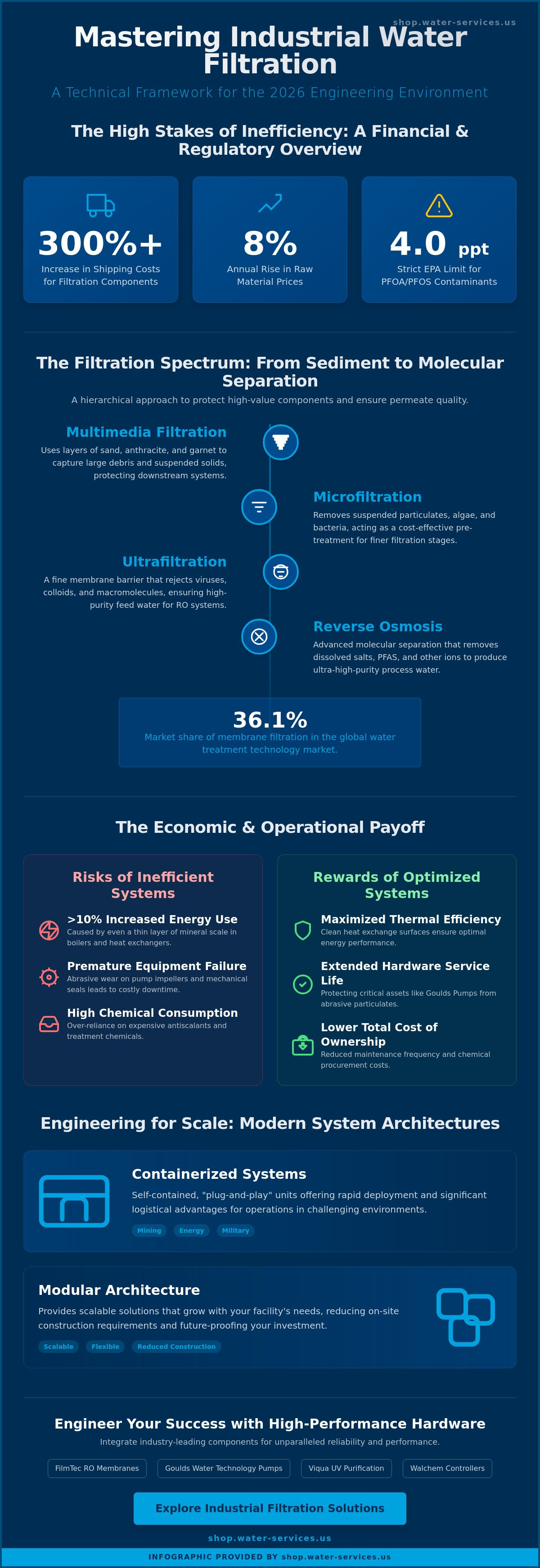
With shipping costs for filtration components increasing by over 300 percent and raw material prices rising up to 8 percent annually, an inefficient water treatment strategy is no longer just a technical oversight; it's a financial liability. You likely recognize that maintaining high-purity process water is critical for equipment longevity and operational stability. You also know that failing to meet the EPA's 4.0 parts per trillion limit for PFOA and PFOS can lead to severe regulatory penalties and immediate operational risks. Optimizing industrial water filtration systems requires more than just standard maintenance; it demands a precise alignment of high-performance hardware and specialized chemical treatment.
This guide provides the technical framework to master the 2026 engineering environment. We'll help you reduce your total cost of ownership while ensuring consistent high-purity output. We'll analyze high-efficiency architectures, including FilmTec reverse osmosis membranes and Viqua UV purification, to help you mitigate the risks of equipment downtime and discharge non-compliance. From Goulds Water Technology pumps to Walchem controllers, we'll examine the hardware synergy required for long-term engineering success.
Key Takeaways
- Learn how circular water economies and resource recovery strategies define the 2026 industrial landscape to protect process integrity.
- Identify the specific filtration spectrum required for your application, ranging from basic sediment removal to advanced molecular separation via reverse osmosis.
- Evaluate the logistical advantages of containerized industrial water filtration systems for remote mining, energy, and military operations.
- Understand the critical engineering relationship between feed pump pressure and membrane longevity to ensure consistent system flux.
- Discover how modular architecture reduces on-site construction requirements while providing scalable solutions for expanding industrial facilities.
Understanding the Role of Industrial Water Filtration Systems in 2026
Industrial water filtration systems serve as the primary engineering barrier against process contamination and equipment degradation. In high-output environments, these systems aren't merely accessories; they're critical infrastructure that ensures process integrity. By 2026, the industrial sector has moved decisively toward circular water economies. This shift focuses on resource recovery and wastewater recycling to mitigate the impact of rising raw water costs and increasing scarcity. Proper filtration allows facilities to reclaim process water, turning a waste stream into a valuable internal resource.
There is a significant technical distinction between standard commercial filters and heavy-duty industrial systems. While commercial units manage light sediment in intermittent cycles, industrial systems are engineered for high-pressure, continuous-duty operations. They handle aggressive contaminant loads and high flow rates that would compromise lighter equipment. A key focus in 2026 is the reduction of Total Suspended Solids (TSS). Effective TSS removal is non-negotiable for downstream protection, particularly for sensitive reverse osmosis membranes that are susceptible to fouling and physical abrasion.
The Economic Impact of Proper Water Treatment
Scale and corrosion in industrial boilers and heat exchangers create massive thermal efficiency losses. Even a thin layer of mineral scale can increase energy consumption by over 10 percent. Effective filtration extends the service life of critical hardware like Goulds Water Technology Pumps by preventing abrasive wear on impellers and mechanical seals. By removing physical particulates early in the process, facilities can also reduce their reliance on expensive water treatment antiscalants and chemicals. This physical pre-filtration strategy lowers the total cost of ownership by decreasing both maintenance frequency and chemical procurement costs.
Regulatory Compliance and Environmental Stewardship
Meeting the 2026 EPA PFAS limits of 4.0 parts per trillion requires a rigorous industrial water treatment overview and precise hardware selection. Regulatory bodies have increased the stringency of discharge standards, making verified filtration performance a prerequisite for operation. Many leaders in the energy and manufacturing sectors now pursue Net Zero Water goals to eliminate discharge-related environmental fines. Implementing advanced industrial water filtration systems ensures that wastewater streams meet both EPA and international standards. This protects local ecosystems while shielding the organization from the legal and financial risks associated with non-compliance.
Core Technologies: From Sediment Removal to Molecular Separation
Industrial water filtration is the multi-stage process of removing physical, chemical, and biological contaminants from a feed stream to achieve specific permeate quality. Engineering these systems requires a thorough understanding of the filtration spectrum. This includes microfiltration, ultrafiltration, nanofiltration, and reverse osmosis. Each stage targets specific particle sizes and molecular weights. In 2026, the membrane filtration segment accounts for 36.1 percent of the global water treatment technology market. Effective industrial water filtration systems utilize a hierarchical approach. They begin with coarse sediment removal and progress toward molecular separation. This tiered strategy protects high-value downstream components from premature fouling and chemical degradation.
Multimedia and Depth Filtration Systems
Multimedia systems use layers of sand, anthracite, and garnet to achieve tiered particle capture. Anthracite sits at the top to trap large debris. Sand and garnet layers follow to capture finer particulates. This configuration allows for higher solids loading compared to single-media filters. Precise backwashing cycles are essential. They prevent media compaction and maintain optimal differential pressure across the bed. Managing the flow rate ensures that the media remains stratified for consistent performance. High-capacity multimedia filter tanks provide the structural integrity needed for these high-pressure operations. Chemical dosing also plays a vital role. Injecting coagulants or flocculants before the media tank increases particle size. This makes it easier for the physical media to trap colloids that would otherwise pass through.
Membrane Technologies: UF and RO
Ultrafiltration (UF) serves as a robust physical barrier against bacteria, viruses, and fine colloids. It's frequently the final pre-treatment step before reverse osmosis. Reverse Osmosis (RO) removes dissolved solids (TDS) and manages brackish water desalination. Choosing the right membrane is a matter of flux requirements and feed water chemistry. Engineers often select between FilmTec and Hydranautics membranes based on specific rejection rates and energy efficiency profiles. Adhering to EPA guidelines on industrial water reuse is critical when designing these systems for circular economies. These guidelines help facilities maximize their water efficiency while meeting strict discharge standards. You can browse our full inventory of water treatment components to find the right hardware for your specific flow requirements.
Industry-Specific Filtration Challenges: Mining, Energy, and Military
Heavy industries operate in environments where contaminant loads exceed the design parameters of standard hardware. Off-the-shelf commercial filters often fail in these settings because they lack the structural reinforcement and media density required for high-turbidity or high-pressure streams. Engineering industrial water filtration systems for these sectors requires a focus on durability and specialized contaminant removal. Whether it's managing abrasive tailings in a mine or providing potable water for a remote military outpost, the equipment must withstand extreme hydraulic surges and aggressive chemical profiles.
Mining Wastewater and Resource Recovery
Mining operations face unique challenges with heavy metal remediation and high-sulfate process water. These streams are often highly abrasive and can quickly degrade standard pump impellers and membrane surfaces. Implementing robust filtration is the primary method for protecting expensive downstream recovery equipment from physical damage. Effective treatment allows for the recycling of process water, which is essential for sites with limited water rights. For a comprehensive technical analysis of these processes, refer to our specialized guide on Mining Wastewater Treatment Solutions. This approach ensures both regulatory compliance and the recovery of valuable mineral resources from waste streams.
Tactical and Mobile Solutions for Military Use
Military deployments and emergency response teams require water treatment logistics that prioritize mobility and rapid deployment. Engineers must choose between containerized and skid-mounted architectures based on the deployment duration and environmental exposure. Containerized plants provide an insulated, secure environment that protects sensitive Walchem controllers and Signet sensors from extreme global climates. These systems must consistently produce water that meets strict potable standards from varied and often contaminated sources. During high-risk treatment operations involving concentrated chemicals, operators must utilize appropriate personal protective equipment (PPE) to ensure safety. Reliability is the only metric that matters in these tactical scenarios.
High-Pressure Filtration in the Energy Sector
The oil and gas industry demands filtration hardware capable of handling high-pressure produced water and injection streams. Standard filter housings often rupture under the hydraulic stresses found in these fields. Specialized Harmsco filtration products and Pentair housings are frequently specified for their high burst-pressure ratings and chemical compatibility. Removing fine particulates and oils before reinjection is critical to prevent wellbore plugging and maintain reservoir permeability. By 2026, the integration of smart Ashcroft pressure gauges allows operators to monitor differential pressure in real-time. This data-driven approach prevents catastrophic housing failures and optimizes the timing of filter element replacements in remote energy projects.
Engineering for Scale: Modular and Containerized System Architecture
Modular architecture has redefined the deployment of industrial water filtration systems. Standardized modules allow for rapid scalability and simplified logistics compared to traditional site-built infrastructure. In 2026, remote mining and energy projects increasingly rely on containerized plants to bypass the delays of on-site construction. These units arrive pre-piped, pre-wired, and factory-tested. This approach ensures immediate operational readiness upon arrival at a project site. Integrating advanced electric power controls allows for remote monitoring and automated adjustments, which is essential for sites with limited technical personnel. This design philosophy minimizes on-site labor costs and reduces the risk of installation errors.
The Anatomy of a Containerized Filtration Plant
A containerized filtration plant is a self-contained engineering environment designed for maximum durability. These systems require integrated climate control, high-efficiency insulation, and industrial lighting to maintain equipment performance in extreme global climates. Internal piping and manifold designs focus on high-flow efficiency to minimize pressure drops across the treatment train. For facilities requiring high biological safety standards, incorporating Viqua UV sterilizers as a final treatment stage provides a chemical-free method for pathogen inactivation. Operators often integrate Ashcroft pressure gauges and Signet flow sensors directly into the manifold to ensure real-time visibility of system hydraulics. This localized approach protects the entire treatment train within a secure, weather-proof shell.
Scalability and Future-Proofing
Future-proofing an industrial facility requires a design that can accommodate increased production volumes without significant downtime. Modular systems allow for the addition of extra filtration trains without a complete overhaul of the existing infrastructure. Precision Walchem controllers manage these multi-train configurations by balancing flow and chemical dosing across parallel systems. This prevents any single train from becoming a bottleneck during peak demand. For a deeper technical overview of these architectures, consult our Industrial Water Filtration Systems Guide. Proper planning at the design phase ensures that the system flux remains within optimal parameters even as the facility expands.
Deciding between a capital purchase and a rental depends on the project's duration and specific budget structure. Temporary remediation projects, pilot testing, or emergency response scenarios often favor mobile ultrafiltration rentals to avoid long-term depreciation. Permanent installations benefit from the lower total cost of ownership associated with a direct purchase of a containerized reverse osmosis plant. These systems provide a stable, long-term solution for consistent process water quality in demanding environments. You can view our containerized RO and mobile UF solutions to determine the most efficient architecture for your site requirements.
Optimizing Performance: Integrated Components and Maintenance
The operational efficiency of industrial water filtration systems depends on the hydraulic stability of the entire treatment train. Feed pump performance directly dictates membrane longevity; inconsistent pressure leads to premature fouling or physical compaction of the media. Implementing precision Goulds Water Technology Pumps ensures a steady flux across the membrane surface, which is critical for maintaining permeate quality. Predictive maintenance strategies now rely on real-time data from Signet flow sensors and Ashcroft pressure gauges to identify performance drifts. By monitoring these metrics, operators can address minor pressure variances before they escalate into catastrophic system failures or unplanned downtime.
Pumping and Pressure Management
Variable Frequency Drives (VFDs) are essential for optimizing energy use in large-scale filtration applications. They allow the system to adjust motor speed based on real-time demand, which significantly reduces electrical consumption. Proper pump control also prevents water hammer and sudden pressure spikes that can rupture Pentair filter housings or damage delicate reverse osmosis membranes. Engineers utilize Ashcroft pressure gauges at both the inlet and outlet of each filtration stage to perform accurate diagnostics. This allows for a precise calculation of differential pressure, indicating exactly when a filter element or membrane requires cleaning or replacement. Maintaining stable hydraulics is the most effective way to protect your capital investment.
Consumables and Long-Term Support
System degradation is often the result of using inferior or non-spec replacement consumables. Using high-quality OEM replacement sediment and carbon filters ensures that the physical barrier remains intact and prevents particulate bypass. To further protect these components, facilities must develop a consistent chemical dosing regimen. Pulsafeeder metering pumps provide the precision required to inject antiscalants and dechlorinating agents at exact ratios. These chemicals prevent mineral scaling and oxidative damage to FilmTec and Hydranautics membranes. For complex industrial installs, technical support and professional commissioning are vital to ensure that Walchem controllers are properly calibrated to the specific water chemistry of the site. High-purity process water is only achievable through the disciplined maintenance of every integrated component.
Securing Operational Longevity Through Engineered Filtration
Mastering the technical landscape of process water requires a shift from reactive repairs to integrated engineering. We have explored the necessity of matching high-performance pumping with specialized membrane technologies to maintain consistent output across demanding applications. Implementing robust industrial water filtration systems remains the most effective method for protecting capital equipment and ensuring long-term reliability in specialized global markets.
Founded in 1994, Water Services, Inc. brings over 30 years of global engineering experience to the water treatment sector. As an authorized distributor for Goulds, Viqua, and Pentair, we provide the hardware required for the rigors of mining, military, and oil and gas operations. Our commitment to technical integrity ensures that your facility maintains a stable and efficient output. Explore our full catalog of industrial water treatment components to find exact solutions for your specific industrial contaminants. We look forward to supporting your logistical and technical requirements.
Frequently Asked Questions
What are the main types of industrial water filtration systems?
The primary categories of industrial water filtration systems are multimedia depth filtration, ultrafiltration (UF), and reverse osmosis (RO). Multimedia tanks utilize stratified layers of anthracite, sand, and garnet to remove suspended solids from high-flow streams. Membrane technologies like FilmTec RO and mobile UF systems provide the molecular separation necessary for high-purity process water and desalination.
How do I choose between a standard commercial filter and an industrial-grade system?
Select an industrial-grade system when your process requires continuous-duty operation and high-pressure ratings. Industrial hardware features reinforced components like Pentair housings and Ashcroft gauges that withstand aggressive chemical profiles and hydraulic surges. Commercial filters are designed for intermittent cycles and light sediment loads, making them unsuitable for the rigors of mining or energy production environments.
Can industrial filtration systems remove dissolved heavy metals from wastewater?
Yes, industrial filtration removes dissolved heavy metals through reverse osmosis or a combination of chemical precipitation and physical separation. High-rejection Hydranautics RO membranes effectively separate dissolved ions from the feed stream. Alternatively, Pulsafeeder metering pumps can inject specialized chemicals to precipitate metals, allowing multimedia filters to trap the resulting particulates before they reach downstream equipment.
What are the benefits of containerized water treatment plants for remote sites?
Containerized plants offer rapid deployment and protection for sensitive hardware in demanding global climates. These units arrive as self-contained engineering environments with integrated climate control, lighting, and internal piping already installed. This architecture is ideal for remote mining sites because it eliminates the need for complex on-site construction and protects Walchem controllers from environmental exposure.
How often do industrial RO membranes and filter media need to be replaced?
RO membranes in industrial water filtration systems typically last 3 to 5 years, while multimedia media requires replacement every 2 to 4 years. These timelines vary based on feed water quality and the effectiveness of your pre-treatment regimen. Monitoring differential pressure with Ashcroft gauges is the most accurate way to schedule maintenance. Regular replacement of sediment and carbon filters also prevents premature membrane fouling.
Is it better to rent or purchase a mobile water treatment unit for a 6-month project?
Renting a mobile ultrafiltration unit is usually the superior choice for a 6-month project to avoid long-term asset depreciation. Rental solutions provide immediate operational capacity without the high upfront cost of a capital purchase. This is particularly useful for temporary remediation or emergency response where the equipment is only needed for a defined duration. Permanent facilities should consider purchasing containerized plants for better long-term ROI.
What role does UV sterilization play in industrial water treatment?
UV sterilization serves as a non-chemical barrier against biological contaminants and biofilm growth in the process stream. Viqua UV systems utilize specific wavelengths to inactivate viruses and bacteria without altering the water's chemical composition. This is a critical final stage for systems requiring high biological safety, as it prevents pathogens from colonizing downstream piping or storage tanks.
How do Goulds pumps integrate with large-scale filtration systems?
Goulds pumps function as the primary hydraulic engine, providing the consistent pressure needed for membrane flux and media penetration. They're typically integrated with Walchem controllers and VFDs to adjust flow rates based on real-time system demand. This synergy ensures that the filtration system operates within its optimal design parameters while protecting sensitive components from damaging pressure spikes.
0 comments