

Did you know the Producer Price Index for construction materials hit a record 354.9 in March 2026? This 6.0% year-over-year increase means every leak in your facility is more expensive than it was last year. Selecting the right industrial water system piping and fittings for RO systems is no longer a routine procurement task. It's a critical engineering decision to protect high-value assets like FilmTec membranes and Goulds pumps from catastrophic pressure failures.
You likely recognize the frustration of chemical degradation in standard PVC or the sudden downtime caused by a burst hose during a high-pressure pump cycle. These failures don't just stop production; they jeopardize OSHA and environmental compliance. This 2026 buying guide helps you master the technical requirements for high-pressure reliability and chemical compatibility. We'll examine the latest NSF/ANSI/CAN 61-2025 standards, the industry shift toward calcium-zinc stabilizers, and the exact specifications required to eliminate leaks in your reverse osmosis infrastructure.
Key Takeaways
- Identify the specific material requirements for high-TDS environments to prevent chemical degradation and premature component failure.
- Learn to utilize flexible industrial hoses to mitigate mechanical stress and vibration on high-value equipment like Goulds Water Technology Pumps.
- Master the technical specifications for industrial water system piping and fittings for RO systems, including the critical delta between working and burst pressure ratings.
- Implement a 2026-compliant maintenance protocol to recognize early signs of fatigue such as hairline fractures and weeping at connection points.
The Critical Role of Piping and Fittings in RO System Integrity
Industrial reverse osmosis (RO) systems require a sophisticated fluid handling infrastructure to maintain operational stability. Unlike general water distribution, an industrial reverse osmosis plant subjects its components to extreme osmotic pressures and aggressive chemical environments. Using standard plumbing components in these settings leads to rapid failure. High Total Dissolved Solids (TDS) levels increase the corrosivity of the source water, while high-frequency pump cycles create mechanical fatigue that basic fittings cannot withstand. Selecting the correct industrial water system piping and fittings for RO systems is the only way to prevent premature membrane fouling and pump cavitation.
Improper fitting selection directly impacts the efficiency of high-value assets. For example, a slight vacuum leak on the suction side of a Goulds pump introduces air that causes cavitation, damaging the impeller and reducing membrane lifespan. Similarly, turbulent flow caused by mismatched internal diameters in fittings leads to localized scale precipitation. Precision-matched components ensure the system maintains the laminar flow necessary for optimal salt rejection and energy efficiency.
Understanding RO Pressure Zones
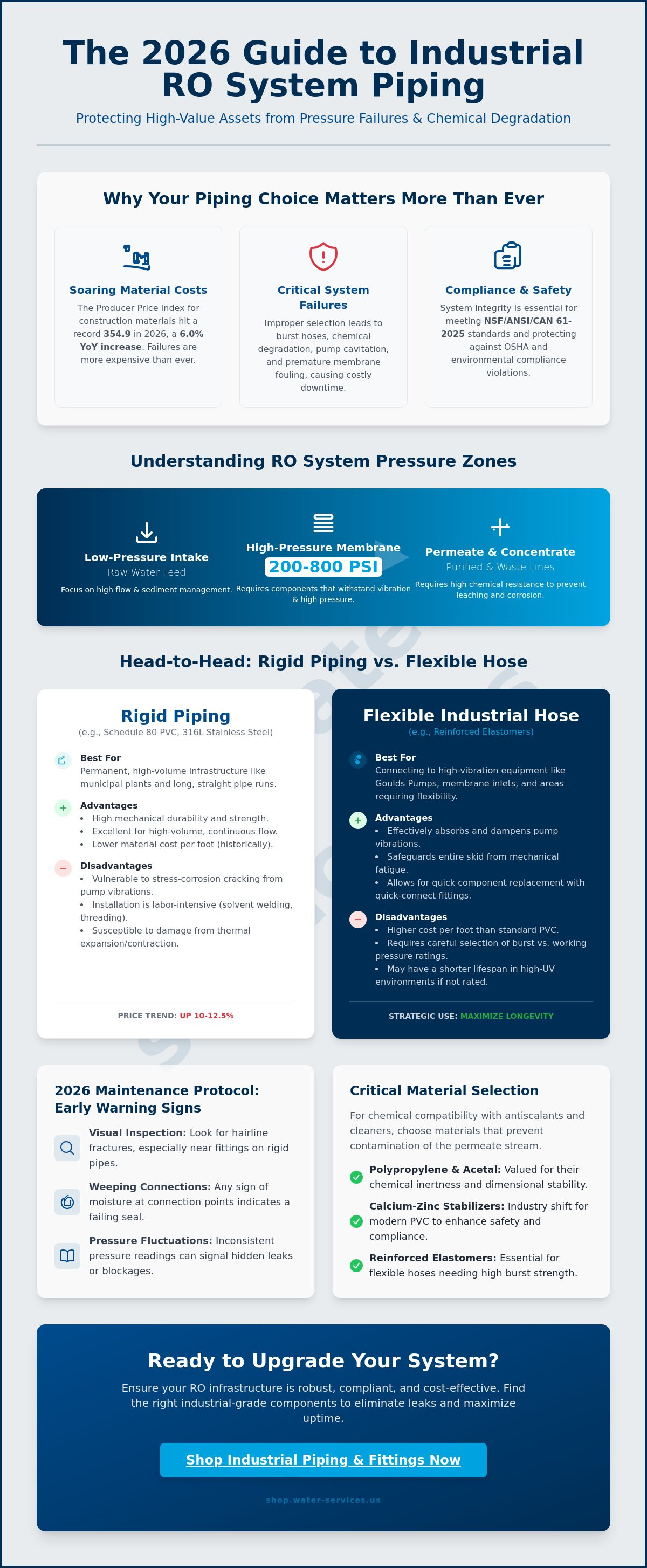
Effective system design categorizes industrial water system piping and fittings for RO systems into three distinct operational zones. The low-pressure intake zone handles raw water feed lines, where the focus is on high flow rates and sediment management. Once the water reaches the high-pressure membrane feed, requirements shift drastically. This zone frequently operates between 200 and 800 PSI, necessitating specialized industrial hoses that absorb the vibration and thermal expansion typical of industrial pump skids.
The final zone manages the permeate and concentrate lines. Permeate water is highly purified and "hungry," often leaching minerals from metallic or low-grade plastic piping. Conversely, the concentrate or brine line handles high-TDS waste, requiring fittings with superior chemical resistance to prevent pitting and stress-corrosion cracking over long-term service cycles.
Chemical Compatibility and Material Science
Material science is the foundation of RO system longevity. Standard elastomers and metallic alloys often degrade when exposed to the antiscalants and cleaning chemicals used to maintain FilmTec or Hydranautics membranes. Polypropylene and Acetal are preferred for their chemical inertness and dimensional stability. These materials don't leach contaminants into the permeate stream, ensuring the water remains at the required purity level for sensitive industrial processes. For those designing or upgrading a facility, you can browse industrial water treatment components to find materials that match these specific resistance profiles. Reinforced elastomers are also essential for flexible connections, providing the necessary burst strength while maintaining flexibility under fluctuating pressure loads.
Comparing Piping Materials: Rigid vs. Flexible Industrial Hose
Selecting industrial water system piping and fittings for RO systems requires balancing mechanical durability with installation flexibility. Rigid piping, such as Schedule 80 PVC or 316L Stainless Steel, remains the standard for high-volume, permanent infrastructure. However, the "vibration factor" is a critical oversight in many traditional designs. High-pressure cycles from Goulds Water Technology Pumps create harmonic vibrations that lead to stress-corrosion cracking in rigid joints over time. Integrating flexible industrial hoses at the pump discharge and membrane inlet points effectively isolates these forces, safeguarding the entire skid from mechanical fatigue.
By May 2026, the producer price index for construction materials reached 354.9, a 6.0% increase over the previous year. With steel pipe prices rising 12.5% and Charlotte Pipe announcing a 10% increase on PVC and CPVC in March 2026, the cost-to-longevity ratio has become a primary operational metric. Operators can't afford frequent piping failures. Following FDA guidelines on RO system integrity requires designs that ensure continuous flow and prevent stagnant water, making the internal smoothness of your chosen material just as important as its external strength. Using quick-connect fittings in these configurations allows for rapid component replacement, reducing the labor costs associated with traditional solvent-welded or threaded systems.
When to Choose Rigid Piping
Permanent installations, such as large-scale mining wastewater plants or municipal desalination facilities, rely on rigid piping for handling maximum concentrate flow. These systems benefit from the high structural integrity and fixed positioning of rigid materials when space is not a constraint. For a detailed analysis of large-scale design requirements, review our Industrial Water Treatment Systems Pillar, which outlines high-purity engineering solutions for 2026 operations. Rigid systems are ideal for long runs where support hangers are easily installed and movement is minimal.
The Advantages of Flexible Industrial Hoses
Flexible hoses simplify maintenance by allowing operators to swap membranes or service pumps without cutting and re-gluing pipe. This adaptability is essential for mobile treatment units or containerized RO plants where space is restricted. In these high-demand applications, burst pressure is the critical metric for RO hose selection, representing the theoretical pressure at which the hose fails during a surge. Most industrial hoses are rated with a 4:1 safety factor, meaning a hose with a 200 PSI working pressure has an 800 PSI burst pressure. This safety margin is vital for protecting personnel and equipment during pump start-up cycles.
Key Features to Evaluate in Industrial Fittings
Fittings represent the highest risk for leaks in high-pressure water treatment. Precision engineering of industrial water system piping and fittings for RO systems relies on exact pressure ratings. Working pressure defines the maximum continuous load a component can handle during standard operation. Burst pressure marks the point of physical failure. Most industrial RO applications require a 4:1 safety factor to manage the hydraulic transients generated during high-pressure pump cycles. Selecting a fitting with an inadequate rating leads to catastrophic failure during system start-up.
Thread compatibility is equally critical for maintaining system vacuum and pressure. National Pipe Thread (NPT) is the standard in North American facilities, utilizing a tapered design to create a seal through thread interference. British Standard Pipe (BSP) is common in international skids and often requires a bonded seal or O-ring to prevent weeping. Mixing these standards is a common cause of system depressurization. Connection mechanisms must match the specific operational zone. Camlocks allow for rapid hose changes on concentrate discharge lines. Compression fittings offer the high-torque reliability needed for membrane feed headers. Industrial push-fits are efficient for low-pressure permeate distribution where mechanical stress is minimal.
Seal material selection dictates chemical resistance and longevity. EPDM seals are the baseline for most water applications due to their resistance to heat and ozone. Viton (FKM) is required for systems utilizing aggressive antiscalants or operating at elevated temperatures. Buna-N provides a cost-effective solution for general-purpose sealing but lacks the broad chemical resistance of fluorinated elastomers.
Avoiding Common Fitting Failures
Over-tightening plastic fittings into metallic pump housings is a frequent installation error. This practice creates localized stress that results in hairline fractures over time. Furthermore, low-grade plastics are susceptible to "creep" or stress relaxation. This is a phenomenon where the material slowly deforms under constant pressure, eventually compromising the seal. High-quality resins and reinforced polymers are necessary to maintain dimensional stability over thousands of operational hours. You can explore electric power controls to integrate automated pressure monitoring, which helps identify these failures before they cause significant downtime.
Standardization and Interoperability
All industrial water system piping and fittings for RO systems must adhere to ANSI or ASTM standards to ensure dimensional accuracy across different manufacturers. Monitoring these components is essential for a robust preventative maintenance program. Ashcroft pressure gauges provide the necessary data to track pressure drops across membrane banks, while Signet flow sensors monitor permeate production rates. Using these instruments allows operators to detect restricted flow or fitting leaks early. Standardizing on high-quality components ensures that replacement parts are always compatible with existing infrastructure, reducing the need for custom fabrication during emergency repairs.
Standout Products: Top Industrial Hoses for RO Systems
Water Services maintains a specialized inventory of over 1,700 products designed for rigorous fluid handling. Selecting the correct industrial water system piping and fittings for RO systems requires matching specific hose construction to the operational zone. High-pressure discharge lines, chemical dosing points, and raw water intake manifolds each demand different material properties to ensure system integrity. Browse the complete collection of industrial hoses and fittings to find precision-engineered solutions for your facility.
Modular and containerized RO systems rely heavily on flexible hose integration to maintain a compact footprint while allowing for easy membrane access. Unlike rigid piping, industrial hoses absorb the hydraulic shocks common in high-pressure pump skids. This flexibility is vital for mobile treatment units where structural shifting during transport would otherwise snap rigid connections. These hoses serve as the primary conduits in demanding environments, providing a level of adaptability that rigid systems cannot match.
High-Pressure RO Feed Hoses
RO feed headers typically operate at pressures exceeding 600 PSI, especially in high-salinity applications like seawater desalination or remote mining operations. These hoses utilize multi-layer reinforced elastomers, often featuring high-tensile wire or textile braiding to prevent diameter expansion under load. Durability is paramount in oilfield and mining sites where environmental conditions are harsh and downtime is costly. For a deeper look at system-wide requirements, refer to our Commercial RO Selection Guide. These hoses are engineered to withstand the continuous duty cycles of industrial pumps without loss of structural integrity or burst strength.
Suction and Low-Pressure Transfer Hoses
Intake lines for mobile treatment units require suction hoses that won't collapse under vacuum. Many industrial applications benefit from transparent hose materials, allowing operators to visually inspect for air bubbles or sediment buildup before the water reaches the filter housings. UV-resistant coatings are necessary for outdoor industrial sites to prevent material embrittlement from sun exposure. When maintaining these lines, especially during cleaning cycles involving concentrated chemicals or antiscalants, ensure staff utilize proper PPE for site maintenance. Food-grade hoses are also available for military deployments and drinking water applications, ensuring compliance with strict health and safety standards.
Maintenance and Implementation: Ensuring 2026 Compliance
Maintaining the structural integrity of industrial water system piping and fittings for RO systems requires a rigorous preventative maintenance schedule. Industrial environments subject components to continuous thermal and mechanical cycling. Operators must conduct weekly visual inspections to identify early signs of fatigue. Discoloration often indicates chemical degradation from antiscalant exposure or UV-induced embrittlement. Weeping at connection points suggests seal failure or thread relaxation. Hairline fractures, particularly near rigid manifolds, signal excessive vibration or over-torque during installation.
Proper support and anchoring are essential for high-pressure lines. Unsecured hoses experience "line whip" during pump start-up cycles, which puts undue stress on fittings and membrane port connectors. Regulatory compliance in 2026 also demands strict adherence to the updated NSF/ANSI/CAN 61-2025 standards for drinking water components. The first PFAS reporting deadlines under the Toxic Substances Control Act (TSCA) in 2026 require facilities to verify the chemical composition of all wetted materials, including gaskets and reinforced hose liners. Selecting materials with calcium-zinc stabilizers rather than lead-based alternatives is now a baseline requirement for environmental and OSHA compliance.
Best Practices for Installation
Strategic piping layouts minimize the risk of water hammer, a common cause of burst hoses and cracked housings. Incorporating surge vessels or pulsation dampeners near high-pressure pumps absorbs hydraulic shocks. When sealing threaded connections, anaerobic thread sealants are often superior to standard PTFE tape in high-vibration RO applications. These sealants provide a more robust mechanical bond that resists loosening over time. For complex industrial environments, such as those described in our analysis of Mining Wastewater Solutions, using the correct wetted materials is the only way to ensure environmental compliance and resource recovery.
The Total Cost of Ownership (TCO)
Calculating the total cost of ownership involves comparing the price of premium components against the expense of unscheduled downtime. In a high-capacity facility, a single hour of system failure often exceeds the cost of a complete set of high-pressure hoses. Investing in superior industrial water system piping and fittings for RO systems reduces long-term operational expenses by extending service intervals and preventing catastrophic leaks. Precision-engineered fittings maintain their seal integrity under the 200 to 800 PSI loads typical of modern RO skids. Secure your system with industrial-grade hoses from Water Services to ensure reliable performance through 2026 and beyond.
Optimizing Your Fluid Handling Infrastructure for 2026
Precision in fluid handling is the foundation of a reliable reverse osmosis plant. You've learned how specialized industrial water system piping and fittings for RO systems mitigate vibration stress and ensure chemical compatibility with the latest 2026 standards. By prioritizing high-pressure reinforced hoses and exact fitting specifications, you protect expensive membranes and pumps from catastrophic failure and unscheduled downtime. Proper material selection isn't just about flow; it's about long-term mechanical stability and safety.
Water Services has served the global mining and military sectors since 1994. We maintain a specialized inventory of more than 1,700 industrial hose products designed for the most demanding commercial environments. Our team offers expert engineering support for custom modular systems, helping you navigate complex technical requirements with confidence. It's time to eliminate leaks and ensure your facility meets all current environmental and OSHA benchmarks. Shop Industrial Hoses and RO Fittings to secure your infrastructure today. Your operation deserves the stability of professional-grade components.
Frequently Asked Questions
What is the best piping material for high-pressure RO feed lines?
316L Stainless Steel is the baseline for permanent high-pressure feed lines, while reinforced elastomers are preferred for modular skids. These materials safely manage the 200 to 800 PSI requirements of industrial reverse osmosis membranes. Stainless steel offers superior corrosion resistance in high-TDS environments. Flexible reinforced hoses provide the necessary vibration isolation for high-pressure pump connections.
Can I use standard PVC fittings for industrial reverse osmosis?
Standard residential PVC fittings lack the burst pressure ratings required for industrial scale operations. Industrial water system piping and fittings for RO systems must utilize Schedule 80 PVC or specialized polypropylene to withstand the cyclic pressures of industrial pumps. Using low-grade fittings leads to stress fractures and catastrophic system failure during high-pressure cycles.
How often should industrial RO hoses be replaced?
Industrial RO hoses require weekly inspection for signs of fatigue and typically need replacement every 24 to 60 months. Environmental factors like UV exposure and chemical cleaning cycles accelerate material degradation. It's essential to replace any hose showing discoloration, weeping at the crimps, or external abrasions to prevent unplanned downtime and potential safety hazards.
What is the difference between EPDM and Viton seals in RO fittings?
EPDM seals are the standard for general water treatment due to their excellent resistance to heat and ozone. Viton (FKM) is required for systems utilizing aggressive antiscalants or high-temperature cleaning chemicals that would degrade standard elastomers. Choosing the wrong seal material results in swelling or hardening, which compromises the leak-proof integrity of the fitting.
Are flexible hoses safe for high-pressure pump discharge?
Flexible hoses are safe and often preferred for high-pressure pump discharge when they carry an appropriate working pressure rating. These hoses are engineered with a 4:1 safety factor, meaning a hose rated for 250 PSI won't burst until 1,000 PSI. They protect the system by absorbing the mechanical vibrations and hydraulic shocks generated by high-pressure pumps.
How do I choose the correct hose diameter for my GPM flow rate?
Select a hose diameter that maintains a fluid velocity between 5 and 10 feet per second on discharge lines to minimize friction loss. For suction lines, the velocity should remain between 2 and 4 feet per second to prevent pump cavitation. Using an undersized hose increases backpressure and forces the pump to work harder, reducing the overall energy efficiency of the system.
What fittings are required for containerized water treatment systems?
Containerized systems require compact, vibration-resistant fittings such as industrial push-fits and camlocks to allow for rapid maintenance in restricted spaces. Because mobile units experience structural stress during transport, the industrial water system piping and fittings for RO systems in these plants must be rated for high mechanical durability. These fittings ensure the system remains leak-proof despite frequent movement.
Does Water Services provide fittings compatible with Goulds pumps?
Water Services stocks a comprehensive range of fittings and adapters specifically designed for compatibility with Goulds Water Technology Pumps. Our inventory includes NPT and flanged connections that ensure a leak-proof seal at the pump suction and discharge ports. These components are engineered to handle the specific torque and pressure requirements of industrial pump housings without risking thread damage.
0 comments