

The controller with the most features may still be the wrong fit for your system. Industrial water treatment controllers can measure and respond to process conditions, while pump control boxes, starters, and other components manage electrical loads or specific functions. Choosing by category name alone can lead to equipment that doesn’t match the job.
To narrow your options, first identify what the equipment must control, which signals and loads it must handle, and the conditions it will face. Then compare the required voltage, phase, pressure range, and connections with the equipment nameplate and manufacturer documentation.
This guide explains the difference between process measurement and pump or electrical control, and how to shortlist equipment before ordering. Water Services’ Controls collection includes Walchem controllers, pump control boxes, enclosed starters, a variable frequency drive, and replacement components. Use the function and specifications you’ve confirmed to focus your search and check compatibility.
Key Takeaways
- Define the process variable or equipment load that needs control, then identify what action should follow a setpoint or operating condition.
- Industrial water treatment controllers can refer to different equipment types. Distinguish process measurement from motor control and replacement components before comparing options.
- Use model numbers and nameplate details to check voltage, phase, load, pressure range, connections, and enclosure requirements.
- Compare product specifications with current manufacturer documentation. Verify wiring, installation, and application requirements before ordering.
- Browse the Water Services Controls collection by function and confirmed specifications, not by brand or visual similarity alone.
What Do Industrial Water Treatment Controllers Actually Control?
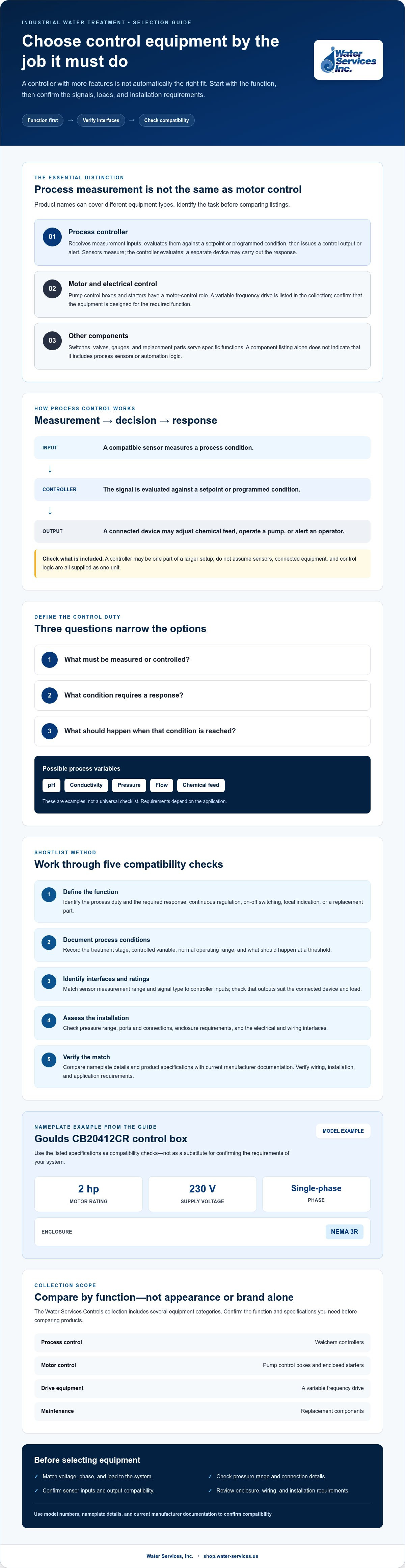
The term industrial water treatment controllers can describe equipment with very different jobs. A process controller receives measurement inputs, evaluates them against a setpoint or programmed condition, then issues a control output. That output may signal equipment to adjust or alert an operator. Inputs report what the process is doing; outputs initiate or request a response.
The controlled variable depends on the treatment process and surrounding equipment. A controller may be one part of a larger system, rather than a device that independently measures water quality, decides what to do, and operates every connected component. The broader field of Industrial water treatment includes processes addressing issues such as scaling, corrosion, and microbiological activity. Each application has its own measurement and control requirements.
Process controllers versus control components
A process-control setup typically combines a controller, compatible sensor inputs, configured logic, and an output connected to an action or alarm. The sensor measures a condition, the controller evaluates the signal, and a separate device may change chemical feed, operate a pump, or alert an operator. Check which elements are included rather than assuming they come as one unit.
Other control components have narrower functions. A starter or pump control box handles a motor-control role; a switch changes state at a specified condition; a valve regulates or opens and closes a path; a gauge displays a reading. Replacement parts maintain or restore a specific piece of equipment. A listing for one of these components does not, by itself, indicate that it includes process sensors or automation logic. Water Services’ Controls collection spans several component categories, alongside Walchem controllers, so identify the required function before comparing listings.
Which process variables may need control?
Depending on the application, a system may monitor or control pH, conductivity, pressure, flow, or chemical feed. These are examples, not a universal checklist. Start with three questions: What must be measured? What condition requires a response? What should happen when that condition is reached?
Match the sensor’s measurement range and signal type to the controller’s input, then check that the controller’s output suits the device it must operate. A pressure reading, for example, is useful only if the measurement range and sensor interface fit the operating conditions. For more context on treatment equipment, see the industrial water treatment equipment collection. Check requirements against current manufacturer documentation before selecting or connecting components.
How to Match a Controller to Treatment Process and Equipment
Choose by the duty the equipment must perform, not by a broad product label. For industrial water treatment controllers and related components, work through five checks: define the function, document process conditions, identify interfaces, assess the installation environment, and verify the match against current manufacturer information.
Start with the process duty and control response
Record the treatment stage, controlled variable, normal operating range, and required response. The Wastewater Treatment Primer describes treatment stages that can help place a control requirement in process context. Then determine whether the application needs continuous regulation, on-off switching, local indication, or a replacement part.
Be specific about what should happen at a threshold. A chemical-feed requirement is not automatically the same as starting a pump or adjusting motor speed. Chemical feed may require a compatible metering device and control signal; pump starting calls for motor-control equipment rated for the load; speed adjustment requires equipment designed for that function. Check input and output types in the manufacturer documentation. Don’t infer sensor support, communication features, or control logic from a product category name.
Check electrical, hydraulic, and environmental interfaces
Compare the equipment nameplate with your system requirements. Check supply voltage, phase, motor rating, pressure range, port type, connection details, and required sensor or wiring interfaces. For example, supplied specifications list the Goulds CB20412CR control box for 2 hp, 230 V, single-phase use with a NEMA 3R enclosure. The WEG CFW500 VFD is listed as 230 VAC, 5 hp, 16 A, three-phase, with a NEMA 4X/IP66 enclosure. These are the listed ratings, not a guarantee of suitability for another installation.
Assess the actual environment before deciding whether an enclosure rating is appropriate. Moisture, exposure, mounting location, and other site conditions can affect equipment selection. Verify wiring, sensor connections, installation requirements, and application limits in current manufacturer documentation. A familiar brand or visually similar component does not establish compatibility.
Before choosing, collect the treatment stage, controlled variable and operating range, desired response, supply voltage and phase, motor or electrical load, pressure and connection details, installation environment, and equipment model or nameplate information. This gives you a defined specification to compare with product documentation and, where relevant, the water treatment equipment range. Once the function and ratings are clear, review the Controls collection by component type and check each candidate against current manufacturer requirements.
Compare Industrial Control Types and Relevant Collection Products
Product names can make unlike equipment seem comparable. A process controller uses inputs and logic to manage a treatment variable; a variable frequency drive adjusts motor speed; a starter switches a motor; and a pressure switch changes state at a pressure condition. Each serves a different role, so confirm the required function before comparing specifications.
The table distinguishes process controllers from individual electrical, mechanical, and replacement components. It includes supplied specifications where available. A listed rating describes that product, not its compatibility with a particular system.
| Control function | Product type | Supplied specification | Verification needed |
|---|---|---|---|
| Process measurement and control | Walchem process controller | No model-specific input, output, or process specifications provided here. | Confirm model, sensor inputs, control outputs, supported signals, and application requirements in current manufacturer documentation. |
| Pump motor control | Goulds CB20412CR control box | 2 hp, 230 V, single-phase; NEMA 3R enclosure. | Check the pump nameplate, supply, wiring, and installation requirements. |
| Motor starting | WEG enclosed starter | Starter product; no model-specific rating provided here. | Verify the exact model’s voltage, phase, motor rating, enclosure, and wiring requirements. |
| Motor speed control | WEG CFW500 variable frequency drive | 230 VAC, 5 hp, 16 A, three-phase; NEMA 4X/IP66 enclosure. | Confirm motor and supply compatibility, installation conditions, and manufacturer requirements. |
| Pressure switching | Pumptrol pressure switch | 5-65 psi range; one port, 1/4-inch FNPS; DPST configuration. | Check pressure conditions, port connection, electrical requirements, and intended application. |
| Flow-path switching | Solenoid valve | Normally closed; 3/4-inch FNPT; 110 VAC; stainless steel; 0-140 psi. | Verify operating pressure, connection fit, electrical supply, and application suitability. |
| Local indication or valve service | Pressure gauge; Fleck piston or seal-and-spacer kit | No model-specific gauge range or kit compatibility details provided here. | Match the gauge range and connection, or confirm the valve model and replacement-part requirements. |
Use the function to narrow the comparison
When comparing industrial water treatment controllers, compare process controllers with equipment intended to receive process measurements and issue control actions. A pressure switch is not a substitute for a process controller, and a gauge indicates pressure rather than automatically regulating it. Fleck piston and seal-and-spacer kits are replacement parts, not electronic controls. Confirm the exact model and current manufacturer specifications before deciding whether a component suits the system.
Avoid Selection Errors: Verify Ratings, Compatibility, and Installation
A product can look right and still be unsuitable for the installed equipment. Industrial water treatment controllers and related components must match the application, electrical ratings, pressure conditions, connections, and installation environment. Don’t rely on brand names or visual similarity to confirm fit.
Common mistakes when buying industrial controls
A pressure gauge indicates pressure; it doesn’t control water quality. A motor starter switches a motor; it isn’t a water-quality instrument. A component’s category alone also doesn’t establish its voltage, phase, motor rating, pressure limit, or enclosure suitability. Take the same care with replacement parts: confirm the installed valve model before ordering a piston or seal-and-spacer kit.
For chemical-feed applications, distinguish the dosing function from the equipment that starts or powers a pump. Review the precision chemical dosing and process control guidance alongside the manufacturer specifications for the controller and connected equipment.
Information to confirm before placing an order
Gather the details below and compare them with current product documentation. Missing or conflicting information is a reason to pause and verify, not assume compatibility.
- Equipment identity: Record the exact model and serial details for the installed equipment and the component being replaced.
- Nameplate ratings: Confirm supply voltage, phase, motor or electrical load, and any other listed limits.
- Process conditions: Note operating pressure and other conditions relevant to the component’s intended function.
- Connections: Confirm port type, size, and connection details rather than estimating from appearance.
- Installation environment: Check whether the enclosure and component suit the actual location and conditions.
- Documentation: Verify wiring, operating limits, sensor requirements, installation instructions, and replacement-part fit against current manufacturer information.
Have qualified personnel verify wiring and installation against the manufacturer’s instructions and site requirements. If your requirement extends beyond control components to treatment equipment, review the water treatment equipment collection separately.
Once you’ve confirmed the application and ratings, browse the Controls collection by component type and check each candidate against its exact model specifications before ordering.
Choose Control Equipment from the Water Services Controls Collection
Use your confirmed specifications to narrow the Water Services Controls collection by function. It includes Walchem controllers and separate motor-control, switching, valve, gauge, and replacement-part categories. These items don’t all perform the same job. A collection listing alone doesn’t establish that a component is a complete process-control system or compatible with your installation.
Shortlist products by the job they perform
For a specified single-phase pump-control application, the Goulds CB20412CR control box is listed for 2 hp, 230 V, single-phase use with a NEMA 3R enclosure. Compare those ratings with the pump nameplate and installation requirements before considering it. WEG enclosed starters are a separate motor-starting category. The WEG CFW500 is a variable frequency drive listed at 230 VAC, 5 hp, 16 A, three-phase, with a NEMA 4X/IP66 enclosure. Verify the exact model ratings and application requirements for either type.
Other products have more specific roles. The Pumptrol pressure switch is listed with a 5-65 psi range, one port, 1/4-inch FNPS, and DPST configuration. The normally closed solenoid valve is listed as 3/4-inch FNPT, 110 VAC, stainless steel, and 0-140 psi. Confirm pressure, electrical, and connection requirements. A pressure gauge provides an indication, while Fleck piston or seal-and-spacer kits are replacement parts for matching valve models. Neither should be mistaken for an electronic process controller.
Walchem controllers are among Water Services’ listed offerings, but check current collection contents and the exact controller’s supported inputs, outputs, and functions. Don’t assume process-sensor support, automation logic, or communications capabilities unless current manufacturer documentation confirms them.
Prepare a clear request before ordering
Before browsing or asking for product clarification, have the control duty, equipment model and serial details, nameplate values, connection measurements, and operating conditions ready. Identify what the component must do and which ratings or interfaces remain uncertain. If the listing doesn’t resolve compatibility, ask Water Services to clarify the supplied specifications, then confirm wiring and installation requirements against current manufacturer documentation.
With the application and exact specifications in hand, browse the Water Services Controls collection to review relevant product categories and verify candidate details before ordering.
Make Your Next Control Selection With Confidence
Start with the job the equipment must perform, then match its ratings and interfaces to the process and installed hardware. Industrial water treatment controllers are not interchangeable with motor controls, switches, gauges, valves, or replacement parts. Confirm model details, operating conditions, and manufacturer requirements before ordering.
Water Services, Inc. has supplied water infrastructure and treatment equipment since 1994. Its Controls collection includes motor-control equipment, pressure components, valves, and replacement parts. Treat each listing as a distinct component category, and verify current specifications and compatibility for your application.
With your process duty, nameplate data, and connection details ready, you can narrow the options more efficiently. Browse industrial control equipment and compare relevant products with your confirmed requirements. A careful specification check is a practical first step toward selecting equipment that fits your system.
Frequently Asked Questions
What does an industrial water treatment controller do?
An industrial water treatment controller measures or responds to process conditions and can trigger an action, such as an alarm, chemical feed, valve movement, or equipment operation. Its exact function depends on the controller, compatible sensors, configured outputs, and application. A motor starter, pressure switch, or gauge may support control work, but each has a distinct role. Don’t assume any one component provides complete treatment control on its own.
How do I choose an industrial water treatment controller?
Identify the process variable, its operating range, and the action required when conditions change. Then check sensor and output requirements, supply voltage, phase, connected load, pressure or port details, and the installation environment. Compare these requirements with the exact model’s current documentation. If a listing doesn’t confirm a specification or compatibility, ask the manufacturer or supplier to clarify before ordering.
What is the difference between a water treatment controller and a motor starter?
A water treatment controller typically uses process measurements or configured inputs to manage treatment actions. A motor starter switches a motor according to its design and ratings. A system may use both, but they aren’t interchangeable: a starter doesn’t automatically measure water quality, and a process controller isn’t necessarily designed to start a motor directly. First identify whether you need treatment regulation, pump starting, speed adjustment, or another function.
Can a variable frequency drive control a water treatment pump?
A variable frequency drive can adjust motor speed if the drive, motor, pump, and application are compatible. Check supply voltage, phase, motor current and power, control requirements, enclosure, and manufacturer instructions for the specific installation. For example, the listed WEG CFW500 specifications are 230 VAC, 5 hp, 16 A, three-phase, with a NEMA 4X/IP66 enclosure. Those ratings alone don’t establish compatibility with a particular pump.
How do I know whether a pressure switch is compatible with my pump system?
Compare the switch’s pressure range, contact configuration, port size and type, and operating conditions with your system requirements. Verify electrical ratings and installation instructions as well. The Pumptrol example is listed as DPST, with a 5-65 psi range and one 1/4-inch FNPS port. These specifications describe the switch, but don’t confirm that it matches every pump or operating setup.
Are industrial water treatment controllers compatible with every sensor?
No. Compatibility depends on the controller’s supported measurement type, signal, range, connection, and configuration. Check current technical documentation for both the controller and sensor. Don’t assume a controller supports pH, ORP, conductivity, or remote communication unless its specifications explicitly confirm it. If the required input or interface is unclear, verify it with the manufacturer or supplier before selecting equipment.
What information should I have before ordering a water treatment control component?
Gather the equipment model and serial details, nameplate information, required function, supply voltage, phase, motor rating, pressure range, connection type, and installation conditions. For replacement parts, confirm the exact valve or equipment model and required part number. These details help distinguish similar-looking components and check fit against manufacturer documentation. If a product listing leaves compatibility unclear, resolve that question before placing the order.
0 comments