

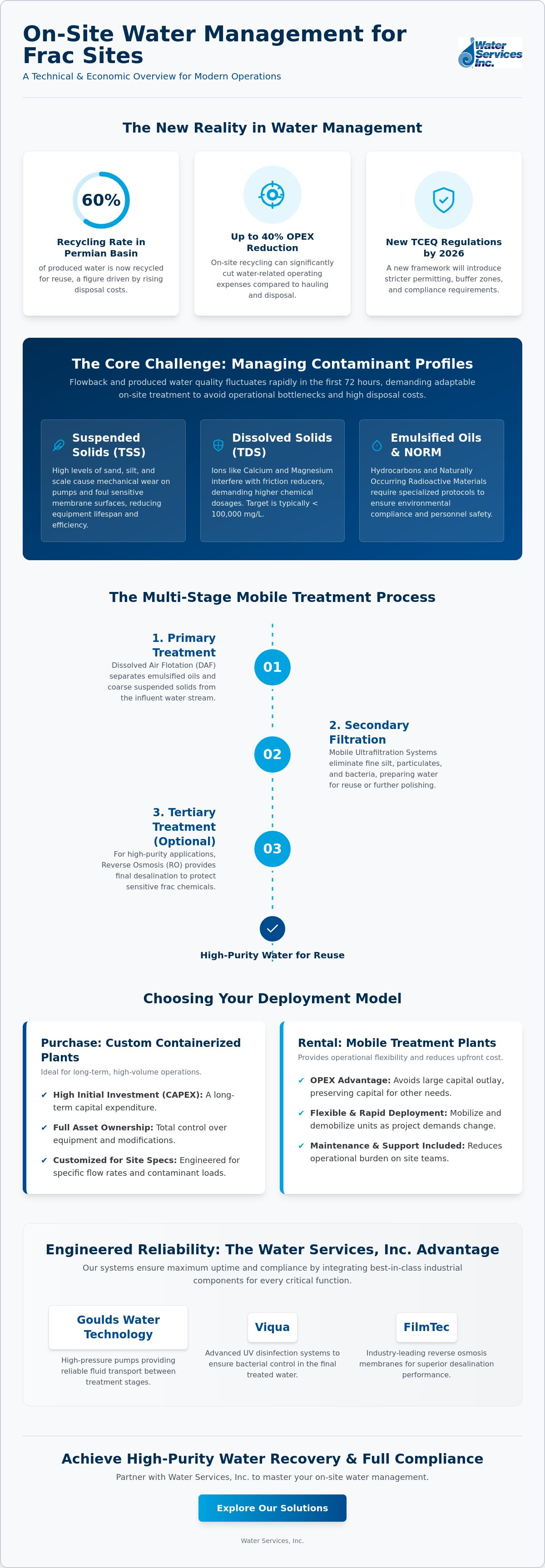
In the Permian Basin, roughly 60% of produced water is now recycled for reuse, a figure that is expected to climb as disposal costs and regulatory pressures increase. As the Texas Commission on Environmental Quality (TCEQ) finalizes its new regulatory framework in August 2026, operators must adapt to stricter permitting and buffer zone requirements. Implementing mobile water treatment for frac sites is no longer just an environmental choice; it's a critical strategy for reducing the high costs of hauling and deep well disposal. Industry data suggests that on-site recycling can reduce water-related operating expenses by up to 40% compared to traditional methods.
You're likely aware that the rapidly changing water quality during the flowback phase makes standard disposal a logistical nightmare. This guide provides the technical roadmap to master on-site water management and ensure high-purity reuse in your next frac stage. We will analyze the engineering specifications of modular systems, compliance strategies for the latest 2026 rules, and methods to minimize your equipment footprint. You'll gain the specific insights needed to achieve reliable, high-purity water recovery while maintaining full regulatory compliance and operational efficiency.
The global produced water treatment market is projected to reach $9.3 billion by 2025, with on-site recycling making up the majority of new infrastructure investment. You're likely aware that managing the chemical complexity of flowback water within the first 72 hours is critical to avoiding excessive disposal costs. This article promises to help you master the technical and logistical requirements of mobile water treatment for frac sites to achieve high-purity reuse. We will preview the deployment of primary treatment like Dissolved Air Flotation and secondary filtration using Mobile Ultrafiltration Systems. The guide also evaluates the financial metrics of purchasing custom containerized plants versus the OPEX advantages of mobile water treatment plant rentals. We detail how to optimize site logistics and engineering reliability using industrial components from Goulds, Viqua, and FilmTec. By leveraging the expertise of Water Services, Inc., operators ensure their systems remain efficient and compliant in the evolving 2026 regulatory landscape.
The Challenge of Flowback and Produced Water at Frac Sites
Managing the hydraulic fracturing lifecycle requires a precise understanding of the fluid streams returning to the surface. Operators distinguish between flowback, the initial return of fracturing fluids mixed with formation water, and produced water, the long-term aqueous byproduct of hydrocarbon production. The management of flowback and produced water represents a primary operational bottleneck. During the first 72 hours of flowback, water quality fluctuates rapidly. Salinity levels, organic loading, and mineral content can shift by orders of magnitude as the well stabilizes. This chemical instability necessitates mobile water treatment for frac sites that can adjust to real-time influent variations without halting operations.
Economic drivers for on-site treatment are intensifying. While deep well disposal costs averaged between $0.60 and $0.70 per barrel in late 2025, rising logistics and regulatory fees are narrowing the gap with recycling costs. Efficient on-site treatment ensures well integrity. High-purity water is essential for the performance of friction reducers and other chemical additives. Contaminated water reduces fracture efficiency, leading to sub-optimal proppant transport and potential formation damage.
Contaminant Profiles: TSS, TDS, and Emulsified Oils
Chemical complexity in shale plays involves high concentrations of Total Suspended Solids (TSS) and dissolved ions. High TSS levels cause mechanical wear on downstream injection equipment and foul sensitive membrane surfaces. Divalent cations like Calcium and Magnesium are particularly problematic. These ions interfere with friction reducers, increasing the surface tension of the fluid and requiring higher chemical dosages to achieve the desired flow rates. Operators must also manage emulsified oils and naturally occurring radioactive materials (NORM). These contaminants require specialized water treatment protocols to prevent environmental non-compliance and protect site personnel.
Regulatory Compliance and Discharge Standards
The regulatory landscape is shifting toward a circular water economy. In 2026, the Texas Commission on Environmental Quality (TCEQ) finalized Rule Project Number 2026-006-309-OW. This framework moves permitting authority from the Railroad Commission to the TCEQ, establishing stricter buffer zones and case-by-case evaluations for land application. These changes make mobile water treatment for frac sites a necessity for operators looking to avoid the legal risks of traditional disposal. Regulatory bodies now favor reuse over discharge to mitigate seismic activity linked to saltwater disposal wells. Operators generally target a Total Dissolved Solids (TDS) threshold of less than 100,000 mg/L for efficient slickwater fracturing, though specific friction reducer tolerances may require lower levels.
Core Technologies for Mobile Water Treatment Units
Effective mobile water treatment for frac sites relies on a multi-stage process designed to handle the volatile influent quality of shale operations. While many providers focus solely on oil and solids removal, modern completion designs require lower Total Dissolved Solids (TDS) and minimal fine particulates to protect formation integrity. This shift in the management of produced water necessitates an integrated engineering approach. Primary treatment begins with Dissolved Air Flotation (DAF) to separate emulsified oils and suspended solids. This is followed by Mobile Ultrafiltration Systems to eliminate bacteria and fine silt. For operators requiring high-purity permeate for friction reducer stability, tertiary Reverse Osmosis (RO) provides the final desalination stage. Reliable fluid transport between these stages is maintained by Goulds Water Technology Pumps, which provide the high-pressure feed necessary for membrane performance.
Clarification and Solids Separation
Mobile clarification units must manage variable flow rates that can reach 1,500 GPM during peak completion phases. Achieving consistent turbidity reduction requires precise chemical dosing strategies. In high-salinity water, the performance of friction reducers and coagulants is often compromised by ionic interference. We integrate Pulsafeeder Metering Pumps to ensure exact polymer injection. This allows for stable flocculation even as influent quality shifts during the flowback period. This precision prevents solids carryover that would otherwise foul downstream filters or cause mechanical wear on high-pressure injection pumps.
Membrane Filtration: UF and RO Integration
The selection of membrane chemistry is critical for long-term operational efficiency. We utilize FilmTec Reverse Osmosis Membranes for influent streams with high boron or silica concentrations, which are common in specific shale plays. When treating brackish produced water for reuse, Hydranautics RO Membranes provide the flux and rejection rates needed for high-volume desalination. Continuous operation in these environments risks rapid scaling. To mitigate this, the application of specialized water treatment antiscalants is mandatory. These chemicals prevent mineral precipitation on the membrane surface, extending the interval between clean-in-place cycles. You can browse our industrial water treatment components to find the exact specifications for your next deployment.
Ultrafiltration acts as a necessary barrier before the RO stage. By removing particulates down to 0.02 microns, these systems protect expensive RO membranes from irreversible fouling. This two-stage membrane approach ensures that the final water quality meets the stringent requirements for advanced slickwater fracturing fluids. Integrating these technologies into a single mobile footprint reduces the need for large storage lagoons and minimizes the overall site footprint.
Deployment Models: Rental vs. Custom Containerized Systems
Selecting the optimal procurement model for mobile water treatment for frac sites depends on well density and completion schedules. Operators must evaluate the Total Cost of Ownership (TCO) beyond simple treatment rates. Hauling produced water off-site involves high trucking fees and disposal surcharges that fluctuate with fuel prices and disposal well availability. While on-site treatment reduces these logistical burdens, maintaining the necessary transport fleet remains critical; companies like Diego's Shop provide the expert diesel repairs needed to keep those heavy-duty trucks on the road and minimize downtime. A standard TCO analysis compares the Capital Expenditure (CAPEX) of owned assets against the Operating Expenditure (OPEX) of rental agreements. Implementing mobile water treatment for frac sites via a rental model provides immediate operational flexibility without the long-term debt associated with asset purchase.
When to Choose Mobile Rental Units
Rental units are ideal for short-term completion projects where flowback volumes peak rapidly and then decline. This model allows operators to manage temporary water loads without committing to long-term asset ownership. It's a strategic choice for unproven shale plays where capital risk must be minimized. Rental agreements typically include technical support and maintenance. This ensures that equipment uptime remains high during critical frac stages. As well density increases, modular rental units can be added to the site to scale capacity without significant lead times.
The Case for Custom Containerized RO Plants
For mature fields with centralized produced water hubs, custom containerized Reverse Osmosis (RO) plants offer a superior Return on Investment (ROI). These systems are engineered for specific basin chemistry. For example, a Permian Basin deployment might prioritize high-salinity tolerance, while a Marcellus site focuses on specific mineral removal. Custom plants integrate seamlessly with existing site SCADA systems and Electric Power Controls. This integration allows for remote monitoring and decentralized energy management in remote locations. Owning the asset provides long-term cost stability and full control over the treatment specifications.
Scalability is a core advantage of modular engineering. By deploying containerized plants, operators can move assets between pads as completion programs shift. This mobility ensures that the infrastructure remains productive throughout the field's lifecycle. While the initial investment for a custom plant is higher, the long-term cost per barrel treated is often significantly lower than third-party disposal or continuous rental fees. Operators should choose the model that aligns with their five-year development plan and available completion budget.
Operational Logistics: Integrating Treatment at the Frac Site
Integrating mobile water treatment for frac sites requires precise coordination with existing completion infrastructure. Space on an active well pad is a premium resource. Operators must choose between containerized and skid-mounted configurations based on environmental exposure and durability requirements. Containerized units offer superior protection for sensitive components like high-pressure pumps and membrane housings in harsh climates. These units are designed for rapid mobilization, allowing for quick connection to flowback tanks and produced water gathering lines via high-pressure hoses or temporary manifold systems.
Power requirements represent a significant logistical hurdle in remote shale plays. Most mobile treatment plants operate on decentralized energy solutions due to a lack of grid access. This typically involves Tier 4 diesel generators or integrated solar-battery hybrids for low-power control systems. Efficient energy management is essential for maintaining the high-pressure feed required for RO membranes without excessive fuel consumption. You can order industrial water treatment components to ensure your power and control systems meet these rigorous field demands.
Automation and Remote Monitoring
Continuous 24/7 operation is necessary to keep pace with high-volume hydraulic fracturing schedules. We utilize Walchem Controllers to automate critical processes such as chemical dosing and system backwashes. These controllers work in tandem with Signet Flow Sensors to provide precise real-time data on throughput and reuse volumes. This automation reduces the headcount required on-site and ensures accurate data logging for regulatory reporting. Remote troubleshooting capabilities allow engineers to adjust setpoints or diagnose pressure drops from a central office, which minimizes downtime during critical completion phases.
As these systems become increasingly interconnected, ensuring robust cybersecurity for your field data is essential; for expert guidance on protecting your industrial IT infrastructure, check out SpaceCenter Systems.
Footprint and Site Preparation
Site preparation begins with a stabilized and level pad. Heavy containerized treatment units require compacted ground to prevent structural strain on internal piping and frame components. Integration involves strategic placement to minimize the length of transfer lines between storage tanks and the treatment unit. For insights into similar large-scale industrial challenges, read our guide on Mining Wastewater Treatment Solutions. This cross-industry perspective highlights the importance of engineering for resource recovery in demanding environments.
Safety protocols are paramount in harsh industrial settings. Operators must be equipped with appropriate personal protective equipment (PPE) when handling chemicals or performing maintenance. This includes chemical-resistant gloves and eye protection for tasks involving antiscalants or membrane cleaning agents. Proper site lighting and clear labeling of high-pressure lines are also essential for maintaining a safe working environment during night operations.
Engineering Reliability: The Water Services, Inc. Advantage
Water Services, Inc. has operated at the forefront of global water infrastructure since 1994. With over 30 years of specialized experience, we engineer mobile water treatment for frac sites that prioritizes technical integrity and industrial durability. Our systems aren't generic assemblies. We utilize a curated selection of Tier-1 components, including Goulds Water Technology Pumps, Viqua UV systems, and FilmTec membranes. These specifications ensure that every unit meets the rigors of military, mining, and oil and gas environments. Our logistical network supports rapid deployment to remote basins, blending domestic engineering reliability with a worldwide distribution reach.
We understand that equipment performance is only one part of the equation. Our approach focuses on the functional value of the hardware in demanding commercial environments. By maintaining a stable and experienced presence in the global market, we provide operators with the confidence that their mobile water treatment for frac sites will perform under pressure. We avoid hyperbole and focus on the technical metrics that define system success, such as flux rates, rejection percentages, and mean time between maintenance cycles.
Technical Support and Commissioning
Commissioning a new treatment system requires precision. Expert engineers handle on-site installation and initial system testing to guarantee immediate operational readiness. We offer ongoing maintenance contracts designed to maintain 99% uptime in the field. To support continuous operation, operators have direct access to replacement sediment and carbon filters through our e-commerce platform. This streamlined procurement process ensures that consumables are always available to prevent unplanned downtime during critical completion phases.
Case Study: Modular RO in Remote Operations
In a recent modular RO deployment for a Permian Basin operator, on-site treatment reduced water hauling and disposal costs by over 40%. By treating produced water to high-purity standards, the operator significantly decreased their reliance on freshwater sourcing for subsequent completion stages. This deployment utilized containerized systems to minimize the physical footprint on a crowded pad. For a deeper analysis of these engineering requirements, consult our guide on Industrial Water Treatment Systems. This resource explains the broader context of engineering high-purity solutions for 2026 regulatory standards.
Reliable water management is the backbone of efficient hydraulic fracturing. Contact Water Services, Inc. today for a custom frac site water analysis and technical consultation to optimize your on-site treatment strategy.
Optimizing Your 2026 Water Management Strategy
Engineering a resilient completion program requires shifting from water disposal to high-purity recovery. Integrating Dissolved Air Flotation with Mobile Ultrafiltration and Reverse Osmosis allows operators to meet the stringent 2026 TCEQ and EPA standards while reducing total operating costs. Effective mobile water treatment for frac sites depends on the reliability of the components and the precision of the automated controls. By treating produced water on-site, you eliminate the logistical burden of hauling and the rising costs of deep well disposal.
Water Services, Inc. provides the industrial expertise necessary for these complex deployments. Founded in 1994, we offer 30 years of experience managing global water infrastructure across Africa, the Middle East, and the Americas. As an authorized distributor for Goulds, Viqua, and FilmTec, we ensure your site uses only Tier-1 hardware for maximum uptime. Our team handles the engineering, commissioning, and ongoing technical support required to maintain high field reliability. We're ready to help you navigate the evolving regulatory landscape with precision.
Ready to optimize your site logistics and reduce disposal overhead? Request a Quote for Custom Mobile Water Treatment Solutions to secure a durable, high-performance system for your next completion project. We look forward to supporting your operational success.
Frequently Asked Questions
What is the maximum GPM a mobile water treatment unit can handle?
A single mobile clarification unit typically manages flow rates up to 1,500 GPM. For operations requiring higher volumes during peak completion phases, modular systems are deployed in parallel. This scalable approach allows operators to increase capacity without the need for permanent infrastructure. Integrating multiple units ensures that mobile water treatment for frac sites remains efficient even as well density and flowback volumes fluctuate.
Can mobile RO systems remove TDS from produced water effectively?
Mobile Reverse Osmosis (RO) systems effectively reduce Total Dissolved Solids (TDS) to levels suitable for high-purity reuse in slickwater fracturing. These systems utilize high-rejection membranes to desalinate brackish produced water, often targeting a permeate quality with TDS levels well below 100,000 mg/L. This process is essential for protecting the stability of friction reducers and maintaining formation integrity during the next frac stage.
How long does it take to deploy a containerized treatment plant to a frac site?
Standard containerized units can be mobilized and commissioned on-site within 3 to 7 days. This timeline includes the physical transport of the containers, connection to existing gathering lines, and system calibration by field engineers. Custom-engineered plants may require additional lead time for initial fabrication, but their modular design allows for rapid relocation between pads once the initial setup is complete.
Is it better to rent or buy a mobile water treatment system for a 6-month project?
Renting is generally the preferred model for a 6-month completion project to minimize upfront capital risk. The rental model categorizes costs as Operating Expenditure (OPEX), which provides immediate flexibility and includes technical support and maintenance services. Purchasing a system is typically reserved for long-term field development where the asset can be utilized across multiple pads over several years to achieve a lower cost per barrel treated.
What are the power requirements for a mobile DAF and RO system?
Mobile DAF and RO systems typically require 480V three-phase power to operate high-pressure feed pumps and mechanical separators. In remote locations without grid access, these requirements are met using Tier 4 diesel generators or integrated solar-battery hybrids for low-power control systems. Efficient energy management is critical to ensure that mobile water treatment for frac sites operates continuously without excessive fuel consumption or power interruptions.
How do Walchem controllers improve the efficiency of oilfield water treatment?
Walchem controllers automate critical chemical dosing and system backwash cycles to ensure consistent water quality. By integrating real-time data from flow sensors, these controllers adjust polymer and antiscalant injection rates based on actual influent quality. This automation reduces the need for manual monitoring and prevents the over-treatment or under-treatment of produced water, which maximizes chemical efficiency and protects downstream membranes from fouling.
What maintenance is required for RO membranes in high-salinity frac water?
RO membranes in high-salinity environments require continuous antiscalant dosing and regular clean-in-place (CIP) cycles. Antiscalants prevent mineral precipitation on the membrane surface, while CIP cycles use specialized chemicals to remove organic and inorganic fouling. Operators must also monitor pressure differentials across the membrane housings to identify when maintenance is required, ensuring the system maintains its rated flux and rejection levels.
Are there mobile systems specifically designed for the Permian Basin water chemistry?
Yes, mobile systems are frequently custom-engineered to handle the unique chemical profiles of the Permian Basin, including high boron and silica concentrations. Engineering teams select specific membrane chemistries, such as those from FilmTec or Hydranautics, that offer high rejection rates for these problematic ions. This basin-specific configuration ensures that the treated water meets the technical requirements for local fracturing fluids and regulatory discharge standards.
0 comments