

Smart pumping systems now account for 27% of all industrial installations and have been shown to reduce unscheduled downtime by 23%. High-head dewatering and abrasive slurry transport remain the most punishing applications in any mine. You're likely dealing with frequent mechanical seal failures or the rising energy costs of deep-pit operations. This makes optimizing pump system design for mining operations a critical priority rather than a luxury. It's a matter of maintaining technical integrity in the face of harsh environments.
This guide provides technical strategies to enhance pump efficiency, reduce your operational expenditure, and ensure full MSHA compliance under the latest July 2026 regulatory updates. We've compiled data on the newest API Standard 610 13th Edition and the impact of the Protecting Domestic Mining Act on project timelines. You'll learn how to increase Mean Time Between Failure (MTBF) using Goulds Water Technology hardware and modular treatment units. We'll examine the integration of IoT-based condition monitoring and the deployment of modular systems for rapid site expansion.
Key Takeaways
- Learn the technical requirements for optimizing pump system design for mining operations by evaluating fluid specific gravity, slurry density, and extreme head constraints.
- Improve energy efficiency and lower OPEX by matching pump curves to system resistance and integrating Variable Frequency Drives for fluctuating flow management.
- Select durable materials like CD4MCu and high-performance mechanical seals to prevent leakage and resist wear in high-abrasion environments.
- Utilize Ashcroft pressure gauges and real-time monitoring to detect system blockages early, significantly increasing Mean Time Between Failure (MTBF).
- Leverage modular containerized systems and Goulds Water Technology pumps to ensure rapid, MSHA-compliant deployment across remote global mining sites.
Core Challenges in Mining Pump System Design
Successful extraction requires managing fluids that are often more destructive than the ore itself. When optimizing pump system design for mining operations, engineers must first account for the physical toll of high specific gravity (SG) and abrasive slurry density. These variables don't just affect flow rates; they fundamentally change the power requirements and wear cycles of the hardware. High viscosity and solid concentrations increase friction losses, requiring precise calculations to avoid motor overloads and premature component failure.
Environmental constraints in deep-pit or underground mining add layers of complexity. High-head requirements often necessitate multi-stage configurations or series pumping to move water across vast vertical distances. Remote site logistics mean that every failure is amplified by the difficulty of transporting replacement parts. Reliable dewatering pumps must operate in extreme temperatures while resisting the chemical corrosion common in mine tailings. Technical integrity is the only way to ensure these systems survive the rigors of the field.
Understanding Slurry and Abrasive Fluid Dynamics
Abrasive solids impact centrifugal pump internal components through impingement and sliding abrasion. Selecting the correct impeller is critical. Open impellers handle higher solid concentrations but may sacrifice efficiency compared to closed designs used for clear water. Engineers must calculate the effect of solids on pump performance using derating factors to ensure the system meets demand. Slurry Pumps in Mining are specifically engineered with thicker cross-sections to withstand this sacrificial wear. Additionally, deep-well applications carry high cavitation risks if Net Positive Suction Head Available (NPSHA) isn't strictly maintained above the required levels.
Compliance and Safety Standards (MSHA & ISA)
Regulatory adherence is mandatory for operational continuity. The Mine Safety and Health Administration (MSHA) recently streamlined its standards, with several outdated regulations withdrawn effective July 27, 2026. Compliance now focuses on the technical integrity of pressure systems, air receivers, and high-pressure hoses. For automated systems, implementing ISA-7.0.01-1996 standards for instrument air ensures that pneumatic controls remain reliable in dusty, humid environments. Safety-first design requires integrated overpressure protection and emergency shut-off protocols to prevent catastrophic pipe bursts or vessel failures during a blockage. Maintaining these standards is a key part of optimizing pump system design for mining operations, as it protects personnel and prevents environmental contamination from primary containment breaches.
Technical Optimization Strategies for Maximum Efficiency
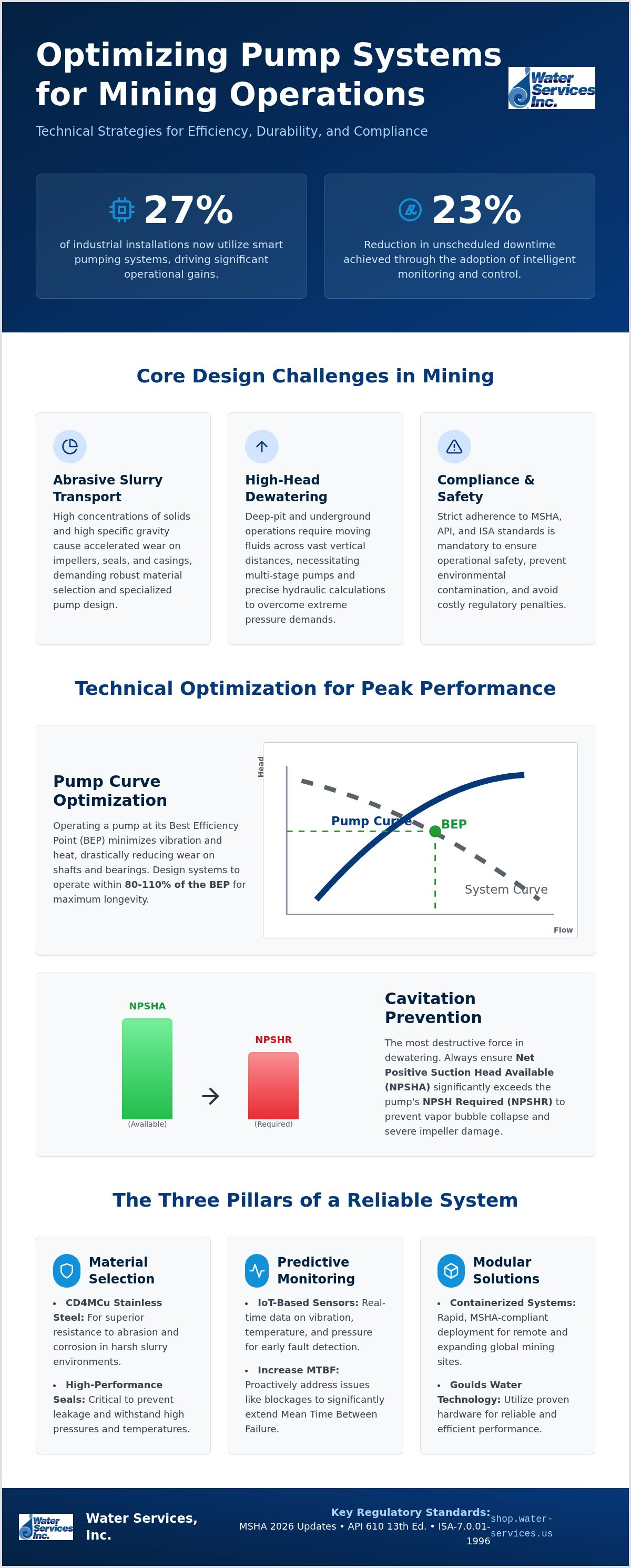
Efficiency in heavy industrial dewatering isn't a byproduct of luck. It's the result of precise engineering. Achieving peak performance when optimizing pump system design for mining operations requires a holistic view of the hydraulic circuit. You must match pump performance curves to the actual system resistance curve. Operating too far to the left or right of the curve causes excessive vibration and heat, leading to premature shaft and bearing failure. Selecting the correct pipe diameter is equally vital. While smaller pipes reduce initial capital costs, they increase fluid velocity and friction loss, which forces the pump to work harder and consumes more energy.
Cavitation remains one of the most destructive forces in deep-pit dewatering. It occurs when the pressure at the pump suction falls below the vapor pressure of the liquid, causing bubbles to form and collapse against the impeller. Calculating Net Positive Suction Head (NPSH) is mandatory to prevent this. You must ensure that the NPSH Available (NPSHA) from the system always exceeds the NPSH Required (NPSHR) by the pump. Maintaining this margin protects the technical integrity of the hardware and prevents the pitted impellers that often result from neglected hydraulic math.
Advanced Hydraulic Analysis
Software modeling allows engineers to predict head loss and flow distribution before a single pipe is laid. This is critical for deep-pit vs. underground operations where elevation changes can exceed several hundred meters. These models account for the static head of the lift and the dynamic head created by friction. The Best Efficiency Point (BEP) is the flow rate at which a pump operates with the highest hydraulic efficiency, minimizing mechanical stress and maximizing the longevity of internal components. Designing the system to stay within 80% to 110% of the BEP ensures stable operation and reduces the frequency of emergency repairs.
Energy Management and VFD Integration
Variable Frequency Drives (VFDs) are essential for managing fluctuating flow rates without wasting energy through throttling valves. According to industry data from 2026, 31% of users report energy cost savings of over 15% after integrating VFDs into their pump systems. These drives allow the motor to slow down during low-demand periods, which significantly reduces electrical draw. Operators can monitor these fluctuations in real-time using water flow meter gpm sensors. For a fully automated process, integrating Walchem controllers allows the system to adjust pump speed based on tank levels or pressure setpoints. Investing in custom engineering for Goulds Water Technology pumps allows operators to recover initial costs through significantly lower long-term OPEX.
Material Selection and Wear Resistance in Mining
Selecting the right metallurgy is a critical step in optimizing pump system design for mining operations. Standard cast iron is suitable for basic dewatering, but it fails rapidly when exposed to the abrasive slurries and corrosive chemicals found in modern extraction sites. While higher grade materials increase the initial capital expenditure (CAPEX), they significantly reduce long term operational costs by extending Mean Time Between Failure (MTBF). For high velocity fluid paths, protective coatings or rubber liners provide a sacrificial layer that preserves the technical integrity of the pump casing and impeller. Balancing durability with cost requires a deep understanding of the specific fluid chemistry at the site.
Metallurgical Options for Corrosive Mine Water
Mine water chemistry often dictates hardware selection. Duplex Stainless Steel is the preferred choice for high chloride environments where standard 316 stainless steel would suffer from pitting and stress corrosion cracking. In Acid Mine Drainage (AMD) scenarios, CD4MCu provides superior resistance to both corrosion and erosive wear. This specialized duplex alloy offers higher hardness and yield strength than standard stainless steels, making it ideal for the abrasive nature of tailings management. You can further protect your pumping assets by implementing industrial water filtration systems for pre pumping treatment to remove larger particulate matter before it reaches the pump intake.
Seal and Bearing Optimization
The mechanical seal is often the first point of failure in a mining pump. Preventing slurry leakage requires selecting the correct flush plan to keep abrasive solids away from the seal faces. Plan 32 or Plan 54 arrangements are frequently used to provide a clean external flush, which maintains a stable fluid film and cools the seal assembly. Advancements in bearing cooling are also vital for high temperature process pumps. Utilizing heavy duty bearing frames with integrated cooling fins or water jackets prevents oil degradation and extends component life. Reducing maintenance cycles through superior component selection ensures that your Goulds Water Technology pumps remain operational in the most demanding remote environments. High quality components like Ashcroft pressure gauges allow operators to monitor seal chamber pressure and detect potential failures before they result in a total system shutdown.
Proper material selection ensures that the system can handle the abrasive slurry dynamics discussed in earlier sections. It's not just about surviving the environment; it's about maintaining peak hydraulic efficiency over the entire life of the pump. Investing in the right alloys and seal configurations up front prevents the catastrophic downtime that can cost a mine thousands of dollars per hour in lost production.
Monitoring and Predictive Maintenance Protocols
Asset longevity in heavy industry depends on consistent data acquisition. When optimizing pump system design for mining operations, engineers must move beyond static hardware selection and implement active monitoring frameworks. Real-time vibration analysis and temperature tracking serve as the primary indicators of pump health, allowing for the detection of misalignment or bearing wear before a catastrophic failure occurs. These protocols shift the maintenance burden from reactive repairs to data-driven schedules, which preserves the technical integrity of the entire dewatering circuit.
Integrating Ashcroft pressure gauges provides the diagnostic data needed to identify system blockages or declining pump performance. A sudden drop in discharge pressure often indicates internal wear or impeller damage, while an increase in suction pressure may signal a clogged intake. By monitoring these metrics, operators can schedule service during planned shutdowns rather than responding to emergency outages. This level of oversight is essential for managing the high-head requirements and abrasive fluids typical of deep-pit environments.
Digital Twins and Remote Telemetry
IoT sensors now allow for health tracking in inaccessible underground sites where manual inspection is difficult. Remote telemetry systems transmit performance data to centralized control centers, enabling global mining operations to be managed with precision. These digital twins provide a virtual representation of the pumping system, allowing engineers to simulate different flow scenarios and optimize chemical dosing with Pulsafeeder metering pumps. Utilizing Walchem controllers ensures cloud-based visibility, which is critical for maintaining MSHA safety benchmarks across remote sites. Predictive maintenance protocols increase Mean Time Between Failure (MTBF) by identifying mechanical stressors before they cause component fracture or system seizure.
Instrumentation for Process Control
Accuracy in fluid management is paramount for resource recovery and environmental compliance. Signet flow sensors and high-accuracy pressure transducers allow for the precise monitoring of pressure differentials across filtration stages. According to 2026 industry statistics, smart pumping systems now account for 27% of all industrial installations and have been shown to reduce unscheduled downtime by 23%. This level of process control ensures that the system operates within its Best Efficiency Point (BEP) even as site conditions change. For those looking to upgrade their monitoring capabilities, explore our industrial control and instrumentation solutions to ensure your system remains reliable under the most demanding conditions.
Implementing Modular and High-Performance Solutions
Modular deployment is the modern standard for rapidly expanding mine sites. When optimizing pump system design for mining operations, the speed of hardware integration directly impacts the project's bottom line. High-performance solutions must offer more than just hydraulic capacity; they require logistical compatibility. Containerized plants and mobile units allow for immediate dewatering or treatment without the delays of permanent on-site construction. Custom engineering fees are often viewed as an upfront cost, but they pay for themselves by ensuring the system is precisely sized for the unique head and flow requirements of the site. This prevents the energy waste and mechanical stress associated with oversized equipment.
Precision engineering during the design phase eliminates the trial-and-error approach that often leads to system instability. By calculating the exact system resistance and selecting the appropriate Goulds model, operators avoid the mechanical stress associated with operating outside the Best Efficiency Point. This proactive design philosophy is the most effective way to lower long-term OPEX and maintain compliance with MSHA's stringent safety standards for pressure systems. Technical integrity remains the anchor for every modular deployment we manage globally.
Goulds Pumps: Industrial Reliability for Mining
The Goulds Water Technology Pumps catalog provides the versatility needed for diverse mining applications. The 3196 series is a benchmark for process water and chemical handling, featuring an open impeller design that resists clogging while maintaining high efficiency. For deep-well and sump applications, submersible solutions offer reliable performance in flooded environments where suction lift isn't feasible. Standardizing on Goulds hardware simplifies remote inventory management. Using a common parts platform across multiple pump sizes reduces the volume of spare seals, bearings, and impellers that must be stocked at remote sites. This logistical efficiency is a core component of maintaining operational continuity in the field.
Modular and Mobile Infrastructure
Deploying mining wastewater treatment solutions via modular containers significantly reduces on-site construction time. These units arrive pre-piped and pre-wired, allowing for rapid connection to existing dewatering lines. Containerized Reverse Osmosis (RO) and ultrafiltration plants provide the flexibility needed for temporary mining phases or emergency capacity increases. Mobile rental options are particularly effective for pilot testing new extraction processes or managing seasonal water surges. Beyond process water, integrating Viqua UV systems into these modular units ensures safe potable water for remote mine camps. This comprehensive approach to fluid management ensures that every aspect of the site's water cycle is handled with industrial-grade reliability and precision.
Advancing Dewatering Efficiency and Operational Continuity
Effectively managing mine water in 2026 requires more than just high-capacity hardware. It demands the integration of advanced hydraulic modeling, precise material selection for abrasive slurries, and the deployment of modular, MSHA-compliant infrastructure. By prioritizing the technical integrity of your dewatering circuit, you ensure long-term stability and significantly lower OPEX. Optimizing pump system design for mining operations is a continuous process of monitoring and technical adjustment that protects your most critical assets.
Utilizing real-time telemetry alongside durable Goulds Water Technology pumps allows your team to maintain peak efficiency even in the most remote global sites. As an authorized distributor and specialist in MSHA-compliant systems, Water Services, Inc. provides the engineering expertise needed to handle complex deep-pit and underground challenges. We've supported projects across Africa and South America since 1994, delivering reliable results in the world's most demanding environments.
Request a custom mining pump system design from Water Services, Inc. to secure your operational future. We're ready to support your next project with global engineering expertise and field-proven hardware that stands up to the rigors of the industry.
Frequently Asked Questions
What are the most common causes of pump failure in mining operations?
The primary causes of pump failure include sliding abrasion from high-solid slurries, mechanical seal degradation, and cavitation. In deep-pit environments, operating outside the Best Efficiency Point (BEP) often leads to excessive vibration and bearing seizure. Maintaining technical integrity requires selecting hardware like Goulds Water Technology pumps that feature thicker wear walls. Regular monitoring of discharge pressure using Ashcroft gauges helps identify internal wear before a total system shutdown occurs.
How do I choose between a centrifugal and a submersible pump for mine dewatering?
Choosing between these designs depends on the vertical lift and site accessibility. Centrifugal pumps are preferred for high-volume process water where the pump can be mounted at the surface. Submersible pumps are essential for deep-well sumps or flooded environments where the suction lift exceeds eight meters. When optimizing pump system design for mining operations, engineers must evaluate whether the pump can be easily maintained in remote locations or if a submersible's self-cooling properties are required.
What is the impact of abrasive slurries on pump efficiency over time?
Abrasive slurries cause physical erosion of the impeller and volute casing, which increases internal clearances and reduces hydraulic efficiency. As components wear, the pump must consume more power to achieve the same flow rate and head pressure. This degradation significantly increases operational expenditure (OPEX) over time. Utilizing sacrificial liners and high-chrome iron impellers helps mitigate these losses, but consistent monitoring of flow metrics is necessary to schedule timely component replacement.
Can Variable Frequency Drives (VFDs) really save money in high-head mining applications?
Variable Frequency Drives (VFDs) provide substantial savings by allowing the motor to run at the exact speed required for the current flow demand. According to 2026 industry data, 31% of industrial pump users reported energy cost reductions exceeding 15% after VFD integration. These drives eliminate the energy waste associated with mechanical throttling valves. In high-head applications, VFDs also reduce hydraulic shock during startup, which protects the piping and extends the lifespan of the pump motor.
How does MSHA regulation affect the design of my pumping infrastructure?
MSHA regulations dictate the safety standards for pressure vessels, air receivers, and high-pressure hose assemblies. Designers must ensure that all systems include overpressure protection and emergency shut-off protocols to protect personnel. Recent July 2026 regulatory changes have streamlined these requirements, but technical compliance remains mandatory for all mining infrastructure. Using MSHA-compliant systems ensures that the site remains operational and avoids the costly fines or shutdowns associated with safety violations in remote environments.
What materials are best for handling acid mine drainage (AMD)?
CD4MCu and Duplex Stainless Steel are the most effective materials for handling the corrosive and abrasive nature of acid mine drainage. These alloys offer a superior balance of mechanical strength and chemical resistance compared to standard 316 stainless steel. While the initial capital cost is higher, these materials prevent the rapid pitting and stress corrosion cracking common in low-pH environments. Selecting the right metallurgy is a key step in optimizing pump system design for mining operations.
When should a mine consider mobile treatment units over permanent installations?
Mines should consider mobile treatment units for temporary extraction phases, rapid site expansions, or emergency dewatering needs. These containerized systems are pre-piped and pre-wired, allowing for deployment in a fraction of the time required for permanent construction. Mobile units also offer flexibility for pilot testing new water treatment processes. For remote mine camps, mobile infrastructure can quickly integrate Viqua UV systems to provide safe potable water without the need for fixed civil engineering.
How do I calculate the required NPSH for a deep-pit pump system?
Calculating Net Positive Suction Head (NPSH) involves determining the pressure available at the pump intake after accounting for atmospheric pressure and friction losses. You must ensure that NPSH Available (NPSHA) is consistently higher than the NPSH Required (NPSHR) specified by the pump manufacturer. In deep-pit systems, elevation changes and high fluid temperatures significantly impact these values. Failure to maintain a sufficient NPSH margin results in destructive cavitation, which destroys impellers and creates unscheduled downtime.
0 comments