

What if the backup pump is available, but a shared control or power failure keeps it from operating? A spare unit can reduce the impact of a pump failure, but peace of mind with redundant pump systems depends on more than having another pump on site. The arrangement must support the required process duty when demand changes or equipment needs maintenance.
Redundancy can limit downtime, but the outcome depends on how the pumps operate together and whether the backup shares critical dependencies with the primary unit. This guide explains the practical differences between parallel and standby configurations, and what to assess before choosing an approach for your duty cycle.
You’ll also learn how capacity requirements, piping, controls, power supply, and maintenance planning affect resilience. Treating pump selection as part of the wider system design helps reveal weak points that a second pump alone may not address. Water Services, Inc. offers Goulds Water Technology pumps and designs modular water-treatment systems for industrial requirements.
Key Takeaways
- Compare parallel and standby arrangements to see which better matches your process duty and operating pattern.
- Assess shared power, controls, and piping dependencies that could prevent backup capacity from serving its purpose.
- For peace of mind with redundant pump systems, define the required duty first, then align equipment, system design, and maintenance planning.
- Use a requirements-based sequence to evaluate flow, pressure, duty cycle, fluid characteristics, operating conditions, and commissioning needs.
- Consider Goulds Water Technology pumps within the wider treatment process and site design, rather than as a standalone redundancy decision.
What redundant pump systems do for industrial water operations
A redundant pump system includes planned backup capacity intended to maintain a required pumping duty when a pump is unavailable. Its purpose is to reduce the consequences of selected equipment failures, not to guarantee uninterrupted operation. The backup must be capable of delivering the required flow and pressure, and the surrounding system must allow it to operate when needed. A spare pump that cannot meet the process requirement may offer little practical protection.
Redundancy is one measure within a larger reliability plan. In Redundancy in engineering, backup elements are introduced to reduce the effect of a failure, but dependencies between components still matter. Equipment redundancy adds backup capacity; whole-system resilience depends on the pumps, utilities, controls, piping, and operating plan working together. That distinction is central to achieving peace of mind with redundant pump systems.
Continuity requirements vary by duty. A process-water interruption may affect production, while a wastewater pumping interruption can disrupt collection or treatment. A temporary treatment site may have different constraints, such as limited access to replacement equipment or support. The right level of backup depends on the consequences and likely duration of an interruption, not simply on the number of pumps installed.
Which operations may need pump redundancy?
Start by identifying what happens if pumping stops and how long the operation can tolerate the interruption. Continuous processes may have little room for downtime. Remote sites can face longer delays before maintenance or replacement equipment is available. Weigh the operational impact against the practical demands of providing, exercising, and maintaining backup capacity.
For system-wide continuity, consider how the pump duty connects to treatment stages, storage, and downstream processes. This is especially important in industrial water-treatment systems, where a functioning pump alone may not keep the full process operating.
What does redundancy protect against?
A backup pump can address the loss of a primary pump if it can take on the required duty. It won’t necessarily protect against loss of power, a shared control failure, blocked or damaged piping, or an interrupted source-water supply. These shared dependencies can become single points of failure: one component whose loss stops both the primary and backup arrangement.
Map those dependencies as part of the design review. Useful backup capacity must match the process duty and remain operable under the conditions in which it is needed. A pump that starts but cannot meet the required flow or pressure may not preserve the process.
Start with the service the system must maintain, then consider the consequences of reduced or interrupted duty. Flow, pressure, fluid characteristics, operating conditions, and the treatment process all shape the requirement. Pump choice belongs within that wider system design. Water Services, Inc. offers Goulds Water Technology pumps and integrates modular water-treatment systems for industrial requirements. Its Goulds Water Technology pump offerings can be considered as part of an application-led evaluation alongside controls, power, piping, and maintenance planning.
How parallel and standby pump redundancy work
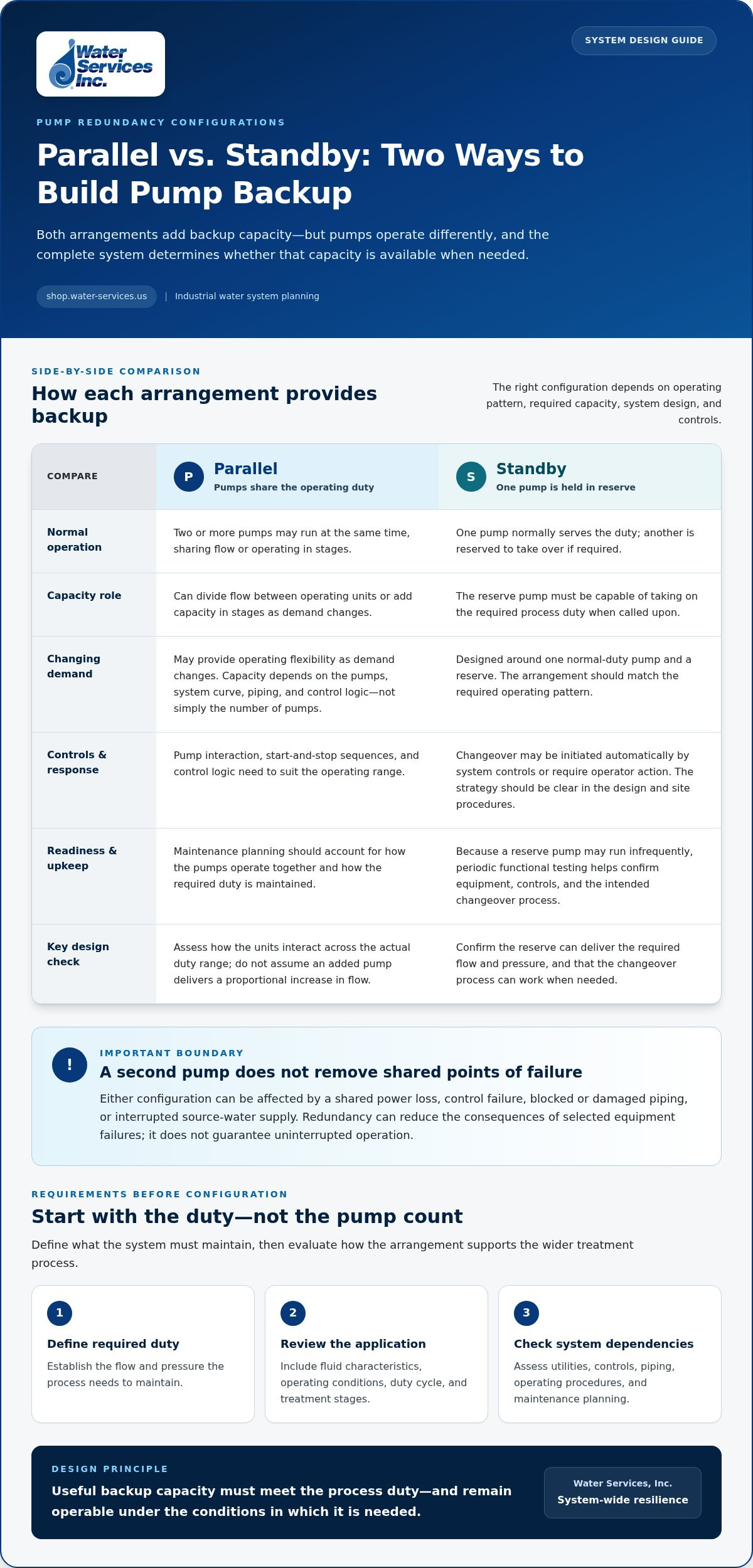
Parallel and standby arrangements provide backup capacity in different ways. Parallel pumps operate together, sharing duty or adding capacity in stages as demand changes. In a standby arrangement, one pump normally serves the duty while another is reserved to take over if required. The appropriate configuration depends on the operating pattern, required capacity, and system design and controls.
Neither arrangement is inherently more reliable in every application. Controls, pump interaction, changeover procedures, and maintenance all affect whether the intended backup is available when needed. For peace of mind with redundant pump systems, evaluate the complete operating arrangement rather than relying on the configuration name alone.
Parallel pumps: sharing the operating duty
With parallel operation, two or more pumps may run at the same time. The design can divide flow between operating units or stage pumps as demand changes. This can provide operating flexibility, but the resulting capacity depends on the pumps, system curve, piping, and control logic. Don’t assume that adding a pump will deliver a proportional increase in flow.
Assess how the units interact across the actual duty range, including their start and stop sequences and response to changing demand. The Hydraulic Institute for pump system standards provides pump-system resources that can support design and application review.
Standby pumps: reserving capacity for a failure or service event
A standby arrangement assigns one pump the normal operating role and holds another in reserve. System controls may initiate changeover automatically, or an operator may need to act. These are different operating strategies, and the design, controls, and site procedures should make clear which one applies.
Because a reserve pump may run infrequently, periodic functional testing helps reveal whether the equipment and controls are ready to respond. Follow the system’s maintenance plan and confirm the intended changeover process, not just that the motor can run.
Quick comparison:
- Parallel: Multiple pumps share duty or provide staged capacity. The arrangement can respond to changing demand, but pump interaction and controls need to suit the operating range.
- Standby: A reserve pump is held for a failure or service event. It avoids routine shared operation, but readiness depends on effective changeover and functional testing.
For either arrangement, define the duty the system must maintain and how the pumps are expected to meet it. Review required flow and pressure across operating conditions, then assess control logic, power, piping, and maintenance needs. This separates useful redundancy from equipment that is present but cannot support the required duty.
Water Services, Inc. offers Goulds Water Technology pumps as part of its water-treatment equipment range. Reviewing Goulds Water Technology pump options alongside the application and system design helps frame equipment requirements as part of the full system plan.
Comparing redundant pump designs: where backup can fall short
Adding a pump alone doesn’t eliminate system downtime. The backup may share a power supply, control panel, suction line, discharge header, or isolation valve with the primary unit. If a shared component fails, both pumps may be unavailable. Compare the full arrangement, including what duty remains during a failure and which dependencies could prevent the backup from operating.
| Arrangement | Duty coverage | Dependencies to review | Operational tradeoffs |
|---|---|---|---|
| Parallel pumps | Multiple units share or stage capacity, subject to design and control logic. | Shared power, controls, suction and discharge paths may affect all units. | Can support changing demand, but adds control and maintenance requirements. |
| Standby pump | A reserve unit is intended to assume the required duty when needed. | Changeover controls, common utilities, piping, and isolation points can limit backup. | Reserve capacity requires functional testing and a defined response process. |
| More independent arrangement | Designed to reduce selected shared failure paths. | Review separate power, controls, suction or discharge routes, and instrumentation. | May add footprint and system complexity, along with testing and upkeep. |
Independence is a design choice, not an automatic feature of redundancy. Separate power feeds, for example, may reduce exposure to a failure in one supply, while shared control hardware could still disable both pumps. Likewise, separate pumps connected to a common blocked suction line cannot maintain the duty if that line is the point of failure.
Check for shared dependencies and single points of failure
Trace the flow path and operating signals from source to discharge. Identify whether units rely on the same electrical supply, control hardware, instrumentation, suction path, discharge header, or isolation components. A single-point-of-failure review should reflect the actual process and site design. Mining wastewater treatment solutions, for example, need to account for site conditions and the specific treatment duty.
Balance resilience, complexity, and lifecycle effort
Additional separation can reduce exposure to selected failures, but it can also require more space, controls, inspection, and maintenance. Evaluate the consequences of an interruption alongside installation needs, energy use, testing tasks, and ongoing maintenance. These inputs support a site-specific lifecycle assessment grounded in the actual system.
The objective is not to remove every possible failure. It’s to decide which interruptions matter most and design backup around those risks. A redundant arrangement can reduce exposure to a pump failure, but it can’t guarantee continuous service if a shared dependency or another process constraint stops the system. Peace of mind with redundant pump systems comes from understanding what the backup covers, what remains vulnerable, and how readiness will be maintained.
How to specify and maintain a redundant pump system
A reliable specification starts with the process duty, not a pump count. Define what service must continue during a pump failure or maintenance event, then carry that requirement through design review, commissioning, and ongoing maintenance. This makes peace of mind with redundant pump systems a matter of defined operating requirements and tested procedures, rather than an assumption about backup equipment.
Translate process requirements into pump and control criteria
Document normal and peak flow, required pressure, duty cycle, fluid characteristics, and operating conditions. Identify the reserve duty the system must maintain while a pump is isolated or unavailable. Record control, power, and instrumentation dependencies so the design review can assess the full operating arrangement.
- Define the process duty. Capture the flow and pressure requirements across normal and peak operation, along with fluid properties and site conditions that affect pump selection.
- Set the backup requirement. State what capacity must remain available during a failure or service event, and which parts of the process can tolerate reduced operation.
- Review the system design. Assess pump selection with suction and discharge piping, isolation points, control logic, instrumentation, and power requirements. Electric power controls are part of this review because a backup pump’s intended role depends on how the system is powered and controlled.
- Commission against the intended duty. Verify the operating sequence, changeover response, alarms, isolation, and performance against the project’s defined requirements. Record the results and any corrective actions.
- Maintain and document readiness. Establish responsibilities, procedures, and a schedule for exercising standby equipment and reviewing controls. Update records after maintenance, testing, or system changes.
Commission, test, and maintain the standby arrangement
A useful functional test checks more than whether the reserve pump starts. Confirm that the intended changeover occurs, alarms respond as designed, isolation can be carried out safely, and the available equipment can support the required duty. Record results so operators can track issues and complete corrective work.
Set exercise intervals and acceptance criteria for the specific application, operating conditions, and system design. Written procedures should identify test steps, responsible roles, records to retain, and how the system returns to its normal operating state. Review the procedures when equipment or operating conditions change.
Water Services, Inc. connects pump selection with broader water-treatment system design and integration. For an equipment review grounded in the application and duty requirements, explore Goulds Water Technology pumps as part of the system specification.
Applying pump redundancy to a Water Services, Inc. system design
Pump redundancy is most useful when specified as part of the complete water-treatment process. A pump’s role, the duty it must meet, the treatment stages around it, and the site’s operating constraints all shape the design. A choice made in isolation can miss dependencies elsewhere in the system, such as available power, control requirements, piping layout, or space for equipment access and maintenance.
Match pump equipment to the water-treatment duty
Start by defining what the pump needs to do in the process. Required flow and pressure, fluid characteristics, operating schedule, and the pump’s process role inform equipment selection. A transfer duty and a treatment-feed duty may place different demands on the system. Site access and the arrangement of connected equipment also affect how pumps can be installed, isolated, and maintained.
Water Services, Inc. offers Goulds Water Technology pumps for water applications. Consider pump selection alongside the treatment equipment it serves, rather than as a standalone decision. This keeps the specified duty connected to the wider process requirements.
Bring redundancy into the wider project conversation
For a modular treatment project, pump requirements belong in the same design discussion as controls, power, piping, maintenance access, and site conditions. Water Services, Inc. designs and integrates modular water-treatment systems around industrial project requirements. This wider view helps align equipment roles with the intended process and operating plan, while keeping the redundancy decision grounded in the complete system design.
Use the project requirements to describe the intended backup duty and how the system should operate during equipment isolation or maintenance. Then consider whether the layout, controls, and power arrangements support that plan. This creates a practical basis for evaluating options and identifying design dependencies before they affect operation.
- Process: Identify the treatment stage and the pump’s role within it.
- Duty: Define the required flow, pressure, fluid characteristics, and operating conditions.
- Integration: Account for controls, power, piping, site space, and access for maintenance.
- Resilience: Describe what duty should remain available during a failure or service event.
These requirements connect pump selection to the project’s operating priorities. They also support a grounded discussion of resilience: redundancy can reduce exposure to selected equipment failures, but it cannot guarantee uninterrupted service across every part of a treatment system. The benefit depends on the design and on how the system is operated and maintained.
As a next step, review Goulds Water Technology pump options alongside your process and system requirements. This keeps the equipment evaluation focused on application fit and the role each pump is expected to perform, rather than on redundancy as a label alone.
Set the next design decision in motion
Use your operating requirements as the starting point for the next project review. Define the duty that must remain available, identify the dependencies that could interrupt it, and decide how the backup arrangement will be tested and maintained. This gives your team a practical basis for discussing equipment and controls without treating an additional pump as a complete resilience plan.
Peace of mind with redundant pump systems comes from matching the design to the consequences of an interruption and making readiness part of routine operations. Keep the evaluation grounded in actual flow, pressure, operating conditions, and maintenance capability.
Explore Goulds Water Technology pump options from Water Services, Inc. as part of your system evaluation, or discuss a modular water-treatment system designed around your industrial project requirements.
Frequently Asked Questions
What is a redundant pump system?
A redundant pump system provides reserve pumping capacity so a required process duty can continue if one unit is unavailable. Its value depends on defining the duty it must preserve, such as maintaining feed to a treatment stage while a pump is isolated for service. The design should also establish how operators identify an unavailable unit and restore normal operation while monitoring process conditions.
What is the difference between parallel and standby pumps?
Parallel pumps operate at the same time when the system is designed for shared or staged duty. A standby pump is held in reserve for a failure or service event. For example, a variable process demand may favor staged operation, while a steady duty with occasional maintenance needs may suit a reserve arrangement. The choice also affects operator procedures, control logic, and how each pump is tested.
Do redundant pumps guarantee uninterrupted water service?
No. Redundancy can’t guarantee uninterrupted service because a failure outside the pump arrangement may still stop the process. A treatment train might have reserve pumping capacity but no storage to bridge a shutdown during maintenance. Assess what happens immediately after a fault: can flow be reduced, held temporarily, or must the process stop? Defining that response and assigning operator responsibilities is part of achieving peace of mind with redundant pump systems.
How do I size a backup pump?
Size a backup pump around the hydraulic duty it must perform, not motor horsepower alone. Define the required flow and pressure at the operating conditions where backup is needed, then account for the fluid and connected system. Decide whether the reserve must support the full process duty or a reduced operating mode. An engineering review should assess pump performance and confirm how the proposed unit interacts with the system.
Does a redundant pump system need a backup power supply?
Not in every application. The need depends on the consequences of losing power and the design of the complete system. If both pumps rely on the same unavailable electrical supply, the second pump may not help during that event. Include power sources, controls, and changeover behavior in the failure assessment. A separate generator or UPS shouldn’t be assumed necessary or sufficient without application-specific engineering.
How often should standby pumps be tested?
There isn’t one testing interval that fits every pump and site. Set a schedule based on equipment requirements, operating conditions, and the consequence of a failed changeover. A test record can capture whether the pump started, alarms and controls responded, and the unit met its assigned duty. Use application-specific acceptance criteria, and review the schedule after equipment changes or repeated test issues.
When is pump redundancy worth considering?
Consider redundancy when a pumping interruption could seriously affect production, treatment continuity, or a remote operation where replacement equipment may be difficult to access. Compare the potential impact with the added space, controls, testing, and maintenance work. For example, a process with limited ability to pause may have a stronger case for reserve capacity than one that can safely hold operation during planned service.
0 comments