

Implementing predictive maintenance for industrial pumps can reduce unplanned downtime by 30% to 45% for critical assets. You likely understand the high cost of emergency repairs and the production losses that follow a pump failure at a remote mining or offshore site. These outages aren't just inconvenient; they compromise your total cost of ownership (TCO) and operational reliability. By integrating hardware like Goulds Water Technology pumps with precision sensors, you transition from reactive repairs to a data-driven strategy that prioritizes technical integrity.
This 2026 guide explains how to eliminate unscheduled outages and extend the lifespan of your pumping infrastructure. We examine the latest standards, including ISO 55012:2024 and ANSI/HI 9.6.9:2025, to provide a framework for professional asset management. You'll learn how Walchem controllers and Ashcroft pressure gauges serve as the technical core of a predictive system. We'll preview how automated alerts and real-time monitoring ensure you reach the goal of zero unscheduled downtime while lowering the TCO of your entire pumping system.
Key Takeaways
- Understand the technical shift from reactive models to condition-based monitoring so you don't have to wait for a total system failure to take action.
- Learn how vibration analysis identifies bearing wear and cavitation in industrial pumps before mechanical damage becomes catastrophic.
- Follow a 5-step implementation framework for predictive maintenance for industrial pumps to prioritize critical assets and integrate specialized sensors.
- See how Walchem controllers and Ashcroft pressure gauges provide the precise data needed to monitor remote mining and offshore installations.
- Discover how optimizing pump health reduces total cost of ownership by eliminating the high logistics costs of emergency repairs.
The Science of Pump Failure: What We Predict
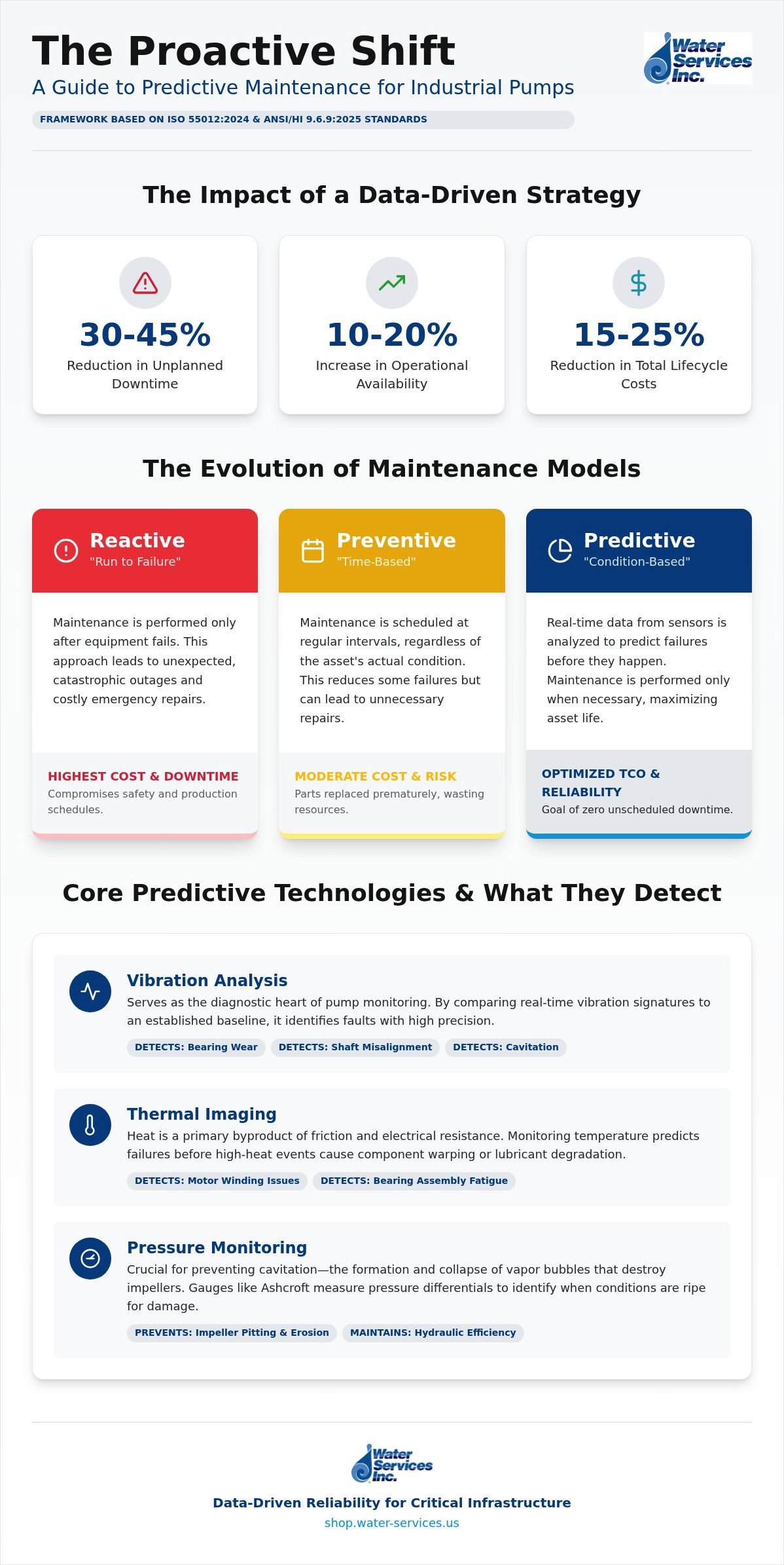
Understanding the physics of equipment degradation is essential for effective predictive maintenance for industrial pumps. Most catastrophic failures aren't sudden events but the result of measurable physical changes. Technical teams prioritize four primary failure modes: bearing fatigue, mechanical seal failure, cavitation, and shaft misalignment. By monitoring these specific stressors, facilities can achieve a 10% to 20% increase in operational availability while reducing unplanned downtime by up to 45%.
Bearing failure often serves as the leading indicator of system distress. While traditional maintenance relies on audible noise, predictive strategies use high-frequency sensors to detect subsurface spalling and lubrication breakdown weeks before a human ear can hear a problem. Similarly, Goulds Water Technology pumps equipped with integrated sensors allow for the early detection of seal leaks. This prevents fluid from entering the bearing housing or motor, which is a common cause of total system loss in mining and oil applications.
Cavitation presents a unique threat to impeller integrity and hydraulic efficiency. It occurs when vapor bubbles form and collapse due to pressure drops. Ashcroft pressure gauges are critical here. By measuring the differential between suction and discharge pressure, these instruments identify the precise conditions where cavitation begins. This data allows operators to adjust flow parameters before the impeller suffers pitting or erosion.
Analyzing Vibration Patterns
Vibration analysis serves as the diagnostic heart of pump monitoring. Every industrial pump has a unique vibration signature during normal operation, known as the baseline. When components wear, the frequency and amplitude of these vibrations change in predictable ways. For example, a spike at a specific frequency might indicate a bent shaft, while a broader spectrum increase often signals cavitation. Modern systems compare real-time data against these established baselines to identify faults with high precision. This ensures maintenance occurs only when the data confirms a deviation from the technical specification.
Thermal Imaging and Temperature Sensors
Heat is a primary byproduct of mechanical friction and electrical resistance. Measuring heat dissipation allows maintenance engineers to predict failures in motor windings and bearing assemblies. When integrated with Walchem controllers, these temperature sensors trigger automated alerts when thermal thresholds are exceeded. This automation is vital for remote sites where manual inspections are infrequent. Effective thermal monitoring helps facilities realize a 15% to 25% reduction in total lifecycle costs by preventing high-heat events that warp components and degrade lubricants. This technical oversight ensures the pumping infrastructure remains reliable under the most demanding industrial loads.
What is Predictive Maintenance for Industrial Pumps?
Predictive maintenance for industrial pumps is a condition-based strategy that monitors equipment health in real-time to identify potential faults before they lead to functional failure. This approach represents a fundamental shift from the traditional "fix-it-when-it-breaks" mentality to a proactive model. By the year 2026, the convergence of AI-integrated monitoring and high-speed data transmission has reached a tipping point, making it the standard for high-capacity pumping systems. Technical teams now rely on continuous streams of data regarding vibration, temperature, pressure, and flow rate to maintain operational integrity. It's an essential transition for facilities that prioritize technical reliability over reactive repairs.
The Core Components of a PdM System
An effective Predictive Maintenance system functions like a nervous system for your pumping infrastructure. Physical sensors measure the mechanical stress on the pump, converting physical phenomena into raw electronic signals. These signals are processed by hardware like Walchem controllers, which act as the primary interface for data acquisition. Advanced analytics then apply algorithms to this data to identify the P-F Interval. This metric defines the time between the first detection of a potential failure and the point of functional failure, allowing for precise maintenance scheduling without interrupting production.
Why Industrial Water Systems Require PdM
Pumps used in mining and wastewater applications operate under extreme conditions where failure often leads to environmental non-compliance or significant production loss. The high cost of mechanical seal failures and impeller cavitation makes a reactive approach financially unsustainable. Implementing a predictive strategy allows facilities to optimize pump performance and reduce energy consumption. It ensures that critical water treatment processes remain stable, protecting the total cost of ownership for the entire pumping system. This data-driven oversight is vital for maintaining the technical reliability required in specialized industrial sectors.
Reactive vs. Preventive vs. Predictive Maintenance
Industrial maintenance strategies fall into three distinct categories based on their approach to asset health. Choosing the wrong model for high-capacity pumping systems leads to inefficient capital expenditure and increased operational risk. Understanding the technical differences between these methods is necessary for optimizing plant reliability.
Reactive maintenance involves operating equipment until a functional failure occurs. While this eliminates scheduled service interruptions, it introduces significant hidden logistics costs. Emergency shipping for replacement parts, technical overtime, and lost production revenue often exceed the cost of the hardware. This "run-to-failure" model is only suitable for non-critical assets where a breakdown doesn't halt the primary process.
Preventive maintenance relies on fixed intervals to service equipment. Technicians replace seals or bearings based on calendar days or run-hours, regardless of actual component condition. This strategy prevents many failures but results in the disposal of perfectly functional parts. It also increases the risk of "infant mortality" failures caused by improper installation during unnecessary service events. It's a conservative approach that often wastes resources.
Predictive maintenance for industrial pumps represents the data-driven sweet spot for high-value industrial pumps. By monitoring real-time performance, you perform maintenance only when the data indicates a pending fault. This model offers the highest ROI, as it maximizes component life while ensuring near-zero unplanned outages. Industry data shows that predictive strategies can reduce maintenance costs by 25% to 30% compared to preventive methods.
When to Use Each Strategy
Selecting a strategy depends on asset criticality. Apply reactive maintenance to low-cost, redundant pumps that are easily replaced. Preventive schedules work for simple, standardized systems with predictable wear patterns. However, mission-critical reverse osmosis (RO) systems and high-pressure injection pumps require a predictive approach. These systems have complex failure modes that time-based schedules often miss, making real-time monitoring essential for wastewater compliance and operational safety.
Calculating the Total Cost of Ownership (TCO)
Total Cost of Ownership includes the initial purchase price, energy consumption, labor, and spare parts. Integrating PdM significantly extends the service life of Goulds Water Technology Pumps by maintaining them within tight technical tolerances. This proactive oversight prevents the collateral damage associated with catastrophic failure. A PdM strategy reduces spare parts inventory costs by 20% by eliminating the need for "just-in-case" stockpiling. This optimization ensures your capital is invested in production rather than sitting on warehouse shelves.
Implementing Predictive Maintenance: A 5-Step Framework
Transitioning to a proactive model requires a structured technical approach that aligns hardware capabilities with operational objectives. Successful predictive maintenance for industrial pumps depends on the precise integration of sensors and controllers into your existing infrastructure. This framework ensures that data collection is both accurate and actionable, preventing the data fatigue often associated with unoptimized monitoring systems.
The first step is a Criticality Assessment. You must identify which pumps are essential for production continuity, such as high-pressure feed pumps in reverse osmosis plants or dewatering systems in mining. Step two involves Sensor Integration. This is the physical installation of vibration sensors and Ashcroft pressure gauges to monitor suction and discharge metrics. In step three, Connectivity, you link this hardware to IoT-enabled controllers. Step four is Baseline Establishment, where you record performance data during normal operating conditions to define "good" state parameters. Finally, step five is Alert Optimization, where you set specific technical thresholds for automated notifications before a functional failure occurs.
Hardware Selection for Data Collection
Reliable data begins with hardware designed for the rigors of harsh environments. In remote mining or offshore sites, sensors must withstand extreme temperatures, corrosion, and mechanical shock. Walchem controllers serve as the primary interface for edge data processing. These units handle raw signal conversion locally, which reduces the bandwidth required for cloud transmission and ensures real-time responsiveness. It's essential to verify that your selected hardware is compatible with existing SCADA or PLC systems to maintain a unified control architecture across the facility.
Data Management and Cloud Integration
Modern industrial facilities are moving away from local, manual gauges toward centralized remote monitoring. As of 2025, cloud platforms account for 66.55% of the predictive maintenance market, a trend that continues to accelerate in 2026. This shift allows technical teams to monitor global assets from a single dashboard. Security remains a priority; industrial IoT (IIoT) protocols must include robust encryption to protect sensitive operational data in the mining and military sectors. Water Services, Inc. provides technical support for commissioning these integrated systems, ensuring that your sensors and controllers are calibrated for maximum precision. To begin upgrading your infrastructure, you can source authorized Walchem and Ashcroft components directly from our distribution center.
Future-Proofing Your Facility with Water Services, Inc.
Water Services, Inc. operates as an authorized distributor for Goulds Water Technology, ensuring your facility receives hardware engineered for maximum durability. A successful strategy for predictive maintenance for industrial pumps requires a foundation of reliable equipment that can withstand the rigors of continuous operation. We provide custom engineering for modular and mobile treatment systems, allowing for rapid deployment in demanding environments. By integrating predictive frameworks into mining wastewater treatment solutions, we help you maintain environmental compliance while optimizing resource recovery. This technical oversight ensures that your pumping infrastructure remains a stable asset rather than a liability.
Our engineering team specializes in the integration of Walchem and Ashcroft instrumentation to create a "brain" for your pumping systems. This hardware-first approach transforms standard pumps into intelligent assets capable of self-reporting their health status. We focus on technical integrity and precision, providing the expertise needed to commission these systems in specialized global markets. Whether you're managing a domestic wastewater plant or a remote industrial site, our solutions prioritize lower total cost of ownership and operational stability.
Global Support for Remote Operations
Remote operations in Africa and South America present unique logistical challenges that can compromise maintenance schedules. Our technical support teams specialize in these high-stakes environments, managing the logistics of commissioning and maintaining complex pumping systems where local infrastructure is limited. Investing in technical support and maintenance service fees ensures a long-term return on investment by providing expert oversight for your critical assets. This proactive engagement prevents the logistical difficulties associated with emergency part shipments. Remote mining camps utilizing our monitoring frameworks have successfully reduced unplanned downtime by identifying hydraulic drift before it triggered a system trip.
Selecting the Right Components Today
Accurate predictive data depends on the quality of every component in the treatment train. Using high-performance brands like FilmTec and Viqua is essential for maintaining system integrity and data accuracy. FilmTec reverse osmosis membranes and Viqua UV purification systems provide the consistent performance needed for sensor-driven monitoring. When your base components meet exact technical specifications, your predictive maintenance for industrial pumps produces more reliable alerts. You can browse our e-commerce catalog for replacement membranes, filters, and sensors to keep your system at peak performance. A site-specific pump health audit is the most effective way to begin this transition. Optimize your pump infrastructure with Water Services, Inc. today to secure the reliability of your industrial operations.
Securing Operational Continuity through Technical Precision
Adopting predictive maintenance for industrial pumps is a strategic investment in technical integrity and long-term reliability. By moving away from reactive "run-to-failure" models, you eliminate the high logistics costs of emergency repairs and preserve the lifespan of your critical pumping infrastructure. Precision sensors and IoT-enabled controllers transform raw performance data into actionable insights. This ensures your facility maintains compliance and meets production targets without interruption.
Upgrade to Goulds Water Technology Pumps and Smart Controls to stabilize your operational costs and protect your critical assets. Technical stability is within reach when you pair the right hardware with data-driven oversight.
Frequently Asked Questions
What is the difference between preventive and predictive maintenance for pumps?
Preventive maintenance is time-based, while predictive maintenance is condition-based. Predictive models use real-time data to schedule work only when the hardware shows signs of wear. This optimizes predictive maintenance for industrial pumps by extending part life and reducing unnecessary teardowns. It shifts focus from a fixed calendar to the actual mechanical health of the system, ensuring resources are used efficiently.
Which sensors are most important for monitoring centrifugal pumps?
Vibration sensors, Ashcroft pressure gauges, and thermal probes are essential. Vibration sensors detect misalignment and bearing wear, while pressure gauges identify suction issues and discharge blockages. Flow sensors, such as those from Signet, provide data on hydraulic efficiency. These components work together to provide a comprehensive view of the pump's operational state and hydraulic performance in real-time.
Can predictive maintenance be retrofitted to older Goulds pumps?
Most existing Goulds Water Technology pumps can be retrofitted with external sensors and Walchem controllers. You don't need to replace the entire pump to benefit from modern monitoring. By adding accelerometers to the bearing housings and pressure transducers to the suction and discharge ports, you can integrate legacy hardware into a centralized, data-driven framework for better oversight.
How much does it cost to implement a predictive maintenance system?
Implementation costs vary based on the number of assets and the complexity of the sensor array. Factors include the hardware requirements, connectivity infrastructure, and the scale of the monitoring platform. While initial capital expenditure is required for sensors and controllers, most facilities find that the reduction in emergency repair costs and production downtime provides a rapid return on investment over time.
What is cavitation and can predictive sensors detect it early?
Cavitation is the formation and collapse of vapor bubbles that erode impellers and casings. Predictive sensors detect this through specific vibration signatures and pressure differential drops. By monitoring the Net Positive Suction Head (NPSH) using Ashcroft gauges, operators can identify the onset of cavitation before physical pitting occurs. This early detection prevents catastrophic failure of the pump's internal components.
Do I need a data scientist to run a pump predictive maintenance program?
No, modern Walchem controllers and integrated software handle the complex analytics automatically. These systems convert raw sensor data into clear alerts and maintenance recommendations for your existing technical staff. While large-scale enterprise programs might utilize data specialists, most industrial facilities manage predictive maintenance for industrial pumps using their standard maintenance and engineering teams without additional specialized hires.
How does predictive maintenance improve safety in mining operations?
It reduces the need for manual inspections in hazardous or remote areas. By providing remote health data, technicians don't have to enter high-risk zones as frequently. Predictive alerts also prevent catastrophic failures, such as seal breaches or housing ruptures, which can lead to chemical spills or high-pressure fluid release. This proactive oversight creates a more stable and predictable environment for personnel.
What are the first signs of bearing failure in a high-pressure pump?
The earliest indicators are high-frequency vibration spikes and localized temperature increases. These changes occur well before audible noise or shaft play become apparent. Vibration sensors detect subsurface spalling in the bearing races, while thermal probes identify increased friction. Monitoring these metrics allows for a scheduled bearing replacement during a planned outage, preventing a total shaft seizure and motor damage.
0 comments