

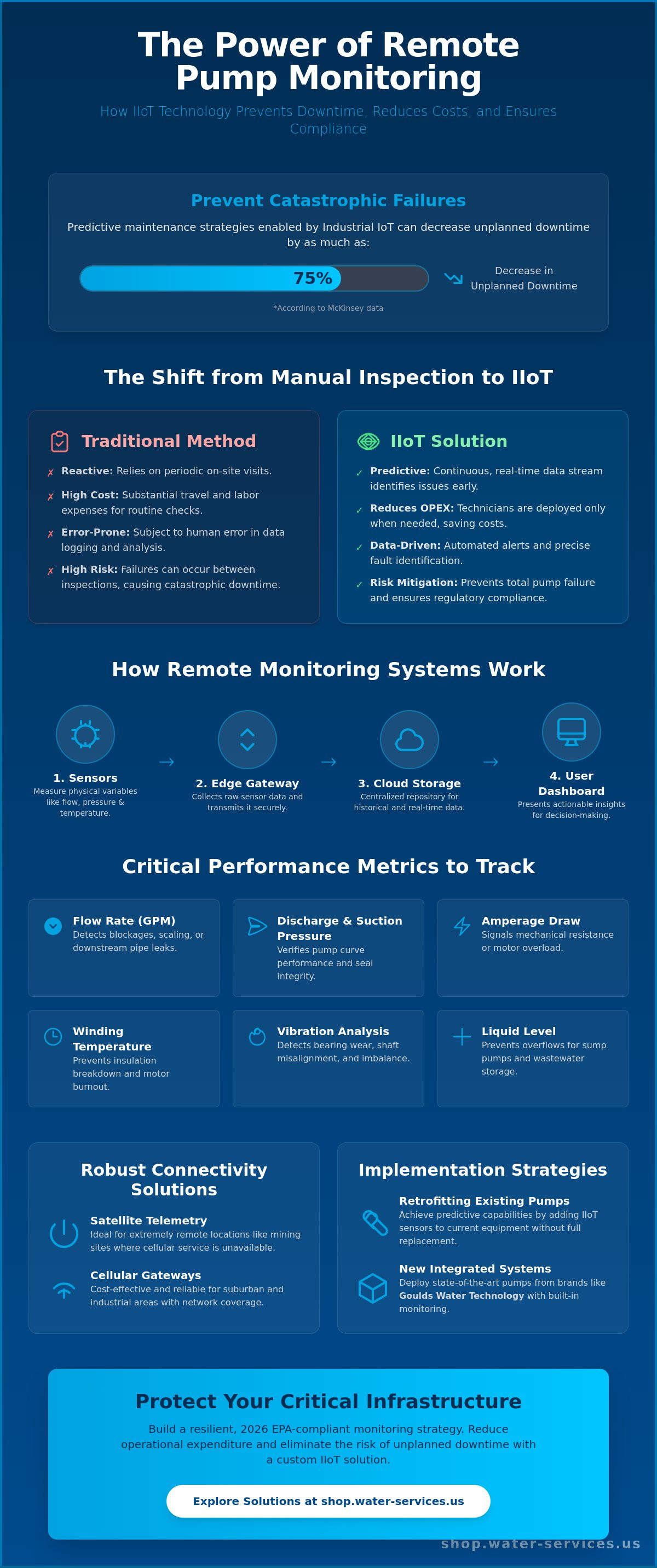
Predictive maintenance strategies enabled by industrial IoT can decrease unplanned downtime by as much as 75% according to McKinsey data cited in June 2026. For operators managing critical infrastructure, remote pump monitoring systems have evolved from optional upgrades into essential components of risk management. You understand the logistical strain and high costs associated with sending technicians to remote sites for routine manual inspections. The threat of environmental compliance penalties, especially with the 2026 EPA Multi-Sector General Permit requirements for quarterly monitoring, makes manual oversight increasingly unsustainable.
This guide explains how integrating IIoT technology protects your pump assets and eliminates unnecessary manual labor costs. You'll learn how to achieve real-time visibility into pump health and configure automated alerts to prevent critical failures before they occur. We'll examine the technical specifications of modern monitoring hardware and the data-driven workflows that significantly reduce your total operational expenditure. By the end of this article, you'll have a clear path to implementing a reliable, 2026-compliant monitoring strategy for your industrial facility.
Key Takeaways
- Transition from localized SCADA to cloud-based IIoT for real-time visibility into critical pump health and performance metrics.
- Utilize Ashcroft pressure gauges and Signet flow sensors to detect blockages and leaks through precise flow rate and discharge monitoring.
- Select robust connectivity solutions like satellite telemetry for remote mining sites or cellular gateways for suburban water infrastructure.
- Deploy remote pump monitoring systems with Goulds Water Technology pumps and Walchem controllers to reduce OPEX and manual labor.
- Assess the economic benefits of retrofitting existing centrifugal pumps with IIoT sensors to achieve predictive maintenance capabilities without full equipment replacement.
What are Remote Pump Monitoring Systems?
Remote pump monitoring systems are integrated hardware and software solutions designed for the precise, off-site tracking of pump performance metrics. These systems provide a continuous stream of operational data, allowing engineers to oversee equipment health from any location. Historically, industrial facilities relied on SCADA systems for localized control and data acquisition. While SCADA remains a foundation for automation, the industry has transitioned toward cloud-based Industrial Internet of Things (IIoT) architectures. This evolution enables data accessibility far beyond the local control room, facilitating global oversight for complex infrastructure.
A standard monitoring configuration consists of four primary components. High-precision sensors measure physical variables such as flow rate, pressure, and temperature. Edge gateways collect this raw data and transmit it via cellular or satellite networks. Cloud storage serves as a centralized repository for historical and real-time data. Finally, user interfaces or dashboards present this information in a digestible format for technical decision-making. These systems are critical in demanding sectors such as mining wastewater management, municipal water booster stations, and mobile military deployments where site accessibility is limited.
The Shift from Manual Inspection to IIoT
Traditional maintenance relies on manual logging and periodic on-site inspections. These routines are inherently reactive and prone to human error. If a pump fails between scheduled checks, the resulting downtime can be catastrophic. Real-time data flow through IIoT integration significantly reduces the mean time to repair (MTTR) by identifying the exact nature of a fault before a technician ever arrives on site. IIoT pump monitoring is a critical risk-mitigation tool that ensures industrial continuity in volatile environments.
Key Benefits for Industrial Operators
Implementing remote pump monitoring systems offers immediate financial and operational advantages. For facilities in remote or geographically dispersed locations, the reduction in travel costs for technicians is substantial. Instead of routine site visits, personnel are deployed only when data indicates a specific need. This targeted approach optimizes operational expenditure (OPEX) and maximizes labor efficiency.
Early detection of mechanical issues like cavitation, bearing wear, or excessive vibration prevents total pump failure. In the mining and oil sectors, these systems also streamline environmental compliance. Automated reporting provides the verifiable data required for regulatory audits, including the 2026 EPA requirements for industrial discharge monitoring. By integrating these systems with Goulds Water Technology pumps and specialized Walchem controllers, operators build a resilient infrastructure capable of withstanding the rigors of industrial service.
Critical Performance Metrics for Remote Pump Tracking
Effective remote pump monitoring systems require high-fidelity data from multiple physical sensors. Relying on a single variable is insufficient for demanding industrial environments. Operators must track a suite of technical metrics to ensure mechanical integrity and hydraulic efficiency across the entire infrastructure. This multi-layered data approach allows for the identification of specific failure modes before they result in unplanned downtime.
- Flow rate (GPM): Vital for detecting blockages, scaling, or downstream pipe leaks.
- Discharge and suction pressure: Tracked via Ashcroft industrial gauges to verify pump curve performance and seal integrity.
- Amperage draw: High current signals mechanical resistance, motor overload, or potential phase imbalance.
- Winding temperature: Prevents insulation breakdown and premature motor burnout during peak demand.
- Vibration analysis: Detects bearing wear, shaft misalignment, and impeller imbalance through frequency shifts.
- Liquid level: Essential for sump pumps and wastewater storage to prevent overflows and environmental permit violations.
- Power status: Monitors battery health and voltage for solar-powered remote installations to ensure data continuity.
Monitoring Flow and Pressure with Precision
Signet flow sensors provide accurate volumetric data, which is critical for balancing reverse osmosis (RO) systems. When integrated with remote logging gateways, these sensors allow for real-time flow calculation without the need for manual measurement. Pressure differential (DP) serves as a primary indicator of system health. A rising DP across filter housings or RO membranes often indicates fouling or sediment accumulation. By using Ashcroft pressure gauges equipped with 4-20mA transmitters, operators receive immediate alerts before high pressure causes a pipe failure. It's often necessary to verify these specifications when selecting Goulds Water Technology pumps for high-pressure applications.
Predictive Maintenance via Vibration and Heat
Advanced vibration sensors identify cavitation before it destroys Goulds centrifugal pump impellers. Cavitation creates microscopic bubbles that implode against the metal, leading to severe pitting and rapid material loss. Early detection allows for the adjustment of Net Positive Suction Head (NPSH) before catastrophic damage occurs. Similarly, high-frequency vibration monitoring provides early warning signs of bearing failure, often weeks before a total seizure. Thermal monitoring of the motor housing prevents burnout during high-demand cycles. If winding temperatures exceed safe operating limits defined by the manufacturer, remote pump monitoring systems can trigger an automated shutdown to protect the asset.
Liquid level sensors are equally vital for wastewater storage. These devices prevent environmental compliance risks by triggering alerts well before a tank reaches capacity. For off-grid sites, monitoring the state of charge (SoC) for battery backups ensures the monitoring hardware remains active during cloud cover or power grid instability.
Connectivity Solutions for Remote Mining and Industrial Sites
Data transmission is the backbone of any IIoT deployment. While sensors capture the physical state of the equipment, the connectivity solution determines the reliability of the alert system. Remote pump monitoring systems utilize a variety of protocols depending on geographical location and local infrastructure availability. Selecting the wrong protocol can lead to data gaps that render predictive maintenance models ineffective.
Cellular gateways (4G and 5G) are the primary choice for suburban and urban water infrastructure. These units offer high bandwidth and low latency, making them ideal for high-frequency data logging and real-time dashboard updates. However, in complex industrial campuses, LoRaWAN and mesh networks provide a cost-effective alternative. These protocols allow hundreds of sensors to communicate with a single central gateway over distances of up to 10 miles. This reduces the need for multiple cellular subscriptions and lowers the total cost of ownership for large-scale deployments.
Satellite vs. Cellular: Choosing the Right Protocol
Industrial projects in the Middle East, Africa, or South America often operate far beyond the reach of cellular towers. In these harsh climates, satellite telemetry is the only reliable option for critical infrastructure. While satellite data carries a higher cost per kilobyte, it's essential for high-consequence monitoring where a failure could result in environmental catastrophe or site-wide downtime. Redundancy is a core requirement for mission-critical sites. Many operators deploy dual-SIM gateways with satellite failover to ensure data continuity if a local cellular carrier experiences an outage.
Data Integration with Existing SCADA
Most industrial sites already utilize legacy protocols like Modbus or Profibus for local control. Modern IIoT gateways bridge these systems by acting as protocol translators, converting serial data into cloud-ready formats like MQTT or HTTPS. This ensures interoperability between different equipment manufacturers. It allows a single dashboard to display data from Walchem controllers and third-party sensors simultaneously. Engineers must account for data latency in remote telemetry applications. Systems should be programmed to distinguish between a genuine equipment fault and a temporary communication delay to prevent nuisance alarms.
Cybersecurity is a baseline requirement for remote pump monitoring systems in 2026. Secure gateways utilize end-to-end encryption and VPN tunnels to prevent unauthorized access to pump control logic. This prevents malicious actors from intercepting sensitive operational data or disrupting critical water supply chains. Secure-by-design principles ensure that the integration of IIoT doesn't create new vulnerabilities in the existing industrial control network.
Implementation Strategy: Retrofitting vs. Integrated Systems
Industrial operators must decide between retrofitting existing assets or deploying new, integrated solutions. This decision hinges on the remaining service life of the equipment and the specific requirements of the monitoring application. Remote pump monitoring systems can be successfully applied to both scenarios, provided the integration strategy accounts for sensor compatibility and data protocol alignment. A well-planned implementation ensures that data flows seamlessly from the pump house to the operations center.
Retrofitting legacy Goulds centrifugal pumps is often the most cost-effective path for aging infrastructure. Many industrial pumps in service today lack native digital connectivity but remain mechanically sound. By adding external instrumentation, these assets are brought into the IIoT ecosystem without the capital expense of a full replacement. This approach allows for a staged rollout of monitoring capabilities across a large facility, prioritizing critical assets first.
Retrofitting Legacy Industrial Pumps
The retrofitting process begins with the installation of external sensors that do not require extensive downtime. Non-invasive Signet flow sensors and Ashcroft pressure transducers allow for data collection without significant piping modifications. Adding smart motor starters with integrated communication modules provides the necessary electrical data, such as amperage draw and power status. You can explore our Electric Power Controls for the hardware required to upgrade your existing pump starters. These components bridge the gap between traditional mechanical operation and modern digital oversight.
Integrated Monitoring in Modular Water Treatment
New installations increasingly utilize a monitoring-first architecture. Modular water treatment systems, including containerized reverse osmosis plants and mobile ultrafiltration units, often feature factory-installed monitoring. These systems provide a significant advantage through centralized control via Walchem multi-parameter controllers. These controllers manage complex water treatment logic while simultaneously functioning as the primary data gateway for the monitoring platform.
Because these units are pre-configured and factory-tested, the risk of sensor misalignment or communication failure is minimized. This is particularly valuable for mobile treatment units deployed in remote mining or military environments where on-site troubleshooting is difficult. The integration of remote pump monitoring systems at the manufacturing stage ensures that every component, from the pump motor to the filtration membrane, is tracked from the moment of commissioning.
Choosing the correct implementation strategy ensures your infrastructure delivers a measurable return on investment. Whether you are upgrading an existing pump station or commissioning a new modular plant, the goal remains achieving real-time visibility. If you are ready to modernize your infrastructure, browse our full catalog of industrial equipment at Water Services, Inc. to find the right components for your specific application.
Engineering Reliable Monitoring with Water Services, Inc.
Water Services, Inc. provides the specialized engineering expertise required to deploy remote pump monitoring systems across global industrial sectors. We understand that data is only as valuable as the hardware capturing it. Our team designs and supplies fully integrated monitoring solutions for the mining, oil, and military sectors, where equipment failure is not an option. By combining high-performance mechanical assets with advanced digital oversight, we ensure your infrastructure remains operational in any geographic location.
Our turnkey solutions focus on the seamless integration of monitoring hardware into mobile and containerized water treatment plants. These systems are engineered for rapid deployment and immediate data connectivity. We provide global technical support to ensure that once a system is online, it stays online. This comprehensive approach covers everything from initial hydraulic design to long-term maintenance of the monitored infrastructure.
Expert Design for Harsh Environments
Reliability in remote industrial sites requires components that withstand extreme temperatures, vibration, and corrosive fluids. We prioritize the integration of Signet flow sensors and Ashcroft pressure gauges to maintain maximum data integrity. These components are selected for their proven durability and precision in the field. Our engineering team ensures that every sensor is calibrated to the specific requirements of the application, whether it's a high-pressure RO plant or a wastewater lift station.
The effectiveness of this approach is evident in complex installations. For instance, our Mining Wastewater Treatment Solutions utilize remote data to maintain environmental compliance and optimize resource recovery. By tracking real-time performance, operators can adjust chemical dosing or flow rates remotely, reducing the need for constant on-site intervention.
Procuring Industrial Components Online
Maintaining a modern monitoring network requires direct access to high-quality replacement parts. Our industrial webstore provides a streamlined procurement path for sensors, gauges, and digital controllers. We stock a comprehensive inventory of Goulds Water Technology Pumps to ensure your primary assets match the quality of your monitoring hardware. Using original equipment manufacturer (OEM) parts is critical for maintaining the accuracy of your predictive maintenance models.
Long-term performance depends on using components that are designed for industrial duty cycles. We offer replacement sediment filters, carbon blocks, and membranes to keep your entire system running at peak efficiency. If you need assistance with system architecture or component selection, Contact our engineering team for a custom remote monitoring consultation. We're ready to help you build a resilient, 2026-compliant infrastructure that protects your assets and your bottom line.
Future-Proofing Industrial Pump Infrastructure
Integrating remote pump monitoring systems is no longer a luxury but a necessity for industrial risk management in 2026. By tracking critical metrics like vibration and pressure differential, you move from reactive repairs to a high-efficiency predictive maintenance model. This transition protects your critical assets and ensures compliance with evolving environmental regulations in any geography. Whether you're retrofitting legacy centrifugal pumps or commissioning a new containerized RO plant, the focus must remain on data reliability and hardware durability.
Water Services, Inc. has provided global engineering expertise since 1994. As an authorized Goulds Water Technology distributor, we specialize in rugged solutions for remote mining and military environments. Our turnkey systems are built to withstand the harshest industrial conditions while delivering real-time performance insights. We ensure that your equipment remains operational, even in locations without traditional infrastructure.
Shop Industrial Pumps and Monitoring Controls to start modernizing your facility today. Our engineering team is ready to assist you in selecting the precise hardware needed for your specific application.
Frequently Asked Questions
Can remote monitoring be added to existing Goulds pumps?
Yes, remote monitoring can be retrofitted to any existing Goulds pump or centrifugal system through the installation of external sensors and edge gateways. You don't need to replace mechanically sound equipment to gain digital oversight. By integrating Ashcroft pressure transducers and Signet flow sensors into your current piping, you can capture real-time data and transmit it to a centralized dashboard for performance tracking.
What happens to the monitoring system if the internet connection is lost?
Modern edge gateways utilize store-and-forward logic to prevent data loss during connectivity outages. The hardware stores all captured sensor data on a local internal memory buffer until a connection is re-established. Once the cellular or satellite link is restored, the gateway automatically uploads the historical packets to the cloud, ensuring your long-term performance logs remain complete and accurate.
Is satellite monitoring cost-prohibitive for small mining sites?
Satellite telemetry is a strategic risk-mitigation investment that often pays for itself by preventing a single catastrophic failure. While the data transmission fees are higher than standard cellular plans, they're minimal compared to the costs of environmental remediation or unplanned downtime. For small sites in regions without cellular coverage, satellite connectivity is the only reliable method to ensure continuous infrastructure protection.
How does remote monitoring improve safety in wastewater treatment?
Remote monitoring significantly improves site safety by reducing the frequency of required confined space entries. Technicians no longer need to enter hazardous areas for routine manual inspections of lift stations or sump levels. Remote pump monitoring systems provide early warnings for potential overflows or toxic gas buildup, allowing staff to address issues from a safe distance before they escalate into dangerous situations.
Do I need a custom app to view my pump data?
No, most industrial monitoring platforms utilize secure, web-based dashboards accessible through any standard internet browser. This approach eliminates the need for proprietary software installations or custom mobile applications. Authorized personnel can view real-time metrics, historical trends, and alarm logs from any desktop or mobile device. This ensures that critical data is available to your engineering team regardless of their physical location.
Can I monitor multiple sites from a single dashboard?
Yes, cloud-based IIoT platforms are designed to aggregate data from geographically dispersed assets into a single management interface. You can view the operational status of pumps across multiple mining camps, industrial parks, or municipal districts simultaneously. This centralized oversight allows your maintenance team to prioritize resources based on the actual health of the equipment rather than following a rigid, time-based schedule.
What is the typical ROI for an industrial pump monitoring system?
Return on investment is typically realized through a combination of reduced manual labor costs and the prevention of major mechanical failures. Some industry reports suggest that predictive maintenance can lower total maintenance expenditure by approximately 25% to 30%. Eliminating just one emergency technician deployment to a remote location often covers the initial capital cost of the monitoring hardware and the first year of data service.
Are these systems compatible with solar-powered pump setups?
Yes, low-power gateways are specifically engineered for compatibility with solar-powered and off-grid installations. These specialized remote pump monitoring systems track battery voltage and solar charging efficiency alongside standard pump metrics. This dual-monitoring approach ensures that you have visibility into both the mechanical performance of the pump and the health of the power supply during periods of low sunlight or high discharge.
0 comments